From representation to equitable participation: An overview of multicultural education research published in 2025
DOI:
https://doi.org/10.65956/meen.2026.152Keywords:
multicultural education, culturally responsive pedagogy, bibliometric analysis, critical multiculturalism, thematic analysis, equitable participationAbstract
Multicultural education research has expanded rapidly, but its definitions remain varied and the distinction between representation and equitable participation remains unresolved. This thematic-bibliometric review of one publication year examines 210 English-language articles published in 2025 and classified in the field of Social Sciences in Scopus, the sole database. The articles span 135 sources and 56 affiliation countries. The single-year design offers a concentrated view of contemporary conceptual patterns without estimating change over time. Bibliometric analysis examined publication, authorship, affiliation-country, keyword, bibliographic coupling, and cited reference patterns. Hybrid codebook thematic analysis examined how titles, author keywords, and abstracts framed multicultural education, without appraising complete articles. Keyword and co-citation patterns connected educator learning with diversity, equity, culturally responsive teaching, intercultural competence, policy, and a shared knowledge foundation in culturally relevant, responsive, and sustaining pedagogy. Six themes addressed recognition, culturally grounded pedagogy, institutional enactment, power and formal inclusion, learner development and access, and conceptual and evidential gaps. Through the theoretical framework, the themes inform a provisional educational ecology specific to this corpus. Within this heuristic, representation becomes consequential when learners and communities can influence knowledge, interaction, decisions, and access, and when unequal power and resources are addressed. Equitable participation serves as a normative analytical organising principle, not a new theory or an outcome demonstrated across the corpus. The review contributes a relational account of recognition, pedagogy, institutions, power, access, and evidence quality in multicultural education. Further research should examine these proposed relations across time, disciplines, languages, settings, databases, and complete articles.
INTRODUCTION
Multicultural education is both a field of study and a reform project concerned with cultural, racial, ethnic, linguistic, religious, and other differences. It encompasses curriculum representation, knowledge construction, prejudice reduction, equity pedagogy, and institutional conditions for participation (Banks, 2009). Such breadth allows substantially different educational arrangements to carry the same label. Some emphasise diverse content, while others address voice, community participation, institutional reform, or knowledge authority. Drawing on prior scholarship and patterns in the 2025 corpus, this review distinguishes symbolic representation from participation that changes educational opportunities. The latter occurs when recognition affects opportunities to contribute to learning, influence decisions, obtain support, or shape the knowledge treated as legitimate.
Growing research activity makes these differences in meaning more pressing. Reviews document rapid publication growth during the past decade and call for clearer research directions (Kılavuz, 2023; Sumargono et al., 2024). Growth alone does not cause conceptual ambiguity. As research covers more settings, disciplines, populations, and interventions, differences in definition make studies harder to compare and findings harder to synthesise. Reviewing the concept can therefore help direct further research, beyond documenting expansion of the field.
Multicultural education shares common aims with intercultural education, inclusive education, and culturally relevant, responsive, and sustaining pedagogies, but each has a distinct focus. Multicultural education provides a broad reform frame for curriculum, knowledge construction, prejudice reduction, equity pedagogy, and institutional change (Banks, 2009). Intercultural education places stronger emphasis on interaction, reciprocity, and exchange across difference rather than cultural coexistence alone (Portera, 2008). Culturally relevant, responsive, and sustaining pedagogies concentrate more directly on teaching, academic success, cultural competence, critical consciousness, and the continuity of community practices (Gay, 2002; Ladson-Billings, 1995; Paris, 2012). Inclusive education begins from barriers to presence, participation, and achievement across learner differences and educational systems (Ainscow, 2020). These traditions share commitments to equity and participation, but they offer different units of analysis and normative emphases. The present search therefore examines research that explicitly identifies itself through multicultural terminology while recognising that related work may use other labels.
A one-year corpus was selected to provide a coherent view of contemporary public framing while retaining full-corpus thematic coding. The 226 retrieved records were sufficient for examining diversity within 2025, although the design cannot support claims of historical rise or decline. Titles, author keywords, and abstracts identify stated purposes, concepts, methods, and reported findings but do not disclose the full arguments or evidence of complete articles. They are therefore treated as evidence of public framing rather than substitutes for full-text appraisal, and interpretations of power, authority, agency, and participation were retained only when the available text supported them. Bibliometric analysis describes productivity, collaboration, conceptual connections, and shared references (Aria & Cuccurullo, 2017), while thematic analysis interprets those framings without treating clusters as themes or frequency as importance. The fourth research question involves a higher-order conceptual synthesis beyond the descriptive evidence addressed by the first three questions. The study draws on a multidimensional account of multicultural education, culturally relevant, responsive, and sustaining pedagogies, critical multiculturalism, and critical constructivism to develop a theoretically informed, corpus-specific educational ecology. Four research questions guide the study.
- What publication, authorship, institutional, geographic, and collaboration patterns characterise the selected 2025 literature on multicultural education?
- Which topics and relationships are most visible in author keyword frequencies and co-occurrence patterns?
- How is multicultural education conceptualised in relation to educational purposes, pedagogy, institutional conditions, power, learner development, and access?
- What broader conceptual account of multicultural education emerges from integrating the bibliometric and thematic findings?
THEORETICAL AND ANALYTICAL FRAMEWORK
The framework was selected because the research questions span different analytical levels. The multidimensional account of Banks (2009) links content integration, knowledge construction, prejudice reduction, equity pedagogy, and school structures, preventing multicultural education from being reduced to diverse content. Culturally relevant pedagogy joins academic success, cultural competence, and critical consciousness (Ladson-Billings, 1995). Culturally responsive teaching focuses on the knowledge, design, communication, expectations, and reflexivity required for teaching across cultural difference (Gay, 2002). Culturally sustaining pedagogy asks whether education maintains and develops community linguistic and cultural practices rather than only responding to them (Paris, 2012; Paris & Alim, 2014). These related traditions address different questions and are not treated as successive names for one approach.
Critical multiculturalism examines how celebratory diversity can leave racial, linguistic, epistemic, and material hierarchies intact (May & Sleeter, 2010). Critical constructivism treats knowledge as situated within histories, values, relationships, and dominant interests (Kincheloe, 2005). These perspectives operate as sensitising lenses rather than one merged theory, addressing educational breadth, pedagogical enactment, cultural continuity, institutional power, and knowledge authority. Tensions remain visible through negative and boundary cases. Intercultural and inclusive education serve as adjacent comparison points rather than primary coding frameworks because the corpus was defined by multicultural terminology and the analysis required a limited set of sensitising concepts. The educational ecology connects six corpus-derived domains without replacing the source frameworks or claiming unity among them.
Educational ecology is used here as a provisional interpretive heuristic, informed by theory and specific to this corpus. It connects recognition, pedagogy, institutional conditions, power, learner development and access, and evidential quality without claiming tested reciprocity, causality, or a universal sequence. Equitable participation provides a normative analytical organising principle informed by equity pedagogy, access, participation, and authority (Ainscow, 2020; Banks, 2009). It asks whether learners, families, and communities can influence knowledge, interaction, decisions, and access while unequal power and resources are addressed. This principle neither constitutes a new theory nor replaces student voice, shared decision making, or other participation concepts. The analysis distinguishes visibility through representation from valued presence through recognition and experienced membership through belonging. Agency concerns the capacity to act, access concerns practical opportunity, and shared authority concerns influence over knowledge and decisions. These distinctions guide interpretation without forming a fixed checklist, since recognition can coexist with restricted authority or access.
METHODOLOGY
Research Design
The study used a thematic-bibliometric review of one publication year. Bibliometric analysis described publication, collaboration, conceptual, and shared reference patterns. Codebook thematic analysis examined meaning across titles, author keywords, and abstracts. Each analysis was completed separately before the findings were integrated. Network structures supplied context but were not treated as themes, thematic evidence, or independent validation of the thematic interpretation.
Data Source, Search, and Eligibility
Scopus was the sole bibliographic data source. The initial search was conducted on 15 May 2026 and updated on 29 July 2026. It was limited to 2025 articles written in English and classified by Scopus within Social Sciences. Using one database provided consistent citation, reference, affiliation, and keyword fields, and restricting the language to English supported consistent interpretation. These choices excluded relevant work indexed elsewhere, published in other languages, or classified outside Social Sciences. The TITLE and AUTHKEY fields retrieved studies that explicitly used multicultural educational formulations in titles or author keywords. This precision-oriented strategy may omit studies using adjacent terminology or mentioning the topic only in abstracts or full texts. The query was refined for the project but was not benchmarked against a predefined set of known studies.
(
TITLE(
“multicultural education”
OR (multicultur* W/3 educat*)
OR (multicultur* W/3 pedagog*)
OR (multicultur* W/3 teach*)
OR (multicultur* W/3 curricul*)
OR (multicultur* W/3 learn*)
OR (multicultur* W/3 school*)
OR (multicultur* W/3 classroom*)
)
OR
AUTHKEY(
“multicultural education”
OR (multicultur* W/3 educat*)
OR (multicultur* W/3 pedagog*)
OR (multicultur* W/3 teach*)
OR (multicultur* W/3 curricul*)
OR (multicultur* W/3 learn*)
OR (multicultur* W/3 school*)
OR (multicultur* W/3 classroom*)
)
)
The query retrieved 226 records, with no exact duplicates. Screening retained articles whose titles and abstracts made education central and substantiated a multicultural focus on pedagogy, teaching, curriculum, learning, schools, or classrooms. Sixteen records were excluded because eleven did not substantiate the query term in the abstract, three used multicultural incidentally, and two mentioned education only in passing. Ambiguous cases were reviewed against the complete exported metadata and resolved through discussion. The study began with screening, continued through coding and team review, and applied the documented rules throughout. This sequential collaborative workflow was not independent duplicate screening, and no intercoder reliability statistic was calculated. Internal ME2025 identifiers mapped one-to-one to Scopus EIDs for project traceability rather than serving as external identifiers. The final corpus contained 210 articles.
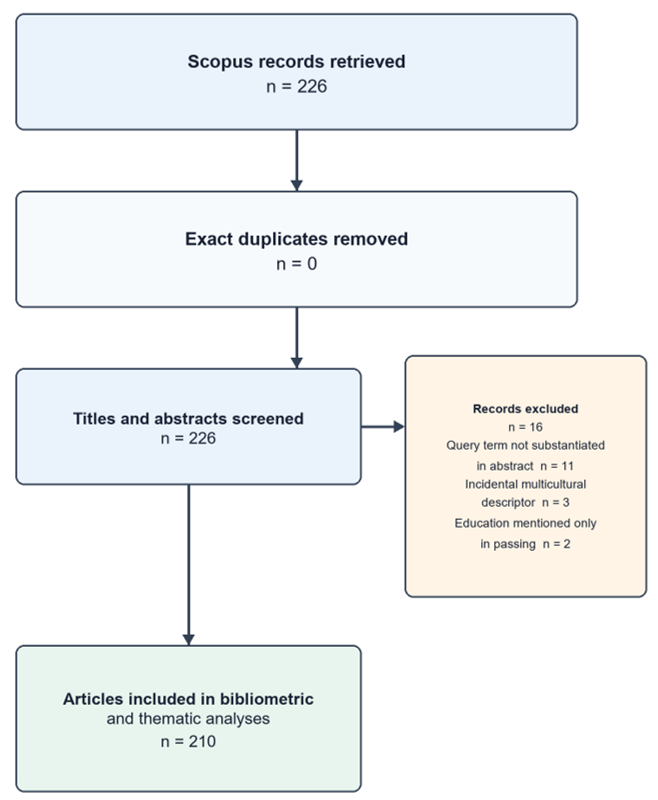
Note. The figure reports 226 retrieved records, no exact duplicates, 16 exclusions by documented reason, and 210 included articles.
Bibliometric Analysis
Data processing and analysis used R 4.6.0 (2026-04-24 ucrt) and bibliometrix 5.4.0. Descriptive indicators were calculated from Scopus source, author, citation, affiliation, institution, publication-stage, document-type, and keyword fields. Country counts refer to affiliations, not nationality. Author keywords were available for 206 records. Thirteen conservative normalisation groups reduced 801 lowercase terms to 787 by merging spelling, hyphenation, singular-plural, and unambiguous lexical variants while retaining non-equivalent concepts. The focal term multicultural education remained in frequency tables but was removed from the visualisation because its search-related frequency obscured other relations. A minimum occurrence of three documents produced a 41-term largest connected component.
Country co-authorship, keyword co-occurrence, document coupling, and reference co-citation were prepared in VOSviewer 1.6.20 with association-strength normalisation and fractional counting (van Eck & Waltman, 2010). The country figure retained pairs occurring in at least two articles. Document coupling required two exact shared references, producing 59 items and 158 links. Its peripheral tail was folded graphically without changing items, links, or weights. Co-citation required four citing corpus articles. The analysis excluded 110 year-only entries across 43 records because they did not identify works, and it applied no approximate reference merging.
Sensitivity checks compared keyword frequencies of two, three, and four. Bibliographic coupling thresholds were one through five, seven, and ten shared references. Co-citation thresholds were two through five, seven, and ten citing articles. At adjacent settings, keyword components contained 90, 41, and 25 terms, coupling components 166, 59, and 21 articles, and co-citation networks 78, 35, and 16 references. The selected middle settings retained interpretable coverage without producing overly dense figures and were not treated as universal optima. Alternative settings changed breadth and density but retained concentration around educator learning, responsive pedagogy, and leading cited works. Threshold comparisons informed presentation, not thematic stability or validity.
Thematic Analysis
The thematic corpus consisted of titles, author keywords, and abstracts. Familiarisation and calibration used a hybrid codebook with definitions, use rules, exclusions, negative cases, and links between claims and evidence. Framework-informed questions and eight provisional organisers directed attention to representation, pedagogy, institutions, power, learner experience, and evidence, while repeated, contradictory, or boundary meanings generated code revisions. Coding was primarily semantic and followed established thematic principles (Braun & Clarke, 2006). A fixed random calibration set of 30 records, seed 20260731, was examined in three contextual passes of ten. Reflexive prompts informed by experience in Vietnam emphasised comparative and multilingual contexts, those informed by Canada emphasised inclusion and accessibility, and those informed by the United States emphasised power and critical traditions. All passes used the same questions and codebook within one collaborative workflow, so they did not support an intercoder reliability claim. Calibration produced 28 working codes and a negative-case register. The remaining 180 records formed three 60-record batches, covering all 210 records.
The analysis continued through full-corpus consolidation, codebook revision, negative-case review, theme construction, boundary adjudication, and claim verification. Alternative interpretations were examined against the source text, code definitions, rules, and emerging claims. Differences were resolved through discussion and recorded in the decision log and thematic audit trail. The eight provisional organisers structured early comparison but were not predetermined themes. They were consolidated, divided, or narrowed when the full corpus did not support their initial scope, producing six final themes.
Each record received a familiarisation memo and three to seven codes. The corpus contained 1,085 coded segments and 258 negative or boundary segments, and candidate themes were assessed for coherence, distinction, alternatives, and overlap. Boundary review moved C025, a theory-and-practice implementation-gap code, from the institutional core to a contributing role because a general gap did not demonstrate resources, leadership, policy, or working conditions. The learner theme was narrowed from whole-person language to multidimensional development because the abstracts did not support a unified construct. Six themes generated 29 scoped claims linked to 415 evidence rows and 268 segments. The 77 records in the claim-to-evidence matrix supported, qualified, or contradicted at least one claim. They were not a separate prior sample, and all 210 records remained in the coding base. Claims were reconstructed from cited evidence and checked against minimum evidence requirements. Counts document analytic coverage, not thematic prevalence or importance.
Integration, Reflexivity, and Ethical Considerations
Integration compared the keyword network with the themes after theme construction. A term was aligned when it named a construct in a theme definition or claim and the thematic evidence supplied an interpretive distinction. Thirty-one terms produced 33 correspondences because equity and critical thinking each had two roles, while ten broad labels among the 41 network items remained unaligned. Clusters were not mapped wholesale, and frequency or link strength did not indicate thematic importance. Network-theme correspondence indicated conceptual overlap rather than validation. Content analysis was a weak contextual alignment, occurring in four articles with fractional total link strength of 0.038, and did not support a substantive relation in the educational ecology. A decision log, audit trail, reflexive journal, codebook, negative-case register, evidence matrix, and integration matrix documented development. Institutional review was not required because the study analysed bibliographic records rather than participant data.
FINDINGS
Bibliometric Context
The corpus contained 210 articles across 135 sources and 578 authors. Fifty-three articles had one author and 157 had multiple authors, with a mean of 2.84 and median of two authors. Multicultural Education Review published 13 articles, Frontiers in Education nine, and the Journal for Multicultural Education eight. By 29 July 2026, the corpus had 508 Scopus citations, with a median of one, 75 uncited articles, and a maximum of 43. These early counts are not quality indicators. Publication was dispersed because the three leading sources accounted for 30 articles and 103 of 135 sources contributed one. The distribution spans curriculum, teacher education, inclusion, psychology, language education, and professional education, indicating reach rather than quality or influence.
Table 1. Selected Descriptive Characteristics of the 2025 Corpus
|
Characteristic |
Result |
|---|---|
|
Included articles |
210 |
|
Sources |
135 |
|
Unique authors |
578 |
|
Articles with one author / multiple authors |
53 / 157 |
|
Mean / median authors per article |
2.84 / 2 |
|
Affiliation countries |
56 |
|
Articles from one affiliation country / multiple countries |
174 / 36 |
|
Records with author keywords |
206 (98.1%) |
|
Records with abstracts, affiliations, and cited references |
210 (100%) |
Affiliations represented 56 countries. The United States contributed to 37 articles, Indonesia to 35, South Korea to 22, and China to 17 under full counting. Thirty-six articles involved multiple affiliation countries. The complete network contained 35 countries and 34 links, but only four pairs shared two articles. Affiliation-country participation was widespread while repeated collaboration remained sparse. These counts describe author affiliations, not study settings.
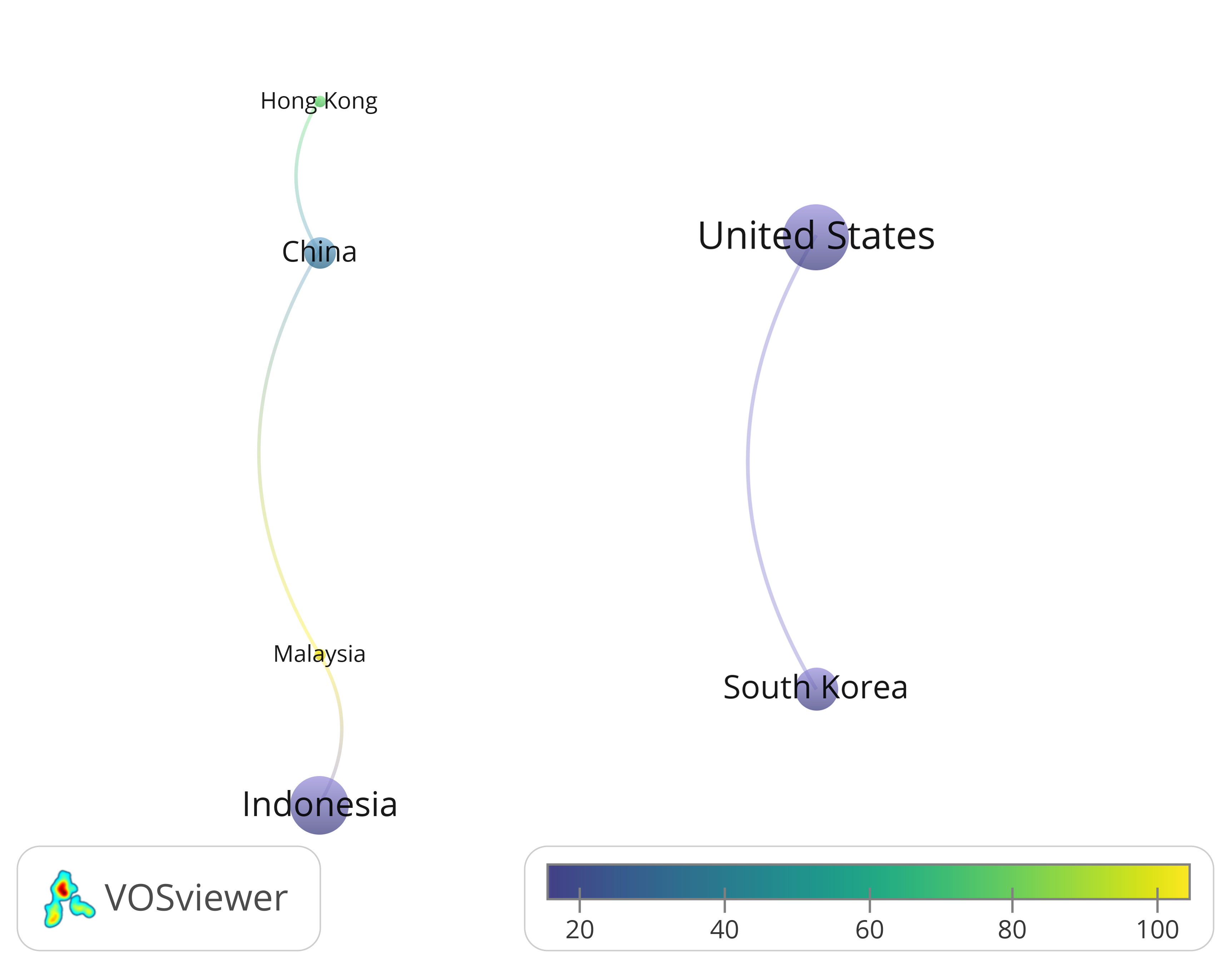
Note. The threshold of two joint articles retains six countries and four links. Node size reflects documents, and colour distinguishes disconnected components. The complete network remained available during analysis.
Author keywords formed a broad vocabulary. The focal term occurred in 101 articles. Frequent terms included multiculturalism (17), teacher education (12), higher education (10), diversity (8), inclusive education (8), and culturally responsive teaching (7). At minimum frequency three, the largest component contained 41 terms and 107 links. Relations connected culturally responsive teaching with professional development and diversity with equity and social justice. Visibility does not establish educational importance.
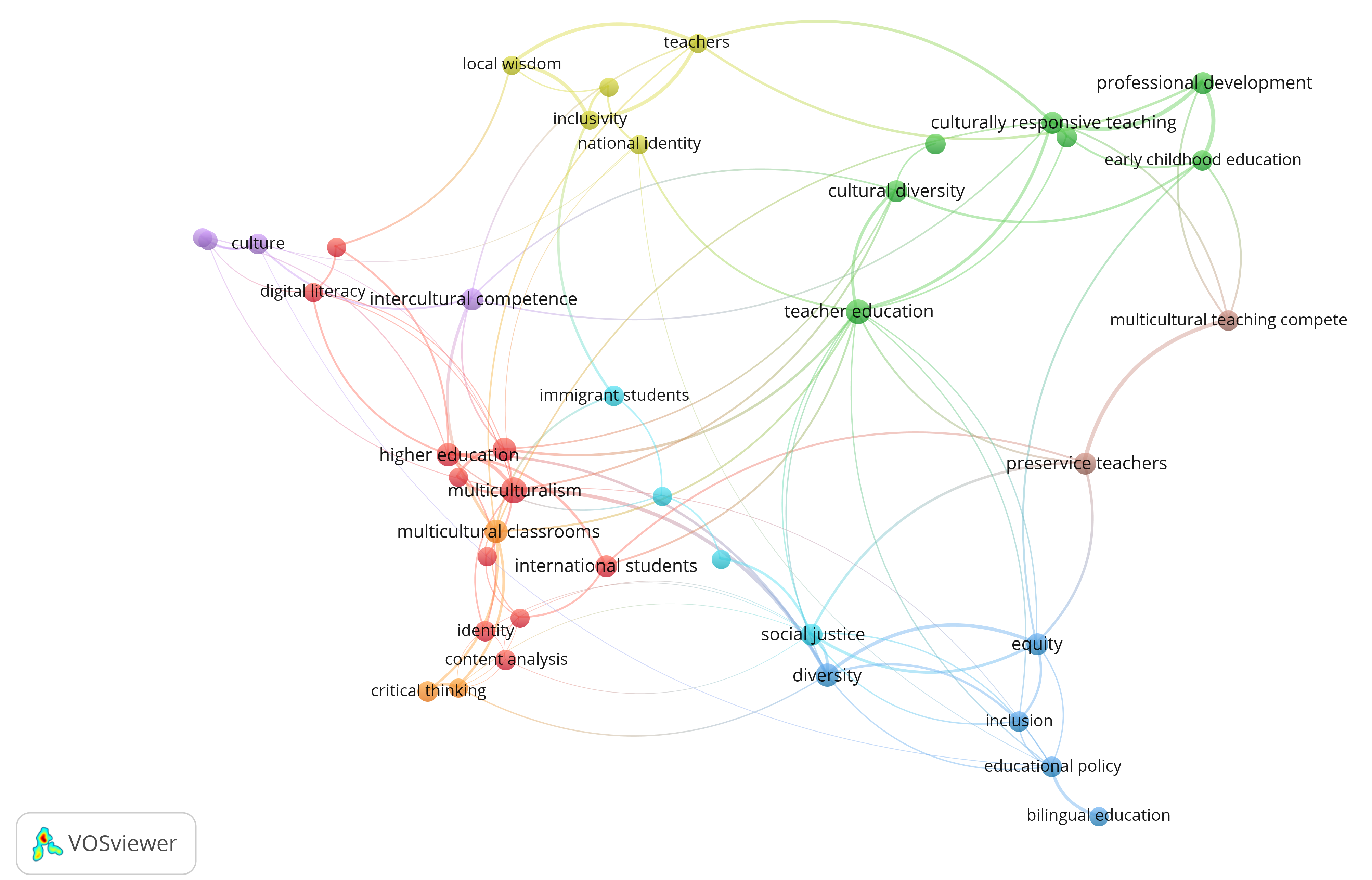
Note. Minimum frequency is three. The focal term was removed only from the visualisation. The largest component contains 41 terms and 107 fractional links.
Bibliographic coupling showed contemporary research connections. At least one reference was shared by 170 articles. At the two-reference threshold, the largest component contained 59 articles and 158 links. Connected work addressed teacher efficacy, professional learning, plurilingual support, responsive teaching, Indigenous knowledge, and intercultural sensitivity. Coupling indicates overlapping literature, not agreement or quality.
Cited reference co-citation identified a shared knowledge foundation. Among 10,793 reference keys, 284 appeared in at least two articles. The approved network retained 35 references cited by at least four articles and 178 links. Leading works were Gay (2002) in 19 articles, Gay (2018) in 18, Ladson-Billings (1995) in 17, Braun and Clarke (2006) in 15, and Paris (2012) in nine. This pattern emphasises culturally responsive, relevant, and sustaining pedagogy alongside thematic analysis. Co-citation does not prove consensus.
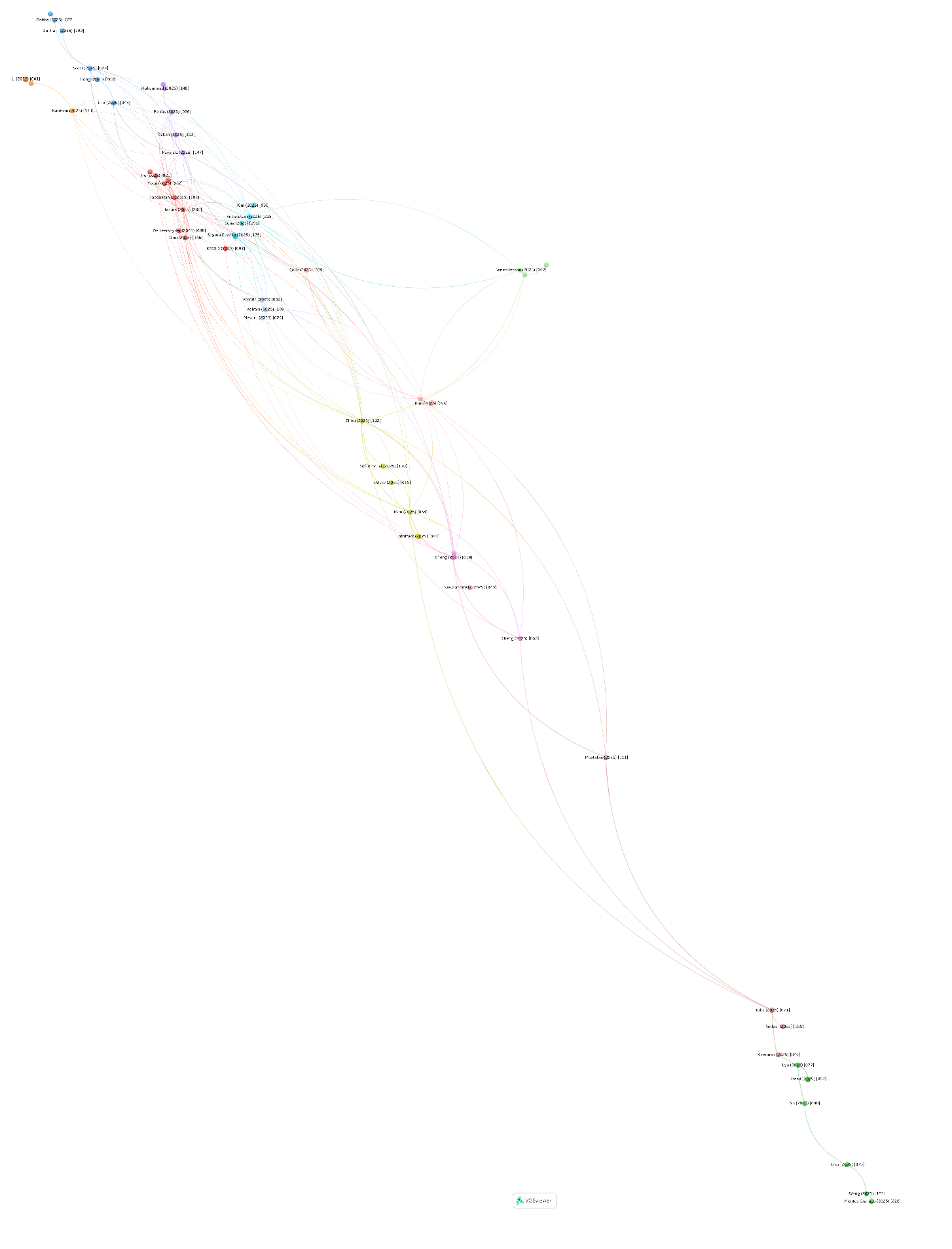
Note. Two exact shared references are required. The largest component contains 59 articles and 158 fractional links. The eight-item peripheral tail is folded upward and back toward the main component to improve visibility. All items, links, and weights are unchanged.
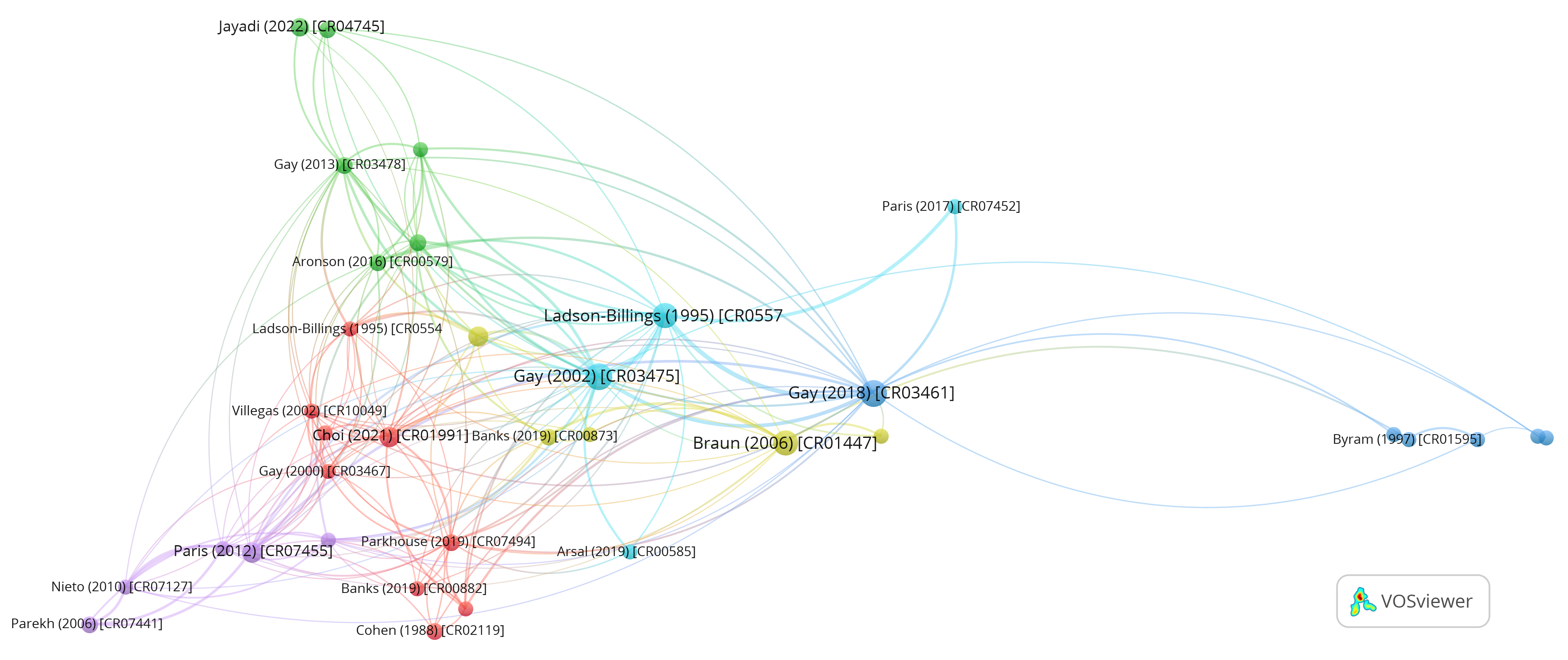
Note. The network contains 35 references cited by at least four articles and 178 fractional links.
Thematic Findings
The bibliometric results show a dispersed field in which educator learning, culturally responsive practice, and equity are prominent. Affiliation-country breadth coexists with sparse repeated collaboration and varied conceptual language. Mapping identifies prominence and connection, whereas thematic analysis interprets how recognition, participation, pedagogy, institutions, power, and evidence are framed in the records. The six themes support a provisional interpretive heuristic rather than a causal sequence. Recognition concerns educational purpose, culturally grounded pedagogy concerns the design of educational practice, and institutional conditions concern enactment. Power provides a critical perspective on whether inclusion changes authority, while learner development describes varied reported associations and outcomes. The quality of concepts and evidence affects confidence in each of these relations.
Recognition, Voice, and Belonging
Recognition involves more than making cultural difference visible. Studies of religious identity, migration, and mobility connected belonging with relational safety, institutional response, and agency. Italian school evidence foregrounded negotiation of religious identities (Santagati et al., 2025), while repeated cultural transitions created distinct educational demands (Nováková & Němejc, 2025). Community mobilisation around Afghan learners in South Korea (Koo, 2025) and curriculum work with Yugur communities in China (Wang & Gao, 2025) positioned learners, families, and communities as contributors to educational meaning rather than recipients of representation. Negative cases showed the limits of visibility. Making identities visible could be harmful when they were fixed, othered, or exposed to bullying. The mineralisation of Malay/Muslim identities in Singapore showed how official multiculturalism can coexist with intersectional othering (Anwar & Sim, 2025). Work with migrant learners with special educational needs in Greece connected cultural difference to bullying and intersecting exclusion (Samsari et al., 2025). Recognition is therefore not equivalent to naming difference. It requires voice, negotiated identity, and membership with material and relational consequences. Within the wider educational ecology, recognition establishes who can participate as a valued contributor rather than merely appear as a represented category.
Culturally Grounded and Responsive Pedagogies
Culturally grounded pedagogy concerns how cultural knowledge shapes educational practice. Responsive pedagogy referred to curriculum, teaching, scaffolding, learning activity, and mediation provided by educators and institutions, not strategies through which learners adapt to existing provision. The analysis distinguished teaching organised around cultural knowledge from teaching that used it as decoration. Experiential reading connected literacy to learners’ experience (Marstaller, 2025), decolonial work treated cultural practice as knowledge and resistance (de Eça & de Freitas Madruga, 2025), and Indonesian materials combined responsive teaching with local stories (Nisa et al., 2025). Digital storytelling in Taiwan illustrated critically designed dialogue (Wang & Hu, 2025), while bilingual support, multimodal scaffolding, and peer structures redistributed opportunities to participate.
Boundary evidence showed that cultural exposure, technology, or bilingual provision was not inherently responsive. Textbook inclusion could remain superficial, digital tools could reproduce bias or unequal access, and a curriculum celebrating diversity could maintain monolingual and racialised norms (Ryu & Kang, 2025). Cultural knowledge therefore needed to shape purposes, relationships, participation, and assessment rather than merely appear in examples. The theme identifies pedagogy as a site where representation may become participation, not as proof that it does so. Design quality and access consequently require separate consideration.
Institutional Conditions for Enactment
Institutional conditions shaped what educators could put into practice. Educator preparation and reflexivity operated within leadership, staffing, policy, time, resources, specialist services, family relationships, and working conditions. South Korean research connected multicultural awareness with professional continuity (Yu et al., 2025), while an antiracist development pilot reported attitude and efficacy changes but limited evidence of sustained reach (Stoffers et al., 2025). Refugee education in Malta showed interdependent classroom, service, and system challenges (Żammit, 2025). Community mobilisation (Koo, 2025) and local curriculum development (Wang & Gao, 2025) illustrated coordinated capacity rather than a universal model. Gaps between policy and practice appeared when commitments were not matched by guidance, aligned curriculum, time, or implementation support. Finnish history teachers’ practices demonstrated how inclusion in curriculum is mediated by teachers’ interpretations and available frameworks (Kohvakka, 2025). Icelandic teachers’ support for plurilingual development showed that a positive orientation could coexist with priority for the dominant language and uneven strategies (Benediktsson et al., 2025). In politically contentious environments, educators’ capacity to sustain practice oriented toward equity was further shaped by policy pressure and professional risk (Kheirkhah & Aronson, 2025).
An explanation centred on individual deficits would overlook these conditions. Positive attitudes, training exposure, or formal commitment cannot alone establish equitable practice, and reported efficacy does not prove durable change. During coding review, C025 was reassigned from a core to a contributing role to preserve this distinction. General theory-and-practice gaps remained relevant, but only evidence about resources, leadership, policy, time, staffing, services, or working conditions qualified as central. Multicultural enactment was therefore interpreted through professional capacity and the arrangements that make responsive action feasible.
Power and the Limits of Formal Inclusion
Formal inclusion remained shaped by dominant racial, linguistic, religious, national, and epistemic norms. Multicultural policy can broaden representation while leaving legitimate knowledge and membership unchanged. Korean curriculum research distinguished authentic multicultural education from tokenistic representation (Eun & Mo, 2025). Critique of Afro-Colombian curricula likewise showed how surface diversity can retain dominant knowledge boundaries (Segura Castillo, 2025). Analysis of linguistic racism showed how inclusionary language can obscure hierarchy (Ryu & Kang, 2025).
Cultural blindness and equal-treatment assumptions could conceal unequal access. Comparison of multicultural approaches with teacher colour blindness distinguished general support from practice addressing diversity (De Leersnyder & Meeussen, 2025). The theme does not classify every appeal to equality or unity as oppressive; it asks whether unequal conditions are recognised and agency redistributed. Multicultural education became thin when narrowed to integration, security, employability, or social management, although unity could support coexistence when local identities retained voice. Participatory arts, community collaboration, and negotiated religious education showed that cohesion need not require assimilation (Suwanpakdee & Jitduangprem, 2025). The organising question is who defines the terms of unity or plurality and whether heritage, knowledge, and decision making remain shared. Power therefore distinguishes formal inclusion that redistributes participation from inclusion that preserves authority.
Learner Development and Unequal Access
Reported learner outcomes varied and included intercultural competence, empathy, engagement, professional competence, and wellbeing. Digital storytelling supported intercultural learning (Wang & Hu, 2025), and cross-country evidence related teacher beliefs and policy contexts to learning and attitudes toward immigrants (Firat & Gencoglu, 2025). Teacher approaches to diversity were associated with engagement, belonging, and health (De Leersnyder & Meeussen, 2025). Migrant and refugee research foregrounded trauma, trust, and resilience (Nantsou et al., 2025). Evidence on culturally responsive teaching and classroom climate also cautioned against assuming uniform effects (Ialuna et al., 2025).
Access was uneven across the corpus. Only two coded records explicitly addressed disability and accessibility. One examined the intersection of migrant status, special educational needs, and bullying (Samsari et al., 2025). The other addressed communication access. This sparse visibility is consequential because multicultural education often invokes inclusion while leaving disability outside its central framing. Treating accessibility as a constituent part of multicultural participation is therefore a normative implication of the documented gap, not a claim that accessible practice was common in the corpus.
These findings do not support a single conclusion about effectiveness. Studies used different constructs, contexts, designs, and outcome measures. Some reported mixed or null findings. High expectations appeared most equitable when combined with identity affirmation, strength-based assumptions, and appropriate support. Learner development is therefore a possible consequence of multicultural education rather than an automatic outcome. Its meaning depends on who gains access, what support is available, and whether measures remain comparable across contexts.
Conceptual Development and Gaps in the Evidence
Conceptual renewal broadened the field while exposing limits to cumulative knowledge. Reviews, relational theory, decolonial analysis, and measurement research widened what counted as knowledge. Intercultural sensitivity research identified definitional variation (Choi, 2025), relational theorising challenged stable assumptions about subjectivity (Nelson & Moon, 2025), and decolonial work treated subordinated traditions as theory (de Eça & de Freitas Madruga, 2025). Measurement studies identified cultural comparability limits in teacher efficacy scales (Lee et al., 2025), while a social work review found inconsistent constructs and interventions (Okantey et al., 2025). Conceptual expansion can therefore fragment the field without clearer definitions, validation, and context. Gaps in the evidence were geographic, methodological, epistemic, and related to the populations studied. A review of multicultural educational leadership with Indigenous communities found a limited and uneven knowledge base (Queupil & Álvarez-Figueroa, 2025). The sparse explicit treatment of disability and accessibility from the corpus provides a second example. Established higher education, teacher education, and survey traditions were visible in the keyword patterns, while community knowledge, accessibility, and some underrepresented contexts became clearer only through thematic reading.
This theme does not treat absence from a title, keyword list, or abstract as proof that a concern is absent from full texts or from the wider field. It identifies limited visibility within the defined corpus. Conceptual development therefore requires methodological experimentation and stronger cumulative practices. These include clearer definitions, culturally responsive measurement, transparent validation, and greater authority for communities whose knowledge is studied. These gaps qualify the proposed educational ecology by showing where its relationships remain weakly defined or insufficiently studied.
Table 2. Final Themes and Their Analytical Contributions
|
Theme |
Central contribution |
|---|---|
|
Recognition, Voice, and Belonging |
Distinguishes visibility from recognition grounded in agency and valued membership. |
|
Culturally Grounded and Responsive Pedagogies |
Explains how cultural knowledge organises teaching, scaffolding, and participation. |
|
Institutional Conditions for Enactment |
Locates educator capacity within resources, leadership, policy, time, and working conditions. |
|
Power and the Limits of Formal Inclusion |
Examines knowledge authority, language, tokenism, instrumental inclusion, and negotiated unity. |
|
Learner Development and Unequal Access |
Retains varied outcomes, mixed evidence, and access gaps. |
|
Conceptual Development and Gaps in the Evidence |
Connects innovation with definitional, validation, epistemic, and population gaps. |
Table 3. Noncausal Relations in the Provisional Educational Ecology and Their Evidence Boundaries
|
Domain |
Observed conceptual relation |
Claim anchors |
Evidence boundary |
|---|---|---|---|
|
Recognition and valued participation |
Corpus evidence associated visibility with valued membership, voice, and agency. |
CLM-FT01-01, CLM-FT01-02, CLM-FT01-04 |
Visibility can coexist with othering or restricted authority. |
|
Culturally grounded pedagogy |
Teaching designs linked community knowledge with curriculum, scaffolding, and participation. |
CLM-FT02-01, CLM-FT02-03, CLM-FT02-05 |
Exposure, technology, or bilingual provision is not inherently responsive. |
|
Institutional conditions |
Resources, leadership, policy, time, and working conditions were associated with enactment or constraint. |
CLM-FT03-02, CLM-FT03-03, CLM-FT03-05 |
Attitudes or training do not demonstrate sustained enactment. |
|
Power and authority |
Inclusion was interpreted as more substantive when knowledge and participation authority changed. |
CLM-FT04-01, CLM-FT04-02, CLM-FT04-05 |
Unity can support coexistence or preserve hierarchy. |
|
Learner development and access |
Reported engagement, competence, belonging, and wellbeing varied with support and access. |
CLM-FT05-02, CLM-FT05-03, CLM-FT05-06 |
Mixed findings and heterogeneous measures prevent a uniform effect claim. |
|
Concepts and evidence |
Definitions, validity, and methods qualified confidence in the other relations. |
CLM-FT06-02, CLM-FT06-04 |
Metadata cannot establish causality or field-wide absence. |
Note. The relations are interpretive propositions supported by the indicated thematic claims. They are not tested causal pathways. Claim identifiers trace to the final claim-to-evidence matrix.
DISCUSSION
Within this 2025 corpus, educational ecology is a provisional, theoretically informed heuristic relating six domains. It is corpus-specific rather than a new general theory and does not imply a causal system. Equitable participation functions as a normative organising principle concerning opportunities to influence knowledge, interaction, decisions, and access while unequal power and resources are addressed. It is neither a seventh theme nor an established outcome, and it does not replace student voice or shared decision making. Representation makes difference visible, while recognition gives it valued legitimacy and belonging concerns experienced membership. Agency concerns the capacity to act, access practical opportunity, and shared authority influence over knowledge and decisions. Considering these distinctions in relation to one another asks whether recognising difference changes participation and authority across curriculum, pedagogy, institutions, and evaluation. No individual element is sufficient alone.
Table 3 displays proposed conceptual relations and evidence boundaries without assigning causal functions. Recognition identifies valued participation, culturally grounded pedagogy describes educational design, and institutional arrangements locate reported conditions of practice. Power directs attention to whether inclusion altered knowledge and participation authority. Learner development retains heterogeneous reported associations, while concepts and evidence qualify confidence. These roles are supported by theme claims but are not observed transitions. Recognition can coexist with inaccessible provision, and responsive classroom activity with institutional constraint. The heuristic makes such disconnections visible rather than assuming that one domain produces another.
The heuristic relates established frameworks rather than competing with them. Banks (2009) identifies educational domains, while culturally relevant pedagogy connects learning, cultural competence, and critical consciousness (Ladson-Billings, 1995). Culturally responsive teaching uses learners’ cultural knowledge and experience (Gay, 2002, 2018), and sustaining pedagogy asks which community practices education maintains (Paris, 2012; Paris & Alim, 2014). Critical multiculturalism examines institutional power (May & Sleeter, 2010), while critical constructivism asks how situated knowledge becomes authorised (Kincheloe, 2005). Intercultural education emphasises interaction and reciprocity (Portera, 2008), and inclusive education extends the institutional question to system-wide participation and equity (Ainscow, 2020). The educational ecology links these concerns through equitable participation while preserving their different purposes.
Responsive and sustaining pedagogy clarify the design of culturally grounded practice. Corpus studies drew on lived experience, local stories, community knowledge, arts, multilingual resources, and differentiated participation. Such practices draw on culturally relevant and responsive pedagogy (Gay, 2002) and connect academic learning with cultural competence and critical consciousness (Ladson-Billings, 1995). Boundary cases asked whether practices sustained plurality or translated difference into dominant forms (Paris, 2012). Adding diverse examples to an otherwise unchanged design was insufficient.
Critical multiculturalism shows why enactment is not merely technical. Resources, policy, staffing, leadership, and professional security distribute power (May & Sleeter, 2010). Formal commitments weakened without time, guidance, relationships, or professional protection, while participatory curriculum and community mobilisation showed alternatives to assimilation. Community authority nevertheless requires plural, resourced, and accountable representation attentive to internal differences. Institutions influence whether responsive action is possible and whether communities can help define it. Reported learner development provides a check on educational intentions. Reported competence, engagement, belonging, and wellbeing varied across populations, constructs, and measures. Disability and accessibility were rarely explicit, and several studies reported mixed findings. Positive average outcomes cannot establish equitable participation when access or interpretability remains unequal. Recognition and belonging may be present while authority or material access remains restricted.
Integration clarifies the distinct contributions of the two methods. Thirty-one network terms corresponded to thematic constructs such as teacher education, responsive teaching, equity, social justice, competence, and wellbeing. Thematic analysis distinguished visibility from voice, exposure from responsive design, training from enactment, unity from instrumentalization, and reported outcomes from equitable access. Broad labels remained unmapped, and the weak content-analysis correspondence located methodological context without supporting a substantive relation. Bibliometric prominence indicates attention and connection within the corpus, while thematic evidence supplies meaning and qualification. Their correspondence is therefore conceptual overlap, not independent validation of the themes. As a thematic-bibliometric review of one publication year, the study provides a detailed 2025 snapshot rather than evidence of rise or decline. The educational ecology is an interpretation of selected English-language Scopus articles classified in Social Sciences. Longitudinal, multilingual, cross-database, and full-text research should examine whether the proposed relations hold, change, or require alternatives.
IMPLICATIONS
The findings suggest several ways to interpret multicultural education. Recognition carries greater analytical weight when it includes voice, agency, and valued membership, beyond visibility alone. Culturally grounded pedagogy depends on whether cultural knowledge organises purposes, relationships, participation, and assessment, rather than merely supplying examples. Accounts of educator capacity also need to consider the institutional resources, time, leadership, policy, and professional conditions that shape enactment. The evidence also supports treating power as relevant to whether formal inclusion changes knowledge authority, although the records do not establish a single measure of such change. Reported learner development must be interpreted alongside uneven access, heterogeneous constructs, and mixed findings. These are corpus-supported interpretive implications rather than direct tests of practice or policy effectiveness.
The recommendations below extend these findings normatively and should not be read as effects observed within the corpus. Educators and institutions can use equitable participation as a diagnostic question for curriculum, interaction, assessment, and authorship, asking who can participate and influence learning. Professional learning can connect cultural knowledge, critical reflexivity, high expectations, multilingual support, and accessibility to observable practice, while institutional planning can address staffing, time, specialist provision, educator wellbeing, accessible communication, and sustained family relationships. Policymakers can connect formal commitments to funding, implementation guidance, professional protection, and accountable review. Community participation should involve plural representation, adequate resources, and transparent processes for influence without assuming that one representative speaks for an internally diverse community. Accessibility is recommended in response to its sparse explicit visibility in the corpus, not as a description of common practice. Research should use transparent definitions, culturally responsive measurement, and validation across contexts. Continued conceptual review is warranted because rapid publication growth can extend the field without resolving differences among representation, recognition, participation, access, and shared authority. Longitudinal and comparative studies should examine intersections among culture, race, language, religion, migration, disability, and social class, and should compare the proposed ecology with alternative accounts across educational levels and settings.
LIMITATIONS
The study is limited to English-language articles published in 2025, indexed in Scopus, and classified within its Social Sciences subject area. Relevant research indexed only in Arts and Humanities, Psychology, health sciences, Computer Science, natural sciences, or other subject areas was excluded even though these fields also examine multicultural education. Articles classified in Social Sciences and one or more additional subject areas remained eligible. The corpus does not represent books, chapters, dissertations, non-English scholarship, other databases, or research outside the title and author-keyword search fields. The precision-oriented TITLE and AUTHKEY strategy may have missed studies using adjacent terms or framing multicultural education only in abstracts or full texts. Restricting the review to one publication year permits detailed analysis of contemporary conceptual patterns but does not support conclusions about historical development, growth, decline, or durable change.
The thematic analysis examined titles, author keywords, and abstracts rather than complete articles. It therefore concerns publicly available framing and cannot verify study quality, causal inference, or complexity not reported in those fields. Four records had no author keywords. Citation counts captured on 29 July 2026 remain sensitive to recency, and bibliometric thresholds and conservative normalisation necessarily excluded weak connections. Sensitivity checks showed changes in network breadth rather than equivalence across settings. The contextual passes formed one collaborative workflow and cannot establish intercoder reliability or independent replication. Audit trails, boundary cases, and claim reconstruction improve transparency but do not remove interpretive judgement. Network-theme correspondence indicates conceptual overlap rather than validation, and the joint display presents noncausal relations. The educational ecology remains a corpus-specific, provisional heuristic rather than a definitive model of multicultural education.
CONCLUSION
This study examined 210 English-language articles on multicultural education published in 2025 and classified within the Social Sciences subject area in Scopus. The bibliometric evidence showed broad but lightly repeated collaboration, conceptual patterns connecting educator learning with equity, and a shared knowledge foundation in culturally responsive, relevant, and sustaining pedagogy. The thematic analysis related recognition, pedagogy, institutions, power, learner development, access, and evidence quality. For the selected 2025 corpus, a provisional educational ecology offers a way to examine how these domains relate to equitable participation without treating them as a causal sequence. Representation was interpreted as educationally consequential when it was associated with recognition, agency, culturally grounded pedagogy, institutional capacity, accessible support, and attention to power. It remained limited when visibility did not alter participation, knowledge authority, or material support. The heuristic is neither a universal sequence nor a superior model for the wider field. Further research should examine its relations across time, settings, languages, databases, and complete articles, with attention to accessibility, measurement quality, community authority, and underrepresented contexts.
References
Ainscow, M. (2020). Promoting inclusion and equity in education: Lessons from international experiences. Nordic Journal of Studies in Educational Policy, 6(1), 7-16. https://doi.org/10.1080/20020317.2020.1729587
Anwar, N. D., & Sim, J. B.-Y. (2025). ‘Intersectional othering’ and the minoritisation of ‘Malay/Muslim’ identities in Singapore’s multicultural education. Intercultural Education, 36(4), 497-512. https://doi.org/10.1080/14675986.2025.2501460
Aria, M., & Cuccurullo, C. (2017). bibliometrix: An R-tool for comprehensive science mapping analysis. Journal of Informetrics, 11(4), 959-975. https://doi.org/10.1016/j.joi.2017.08.007
Banks, J. A. (2009). Multicultural education: Dimensions and paradigms. In J. A. Banks (Ed.), The Routledge international companion to multicultural education (pp. 9-32). Routledge. DOI: https://doi.org/10.4324/9780203881514
Benediktsson, A. I., Tran, A.-D., Emilsson Peskova, R., Ragnarsdóttir, H., & Lefever, S. (2025). Icelandic teachers’ perspectives and strategies for supporting children’s plurilingual development in compulsory schools. Education Inquiry. Advance online publication. https://doi.org/10.1080/20004508.2025.2466890
Braun, V., & Clarke, V. (2006). Using thematic analysis in psychology. Qualitative Research in Psychology, 3(2), 77-101. https://doi.org/10.1191/1478088706qp063oa
Choi, J. (2025). A systematic review of intercultural sensitivity studies. Asia Pacific Journal of Education, 45(1), 296-313. https://doi.org/10.1080/02188791.2023.2291984
de Eça, J. L. M., & de Freitas Madruga, Z. E. (2025). Annunciation of a decolonial epistemology: Zambiapunga as a cultural movement of resistance. Bakhtiniana, 20(3), Article e66641p. https://doi.org/10.1590/2176-4573p66641
De Leersnyder, J., & Meeussen, L. (2025). Better be multicultural or colorblind? How teachers’ approach to diversity during COVID-19 school closures predicts adolescents’ class engagement, school belonging and health beyond general teacher support. Journal of Community & Applied Social Psychology, 35(4), Article e70122. https://doi.org/10.1002/casp.70122
Eun, J.-Y., & Mo, K.-H. (2025). Beyond tokenism: Promoting authentic multicultural education in Korean social studies. Multicultural Education Review, 17(3), 215-234. https://doi.org/10.1080/2005615X.2025.2553986
Firat, M., & Gencoglu, B. (2025). Teachers’ multicultural beliefs or countries’ integration policies? Contextual influences on students’ multicultural learning and attitudes towards immigrants. Social Psychology of Education, 28(1), Article 169. https://doi.org/10.1007/s11218-025-10126-5
Gay, G. (2002). Preparing for culturally responsive teaching. Journal of Teacher Education, 53(2), 106-116. https://doi.org/10.1177/0022487102053002003
Gay, G. (2018). Culturally responsive teaching: Theory, research, and practice (3rd ed.). Teachers College Press.
Ialuna, F., Civitillo, S., Schachner, M. K., & Jugert, P. (2025). Culturally responsive teaching self-efficacy and cultural diversity climate are positively associated with the academic and psychological adjustment of immigrant and nonimmigrant students. Cultural Diversity and Ethnic Minority Psychology, 31(4), 683-698. https://doi.org/10.1037/cdp0000697
Kheirkhah, H., & Aronson, B. (2025). Teacher perceptions of critical race theory and multicultural education in “dangerous times”. Journal for Multicultural Education, 19(2-3), 209-228. https://doi.org/10.1108/JME-01-2025-0008
Kılavuz, F. (2023). A bibliometric analysis of multicultural education research. Journal of Social Sciences and Education, 6(Education Special Issue), 216-238. https://doi.org/10.53047/josse.1359321
Kincheloe, J. L. (2005). Critical constructivism primer. Peter Lang.
Kohvakka, T. (2025). Teaching multicultural history in Finland: The views and practices of history teachers in Finland. Journal of Curriculum Studies. Advance online publication. https://doi.org/10.1080/00220272.2025.2522467
Koo, G. Y. (2025). A whole village involved in raising children: Community mobilisation and educational integration of Afghan special contributors in South Korea. Anthropology of the Middle East, 20(2), 84-101. https://doi.org/10.3167/ame.2025.200206
Ladson-Billings, G. (1995). Toward a theory of culturally relevant pedagogy. American Educational Research Journal, 32(3), 465-491. https://doi.org/10.3102/00028312032003465
Lee, S., Bustamante-Barreto, A., & Yoo, J. E. (2025). Toward a more discriminative and culturally responsive TALIS teacher self-efficacy in multicultural classrooms scale: Cross-national evidence from Japan and Colombia using the generalized partial credit model. Large-Scale Assessments in Education, 13(1), Article 35. https://doi.org/10.1186/s40536-025-00272-9
Marstaller, M. (2025). The experience of reading and writing, and the reading and writing of experience. Changing English: Studies in Culture and Education, 32(4), 343-354. https://doi.org/10.1080/1358684X.2025.2539826
May, S., & Sleeter, C. E. (Eds.). (2010). Critical multiculturalism: Theory and praxis. Routledge. DOI: https://doi.org/10.4324/9780203858059
Nantsou, L., Karanikola, Z., & Palaiologou, N. (2025). Building resilience: The critical role of multicultural education to cope with the psychological trauma of migrant and refugee youth. Behavioral Sciences, 15(7), Article 916. https://doi.org/10.3390/bs15070916
Nelson, J., & Moon, S. (2025). Relationships in-the-making in virtual learning communities: Theorizing relationships in critical multicultural education. Multicultural Education Review, 17(3), 307-329. https://doi.org/10.1080/2005615X.2025.2553992
Nisa, K., Syafitri, E., & Simanungkalit, A. (2025). Integrating culturally responsive teaching and TPACK frameworks in the design and validation of Indonesian language learning tools for multicultural schools. International Journal of Learning, Teaching and Educational Research, 24(12), 268-294. https://doi.org/10.26803/ijlter.24.12.12
Nováková, D., & Němejc, K. (2025). Beyond borders: Educating third-culture children in a globalised world. Education 3-13. Advance online publication. https://doi.org/10.1080/03004279.2025.2483965
Okantey, B., Murgor, J. C., Wong, F. Y., Millender, E. F., & Xavier Hall, C. D. (2025). How U.S. social work students are prepared to work with culturally diverse individuals: A scoping review of constructs and interventions. Social Work Education, 44(6), 1535-1560. https://doi.org/10.1080/02615479.2024.2409195
Paris, D. (2012). Culturally sustaining pedagogy: A needed change in stance, terminology, and practice. Educational Researcher, 41(3), 93-97. https://doi.org/10.3102/0013189X12441244
Paris, D., & Alim, H. S. (2014). What are we seeking to sustain through culturally sustaining pedagogy? A loving critique forward. Harvard Educational Review, 84(1), 85-100. https://doi.org/10.17763/haer.84.1.982l873k2ht16m77
Portera, A. (2008). Intercultural education in Europe: Epistemological and semantic aspects. Intercultural Education, 19(6), 481-491. https://doi.org/10.1080/14675980802568277
Queupil, J. P., & Álvarez-Figueroa, F. (2025). Multicultural educational leadership with Indigenous communities: A literature review. Journal of Professional Capital and Community, 10(3), 273-287. https://doi.org/10.1108/JPCC-06-2024-0097
Ryu, Y., & Kang, J. (2025). Racism without race in South Korea: Linguistic racism within a curriculum embracing language diversity. Language, Culture and Curriculum, 38(1), 77-96. https://doi.org/10.1080/07908318.2024.2416630
Samsari, E., Nikolaou, G., & Palaiologou, N. (2025). Multicultural education and students with special needs: A case study from Greece. International Journal of Disability, Development and Education, 72(1), 134-148. https://doi.org/10.1080/1034912X.2024.2336250
Santagati, M., Lodigiani, R., & Caragiuli, A. (2025). Exploring (in)visible religious identities in multicultural classrooms: A qualitative analysis from Italian schools. International Journal of Diversity in Education, 25(2), 189-211. https://doi.org/10.18848/2327-0020/CGP/v25i02/189-211
Segura Castillo, Y. (2025). Beyond surface diversity: Unmasking the flaws of multicultural education in the Afro-Colombian curriculum. Journal of Curriculum and Pedagogy, 22(2), 360-383. https://doi.org/10.1080/15505170.2023.2293033
Stoffers, M., Barnes, T. N., Strickland, L., Jung, J., Branch, K., Perry, D., & Hatchimonji, D. (2025). Pilot study of an anti-racist professional development: Effects on educators’ multicultural attitudes and efficacy. Journal for Multicultural Education, 19(1), 14-27. https://doi.org/10.1108/JME-06-2024-0064
Sumargono, Sinaga, R. M., Ariyani, F., & Rini, R. (2024). Studies of multicultural education in three last decades: Global trends and future directions in educational researches. International Journal of Evaluation and Research in Education, 13(5), 2957-2970. https://doi.org/10.11591/ijere.v13i5.28482
Suwanpakdee, S., & Jitduangprem, P. (2025). Participatory creative music in multicultural contexts: A case study of youth engagement and community development in Thailand’s southern border provinces. Research Studies in Music Education. Advance online publication. https://doi.org/10.1177/1321103X251395546
van Eck, N. J., & Waltman, L. (2010). Software survey: VOSviewer, a computer program for bibliometric mapping. Scientometrics, 84(2), 523-538. https://doi.org/10.1007/s11192-009-0146-3
Wang, A. Y., & Hu, W.-C. (2025). Fostering intercultural competence through digital storytelling: A critical approach in EFL education in Taiwan. Language, Culture and Curriculum, 38(4), 559-582. https://doi.org/10.1080/07908318.2025.2528771
Wang, G., & Gao, F. (2025). The school-based multicultural education curriculum in China: A case study of two Yugur middle schools. Journal of Multilingual and Multicultural Development, 46(10), 3350-3362. https://doi.org/10.1080/01434632.2023.2166944
Yu, S., Gil, M., Lyu, S.-R., & Son, K. (2025). Multicultural awareness and educational continuity among early childhood and elementary school teachers in South Korea. International Journal of Early Childhood. Advance online publication. https://doi.org/10.1007/s13158-025-00431-7
Żammit, J. (2025). Navigating the stormy seas of inclusion: Educator insights on refugee children in Maltese classrooms through ecological and multicultural lenses. Social Sciences & Humanities Open, 12, Article 101711. https://doi.org/10.1016/j.ssaho.2025.101711
Downloads
Published
Data Availability Statement
The research data is available upon request.
Issue
Section
License
Copyright (c) 2026 Tin T. Dang, Safa Elnaili, Thu Thi Kim Le

This work is licensed under a Creative Commons Attribution-NonCommercial-NoDerivatives 4.0 International License.