
Professional identity development process of mid-career EFL teachers
DOI:
https://doi.org/10.65956/late.2026.40Keywords:
professional identity, teacher identity, mid-career teachersAbstract
Professional identity development is a slow and complex process of self-negotiation and renegotiation, with the initial stages often more unstable and less predictable than later stages. This study explores how EFL teachers’ professional identity shifts from the early-career to the mid-career stage and identifies the factors that contribute to this process. Drawing on a synthesised conceptual framework of five subcomponents, namely roles and values, job motivation, satisfaction, commitment, and self-efficacy, together with an analytical framework of six influential career stages, the study employs a qualitative life-history approach. Data were collected through semi-structured interviews with four mid-career EFL tertiary teachers in Vietnam with different academic backgrounds and career trajectories. The findings reveal that teacher identity development is an ongoing process that unfolds in both positive and negative directions, shaped by lived experience and intentional reflection. Changes in individual subcomponents were also found to influence overall professional identity. The study contributes a synthesised conceptual framework for teacher identity research. Practically, early-career teachers are encouraged to embrace reflective practice and allow time for identity formation; mid-career teachers are advised to sustain reflective work and invest in self-efficacy; and institutional managers may use these insights to design more responsive professional development programmes.
INTRODUCTION
In recent years, increasing scholarly attention has been directed towards understanding teachers’ professional experiences and development. Teacher identity scholarship provides an important lens for understanding teachers’ professional lives across diverse contexts worldwide (Rushton et al., 2023). Studies on the evolution of teacher professional identity have increased across all levels, including primary and secondary education (Beauchamp & Thomas, 2009; Beijaard et al., 2004) and higher education (Van Lankveld et al., 2016). In this area, many scholars have focused on the transition of student teachers into professional teachers to examine identity transformation (Carrillo & Flores, 2018; Flores & Day, 2006). However, it would be premature to study identity only at this stage without further considering the experience teachers gain over the years. Beijaard (2009) points out that the more experience teachers obtain, the stronger their continuing interaction with the working environment becomes, eventually stabilising their professional identity. Therefore, teacher identity should not be explored only in the early stage of a teaching career, but also in later stages, when teachers have accumulated sufficient professional experience and their identity has, to some extent, taken shape.
In line with this perspective, this study targets teachers who are expected to have adequate professional experience. The term “mid-career phase” refers to a period of stabilisation and settling down (Huberman, 1993), with a minimum of seven years and a maximum of 20 years in the teaching profession (Cawte, 2020). This research analyses professional identity from a psychosocial perspective, informed by a synthesis of conceptual frameworks in the field (Beijaard et al., 2004; Canrinus et al., 2011a; Day, 2002; Lee & Schallert, 2016; Van Lankveld et al., 2016), which collectively attend to both psychological dimensions, including motivation, self-efficacy, and commitment, and social dimensions, including roles, values, and professional context (Nguyen et al., 2024). This lens also informs the analytic choices elaborated in the conceptual framework section. To gain insight into how teacher identity changes over time, the current study investigates the development of professional identity among mid-career teachers. The research focuses on four university lecturers with between ten and thirteen years of experience in teaching English as a foreign language (TEFL), who come from varied educational and teaching backgrounds.
More specifically, the study explores major changes in EFL teachers’ professional identity from the early stage to the mid-career stage on the basis of a conceptual framework consisting of five components, namely roles and values, job satisfaction, motivation, commitment, and self-efficacy. It examines how teachers negotiate and renegotiate their roles, values, and investment in the job over a 10-year journey. The paper also aims to identify the factors that contributed to the evolution of teacher identity.
To capture the evolution of professional identity and its contributing factors, two guiding research questions are proposed.
- How does EFL teachers’ professional identity change from the early career stage to the mid-career stage?
- What factors contribute to the shift in their teacher identity?
The study explores the identity development process of teachers from the early stage to the mid-career stage. It also investigates how teachers adjust themselves and what factors shape these adjustments. The findings can inform pedagogical practice by equipping teachers with deeper insight into how their identity develops and by supporting more informed career decisions. They can also benefit boards of management by informing teacher professional development programmes. This contribution is particularly important because teacher identity continues to receive limited attention in teacher education and educational policy, and remains insufficiently addressed in policy conversations and initiatives dealing with ongoing issues such as teacher recruitment and retention (Beijaard et al., 2022; Rushton et al., 2023). Additionally, this study contributes to the literature by offering a synthesised framework informed by multiple established conceptual frameworks in teacher identity research. The four cases examined in this study serve as an initial empirical exploration of this framework, providing contextually situated insights into mid-career EFL teacher identity development in Vietnam. Future studies with larger and more diverse samples are expected to refine and validate this framework further.
LITERATURE REVIEW
Teacher Professional Identity (PI)
Possible substitute terms for PI include self-as-a-teacher, teacher identity, and self-identification (Lee & Schallert, 2016). However, reaching a common definition of teacher identity remains difficult. Some scholars define PI as an ongoing and dynamic process of self-interpretation and reinterpretation as a social being in a professional context. It is sensitive to internal and external influences, including time, contexts, and relations (Beijaard et al., 2004; Canrinus et al., 2011b; Gray & Morton, 2018; Kerby, 1991; Van Lankveld et al., 2016; Lee & Schallert, 2016; Lutovac & Flores, 2021). Nesje et al. (2018) define teacher identity as a sense of self, while highlighting the importance of the future self, namely who the teacher wishes to become, or the desired self, and who the teacher avoids becoming, or the feared self. Each of these definitions contributes to understanding teacher identity, but also makes it more abstract and complex. Although the term is difficult to define, most scholars acknowledge the dynamic and multifaceted nature of teacher professional identity.
Factors Influencing PI
Job commitment is one of the factors that appear in the findings or conceptual frameworks of many studies. Van Lankveld et al. (2016) attempted to provide a comprehensive understanding of what strengthens and constrains the development of teacher identity by conducting a qualitative synthesis of 59 studies. They found that five psychological processes influence teacher identity development, namely a sense of appreciation, a sense of connectedness, a sense of competence, a sense of commitment, and imagining a future career trajectory. Job commitment was also found in other studies to be an important construct of teacher identity (Flores, 2020; Lee & Schallert, 2016; Day, 2002; Canrinus et al., 2011a). Job satisfaction, motivation, and self-efficacy have also been presented in numerous studies on teacher identity. Day (2002) argued that professional identity is a social construct that manifests itself through four indicators, namely job satisfaction, self-efficacy, occupational commitment, and changes in the level of motivation.
An exploration of identity development in teachers highlights the importance of teachers’ roles and values in the process. In their studies, Lee and Schallert (2016) examined professional functions such as roles, capabilities, commitment, and values in a professional environment. Similarly, Maclean and White (2007) considered three components, namely teachers’ values, roles, and competence, to be important to PI because they guide teaching staff towards stronger professional commitment.
Many studies have highlighted the importance of reflection in teacher identity development. In a longitudinal study of how students preparing to become teachers conceptualised teaching and developed their identities as teachers, Walkington (2005) argued that reflective work is one means of “promoting a positive and personally meaningful teacher identity” (p. 12). From a similar angle, Beauchamp and Thomas (2010) investigated the interplay among reflection, identity, and the ideal. They argued that “holding an ideal of their future selves and recognizing the varying influences that may affect the achievement of these future selves may be a way to help them monitor their progress through the uncertain time ahead” (p. 10).
Synthesized Conceptual Framework
Overall, the above review suggests that job commitment, job satisfaction, self-efficacy, roles, values, and reflection are important constructs in shifts in teacher identity. However, they have been studied either separately or in different combinations. No research has yet combined them all within one conceptual framework. A synthesised conceptual framework that relates these constructs to one another can provide a stronger lens for examining teacher identity development.
Roles are known as an organising element of teachers’ lives. Once someone takes a particular role, the role becomes part of the person (Van Lankveld et al., 2016). According to Harmer (2007), a good teacher can undertake various roles in class, such as controller, prompter, assessor, and tutor. Values, on the other hand, are interpreted as a person’s principles or the basis on which judgement is made. For teachers, they are core beliefs that drive them to take up some practices deliberately and avoid others (Cordingley et al., 2019). This construct forms teachers’ identification. Maclean and White (2007) show that values, along with roles and competence, are closely connected with PI, as they steer teachers towards professional commitment. Values play an important role in shaping and reshaping PI. In this study, values are considered teachers’ core beliefs about their professional qualities and what makes them important to students.
Job motivation has been shown to be a crucial element influencing a person’s actions and attitude towards their career. In this study, the focus is on motivation for work. As defined by Latham and Pinder (2005), work motivation consists of intrinsic and extrinsic dynamic forces that generate job-related behaviours and regulate their direction, form, intensity, and time span. Previous studies have found motivation to be a strong factor influencing PI. In a quantitative study using a correlational approach, Canrinus et al. (2011a) demonstrate the importance of motivational factors in indicating a sense of professional identity. Accordingly, motivation can be seen as an implicit construct of PI because it directly influences job commitment. Moreover, motivational aspects can suggest a strong connection with efficacy and values (Whitaker & Valtierra, 2018). Based on previous findings, motivation is an integral part of professional identification. In this research, motivation is considered an energetic force that initiates and sustains a person in their job. Changes in the level of motivation are observed and compared from the time the participants entered the career to the present.
Job commitment in teaching is believed to pertain to the passion to teach the younger generation (Van Lankveld et al., 2016). It is one of the psychological factors closely related to PI. Lee et al.’s (2000) definition, which has been adopted by many researchers, offers a clearer understanding of the emotional connection between a person and their occupation. In a series of studies, Canrinus et al. (2011a) point out that commitment factors, among other indicators, strongly represent professional identity. In line with these findings, Van Lankveld et al. (2016) also highlight the importance of this construct in identity work. Forde et al. (2006) maintain that job commitment, which is influenced by job community, self-realisation, and emotional factors, represents a person’s identification. In this study, teacher commitment is understood as teachers’ dedication to, and investment in, their work and profession in the long run. Van Lankveld et al. (2016) state that teacher identity may be influenced by professional, academic, and intellectual identities.
The concept of job satisfaction has been widely discussed, with a variety of definitions and dimensions. In general terms, it can be understood as the extent to which individuals feel happy or fulfilled in their work (Viernes et al., 2024). Jorde-Bloom (1986) describes job satisfaction as an employee’s reactions, judgements, and emotions regarding many aspects of the job. Satisfaction with the job relates to positive feelings that contribute to personal advancement, while job dissatisfaction carries a sense of non-fulfilment and failure (Sadeghi et al., 2021). To explore satisfaction among teachers, the authors employ a definition by Van der Ploeg and Scholte (2003), which involves an evaluation of all relevant facets of the job and its context.
Self-efficacy is regarded as a vital element of professional development (Forde et al., 2006). It is commonly used as a determining construct, with a strong effect on intrinsic motivation, commitment, and satisfaction (Canrinus et al., 2011a). For this reason, the authors use this element as the starting position of their conceptual framework. Self-efficacy is presented in this paper as teachers’ belief in their own ability to achieve what they and their college expect in an assigned task. This research, however, does not highlight efficacy as a governing factor in the framework. According to Van Lankveld et al. (2016), as long as academics have complete confidence in their roles, their professional identity will develop. Moreover, Flores (2020) claims that self-competence begins to flourish when teaching aims are developed. Self-efficacy is therefore suggested not to be located at the top of the conceptual framework of this study, but to come after stabilised roles and values.
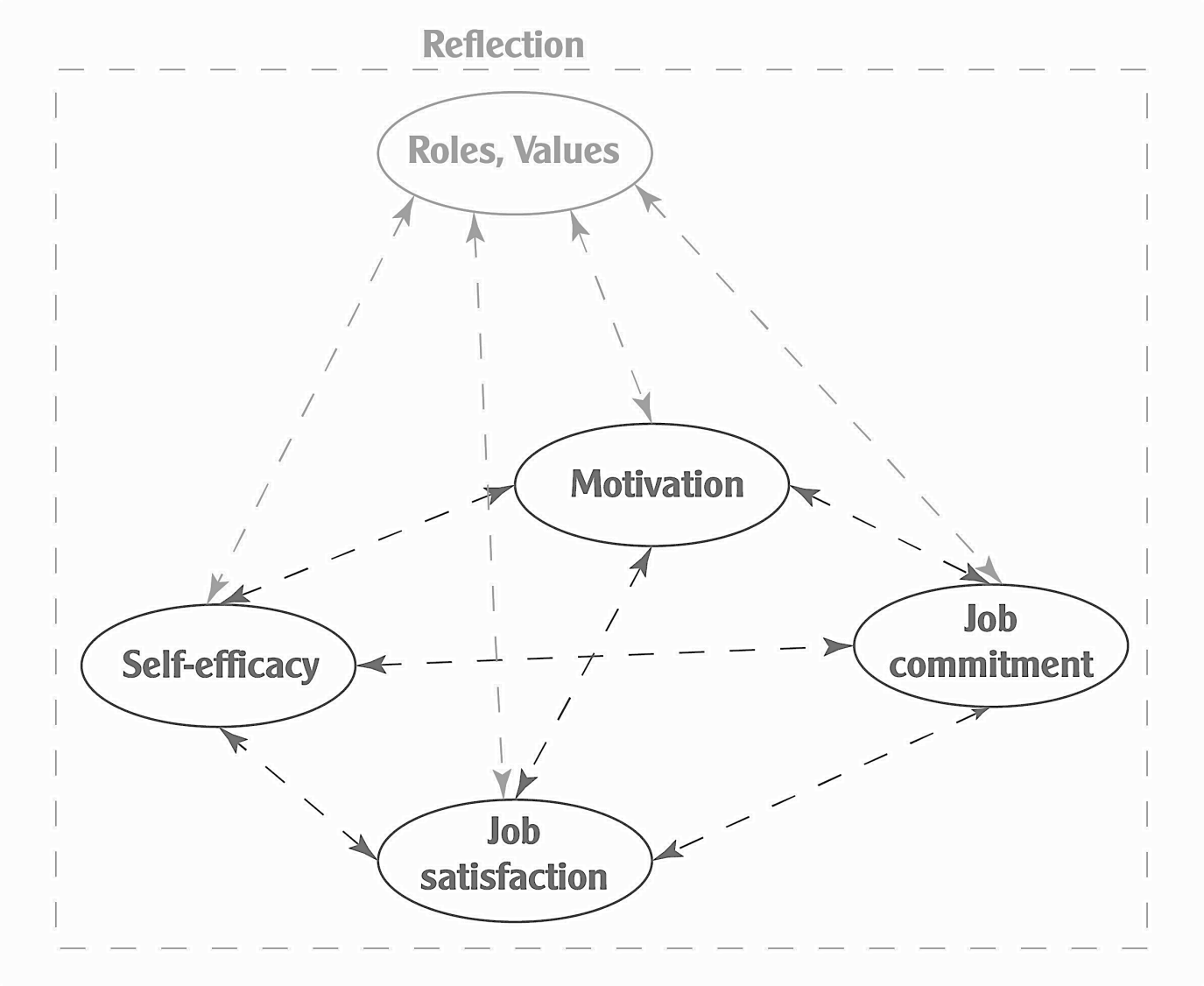
Reflection has been shown to be an integral part of professional identification (Maclean & White, 2007; Walkington, 2005) and professional development (Barkhuizen, 2016). Reflection is interpreted as conscious thinking that brings someone to a deeper level of awareness about what has been done and the reasons behind it. Reflection has many benefits for practitioners, despite the uncomfortable tension it may cause when they realise what has been inadequately invested (Lee & Schallert, 2016). Deeper insight into professional roles and how they are fulfilled is achieved through reflection (Forde et al., 2006). To build a strong identity, intentional reflective work is needed (Beauchamp & Thomas, 2009). Through such reflective practice, teachers can better understand themselves, develop their pedagogical identity, and refine their teaching methods (Protassova et al., 2021).
Combining the findings of the above-mentioned studies, the following conceptual framework is proposed. Reflection, positioned at the top, affects teachers’ identity, including roles, values, and the four bases of motivation, self-efficacy, job commitment, and job satisfaction.
METHODOLOGY
Research Design
This study employs a qualitative single-case study design bounded by institution, faculty, and career stage (Yin, 2018). The boundary of this case is defined by four mid-career EFL university lecturers working within the same faculty, each with between ten and thirteen years of teaching experience. This bounded design enables an in-depth exploration of how professional identity develops over time within a shared professional context. The qualitative approach is appropriate for examining abstract and complex phenomena such as professional identity, as it allows in-depth analysis of attitudes, behaviours, and lived experiences (Dawson, 2009). To trace identity development longitudinally within each case, the life-history method was employed because it captures how individuals make sense of past events and how those events shape their present and future professional selves (Tierney & Lanford, 2019).
Research Site and Participants
The study was conducted at a state university in Vietnam. Participants were selected through purposive sampling, which prioritises description over generalisation (Dawson, 2009). Four mid-career EFL university lecturers were recruited because they worked within the same faculty, had between ten and thirteen years of university-level teaching experience, and represented diverse academic backgrounds and career trajectories. All participant names used in this study are pseudonyms to protect confidentiality. Their demographic information is summarised in Table 1.
Table 1. Demographic Information of the Participants
|
Participants |
||||
|---|---|---|---|---|
|
Information |
An |
Bao |
Chau |
Duy |
|
Gender |
Female |
Male |
Female |
Male |
|
Age |
40 |
32 |
42 |
33 |
|
Teaching Experience |
12 years at university level |
Nearly 10 years at university level |
13 years at university level; 7 years at high school |
11 years at university level |
|
Qualification(s) |
MA in Applied Linguistics |
MA in TESOL |
MA in TESOL; PhD in Education |
Master of Educational Science in Research and Innovation for Higher Education |
Four participants were recruited for this study, all of whom were given pseudonyms. An (female, 40) holds an MA in Applied Linguistics and has 12 years of university-level teaching experience, having previously worked in non-educational companies. Bao (male, 32) holds an MA in TESOL, has nearly 10 years of experience, and previously ran a private English centre. Chau (female, 42) holds an MA in TESOL and a PhD in Education, with 13 years at university level and 7 years at high school. Duy (male, 33) holds a Master of Educational Science and has 11 years of experience across multiple educational contexts in Asia and Europe.
Data Collection Methods and Procedure
Semi-structured interviews were employed as the primary data collection instrument. Person-to-person interviews allow participants to narrate their lived experiences in depth (Creswell, 2013), while the semi-structured format enables comparison across cases while remaining open to new information from participants (Dornyei, 2007). The interview protocol consisted of guided, open-ended questions developed in advance to encourage participants to elaborate on their professional journeys in an exploratory manner.
Each interview was conducted individually with the four participants. Interviews were audio-recorded and subsequently transcribed for analysis. The five-month data collection period, while relatively short for longitudinal observation, was supplemented by the life-history approach, which invited participants to narrate retrospectively their full career journeys from the early-career to the mid-career stage.
Data Analysis and Ethical Considerations
Data analysis followed an inductive-deductive approach. In the first phase, interview transcripts were read repeatedly to allow familiarisation with the data. Initial codes were generated inductively from the transcripts, after which repetitive or irrelevant data were reduced. Codes were then grouped into subcategories and thematic representations.
In the second phase, deductive coding was applied using the study’s analytical framework, which maps six influential career stages against six subcomponents of professional identity, namely roles, values, job motivation, job satisfaction, job commitment, and self-efficacy. This framework guided the identification of how each subcomponent shifted across the six stages for each participant.
To illustrate, the subcomponent “Roles” was coded by identifying any instance in which a participant described how they perceived their function as a teacher, including metaphors or explicit descriptions of their teaching position. For example, when An described herself as a “role model, mentor, and inspirer,” this was coded under Roles at the mid-career stage. When Bao described himself initially as solely a “knowledge transmitter,” this was coded under Roles at the entering-the-profession stage. Shifts in these codes across stages were then mapped onto the analytical framework to capture role evolution over time.
To ensure the trustworthiness of the coding process, intra-rater reliability was established by having the researcher independently recode a portion of the data after a two-week interval and compare the two sets of codes to check for consistency. Discrepancies were reviewed and reconciled before the final thematic analysis was produced.
Figure 2. Analytical Framework for Influential Stages of EFL Teachers’ Identity Development
|
Participant’s Name |
Analytical framework: Influential Stages of EFL teachers’ Identity Development |
||||||
|---|---|---|---|---|---|---|---|
|
Pre-entering the profession |
Entering the profession |
Pursuing further education (1) |
Taking managerial responsibilities |
Making long-term career decision |
Pursuing further education (2) |
||
|
Conceptual framework |
Roles |
||||||
|
Values |
|||||||
|
Job motivation |
|||||||
|
Job satisfaction |
|||||||
|
Job commitment |
|||||||
|
Self-efficacy |
|||||||
With respect to ethical considerations, all participant names were replaced with pseudonyms to protect confidentiality. Participation was entirely voluntary, and participants were informed of the research purpose before the interviews. No participants faced any risk of harm as a result of this research.
FINDINGS
The findings are presented in two parts, beginning with within-case analysis of each participant and then moving to cross-case analysis. With respect to the first research question, the data reveal that professional identity development is a continuous and non-linear process, with roles and values emerging as the most consistently shifting constructs across all four cases. Job commitment and self-efficacy showed moderate improvement overall, while job satisfaction and motivation diverged across participants. With respect to the second research question, two factors were identified as the primary drivers of identity change across all cases, namely lived experience and intentional reflection. Each participant’s identity renegotiation was triggered at a different career stage and shaped by the nature of their individual experiences. The following within-case analyses show how these changes unfolded for each participant.
Case 1. An
An’s professional identity changed considerably over nearly 13 years of service. At the beginning, she felt uncertain about her teacher roles in the university environment. Over time, An developed a clearer sense of her position, seeing herself as a role model, mentor, and inspirer, with curiosity as a core professional value. During her mid-career stage, however, motivation and job satisfaction declined. Initially driven to prove her competence, she later found job security and compensation more influential and grew disappointed when comparing her position with the business sector. Her commitment narrowed to teaching-focused work, reducing involvement in management and research so that she could concentrate on further study. Although her expertise deepened, self-efficacy shifted as the widening age gap made relating to students increasingly difficult. An emphasised that reflective work played a critical role in bringing about changes in teachers’ perceptions.
Reflective work is part of life-long learning. I did frequent self-reflection, especially with some specialized subjects for English-major students. For instance, reading some materials for the first time, I understood the issue this way, but when I was preparing the lesson, I realized that the issue could be looked at from a different perspective. What is more, I can learn from my students, who may look at the issue from a very different angle.
Another factor contributing to the shift in An’s professional identity was her lived experience. Her four years in non-educational companies significantly shaped how she interpreted subsequent teaching experiences, leading her to compare salaries and benefits with those in the private sector, which undermined her job satisfaction and motivation. Seeking improved financial conditions to better focus on research and teaching, she gradually developed a less positive view of her professional identity over time.
Case 2. Bao
Beginning with uncertainty about both self and professional identification, Bao gradually renegotiated his identity over time. Initially viewing himself solely as a knowledge transmitter, he later came to see himself as a guide and inspirer, valuing expertise alongside broader professional qualities. He began his career with low motivation and satisfaction and treated teaching mainly as a means of earning a living. Eventually, however, he developed a stronger sense of belonging, becoming more motivated and satisfied, with growing confidence evidenced by recent publications in national conference proceedings.
Two main factors drove this shift over approximately seven years, namely personal experience and reflection. The collapse of his private business prompted him to rethink his career; realising that business was not his strength, he lowered his financial expectations and became more content with teaching. As he clarified his roles and values and made a long-term commitment, his motivation, job commitment, and academic proficiency improved. Through reflection on this experience, he developed a stronger sense of belonging and focused on improving his self-efficacy through greater expertise, practical experience, and better self-management.
I frequently reflect on my teaching. I normally reflect at the end of a lesson, but I may also do it following some feedback from students, a classroom activity, or a situation in class. Sometimes while I’m riding my motorbike, a sudden thought related to a lesson comes to my mind and I keep thinking about it.
Overall, the shift in Bao’s professional identity resulted from his lived experience and constant reflection.
Case 3. Chau
Over 13 years of service, Chau continuously negotiated and renegotiated her professional identity, although she tended to view it less positively over time. Her seven years as a high school teacher strongly shaped her early roles and values. Initially seeing herself as a controller, she later shifted towards a guide role as she became more aware of learner autonomy, adding tolerance to her early core value of responsibility under the influence of her PhD experience and her supervisor’s approach.
Chau entered the university hoping to leave behind negative school experiences, which gave her acceptable early motivation and satisfaction. Both gradually declined as she grew disappointed with salary and students’ attitudes. Her commitment evolved from a teaching-only focus, through a brief managerial role, to an eventual commitment to teaching and further study. Her self-efficacy increased over time, although she continued to see professional development as necessary.
Lived experience and reflection were the two main factors shaping Chau’s identity over approximately three years. Her prior teaching background influenced her role perceptions, while regular reflection helped her become less controlling and more tolerant, continuously reshaping her professional identity.
Case 4. Duy
Duy’s story unfolded over a 10-year timeline during which teaching served mainly practical goals and offered limited career development, leaving his teacher identity weak. Only towards the end did he make a decisive change, choosing to stay in the profession and actively improve himself, which led to a stronger sense of identity. Around the tenth year, he redefined his role from knowledge transmitter to guide and came to value integrity as a key professional quality. Motivation and satisfaction increased, influenced by flexible working hours, opportunities for further study, and stable income. His commitment grew as he focused more on teaching and research, and his self-efficacy improved despite his acknowledgement of room for growth.
Two main factors contributed to this shift. First, Duy’s wide range of experiences across Asian and European education systems, spanning teaching, management, and running his own educational business, allowed him to view his career more broadly and make a more informed decision. Second, serious self-reflection over his ten-year journey enabled him to connect his personal characteristics and needs with job features such as stable income, flexible time, and professional development opportunities. Through this process, he recognised that teaching suited him well. Without such active reflection, the shift in his professional identity might not have occurred.
Cross-Case Analysis
Across all four cases, teacher identity evolved continuously through six key career stages, with each stage contributing differently to the shaping of participants’ professional sense of self.
Pre-entering the profession. Among the four cases, only Chau had a clear professional identity at this stage, having taught at high school for seven years, where she perceived herself as a controller and highly valued responsibility. The other three participants had yet to form any clear sense of teacher identity before entering higher education.
Entering the profession. Upon entering university-level teaching, the four participants began forming their identities in markedly different ways. Their roles diverged, as Chau continued as a controller, Bao and Duy perceived themselves as knowledge transmitters, and An remained uncertain about her role. Job motivation also varied widely, with Chau and An entering with high motivation due to career transitions, while Bao and Duy were initially unmotivated. Job commitment and satisfaction were similarly unclear across most cases at this stage.
Pursuing a further degree (1). Most participants pursued a master’s degree after entering the profession, with the exception of Chau, who completed hers during her high school years. Notably, the completion of postgraduate study did not result in significant identity shifts for any of the participants at this stage.
Taking managerial responsibilities. All four participants attempted managerial roles but eventually returned to full-time teaching. An and Chau were promoted to Deputy Head of Faculty but resigned due to time demands and political pressure, respectively. Bao and Duy founded their own English centres, but both concluded that management was not suited to their strengths. Despite the brevity of these experiences, this stage proved to be the most influential, as it led all participants to refocus on teaching and research with greater commitment and motivation.
Making long-term career decisions. Upon returning to teaching, all participants underwent significant identity shifts, particularly in roles and values. Bao and Duy showed the most pronounced changes, both embracing the role of inspirer and placing greater value on pedagogical and academic expertise, accompanied by notable increases in self-efficacy, motivation, and satisfaction. An and Chau also shifted their perceived roles towards inspiring and facilitating, although their job satisfaction remained relatively unchanged or declined.
Pursuing a further degree (2). With teaching confirmed as their long-term career, all participants either pursued or planned further academic qualifications. An, Bao, and Duy actively worked towards PhD applications through research and publication, while Chau had already completed her doctorate, which significantly deepened her perceived teaching role and values.
Overall, roles and values were the two constructs that changed most significantly for all participants. Job commitment and self-efficacy showed moderate improvement across all cases. Job satisfaction and motivation diverged, while Bao and Duy reported significant increases by mid-career, An and Chau’s levels remained relatively unchanged or declined. Life experience and reflection on that experience emerged as the key drivers of identity shifts across all cases.
Table 2. Level of Change in Each Construct of the Participants’ Teacher Identity over Their Career Journey

|
An |
Bao |
Chau |
Duy |
|
|---|---|---|---|---|
|
Roles |
||||
|
Values |
||||
|
Job Motivation |
||||
|
Job Satisfaction |
||||
|
Job Commitment |
||||
|
Self-efficacy |
DISCUSSION AND IMPLICATIONS
Professional Identity Development, Patterns of Change and Contributing Factors
The findings of this study advance understanding of teacher professional identity development in three significant ways.
First, the study confirms that professional identity is neither static nor uniformly progressive. All four participants continuously negotiated and renegotiated their identities over a decade, with roles and values emerging as the most consistently and significantly shifting constructs. This aligns with the dynamic and ongoing nature of identity theorised by Beijaard et al. (2004), Canrinus et al. (2011b), and Lee and Schallert (2016). Notably, however, the pace and direction of change diverged considerably across participants. While An and Chau experienced declining job satisfaction and motivation, largely attributed to inadequate compensation, Bao and Duy demonstrated renewed professional momentum after redirecting their careers towards teaching and academic work. This divergence challenges Beijaard’s (1995) claim that teachers tend towards an increasingly negative professional identity over time, and contributes to the literature by demonstrating that identity shifts can be both positive and negative, depending on the nature of individual experiences and the quality of self-reflection undertaken.
Second, the study offers a more nuanced account of which identity constructs are most susceptible to change and why. Roles and values were the constructs most significantly transformed across all cases, as participants moved from rigid, transmission-focused conceptions of teaching towards more facilitative and inspirational role identities. This is consistent with Forde et al. (2006) and Flores and Day (2006), who argue that role renegotiation is central to identity development. Job commitment and self-efficacy showed moderate but consistent growth, while satisfaction and motivation proved more context-dependent and vulnerable to external factors such as compensation structures and institutional conditions. These findings suggest that identity subconstructs do not develop in isolation; shifts in roles and values appear to precede and enable broader identity reconstruction, a pattern not explicitly theorised in prior frameworks.
Third, the study identifies lived experience and intentional reflection as the two central mechanisms driving identity change, a finding consistent with Izadinia (2013) and Beauchamp and Thomas (2009). Critically, however, this study extends prior work by showing that the stage at which identity renegotiation occurs differs across individuals. For An, the pre-entry period in the private sector was most formative; for Bao, it was the failure of his private business; for Chau, the experience of being a doctoral student; and for Duy, the cumulative weight of a decade of diverse professional experiences. This variation suggests that identity development cannot be reduced to a single trajectory, and that the relationship between experience and reflection is highly individual. Notably, negative experiences proved particularly catalytic. Rather than destabilising identity, they prompted deeper self-examination and ultimately clearer professional commitment, consistent with Lutovac and Flores (2021).
Pedagogical Implications
These findings carry meaningful implications for practice. For early-career teachers, the study underscores the importance of patience and reflective practice in identity formation, as a clear sense of professional self typically emerges only after sustained engagement with the profession. For mid-career teachers, sustaining intentional reflection and investing in self-efficacy development remain essential, particularly during periods of institutional or personal disruption. For institutional management, the findings suggest that professional development programmes should be responsive to teachers’ career stage, creating structured opportunities for reflection, peer dialogue, and academic engagement. Attention to compensation and working conditions is also warranted, given their demonstrated influence on motivation and satisfaction.
CONCLUSIONS
This study set out to examine how professional identity develops among mid-career EFL university lecturers in Vietnam and what drives such development over time. Across the four cases, identity proved to be an ongoing process of negotiation rather than a fixed state, with roles and values showing the most consistent transformation. Job commitment and self-efficacy grew steadily across participants, while satisfaction and motivation followed more varied paths depending on individual circumstances. Contrary to earlier assumptions that mid-career teachers trend towards a less positive sense of professional self (Beijaard, 1995), the findings show that identity can move in either direction, and that even difficult or unsuccessful experiences can serve as turning points towards stronger professional clarity (Lutovac & Flores, 2021).
Lived experience and reflection emerged as the two forces most consistently behind these shifts, though the moment at which they proved decisive varied considerably from person to person. This points to an issue that the existing literature has not fully captured, namely that mid-career identity development is deeply individual and no single stage or event can be taken as universally formative. In addressing this gap, the study offers a conceptual framework that brings together multiple identity constructs and career stages under one lens, providing a more integrated basis for future research on teacher identity beyond the early-career years.
LIMITATIONS AND FUTURE DIRECTIONS
This study has several limitations that should be acknowledged. First, data collection was conducted online, which may have somewhat limited the depth of rapport and data richness compared with direct face-to-face interaction. Second, the five-month timeframe was relatively short, limiting the scope of longitudinal observation. Third, the retrospective nature of the interview questions, which required participants to recall events from over ten years ago, may have affected the accuracy of their recollections. Finally, the study’s small sample of four participants from a single institution limits the generalisability of the findings.
These limitations point to several directions for future research. Longitudinal studies with extended observation periods would allow more detailed tracking of identity changes in real time. Research with larger and more diverse samples across different institutional and cultural contexts would help validate and refine the conceptual framework proposed in this study. Future studies may also consider incorporating classroom observation and document analysis alongside interviews to provide a richer account of how identity shifts manifest in actual teaching practice. A further timely direction concerns AI. It now performs the knowledge-transmitter and corrector roles that several participants moved away from. How mid-career EFL teachers renegotiate their identity in response, especially through roles, values, and self-efficacy, is an urgent question. The proposed framework may offer a useful lens for examining it.
References
Barkhuizen, G. (2016). A short story approach to analyzing teacher (imagined) identities over time. TESOL Quarterly, 50(3), 655-683. https://doi.org/10.1002/tesq.311
Beauchamp, C., & Thomas, L. (2009). Understanding teacher identity: An overview of issues in the literature and implications for teacher education. Cambridge Journal of Education, 39(2), 175-189. https://doi.org/10.1080/03057640902902252
Beauchamp, C., & Thomas, L. (2010). Reflecting on an ideal: Student teachers envision a future identity. Reflective Practice, 11(5), 631-643. https://doi.org/10.1080/14623943.2010.516975
Beijaard, D. (1995). Teachers’ prior experiences and actual perceptions of professional identity. Teachers and Teaching: Theory and Practice, 1(2), 281-294. https://doi.org/10.1080/1354060950010209
Beijaard, D. (2009). Leraar worden en leraar blijven [Becoming a teacher and staying a teacher]. Eindhoven School of Education.
Beijaard, D., Koopman, M., & Schellings, G. (2022). Reframing teacher professional identity and learning. In I. Menter (Ed.), The Palgrave Handbook of Teacher Education Research (pp. 763-785). Springer. https://doi.org/10.1007/978-3-030-59533-3_28-1
Beijaard, D., Meijer, P. C., & Verloop, N. (2004). Reconsidering research on teachers’ professional identity. Teaching and Teacher Education, 20(2), 107-128. https://doi.org/10.1016/j.tate.2003.07.001
Canrinus, E., Helms-Lorenz, M., Beijaard, D., Buitink, J. & Hofman, A. (2011a). Self-efficacy, job satisfaction, motivation and commitment: exploring the relationships between indicators of teachers’ professional identity. European Journal of Psychology of Education, 27(1), 115-132. https://doi.org/10.1007/s10212-011-0069-2
Canrinus, E., Helms‐Lorenz, M., Beijaard, D., Buitink, J. & Hofman, A. (2011b). Profiling teachers’ sense of professional identity. Educational Studies, 37(5), 593-608. https://doi.org/10.1080/03055698.2010.539857
Carrillo, C., & Flores, M. A. (2018). Veteran teachers’ identity: What does the research literature tell us? Cambridge Journal of Education, 48(5), 639-656. https://doi.org/10.1080/0305764X.2017.1394982
Cawte, K. (2020). Teacher crisis: Critical events in the mid-career stage. Australian Journal of Teacher Education, 45(8), 75-92. https://doi.org/10.14221/ajte.2020v45n8.5
Cordingley, P., Crisp, B., Johns, P., Perry, T., Campbell, C., Bell, M., & Bradbury, M. (2019). Constructing teachers’ professional identities. Education International.
Creswell, J. W. (2013). Qualitative inquiry and research design: Choosing among five approaches (M. Bütün & S. B. Demir, Trans.). Siyasal Publishing.
Dawson, C. (2009). Introduction to research methods: A practical guide for anyone undertaking a research project (4th ed.). How To Books.
Day, C. (2002). School reform and transitions in teacher professionalism and identity. International Journal of Educational Research, 37, 677-692. https://doi.org/10.1016/S0883-0355(03)00065-X
Dornyei, Z. (2007). Research methods in applied linguistics. Oxford University Press.
Flores, M. A. (2020). Feeling like a student but thinking like a teacher: A study of the development of professional identity in initial teacher education. Journal of Education for Teaching, 46(2), 145-158. https://doi.org/10.1080/02607476.2020.1724659
Flores, M. A., & Day, C. (2006). Contexts which shape and reshape new teachers’ identities: A multi-perspective study. Teaching and Teacher Education 22, 219-232. https://doi.org/10.1016/j.tate.2005.09.002
Forde, C., Patrick, F., McPhee, A. & McMahon, M. (2006). Professional development, reflection and enquiry. SAGE Publications Ltd.
Gray, J. & Morton, T. (2018). Social interaction and ELT teacher identity. Edinburgh University Press.
Harmer, J. (2007). How to teach English. Longman.
Huberman, M. (1993). The lives of teachers. Cassell.
Izadinia, M. (2013). A review of research on student teachers’ professional identity. British Educational Research Journal 39 (4), 694-713. https://doi.org/10.1080/01411926.2012.679614
Jorde-Bloom, P. (1986). Teacher job satisfaction: A framework for analysis. Early Childhood Research Quarterly, 1(2), 167-183. https://doi.org/10.1016/0885-2006(86)90010-3
Kerby, A. P. (1991). Narrative and the self. Indiana University Press.
Latham, G. P., & Pinder, C. C. (2005). Work motivation theory and research at the dawn of the twenty-first century. Annual Review of Psychology, 56(1), 485-516. https://doi.org/10.1146/annurev.psych.55.090902.142105
Lee, K., Carswell, J. J., & Allen, N. J. (2000). A meta-analytic review of occupational commitment: Relations with person- and work-related variables. Journal of Applied Psychology, 85(5), 799-811. https://doi.org/10.1037/0021-9010.85.5.799
Lee, S., & Schallert, D. L. (2016). Becoming a teacher: Coordinating past, present, and future selves with perspectival understandings about teaching. Teaching and Teacher Education, 56, 72-83. https://doi.org/10.1016/j.tate.2016.02.004
Lutovac, S. & Flores, M. A. (2021). Those who fail should not be teachers: Pre-service teachers’ understandings of failure and teacher identity development. Journal of Education for Teaching, 47(3), 379-394. https://doi.org/10.1080/02607476.2021.1891833
Maclean, R., & White, S. (2007). Video reflection and the formation of teacher identity in a team of pre-service and experienced teachers. Reflective Practice, 8(1), 47-60. https://doi.org/10.1080/14623940601138949
Nesje, K., Canrinus, E., & Strype, J. (2018). “Trying on teaching for fit” - Development of professional identity among professionals with multiple career opportunities. Teaching And Teacher Education, 69, 131-141. https://doi.org/10.1016/j.tate.2017.10.011
Nguyen, P. T., Nguyen, L. T., & Nguyen, V. M. (2024). Teacher practices regarding teaching presence in Vietnamese tertiary online distance education programmes. Humanities and Social Sciences Communications, 11(1). https://doi.org/10.1057/s41599-024-03549-6
Protassova, E., Mikelsone, I., & Latsone, L. (2021). Teacher’s identity development through reflection. In European Proceedings of Social and Behavioural Sciences (pp. 67-77). European Publisher. https://doi.org/10.15405/epsbs.2021.07.02.9
Rushton, E. A. C., Smith, E. R., Steadman, S., & Towers, E. (2023). Understanding teacher identity in teachers’ professional lives: A systematic review of the literature. Review of Education, 11(2), 1-52. https://doi.org/10.1002/rev3.3417
Sadeghi, K., Ghaderi, F., & Abdollahpour, Z. (2021). Self-reported teaching effectiveness and job satisfaction among teachers: The role of subject matter and other demographic variables. Heliyon, 7(6), 1-8. https://doi.org/10.1016/j.heliyon.2021.e07193
Tierney, W., & Lanford, M. (2019). SAGE research methods foundations. https://doi.org/10.4135/9781526421036
Van der Ploeg, J.D., & Scholte, E.M. (2003). Arbeidssatisfactie onder leraren [Job satisfaction among teachers]. Pedagogiek 23, 276-90.
Van Lankveld, T., Schoonenboom, J., Volman, M., Croiset, G., & Beishuizen, J. (2016). Developing a teacher identity in the university context: A systematic review of the literature. Higher Education Research & Development, 36(2), 325-342. https://doi.org/10.1080/07294360.2016.1208154
Viernes, D. R., Pontillas, P. V., Ongcachuy, B. L., Corpuz, G. G., & Samson, V. B., Jr. (2024). Job commitment, satisfaction, and teachers’ performance: Basis for retention program. European Modern Studies Journal.
Walkington, J. (2005). Becoming a teacher: Encouraging development of teacher identity through reflective practice. Asia-Pacific Journal of Teacher Education, 33(1), 53-64. https://doi.org/10.1080/1359866052000341124
Whitaker, M., & Valtierra, K. (2018). Enhancing preservice teachers’ motivation to teach diverse learners. Teaching And Teacher Education, 73, 171-182. https://doi.org/10.1016/j.tate.2018.04.004
Yin, R. K. (2018). Case study research and design: Design and methods (6th ed.). SAGE Publications.
Downloads
Published
Data Availability Statement
The data are not publicly available due to ethical restrictions and participant confidentiality.
Issue
Section
License
Copyright (c) 2026 Hoa T. Y. Nguyen, Long D. T. Tran

This work is licensed under a Creative Commons Attribution-NonCommercial-NoDerivatives 4.0 International License.