
Reflective teaching practices among EFL teachers: Insights from MA TESOL students in Vietnam
DOI:
https://doi.org/10.65956/late.2026.50Keywords:
EFL teachers, MA TESOL students, reflective teaching practices, VietnamAbstract
Reflective Teaching Practices (RTPs) play a crucial role in educational development, encouraging teachers to actively reflect on their teaching methods to address in-class challenges for improved academic outcomes. This convergent mixed-methods study aims to investigate RTPs among MA TESOL students enrolled in a postgraduate programme at a university in Ho Chi Minh City, Vietnam. This study applied a convergent mixed-methods research design, with a survey of 63 MA students and semi-structured interviews with 10 participants. The survey’s findings indicate that participants engage in RTPs at a highly moderate level. The most frequent reflection is meta-cognitive, and the least frequent one is critical. Interview findings show that participants frequently reflected on informal post-class reflections, collegial collaboration, self-evaluation, and learners’ understandings. Yet, critical, research-based, or theory-informed practices were absent, leading to insignificant transformation in real-world classrooms. Also, the interview data reveal certain differences between the two groups of teachers: mainstream teachers and private tutors in how they employed reflective practices. The differences may be attributed to their work environments. Based on the results of this study, this study suggests the necessity for teachers to go beyond informal and spontaneous reflections and implement more formalized and critical RTPs through theoretical and research engagement or a structured reflective framework.
INTRODUCTION
Reflection in education encourages teachers to actively examine their methods and modify their approaches to enhance students’ language acquisition, address students’ obstacles, and foster their professional growth. Baluchzada (2023) postulates that reflective teaching practices (RTPs) significantly enhance English as a foreign language (EFL) teachers’ instructional skills, so EFL teachers are certain to efficiently self-evaluate their RTPs (Richards & Lockhart, 1994). Additionally, when reflective EFL teachers successfully identify areas for improvement in their instruction and deepen their understanding of RTPs, they can develop more effective professional development plans (Gudeta, 2022).
Recently, there have been many studies on RTPs in language teaching relating to ELF teachers’ perceptions of their RTPs, the benefits of RTPs, and the hurdles EFL teachers encounter (Almutawa & Alfahid, 2024; Phan & Nguyen, 2024). However, the current study’s primary inspiration arose from the fact that, despite the widely acknowledged role of self-reflection in educational practices, many EFL teachers face difficulties in implementing RTPs effectively due to time limitations, lack of institutional support, and limited understanding of RTPs in their teaching contexts (Suphasri & Chinokul, 2021). Although various RTPs have been employed, including peer collaboration and teaching journals (Sunra et al., 2020), classroom-based action research (Riyanti, 2021), self-reflection and student feedback (Van et al., 2022), there is still a lack of structured and effective tools for engaging in RTPs that substantially improve the instructional quality beyond journaling and peer discussions (Ishaaq & Nasreen, 2024).
Numerous studies have investigated EFL teachers’ RTPs; however, most of these studies have addressed the pre-service and in-service teachers rather than focusing on the unique demographic of Master of Arts (MA) TESOL student-practitioners. MA TESOL programs often attract learners from diverse linguistic and cultural backgrounds who experience a variety of real-life teaching contexts. As a result, investigating MA TESOL student-practitioners’ perspectives highlights that a wider spectrum of teachers’ voices is heard and a broader cross-section of Vietnamese EFL teaching contexts is represented. This may help capture varied RTPs. These participants are those who have already finished their undergraduate training and are pursuing higher education in Vietnamese universities. In light of these gaps, the current study aims to gain further insights into the reflective practices of MA TESOL student-practitioners as EFL teachers. The current study, therefore, aims to answer the following research question: What reflective teaching practices do MA TESOL student-practitioners exercise?
REFLECTIVE TEACHING COMPONENTS
Richards and Lockhart (1994) defined reflective teaching (RT) as an approach in which teachers gather data on their teaching practices, examine their attitudes and beliefs, and use empirical evidence to inform self-evaluation. Akbari et al. (2010) proposed a multidimensional model of RT comprising six core practical, cognitive, affective, metacognitive, critical, and moral components. However, Yesilbursa (2013) argued that the moral component showed no significant covariance with other factors and was therefore removed from the model. These components provided a robust foundation for understanding the multifaceted nature of reflective teaching in language education. Combining Akbari et al. (2010) and Yesilbursa’s (2013) argument, this study proposed a theoretical framework of five dimensions of RTPs (Figure 1).
The practical component concerns direct engagement with instructional effectiveness, aligning with Schön’s (1995) concepts of reflection-in-action (RiA) and reflection-on-action (RoA) and echoing Van Manen’s (1977) technical level of reflection. The practical element encompasses a myriad of tools and methods. While lesson reports and teaching portfolios help teachers record and evaluate their instructional practices (Karsenti et al., 2014), journal writing enables them to document and critically examine their teaching experiences (Almutawa & Alfahid, 2024). Practical reflection also involves teachers’ sharing of teaching issues with colleagues and reciprocal observations. Peer collaboration contributes to professional growth by fostering a reflective mindset in which teachers analyse their teaching experiences with colleagues and adapt their methodologies (Van et al., 2022)
The cognitive dimension focuses on analysing the instructional effectiveness and processing teaching experiences that enhance pedagogical knowledge and the direct connection to teacher professional development (Dewey, 2012; Kolb, 2015). Cognitive reflection refers to teachers' conscious pursuit of lifelong learning, exemplified by their participation in conferences, seminars, training courses, and workshops, as well as by the habit of reading specialised journals (Akbari et al., 2010).
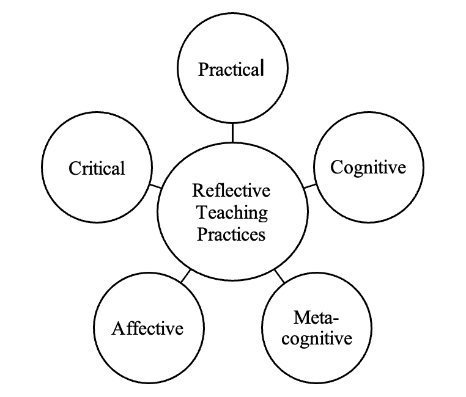
The metacognitive component reflects on teachers’ beliefs, learning processes, and identity as teachers (Akbari et al., 2010), which resonates with Flavell’s (1979) theory of metacognition, emphasising the awareness and regulation of cognitive processes. Flavell (1979) emphasises that metacognition plays a vital role in effective problem-solving and learning, laying the groundwork for its application across educational contexts, including teacher reflection and professional development. The metacognitive dimension involves a higher level of self-awareness, in which teachers monitor, evaluate, and regulate their own thinking and learning processes, and often revise their beliefs and strategies through reflection (Larrivee, 2008).
The affective dimension reflects the exploration of personal feelings, values, and attitudes that influence teachers’ teaching practices and interactions with students (Zembylas, 2007). In addition, Nias (1996) argues that teachers’ identities and practices are profoundly shaped by their emotional experiences. This underscores the crucial role of the affective component in reflective practice, linking the pedagogical and ethical development to emotional awareness. In other words, the affective component captures teachers’ awareness of students’ emotions, their responses to teachers and the class peers, and their progress, reflecting Vygotsky’s (1978) social constructivist perspectives on the socio-emotional dimension of learning. Affective reflection centres on teachers’ efforts to deepen their understanding of their students’ backgrounds and perspectives, including seeking their input on the effectiveness of varied teaching approaches (Kazemi & Hubbard, 2008).
The critical element implicates reflection on the socio-political aspect of education (Akbari et al., 2010). The critical dimension urges teachers to question existing assumptions and socio-cultural influences in education, fostering a more transformative approach to teaching (Brookfield, 1995). The critical component, addressing teachers’ reflections on the moral, ethical, and socio-political dimensions of pedagogy, is also informed by Van Manen (1977), who explores teachers’ understanding of the broader socio-political factors shaping their teaching practices.
METHODOLOGY
Research Design
The current study adopted a convergent mixed methods research design that aims to triangulate the findings of RTPs (Creswell, 2012). Data from the survey aims to collect quantitative data related to RTPs, while interview data help to provide deeper information on how they practice RTPs.
Research Participants
Table 1 shows the demographic information of participants who responded to the survey. Concerning gender distribution, female participants accounted for the majority of the group (65.1%, n = 41), while male participants accounted for 34.9% (n = 22). At the time of the study, most participants had been teaching English for more than two years: 49.2% had two to five years of experience, and 25.4% had more than five years of experience. Those with more than 10 years of teaching experience accounted for 19%, and 6.3% had fewer than 2 years of experience.
Table 1. Background Information of Participants for the Questionnaire.
|
Category |
Sub-Category |
n |
Percentage (%) |
|---|---|---|---|
|
Gender |
Male |
22 |
34.9% |
|
Female |
41 |
65.1% |
|
|
Total |
63 |
100% |
|
|
Teaching experience |
Less than 1 year |
4 |
6.3% |
|
From 2 to 5 years |
31 |
49.2% |
|
|
More than 5 years |
16 |
25.4% |
|
|
More than 10 years |
12 |
19.0% |
|
|
Total |
63 |
100% |
|
The questionnaire was sent to students who were undertaking the MA TESOL programs at a university in southern Vietnam. Convenience sampling was employed to recruit participants accessible to the researcher via her professional network . The researcher asked for permission to conduct the survey from the postgraduate department of the university before distributing the questionnaire to 100 postgraduates in the MA TESOL programs in the academic years of 2022, 2023, and 2024. All participants indicated their consent to join the study in the cover letter attached to the questionnaire.
Among the participants who responded to the questionnaire, ten were invited to join the interview, with five being private tutors and five being teachers at mainstream schools (Table 2). Creswell (2012) describes the subject selection process for interviews as purposive sampling, where researchers deliberately choose participants and locations to investigate a phenomenon. The reasons for choosing two groups of participants stem from their distinct differences in their working environment and class sizes. Consent forms and information sheets in both English and Vietnamese were sent to the interviewees before official interviews were conducted. All the participants agreed to join the interviews without any concerns.
Table 2. Background Information of Participants for the Interview
|
Category |
Sub-Category |
n |
Percentage (%) |
||||||
|---|---|---|---|---|---|---|---|---|---|
|
Gender |
Male |
2 |
20.0% |
||||||
|
Female |
8 |
80.0% |
|||||||
|
Total |
10 |
100.0% |
|||||||
|
Teaching experience |
Less than 1 year |
0 |
0.0% |
||||||
|
From 2 to 5 years |
7 |
70.0% |
|||||||
|
More than 5 years |
1 |
10.0% |
|||||||
|
More than 10 years |
2 |
20.0% |
|||||||
|
Total |
10 |
100.0% |
|||||||
|
Teaching Experience |
Total |
||||||||
|
from 2 to 5 years |
more than 5 years |
more than 10 years |
|||||||
|
Job |
Private tutors |
2 |
1 |
2 |
5 |
||||
|
Mainstream teachers |
5 |
0 |
0 |
5 |
|||||
|
Total |
7 |
1 |
2 |
10 |
|||||
Data Collection Methods
Questionnaire
The questionnaire was divided into two parts. The first part consisted of items from the ELTRI (Akbari et al., 2010). The questionnaire comprises five reflection aspects: practical (6 items), cognitive (6 items), metacognitive (7 items), affective (3 items), and critical (7 items), with a total of 29 items rated on a 5-point scale from 1 (never) to 5 (always). Example items asked for the practical component are “I have a file where I keep my accounts of teaching for reviewing purposes” or “I talk about my classroom experiences with my colleagues and seek their advice/ feedback.” Example items for the critical component are “I think of the way to enable my students to change their social lives in fighting poverty, discrimination, and gender bias” or “I think about the political aspects of my teaching and the way I may affect my students’ political views.” Table 3 displays the results of Cronbach’s alpha. The internal consistency reliability of the scales was acceptable to good with practical reflection (α = 0.728), cognitive (α = 0.857), metacognitive (α = 0.862), affective (α = 0.771), and critical (α = 0.850). Three months were spent distributing an online questionnaire via a Google Forms link to 100 participants. A total of 63 questionnaires, representing a 63% response rate, were collected.
Semi-structured interviews
Interview questions were developed around five aspects of RTPs relevant to the aspects asked in the original ELTRI. From these 5 reflective components, 29 prompts were asked to facilitate the interviews. Interviews were conducted from July 7th, 2025, to July 26th, 2025. Each interview spanned between 60 and 120 minutes and was conducted online at the participants’ convenience.
Table 3. Reliability Analysis
|
Reflection Aspects |
Cronbach's Alpha |
Cronbach’s Alpha Based on Standardised Items |
No. of Items |
||
|---|---|---|---|---|---|
|
Practical |
0.728 |
0.723 |
6 |
||
|
Cognitive |
0.857 |
0.858 |
6 |
||
|
Meta-cognitive |
0.862 |
0.867 |
7 |
||
|
Affective |
0.771 |
0.775 |
3 |
||
|
Critical |
0.857 |
0.858 |
7 |
||
Data Analysis
Quantitative data were coded and analysed using SPSS 27. First, Cronbach’s alpha was run for internal consistency of all scales used . Means and standard deviations were then computed to summarise participants’ responses to RTPs.
The qualitative interview data were analysed using thematic analysis, which identifies shared themes among participants. Data were coded inductively and deductively. Following a systematic coding process, transcripts were iteratively reviewed to identify, refine, and organise recurring themes that captured shared meanings and divergent perspectives. This approach enabled the integration of rich, contextualised insights with the quantitative findings, supporting a more comprehensive understanding of the research problem (Braun & Clarke, 2022). The data were segmented into five distinct aspects: practical, cognitive, meta-cognitive, affective, and critical. Any emerging themes were also coded to reflect how they used different types of reflection for their teaching.
FINDINGS
EFL Teachers’ Varied Reflective Practices
Practical reflection
Table 4 displays the frequency of practical reflection used by the participants. The results show moderate engagement in practical reflection activities, with mean scores ranging from 2.52 to 3.72 (n = 63). Two distinct patterns emerged. First, relatively higher-frequency, collegial reflection practices include discussing classroom experiences and seeking feedback (M = 3.72, SD = 0.97), maintaining reflective records (M = 3.63, SD = 1.07), and discussing practical/theoretical issues (M = 3.44, SD = 1.09). Second, less frequently reported practices involve more formalized or effort-intensive reflection activities, such as observing peers (M = 3.32, SD = 1.26), writing post-lesson reflections (M = 2.94, SD = 1.05), and inviting peer observation of one’s own teaching (M = 2.52, SD = 1.23). The findings suggest a tendency toward informal, discussion-based reflection rather than structured or reciprocal reflective practices.
Table 4. .Practical Reflection
|
Items |
Mean |
SD |
|---|---|---|
|
I have a file where I keep my accounts of my teaching for reviewing purposes. |
3.63 |
1.067 |
|
I talk about my classroom experiences with my colleagues and seek their advice/feedback. |
3.72 |
0.974 |
|
After each lesson, I write about the accomplishments/failures of that lesson, or I talk about the lesson to a colleague. |
2.94 |
1.045 |
|
I discuss practical/theoretical issues with my colleagues. |
3.44 |
1.089 |
|
I observe other teachers’ classrooms to learn about their efficient practices. |
3.32 |
1.255 |
|
I ask my peers to observe my teaching and comment on my teaching performance. |
2.52 |
1.229 |
|
Mean |
3.26 |
Cognitive reflection
Table 5 shows that the participants also engage in their teaching practices cognitively at a highly moderate level. Teacher participants reported the highest frequencies for reading professional materials (M = 3.65) and looking at journal articles or searching the internet for recent developments (M = 3.67). At the reflective engagement layer, conceptualising classroom events as research topics (M = 3.38) showed a moderate engagement. At the knowledge production level, participation in workshops (M = 3.16), conducting classroom research (M = 2.97), and writing articles (M = 3.05) were less frequent and more variable, suggesting that there were barriers that prevented them from delving deeper into the research field, which requires significant effort, time, and determination.
Table 5.. Cognitive Reflection
|
Items |
Mean |
SD |
|---|---|---|
|
I read books or articles related to effective teaching to improve my classroom performance. |
3.65 |
0.864 |
|
I look at journal articles or search the internet to see what the recent developments in my profession are. |
3.67 |
1.016 |
|
I participate in workshops/conferences related to teaching/learning issues. |
3.16 |
1.110 |
|
I carry out small scale research activities in my classes to become better informed of learning/teaching processes. |
2.97 |
1.282 |
|
I think of writing articles based on my classroom experiences. |
3.05 |
1.184 |
|
I think of classroom events as potential research topics and think of finding a method for investigating them. |
3.38 |
1.023 |
|
Mean |
3.31 |
Meta-cognitive reflection
The results indicate a high overall level of reflective practice (M = 3.94). It can be seen that for the self-evaluative reflection, teachers reported the highest engagement in reflecting on strengths and weaknesses (M = 4.22), sources of satisfaction (M = 4.13), and the meaning of their profession (M = 4.05). As regards professional identity reflection, considering past role models (M = 4.00) and teaching philosophy (M = 3.84) showed a slightly lower but consistent level of engagement. The results also showed that they examined personal background (M = 3.63) and classroom inconsistencies (M = 3.68) less frequently (Table 6). This reflects a lower level of critical metacognitive reflection.
Table 6. Meta-cognitive Reflection
|
Items |
Mean |
SD |
|---|---|---|
|
I think about my strengths and weaknesses as a teacher. |
4.22 |
0.750 |
|
I think of the meaning or significance of my job as a teacher. |
4.05 |
0.906 |
|
I try to find out which aspects of my teaching provide me with a sense of satisfaction. |
4.13 |
0.772 |
|
I think of the positive/negative role models I have had as a student and the way they have affected me in my practice. |
4.00 |
0.741 |
|
As a teacher, I think about my teaching philosophy and the way it is affecting my teaching. |
3.84 |
1.081 |
|
I think of the ways my biography or my background affects the way I define myself as a teacher. |
3.63 |
0.938 |
|
I think of inconsistencies and contradictions that occur in my classroom practice. |
3.68 |
0.800 |
|
Mean |
3.94 |
Affective reflection
The analysis reveals that teachers frequently attempted to talk to learners to investigate not only their learning styles and preferences (M = 3.89, SD = 1.03), but also their family backgrounds, hobbies, interests, and abilities (M = 3.75, SD = 1.02). This illustrates a moderately high level of engagement in affective reflection, aimed at developing a holistic understanding of students to provide additional support. The results also indicated a relatively lower frequency of asking students about their preferences toward teaching tasks (M = 3.37) (Table 7). This may suggest that feedback-seeking practices are less consistently enacted compared to other forms of student-oriented engagement.
Table 7. Affective Reflection
|
Items |
Mean |
SD |
|---|---|---|
|
I talk to my students to learn about their learning styles and preferences. |
3.89 |
1.033 |
|
I talk to my students to learn about their family backgrounds, hobbies, interests and abilities. |
3.75 |
1.015 |
|
I ask my students whether they like a teaching task or not. |
3.37 |
1.168 |
|
Mean |
3.67 |
Critical reflection
Table 8 indicates a moderate level of critical reflection (M = 3.14) among teachers in this study. For items related to contextual awareness, teachers reported relatively higher engagement in considering external social influences on teaching (M = 3.43), promoting tolerance and democracy (M = 3.44), and recognising how social factors shape student achievement (M = 3.37). For the pedagogical enactment, incorporating social issues into teaching (M = 3.06–3.08) was less frequent. Reflecting on the political dimensions of teaching (M = 2.56) was the least frequent way in this reflection.
Table 8. Critical Reflection
|
Items |
Mean |
SD |
|---|---|---|
|
I think of ways to enable my students to change their social lives in fighting poverty, discrimination, and gender bias. |
3.05 |
1.007 |
|
I think of outside social events that can influence my teaching inside the class. |
3.43 |
0.995 |
|
I think of ways through which I can promote tolerance and democracy in my classes and in society in general. |
3.44 |
0.980 |
|
I think about the ways gender, social class, and race influence my students’ achievements. |
3.37 |
1.052 |
|
I think about instances of social injustice in my own surroundings and try to discuss them in my classes. |
3.06 |
1.061 |
|
In my teaching, I include less-discussed topics, such as old age, AIDS, discrimination against women and minorities, and poverty. |
3.08 |
1.067 |
|
I think about the political aspects of my teaching and the way I may affect my students’ political views. |
2.56 |
1.118 |
|
Mean |
3.14 |
Interview data
Structural and informal post-class reflection with limited theoretical engagement with peers
The interview analysis shows that both high school teachers and private tutors frequently engage in post-class reflections to track their teaching, avoid repeating past failures, and monitor students’ learning, whether documented or not.
For documented reflection, the participants kept teaching records “…to see how far the student has progressed and what areas need improvement.” (T1), wrote reflective notes as reported,“After each session, I will take notes in my handbook about my teaching practices” (T5), and compiled systemised summary tables noting that “I maintain a weekly reflection table to document unit-specific activities, with columns for unit name, activities, and reflections. Then, monthly, I make a summary table” (T10). This reflection provides evidence-based strategies for recognising their personal prejudices and building a strong foundation for improvement. Participants reflected on their teaching through mental recall (“I conduct mental reviews and self-evaluation of teaching experiences” [T7]), peer discussions to exchange ideas and solve classroom challenges (T8), and reciprocal observations that supported mutual learning and improved teaching practices (T2).
One notable point is that they rarely discuss theoretical issues with their peers. They reported two main hurdles that prevented them from engaging in discussions with peers about theoretical issues: time constraints and differing insights among peers. Three of them claimed that when it came to theories, it was better for them to self-explore and learn from multiple sources, such as articles, books, or the Internet. Findings also report that while mainstream teachers are bound to engage in reciprocal peer observations, private tutors lack opportunities to exercise this reflective practice.
From theoretical synthesis to empirical application: Barriers to research undertaking
The cognitive aspect is another exceptional facet of RT that participants mentioned. In this theme, participants engaged in multiple cognitive processes, ranging from lower-order tasks, such as reading scholarly materials and attending professional events, to higher-order tasks, such as conducting research and writing articles to improve their teaching practices. Participants actively accessed scholarly literature through sources such as Google Scholar, online professional communities, and professional events. They searched for recent publications to inform their practice (“I access online sources such as Google Scholar... and check the most recent publications to learn from them” [T2]) and exchanged teaching ideas in online networks (“I joined an online community on social media where teachers from all over the country share teaching methods” [T7]). Social media and online forums were particularly valued for their accessibility and practical relevance, with many participants preferring short videos and community-shared tips because they were “faster and more practical” and could be “immediately applied” in lessons (T8). Participation in professional events varied from rare involvement due to geographical constraints (T2, T3), to occasional attendance (T1, T5, T9, T10), and regular participation supported by institutions (T4, T6, T7, T8), with one teacher noting, “I usually attend conferences or workshops suggested by my language center” (T4).
The benefits teachers can gain were similar because they could broaden new pedagogical insights and situate their professional development within a collaborative learning culture by engaging with other teachers and researchers. They said that “I can connect with other teachers in the community (T4). Another big reason is the networking. I want to reach out, collaborate, and learn from teachers all over the country who have totally different approaches and experiences” (T7). Apart from acquiring academic expertise, one teacher also emphasised the importance of being recognised for self-learning and improvement through certificates, which were beneficial in the professional journey. She noted that “Teachers should have relevant degrees and certificates to demonstrate that they continuously develop their skills” (T9).
As regards the higher-order cognitive level is illustrated by participants’ active engagement in small-scale action research and by their writing of articles. Only five participants reported frequently conducting classroom-based action research, ranging from the incorporation of gamification (T4, T5, and T9) to drama-based activities (T6) and workshop-style speaking lessons (T10). To assess the outcomes of their new instructional design, they administered surveys and questionnaires, as well as conducted classroom observations. They said:
I adopted a creative trend called ‘blind bag review game,’ and my students loved it; it created a lively classroom atmosphere. (T5)
I used questionnaires with yes/no items and Likert-scale responses to collect and analyse students’ feedback to evaluate the effectiveness of my designed activities. (T10)
Meanwhile, the other participants considered implementing a new teaching approach when they encountered problems, but they were unable to pursue it due to limited motivation, willingness, and determination. They stated that “I carried out action research to help students when noticing that they were struggling with their speaking skills (T8). I rarely think of new teaching methods unless the problem presents itself.” (T3)
Compared with other reflective strategies, the number of participants writing research articles was relatively small. Only 2 teachers demonstrated strong determination in publication. The challenges that most participants faced in writing research were a lack of motivation or academic expertise, time constraints, and concerns about the research’s potential impact on real-world applications. They said:
I think I am incapable of performing research writing on my own. (T3)
Right now, I am so busy with my work that I lack time for doing research. If I have a chance, I will certainly try to write some research articles in the future. (T10)
Social constructs of teachers’ identity formation and self-evaluation of job significance for intrinsic motivation
Interview data show that participants reflected on their teaching metacognitively. Through consistent self-evaluations and drawing on past experiences, the participants developed a teaching motto and a professional identity aligned with the roles and expectations of the professional community to which they belong. They reasoned:
Each teacher’s uniqueness can attract a different range of students, so a teacher just needs to be themselves. (T4)
I don’t fear having weak students; I just fear students who don’t try. So, to motivate them, I will praise them for even their smallest effort. (T10)
When developing their own teaching philosophy, whether rooted in their own experience or in the work of a well-known scholar, all participants prioritised learners. They try to create a positive learning environment (T7), empower learners to make their own learning choices (T3), and acknowledge learners’ development potential (T1).
The findings also reveal how teachers’ personal, cultural, and academic backgrounds shape their teaching philosophies, professional identities, beliefs, and instructional approaches. Participants consciously avoided replicating negative teaching practices they had experienced and instead emulated teachers who had positively influenced them. Some teachers reported that their own learning difficulties fostered greater empathy toward students. As T10 explained, “When I was a student, I understood how it felt to be ignored by teachers, so now I pay attention to both weaker and stronger students to ensure fairness.”
In addition, all participants highlighted the importance of career satisfaction in sustaining their motivation. They derived a strong sense of achievement from students’ engagement, learning progress, and success. For example, T2 associated satisfaction with “students’ engagement, comprehension, and active participation,” while T7 emphasized learners’ achievement of course objectives, including improved communicative competence and success in English proficiency tests.
Personalised learning resulting from comprehensive insights into students’ lives
All ten participants recognised the importance of gaining comprehensive insights into students’ lives to implement personalised education. Participants collected information through a wide range of sources, such as asking learners’ peers (T2), discussing with other former teachers (T7), observing, and conducting surveys (T8, T10), and noticed that “At the end of each semester, I’ll deliver an on-site survey to collect my students’ self-evaluations.” (T10)
Moreover, they frequently contacted parents to learn more about learners’ obstacles to learning outside the classroom context. Thanks to smaller class sizes, private tutors found it easy to gather learners’ information or feedback through direct dialogues inside the classroom as a form of a brain break activity, reporting that “I usually talk with students during break time as brain breaks” (T1). In contrast, mainstream teachers encounter some struggles when holding private talks with students due to large class sizes; they often turn short breaks in class into meaningful, relationship-building moments that “I spend time connecting more with the students during the short breaks; instead of going outside” (T10). Based on the collected information, they can decide the appropriate in-class activities or perform adaptations in lesson planning to meet the learners’ needs and support their learning. They insisted, “Students’ characteristics are vital in helping me design suitable in-class activities. I will incorporate more play-based activities if a student enjoys games. Or I even design slides with animation and colours that my students prefer.” (T1)
Not only did the participants ask learners to share their learning preferences, but they also wanted them to evaluate the task’s difficulty level for lesson modification. Nine participants shared similar strategies, such as asking students for feedback on teaching tasks (T1, T6), observing learners’ reactions (T8, T9), consulting parents (T3, T7), and using a semester-end feedback survey (T10, T4, and T5).
Contextual awareness leading to pedagogical enactment
All participants declared that social injustices and social events truly influence their pedagogical practices, classroom interactions, and curriculum design. Regarding the former, by engaging learners in discussions about social inequalities, teachers help students understand the world they live in more clearly and encourage them to take appropriate, responsible actions to address social challenges. All participants agreed that teachers could design in-class activities, such as debates, discussions, mini-projects, presentations, writing tasks, scenario analysis and resolution, and video viewing, to help learners recognise that they have the potential to change the world around them through small yet meaningful actions. They reasoned:
I believe that gradually engaging students with diverse sources of information can facilitate the development of their independent thinking and personal viewpoints. (T3)
I encourage learners to express their opinions about social injustice or cases of unfairness within the family or classroom, while guiding them to discuss respectfully and appreciate opposite perspectives. (T5)
Apart from allowing learners to engage in changing social life through simple acts, promoting values concerning democracy and tolerance can foster learners’ development holistically, not only in terms of moral competence but also in cognitive awareness. Teachers can orient students to ethical norms and encourage students to practice kindness and respect toward all individuals, thereby fostering an atmosphere of mutual understanding and tolerance. They said: “I guide them with a simple philosophy: Be nice to everyone.” (T1) and “I tell my students to respect others’ opinions. There’s no need to argue; just simply show respect.” (T6)
With respect to the latter, the participants stated that social events such as a pandemic, a concert, a natural disaster, or a municipal merger directly affect students’ emotional well-being and learning engagement. Therefore, teachers should design a new curriculum or adopt new pedagogical approaches to promote a psychologically safe, supportive, and motivating learning environment for students. For example, the inclusion of up-to-date materials (T3) and the allocation of time for open dialogue and emotional guidance (T5, T9) demonstrate teachers’ responsiveness to learners’ psychological states: “For tragic events, such as gender-based violence and public protests, I often adjust lesson content to connect it with real-life situations or modify my teaching approach.” (T5)
To create a safe and comfortable learning environment, the participants committed to maintaining political neutrality and to developing learners’ language proficiency and honing their critical thinking skills. As a result, they were careful in choosing proper materials, topics for discussion, instructional languages, and pedagogic activities in their teaching practices.
DISCUSSION
Metacognitive Reflection: Strong Self-Awareness with Limited Critical Depth
Metacognitive reflection was reported at the highest level in our study, particularly in teachers’ self-evaluative and identity-oriented practices, although engagement with deeper, critical interrogation of assumptions appeared more limited. The interview result suggests that teachers demonstrate substantial awareness of their professional thinking; such awareness may not consistently extend to more transformative forms of reflection. This finding aligns with previous research, indicating that teachers’ reflection often remains at descriptive or evaluative levels rather than progressing toward critical examination of underlying beliefs and practices (Voulgari & Koutrouba, 2026). From a developmental perspective, Korthagen (2004) argues that deeper reflection requires systematic engagement with teachers’ core beliefs, identity, and contextual influences, rather than focusing solely on immediate teaching experiences. In a similar vein, recent studies further suggest that the quality of deeper metacognitive reflection is shaped by the presence of teachers’ teaching and social support (Nguyen et al., 2024). For example, Gao et al. (2025) show that guided reflection and collaborative dialogue can enhance the depth of teachers’ reflective thinking, while Chaseley et al. (2025) demonstrate that scaffolded reflective activities are associated with more analytical and critical forms of reflection. At a broader level, Chen et al. (2025) highlighted that metacognitive engagement is most effective when intentionally embedded within professional learning designs that integrate digital tools, including interactive simulations, virtual labs, and a conceptual mapping application.
Practical Reflection: Collegial but Informal Reflection with Limited Class Observation and Theoretical Engagement
Practical reflection in this study appeared to be at a moderate level, with teachers more frequently engaging in collegial discussion and teaching records than in more structured practices such as post-lesson writing and peer classroom observation. The qualitative results support the survey’s finding, showing that teachers often reflected through teaching records, mental recall, peer conversations, and occasional observations, but not systematic post-lesson writing, theoretical discussions, or peer observations. The interview results also clarify the reasons for the low frequency of theoretical discussions, which were time constraints, varied peer insights, and the preference to explore theory through books, articles, or online sources. These results suggest that MA TESOL student-practitioners concentrate on informal reflection rather than on more structured or formal practices and indicate that practical reflection was embedded in their everyday professional routines but not always institutionalised as a systematic or reciprocal process. Mutual constructive feedback through class observations may provide them with the information they need to identify their potential for self-development (Miquel et al., 2024). Without this process, how teachers achieve their professional learning goals is limited. This result aligns with previous studies. Miquel et al. (2024) state that reciprocal peer observation is a mutual, non-hierarchical process in which teachers observe one another, exchange feedback, and identify professional learning goals. The reported low result for inviting peers to observe teaching reflects a missing component of reciprocal professional learning. Similarly, Flores et al. (2025) show that peer observation can support collaborative knowledge building through feedback meetings. Brown et al. (2024) further demonstrate that teaching squares can foster academic reflection and collegiality, reinforcing the value of observation-based reflection. These studies suggest that teachers’ practical reflection in our study is professionally meaningful but remains more informal and spontaneous than collaboratively structured.
Cognitive Reflection: Strong Knowledge Acquisition but Limited Research Output
Both survey and interview results indicate a clear pattern of how teachers reflected cognitively on more frequent knowledge acquisition and less frequent research output. Teachers most often reported reading professional materials and searching for recent developments in the topic of their interest, whereas conducting small-scale classroom research and writing articles were less common. The interview results reinforce this finding. Participants actively used Google Scholar, online communities, social media, workshops, and practical teaching videos, yet only a smaller group reported sustained classroom-based inquiry or article writing. This result is consistent with recent work on research-informed language teaching, which distinguishes between teachers’ reading, doing, and using research. M. Hosseini et al. (2024) show that becoming research-informed is not a simple linear movement from reading to classroom application; rather, teachers encounter thresholds and bottlenecks that shape whether research engagement becomes sustained practice. This helps explain why teachers in this study appeared open to professional knowledge but less consistently engaged in producing research themselves. As regards constraints to research output, time, motivation, expertise, and practical relevance were identified. This is reported extensively in the related literature. Tindowen et al. (2019) state that the obstacles for teachers not conducting action research were heavy workload, writing anxiety, time constraints, and inadequate knowledge. There is broader evidence on the barriers to research engagement suggested by Guerrero and Alarcón (2025), which were limited institutional support and inadequate preparation in academic writing.
Affective Reflection: Learner-Centred Understanding with Less Systematic Student Voice
This study found a relatively strong affective reflection: teachers actively sought to understand students’ learning preferences, backgrounds, interests, and abilities, although asking students to evaluate teaching tasks was less frequent. The qualitative findings deepen this result by showing that teachers used conversations, observation, parent contact, peer information, and surveys to adapt activities to students’ needs, but feedback-seeking was not always systematic or student-led. This aligns with studies on teacher-student relationships, which show that responsive and supportive relationships are associated with students’ engagement and longer-term school outcomes, especially for vulnerable learners (Gunawardena et al., 2024). Finally, the survey result also shows that participants did not frequently ask students whether they liked teaching tasks or not. This suggests a limitation in student voice that may contribute to teachers’ affective reflection. Recent work shows that student voice requires deliberate opportunities, psychological safety, and teacher responsiveness (To et al., 2025), while Silva-Didier et al. (2025) found that teachers’ use of student feedback remains difficult even within professional learning communities. Thus, affective reflection in this study appears relationally strong, but it’s mostly a collection of informal dialogues rather than a formal structure collection.
Critical Reflection: Social Awareness with Constrained Political and Transformative Pedagogical Engagement
Critical reflection was the least developed reflective practice in this study. Although teachers showed moderate awareness of social factors shaping learning, such as poverty, discrimination, gender, class, and wider social events, they reported less frequent enactment of critical topics in teaching and the lowest engagement with the political dimensions of pedagogy. The qualitative findings clarify how teachers carry out teaching transformation. They described using discussions, debates, mini-projects, scenario analysis, and real-life events to foster tolerance, empathy, and evidence-based thinking, while also emphasizing political neutrality and careful topic selection. This suggests that critical reflection was present, but often framed as moral, relational, and civic education rather than as explicit political or transformative critique. This interpretation aligns with recent research on social justice-oriented teacher education. N. Hosseini et al. (2024) argue that social justice-oriented teaching involves identifying structural inequities, disrupting unjust hierarchies, and engaging with communities and marginalised perspectives, which supports the view that your participants’ awareness of inequality represents an important but incomplete form of critical reflection. Güngenci (2025) found that some pre-service teachers expressed hesitation in discussing socio-political topics in a language learning context since they were outside the scope of the course. However, he also stated that integrating context-sensitive critical pedagogy could deepen critical perspectives and socio-cultural awareness of pre-service teachers as well as promote their job motivation.
CONCLUSION
The study has investigated the implementation of RTPs of MA TESOL students in Vietnam with a mixed-method design. Findings show that MA TESOL students exercise meta-cognitive reflective practices at the highest level, indicating that they have a strong awareness of their profession through self-evaluative and self-regulatory practices. However, findings reveal that although they frequently perform RTPs across five reflective dimensions, all practices lack critical depth, research-based evidence, and a systematic structure for transformative pedagogical enactment. This implies the need for a more balanced reflective framework among Vietnamese EFL teachers.
LIMITATIONS AND FUTURE RESEARCH DIRECTIONS
This study has some drawbacks. The first limitation is the small sample size and the use of convenience sampling, which restricted the validation of the study. Second, the generalizability of the results to other educational settings may be limited because only MA TESOL students were selected. Future studies could examine EFL teachers with diverse academic backgrounds. The third problem is the data instruments. The study employed a mixed-method design with surveys and interviews; future studies could use class observations for a broader picture of how teachers actually engage in post-class reflection after their teaching practices. Furthermore, 29 questions in the interviews could lead to participants’ fatigue and limit the feasibility of obtaining rich, reflective responses. Fourth, the current study is a cross-sectional study, which cannot explore the effect of RTPs on teachers’ professional development or students’ learning outcomes.
References
Akbari, R., Behzadpoor, F., & Dadvand, B. (2010). Development of the English language teaching reflection inventory. System, 38(2), 211-227. https://doi.org/10.1016/j.system.2010.03.003
Almutawa, H., & Alfahid, M. (2024). Reflective journal writing: EFL pre-service teachers’ perceptions during practicum. Language Teaching Research Quarterly, 45, 140-156. https://doi.org/10.32038/ltrq.2024.45.08
Baluchzada, S. (2023). Effectiveness of reflective teaching on professional development of English as a foreign language (EFL) teachers. MEXTESOL Journal, 47(3), 1-9
Braun, V., & Clarke, V. (2022). Thematic analysis: A practical guide. Sage Publications.
Brookfield, S. D. (1995). Becoming a critically reflective teacher. Jossey-Bass.
Brown, A. E., Harmon, J., Birbeck, D., & Costabile, M. (2024). Interdisciplinary teaching squares enhance reflection and collegiality: A collaborative pedagogical approach. Nurse Education in Practice, 80, 1-8. https://doi.org/10.1016/j.nepr.2024.104121
Creswell, J. W. (2012). Educational research: Planning, conducting, and evaluating quantitative and qualitative research (4th ed.). Pearson.
Chaseley, T. L., & Abercrombie, S. A. (2025). Using scaffolds to support preservice teachers’ reflective practice. Frontiers in Education, 10, 1-13. https://doi.org/10.3389/feduc.2025.1621269
Chen, X., Li, X., Zou, D., Xie, H., & Wang, F. L. (2025). Metacognition research in education: topic modeling and bibliometrics. Educational Technology Research and Development, 73(3), 1399-1427. https://doi.org/10.1007/s11423-025-10451-8
Dewey, J. (2012). How we think. Dover Publications.
Flavell, J. H. (1979). Metacognition and cognitive monitoring: A new area of cognitive-developmental inquiry. American Psychologist, 34(10), 906-911. https://doi.org/10.1037/0003-066X.34.10.906
Flores, M., Miquel, E., & Duran, D. (2025). Teacher collaborative knowledge building in reciprocal peer observation. European Journal of Psychology of Education, 40, 1-20. https://doi.org/10.1007/s10212-025-00945-7
Gao, Y., Gan, L., Zhang, X., & Zhang, D. (2025). Knowledge-building activities foster reflective mindsets in EFL pre-service teachers: enhancing creative teaching practices. Humanities and Social Sciences Communications, 12, 1-12. https://doi.org/10.1057/s41599-025-05818-4
Gudeta, D. (2022). Professional development through reflective practice: The case of Addis Ababa secondary school EFL in-service teachers. Cogent Education, 9(1), 1-26. https://doi.org/10.1080/2331186X.2022.2030076
Guerrero, S., & Alarcón, D. (2025). Barriers to research engagement among in-service EFL teachers in Esmeraldas, Ecuador: An exploratory study [Barreras para la participación en la investigación entre docentes de EFL en servicio en Esmeraldas, Ecuador: Un estudio exploratorio]. Boletín Científico Ideas y Voces, 5(2), 73-86. https://doi.org/10.60100/bciv.v5i2.214
Gunawardena, M., Bishop, P., & Aviruppola, K. (2024). Personalized learning: The simple, the complicated, the complex, and the chaotic. Teaching and Teacher Education, 139, 1-11. https://doi.org/10.1016/j.tate.2023.104429
Güngenci, M. M. (2025). The implementation of critical pedagogy in Turkish pre-service teacher education: an empirical case study. Humanities and Social Sciences Communications, 12, 1-18. https://doi.org/10.1057/s41599-025-06158-z
Hosseini, N., Leijgraaf, M., Gaikhorst, L., & Volman, M. (2024). Practices of social justice-oriented teacher education: A review of the literature. Frontiers in Education, 9, 1-19. https://doi.org/10.3389/feduc.2024.1432617.
Hosseini, M., Bahrami, V., & Dikilitaş, K. (2024). From research reading and doing to research use: Tracking trajectories of becoming research-informed second language teachers. System, 125, 1-13. https://doi.org/10.1016/j.system.2024.103445
Ishaaq, A., & Nasreen, A. (2024). Reflective practices of secondary school teachers for effective teaching and learning: Using Gibbs’ reflective model. Journal of Asian Development Studies, 13(4), 126-133. https://doi.org/10.62345/jads.2024.13.4.10
Karsenti, T., Dumouchel, G., & Collin, S. (2014). The e-portfolio as support for the professional development of preservice teachers: A theoretical and practical view. International Journal of Computers & Technology, 12(5), 3486-3495.
Kazemi, E., & Hubbard, A. (2008). New directions for the design and study of professional development: Attending to the coevolution of teachers’ participation across contexts. Journal of Teacher Education, 59(5), 428-441. https://doi.org/10.1177/0022487108324330
Korthagen, F. A. J. (2004). In search of the essence of a good teacher: Towards a more holistic approach in teacher education. Teaching and Teacher Education, 20(1), 77-97. https://doi.org/10.1016/j.tate.2003.10.002
Kolb, D. A. (2015). Experiential learning: Experience as the source of learning and development (2nd ed.). Pearson Education.
Larrivee, B. (2008). Development of a tool to assess teachers’ level of reflective practice. Reflective Practice, 9(3), 341-360. https://doi.org/10.1080/14623940802207451
Miquel, E., Monguillot, M., Soler, M., & Duran, D. (2024). Reciprocal peer observation: a mechanism to identify professional learning goals. Education Inquiry, 17(2), 369-385. https://doi.org/10.1080/20004508.2024.2370116
Nguyen, P. T., Nguyen, L. T., & Nguyen, V. M. (2024). Teacher practices regarding teaching presence in Vietnamese tertiary online distance education programmes. Humanities and Social Sciences Communications, 11, 1-8. https://doi.org/10.1057/s41599-024-03549-6
Nias, J. (1996). Thinking about feeling: The emotion in teaching. Cambridge Journal of Education, 26(3), 293-306. https://doi.org/10.1080/0305764960260301
Phan, Q. N., & Nguyen, Q. T. (2024). Reflective teaching: Voices from Vietnamese pre-service EFL teachers. Issues in Educational Research, 34(2), 666-681.
Richards, J. C., & Lockhart, C. (1994). Reflective teaching in second language classrooms. Cambridge University Press.
Riyanti, D. (2021). Reflective teaching as a tool for teacher professional development. English Education: Journal of English Teaching and Research, 6(2), 101-110. https://doi.org/10.29407/jetar.v6i2.16526
Schön, D. A. (1995). The reflective practitioner: How professionals think in action. Ashgate.
Silva-Didier, L., Schildkamp, K., Visscher, A. J., & Bosker, R. J. (2025). Improving teachers’ beliefs about using student feedback: Can professional learning communities make a difference? Studies in Educational Evaluation, 87, 1-10. https://doi.org/10.1016/j.stueduc.2025.101534
Sunra, L., Haryanto, H., & Nur, S. (2020). Teachers’ reflective practice and challenges in an Indonesian EFL secondary school classroom. International Journal of Language Education, 4(2), 289-300.
Suphasri, P., & Chinokul, S. (2021). Reflective practice in teacher education: Issues, challenges, and considerations. PASAA: Journal of Language Teaching and Learning in Thailand, 62(1), 236-264. https://doi.org/10.58837/CHULA.PASAA.62.1.9
Tindowen, D. J., Guzman, J., & Macanang, D. (2019). Teachers’ conception and difficulties in doing action research. Universal Journal of Educational Research, 7(8), 1787-1794. https://doi.org/10.13189/ujer.2019.070817
To, J., Tai, J., & Haines, T. (2025). Student voice in feedback: Creating dialogic spaces for learning. Frontiers in Education, 10, 1-17. https://doi.org/10.3389/feduc.2025.1550328
Van Manen, M. (1977). Linking ways of knowing with ways of being practical. Curriculum Inquiry, 6(3), 205-228. https://doi.org/10.1080/03626784.1977.11075533
Van, T. T., Nguyen, P. L. T., & Nguyen, K. D. (2022). Exploring English as a foreign language high school teachers’ perceptions of reflective teaching strategies in language teaching. European Journal of Educational Research, 11(3), 1825-1837. https://doi.org/10.12973/eu-jer.11.3.1825
Voulgari, R., & Koutrouba, K. (2026). The level of teachers’ reflection: A systematic literature review. International Journal of Instruction, 19(1), 1-16. https://doi.org/10.29333/iji.2026.1911a
Vygotsky, L. S. (1978). Mind in society: The development of higher psychological processes. Harvard University Press.
Yesilbursa, A. (2013). Construct validation of the English language teaching reflective inventory with a sample of Turkish university EFL instructors. English Language Teaching, 6(5), 28-37. https://doi.org/10.5539/elt.v6n5p28
Zembylas, M. (2007). Theory and methodology in researching emotions in education. International Journal of Research & Method in Education, 30(1), 57-72. https://doi.org/10.1080/17437270701207785

Downloads
Published
Data Availability Statement
The data that support the findings of this study are available from the corresponding author upon reasonable request.
Issue
Section
License
Copyright (c) 2026 Truc Thanh Trang, Huong Thi Pham

This work is licensed under a Creative Commons Attribution-NonCommercial-NoDerivatives 4.0 International License.