Academic integrity among undergraduate students: Does academic environment matter?
DOI:
https://doi.org/10.65956/leqa.2026.54Keywords:
academic environment, dishonesty, integrity, policy, higher education institutionAbstract
This research paper investigates the impact of the academic environment on undergraduate students’ academic dishonesty. It also examines the relationship between students’ awareness and the frequency of engaging in dishonest behaviours. Data was collected from 2,088 students in three Vietnamese universities, ensuring anonymity for honest responses. The findings highlight the significant role of the academic environment in shaping students’ awareness and involvement in academic dishonesty. Honour codes show promise in promoting academic integrity, and their implementation is recommended as a proactive measure. Surprisingly, despite being aware of the ethical unacceptability, students still choose to cheat or plagiarize. Educating students about academic integrity is crucial to increasing awareness and effectively addressing this issue. By fostering a culture of honesty and ethical conduct, higher educational institutions can tackle academic dishonesty more effectively.
INTRODUCTION
Academic dishonesty has emerged as a global issue that has garnered significant attention among scholars (Whitley Jr & Keith-Spiegel, 2001). Extensive empirical research on academic integrity has yielded noteworthy findings, revealing that higher education institutions are not immune to instances of academic fraud. In a study conducted across 31 colleges and universities in the United States, it was found that over a third of 6,000 students admitted to engaging in academic dishonesty (McCabe & Trevino, 1997). Similarly, a sample of 1,056 undergraduate and graduate business students from six US universities displayed rates of academic fraud ranging from approximately 30% to 96% (Nonis & Swift, 2001). Over a ten-year period (1991-2000), instances of cheating behavior exhibited an upward trend within universities and colleges (McCabe et al., 2001a). Both Mainland Chinese (n=368) and Taiwanese (n=237) students were found to have violated academic integrity; however, the rates were comparatively lower among Taiwanese students (Yang et al., 2017). Moreover, research conducted in Botswana and Zimbabwe indicated that cheating had been perpetrated by 40% to 60% of students in those regions (Akakandelwa et al., 2013).
Vietnam stands out as one of the countries exhibiting a high frequency of plagiarism, with rates ranging from 15% to 20%. A global overview of scientific plagiarism highlights that approximately 1 in 16 authors from Vietnam engage in self-plagiarism, while 1 in 1,000 authors fail to appropriately cite their sources (Amirta, 2014; Bohannon, 2017). The proliferation of online dissertation and thesis writing services has contributed to the affordability and accessibility of plagiarism. Additionally, cheating behaviours, such as the rental of lessons and exams at universities and colleges, have become prevalent. These examples underscore the worsening state of academic integrity, with limited solutions in sight (Hiền Lê, 2018; Nguyễn Minh Anh, 2019). Recently, the issue of cheating in college entrance exams has emerged as a significant challenge to the promotion of academic integrity, raising concerns about the integrity of future generations (Arcana, 2021; Nga Đỗ, 2021).
However, research on academic dishonesty behaviours, especially regarding the impact of the academic environment, remains very limited in Vietnam. In one study conducted by Trần Thị Út et al. (2016), academic integrity was assessed using Turnitin by measuring the similarity index of one article against another without proper citation. Another study by Phan Thị Diễm Hương and Nguyễn Thị Minh Nghĩa (2017) explored the perception and causes of plagiarism, examining ten different types of plagiarism within a specific faculty of a university. Đặng Hùng Vũ and Nguyễn Thành Long (2021) analyzed students’ perceptions and academic dishonesty at a particular university within a university. Building upon their previous work, Nguyễn Thành Long et al. (2022) continued their investigation into students’ perceptions and academic dishonesty at a Vietnamese university. However, more research is still needed on this topic. This paper seeks to explore the influence of the academic environment on academic dishonesty among undergraduate students at three Vietnamese universities. Given that students are the future (Moya & Eaton, 2024), their comprehension and practice of academic integrity, especially in the absence of supervision, can help foster a more ethical future for educational institutions and for Vietnamese society as a whole.
Despite these early efforts, research on academic dishonesty in Vietnam remains fragmented and limited in scope. Previous studies have often relied on technical indicators such as similarity indexes (e.g., Turnitin) or examined perceptions of plagiarism within single institutions, thereby restricting the generalizability of findings. Moreover, these studies have primarily focused on identifying the prevalence and forms of dishonest behaviours without fully addressing the underlying mechanisms through which the academic environment shapes students’ awareness and engagement in such practices. Critical dimensions such as institutional policies, peer norms, assessment methods, and honour codes have received little empirical attention, and the role of integrity awareness as a potential mediator has not been systematically tested. Furthermore, the growing digitalization of higher education, including contract cheating services, online examinations, and the misuse of AI tools, has introduced new challenges to academic integrity that remain underexplored in the Vietnamese context. Addressing these gaps, the present study seeks to contribute by examining the multidimensional influence of the academic environment on dishonesty, incorporating both traditional and digital-era dimensions.
Drawing on prior research on academic integrity, this study proposes a conceptual model that links the academic environment to students’ engagement in academic dishonesty. The model assumes that the academic environment, comprising institutional policies, faculty enforcement, peer norms, assessment practices, and exposure to honour codes, plays a critical role in shaping student behavior. A supportive and transparent academic environment is expected to reduce dishonest practices, whereas environments perceived as lenient or inconsistent may foster such behaviours. In addition, students’ awareness of academic integrity is introduced as a mediating factor, as increased knowledge and recognition of ethical standards can translate environmental influences into behavioral outcomes. The model also acknowledges the potential moderating role of honour codes and institutional enforcement mechanisms, which may strengthen the link between awareness and behaviour. By integrating these dimensions, the model seeks to provide a comprehensive explanation of how environmental and cognitive factors jointly determine academic dishonesty among undergraduate students.
Accordingly, this study addresses the following research questions: (1) How does the academic environment influence undergraduate students’ engagement in academic dishonesty in Vietnamese universities? (2) How do the dimensions of the academic environment affect students’ awareness of academic integrity?, and (3) To what extent does students’ awareness of academic integrity influence their engagement in academic dishonesty?
The remaining sections of this paper will be organized as follows. The next section will provide a theoretical background on academic integrity and dishonesty, followed by a research framework. Subsequently, the research methods employed in this study will be introduced. The findings and results of the research will then be discussed, leading to the final section, which will present the conclusions derived from the study.
CONCEPTUAL FRAMEWORK
Academic Integrity and Dishonesty
The International Center for Academic Integrity (ICAI, 2021) provides the most comprehensive definition of academic integrity. According to ICAI, academic integrity is a dedication to six core values: honesty, trust, fairness, respect, responsibility, and courage. Over 80 academic institutions, including universities, colleges, centres, and institutes, have affirmed their commitment to upholding these fundamental values. Academic integrity is characterized as a manner of conducting oneself with uprightness, honesty, and purity in various academic activities such as studying, teaching, researching, and engaging in creative endeavours. These definitions are typically accompanied by a list of behaviours that constitute academic dishonesty.
There is no universally agreed-upon definition of academic dishonesty (Maramark, 1993). However, it is commonly understood by identifying various groups of behaviours that constitute academic dishonesty, including plagiarism, cheating, fabrication, improper help, and others (Akakandelwa et al., 2013; Canham, 2008; Ferguson, 2010; Maramark, 1993; McCabe & Trevino, 1997). Cheating refers to intentionally or attempting to use unauthorized materials, information, or learning aids in any academic work, such as assignments, essays, exams, reports, or any other required work for a course. Fabrication involves intentionally distorting or inventing information or quotations in academic work. Plagiarism entails using someone else’s words, sentences, paragraphs, or ideas without proper citation, presenting them as one’s own in scholarly works. Facilitating academic dishonesty refers to assisting others in violating academic integrity rules. Other forms of academic dishonesty include collusion, bribery, or threats. Some studies use the term “cheating” to encompass all forms of academic dishonesty (Jones, 2011; McCabe et al., 2001a). These aforementioned behaviours align with the definitions adopted by certain Vietnamese universities.
Academic dishonesty encompasses various behaviours that students may engage in, which can be categorized into four main forms: plagiarism (or citation), fraud, fabrication, and unwarranted help. These behaviours involve actions such as copying or using someone else’s work without proper attribution (plagiarism), misrepresenting information or data (fraud), inventing or falsifying information (fabrication), and providing or receiving unauthorized assistance on academic tasks (unwarranted help). These forms of academic dishonesty are commonly observed in educational settings.
Students’ awareness of academic integrity can be reflected in their assessment of the aforementioned academic dishonesty behaviours. Students evaluate each behavior and determine whether it constitutes a violation or not. If they consider a behavior to be a violation, they further assess its seriousness. In other words, students’ perception of academic integrity is demonstrated through their recognition of these behaviours as either violations or non-violations, and their judgment of the severity of the violations if they occur. This assessment allows us to gauge students’ understanding and recognition of the importance of academic integrity in their academic pursuits.
The academic environment encompasses various factors that influence students’ performance and their perception of learning. These factors include:
- The university’s current academic integrity policy (Von Dran et al., 2001): This refers to the sources and availability of information about the academic integrity policy provided by the university, as well as the extent to which the policy is enforced rigorously and effectively. According to Bretag et al. (2011), exemplary academic integrity policies typically consist of five core elements, i.e., access, approach, responsibility, detail, and support.
- The prevalence of academic dishonesty (Balbuena & Lamela, 2015): The presence and frequency of academic dishonesty within the academic setting can impact students’ perception of the seriousness and prevalence of these behaviours.
- Faculty members’ awareness of academic integrity (Burnaz et al., 2010; Macfarlane et al., 2014): The awareness and understanding of academic integrity among faculty members can shape students’ attitudes and behavior regarding academic honesty.
- Attitudes of peers towards academic dishonesty (Zhao et al., 2022): Students’ perceptions and attitudes towards academic dishonesty can be influenced by the behavior and opinions of their peers.
- Additionally, the academic environment can extend to the attitudes of parents (Ercegovac & Richardson, 2004), who may have high expectations for their children’s academic performance and may influence their attitudes towards academic integrity and dishonesty.
These various components of the academic environment collectively contribute to shaping students’ perceptions, attitudes, and behaviours related to academic integrity.
Research Framework and Hypotheses
Based on the research conducted by Trevino (1986), perception plays a crucial role in moral behaviour. However, academic dishonesty is also influenced by various situational, contextual, and personal characteristics (McCabe & Trevino, 1997). Factors such as individual student characteristics, peer cheating, approval of cheating, and students’ perception of the severity of penalties for academic dishonesty can all impact the occurrence of academic dishonesty.
Honour codes have been found to be associated with lower levels of academic dishonesty (McCabe et al., 2002; Von Dran et al., 2001). Additionally, reviews of academic dishonesty research (Ercegovac & Richardson, 2004; McCabe et al., 2001a) demonstrated that contextual factors, such as students’ perceptions of their peers’ behaviour, strongly influence academic dishonesty, despite the significance of individual and contextual factors in shaping these behaviours.
More recent scholarship further reinforces the importance of contextual and social influences. Studies indicate that peer norms, institutional culture, and perceived fairness of policies significantly shape students’ ethical decision-making processes (Bearman et al., 2024; Bretag, Harper, Burton, Ellis, Newton, Rozenberg, et al., 2019; Eaton, 2023). In particular, the normalization of dishonest behaviour within peer groups has been shown to increase the likelihood of academic misconduct, even among students with otherwise strong ethical orientations (Sucitra, 2025).
The present study is further grounded in Social Cognitive Theory (Bandura, 1986, 1999), which posits that human behaviour is the result of reciprocal interactions between environmental factors, cognitive processes, and behavioural patterns. In the context of academic integrity, this implies that students’ awareness (cognitive factor), academic environment (environmental factor), and dishonest behaviour (behavioural outcome) are dynamically interrelated. A supportive and integrity-oriented academic environment can shape students’ ethical perceptions and reduce misconduct through observational learning, social norms, and self-regulation mechanisms. Empirical evidence also supports the role of institutional mechanisms such as honour codes and integrity policies in reducing academic dishonesty, particularly when these are actively embedded in institutional culture (Bretag, Harper, Burton, Ellis, Newton, Rozenberg, et al., 2019; McCabe et al., 2002). However, their effectiveness depends on students’ awareness and internalization of ethical standards, as well as consistent enforcement and peer influence (Iloka, 2025; Ramdani et al., 2025).
The proposed framework for this study is based on the interaction model of ethical organizational decision-making developed by Trevino (1986) as well as the findings from previous studies, with particular emphasis on the review conducted by McCabe et al. (2001). Figure 1 presents the visual representation of this framework.
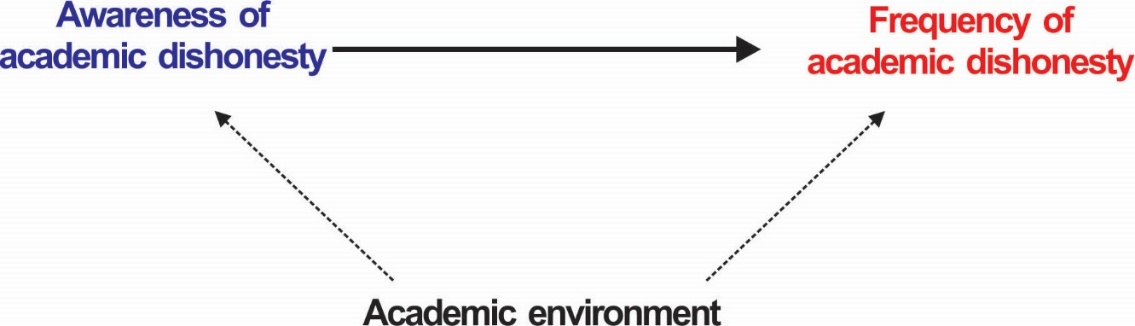
The prevalence of academic dishonesty can be hypothesized as follows:
H1: Awareness of academic integrity would likely limit academic dishonesty.
This hypothesis suggests that when students have a strong awareness of academic integrity and its importance, they are less likely to engage in academic dishonesty. Awareness programs, education, and clear communication about academic integrity policies can help promote ethical behavior among students.
H2: The positive academic environment would likely limit academic dishonesty.
This hypothesis proposes that a positive academic environment, which includes factors such as faculty support, effective enforcement of academic integrity policies, and a culture that values integrity, can contribute to reducing academic dishonesty. Students are more likely to uphold academic integrity when they perceive a supportive and ethical atmosphere.
H3: The positive academic environment would likely enhance students’ awareness of academic integrity.
This hypothesis suggests that a positive academic environment can foster a stronger awareness of academic integrity among students. When the institution emphasizes and promotes ethical behavior, students are more likely to develop a heightened sense of the importance of academic integrity.
These hypotheses provide a framework for further research to explore the relationships between awareness, academic environment, demographic factors, and academic dishonesty prevalence among students.
METHODOLOGY
Research Design
This research comprises a pilot study and a main study. The initial qualitative study aims to validate the questionnaire for the subsequent quantitative study within the context of Vietnamese universities. To accomplish this, a questionnaire and a semi-structured interview framework were designed based on the research model and questionnaire developed by McCabe and CAI. These instruments were tailored to account for the specific characteristics of Vietnamese universities. Qualitative research was conducted, involving twelve interviews, to identify the characteristics of the academic environment and the prevailing practices of academic integrity.
Semi-structured interviews were conducted with a purposive sample of 12 undergraduate students (7 men and 5 women) from the second, third, and fourth years of a Faculty to support instrument development. An interview guide was developed to ensure consistency while allowing flexibility for probing. The guide comprised three sections: (1) students’ understanding of academic integrity, including identification of credible sources and quality indicators (e.g., citation practices and originality); (2) perceptions and experiences of academic dishonesty, such as plagiarism, inappropriate collaboration, and contract cheating; and (3) practical considerations in academic writing, including appropriate word counts and necessary revisions. The guide was pilot-tested with two students, resulting in minor refinements to wording and structure. Interviews lasted approximately 30-45 minutes, were conducted in a confidential setting, and were audio-recorded with consent. Insights from the interviews informed the refinement of the preliminary questionnaire, which was subsequently developed into a test questionnaire.
Following the qualitative phase, the questionnaire was revised based on the insights obtained. A quantitative study was then conducted with a sample of 2,088 undergraduate students from three universities (A, B, and C). The survey was administered using a paper-based questionnaire, and data were collected by student collaborators at the three participating universities. All interviews and surveys were conducted anonymously, ensuring the confidentiality of the participants.
Measurement Scale
The questionnaire was developed based on surveys designed by McCabe and CAI, as suggested by Canham (2008). It employed a Likert scale for closed questions and was divided into four main parts:
- Academic environment [27 items]: This section assessed various aspects related to the academic environment, including sources of information on academic integrity, the role of faculty in addressing integrity policy, perceptions of academic integrity, and the level of awareness and effectiveness in promoting integrity.
- Academic dishonesty [38 items]: This part focused on the frequency of engagement in various academic dishonesty behaviours and the participants’ awareness of the severity of these behaviours.
- Attitudes of others towards dishonesty [03 items]: This section explored the attitudes of friends, parents, and other relatives towards academic dishonesty.
- Individual information [04 items]: This part collected demographic information about the participants, including their gender, years of study, grade point average (GPA), and faculty affiliation.
Sampling
In the qualitative research phase, twelve students were conveniently invited to participate in interviews based on recommendations from faculty members or from students who had previously been interviewed. Before the interviews, a strong emphasis was placed on ensuring the confidentiality of personal information. Sampling for interviews was conducted until the point where the information gathered began to overlap significantly (Hennink & Kaiser, 2022; Lim, 2025).
In the quantitative research phase, the sampling method follows the following steps:
- Official approval: The sampling process is initiated by the research team submitting a written request to the university, seeking approval for the sampling procedure.
- Collaboration with university staff: Collaborators, such as lecturers or staff members, from the university are engaged in the process. They seek permission from the lecturers of various faculties and visit classes in a convenient manner.
- Presentation of research objectives: During class visits, the collaborators present a summary of the research objectives and ethical commitments. They emphasize the importance of maintaining the confidentiality of participant information.
- Invitation to participate: Students are invited to participate in the research by answering the questionnaires. They are informed about the purpose of the study and assured that their responses will be treated with strict confidentiality.
Sample Description
After reviewing and cleaning the data, a total of 2,088 responses were deemed satisfactory for analysis, as shown in Table 1. The distribution of the sample across individual variables is considered adequate for analysis. Some notable observations include:
- The number of students in the health sector is relatively small, accounting for about 2.9% of the sample (60 respondents). In contrast, the largest group is from the business sector, comprising 42% of the sample (887 respondents).
- Both first-year and fourth-year students are represented by smaller numbers compared to other years (around 11.5% and 15%, respectively).
- There is a relatively low number of students who achieved excellent grades (cumulative score between 4.0 and 3.6), accounting for approximately 5.8% of the sample (122 respondents). On the other hand, the majority of students (36.3%) have good academic performance, with cumulative scores ranging from 3.19 to 2.5 (758 respondents).
- It is worth noting that there is a significant number of missing values in cumulative grades and university years, particularly concentrated in University B. This suggests some hesitancy among participants in providing personal information, despite the assurance of anonymity in the study.
Table 1. Description of Participants in the Main Quantitative Study
|
Variable |
Category |
Academic programs |
Sub Total |
||||||||
|---|---|---|---|---|---|---|---|---|---|---|---|
|
Bu |
Lw |
Lg |
Pe |
He |
Ag |
Te |
Mv |
||||
|
Gender |
Female |
556 |
88 |
171 |
214 |
33 |
32 |
90 |
3 |
1,187 |
|
|
Male |
313 |
72 |
44 |
118 |
27 |
97 |
205 |
5 |
881 |
||
|
Total |
869 |
160 |
215 |
332 |
60 |
129 |
295 |
8 |
2,068 |
||
|
Missing |
8 |
0 |
5 |
4 |
0 |
0 |
1 |
2 |
20 |
||
|
Grade Point Average |
4,00..3,60 |
39 |
1 |
14 |
31 |
5 |
4 |
28 |
122 |
||
|
3,59..3,20 |
266 |
24 |
38 |
72 |
37 |
11 |
95 |
543 |
|||
|
3,19..2,50 |
338 |
53 |
73 |
100 |
12 |
66 |
113 |
3 |
758 |
||
|
< 2.50 |
186 |
82 |
23 |
24 |
5 |
44 |
58 |
422 |
|||
|
Total |
829 |
160 |
148 |
227 |
59 |
125 |
294 |
3 |
1,845 |
||
|
Missing |
48 |
0 |
72 |
109 |
1 |
4 |
2 |
7 |
243 |
||
|
Years of study |
First |
136 |
1 |
13 |
48 |
0 |
0 |
40 |
3 |
241 |
|
|
2nd |
313 |
60 |
108 |
92 |
2 |
20 |
106 |
3 |
704 |
||
|
3rd |
284 |
1 |
33 |
110 |
53 |
105 |
74 |
0 |
660 |
||
|
4th |
113 |
98 |
11 |
15 |
5 |
2 |
70 |
0 |
314 |
||
|
Total |
846 |
160 |
165 |
265 |
60 |
127 |
290 |
6 |
1,919 |
||
|
Missing |
31 |
0 |
55 |
71 |
0 |
2 |
6 |
4 |
169 |
||
|
University |
A |
346 |
101 |
85 |
156 |
0 |
109 |
159 |
1 |
957 |
|
|
B |
103 |
0 |
135 |
180 |
0 |
20 |
13 |
9 |
460 |
||
|
C |
428 |
59 |
0 |
0 |
60 |
0 |
124 |
671 |
|||
|
Total |
877 |
160 |
220 |
336 |
60 |
129 |
296 |
10 |
2,088 |
||
|
|
Missing |
0 |
0 |
0 |
0 |
0 |
0 |
0 |
|
0 |
|
|
TOTAL |
N |
877 |
160 |
220 |
336 |
60 |
129 |
296 |
10 |
2,088 |
|
|
|
% |
42.0 |
7.7 |
10.5 |
16.1 |
2.9 |
6.2 |
14.2 |
0.5 |
100 |
|
|
Note: Bu: Business; Lw: Law; Lg: Language; Pe: Pedagogy; He: Health; Ag: Agriculture; Te: Technology; Mv: Missing value |
|||||||||||
The survey was conducted in three universities situated in South Vietnam, which were founded after 2000. These universities have a minimum faculty size of 500 and a student population of at least 8,000. They are comprehensive educational institutions that provide postgraduate education in diverse disciplines. Each of the three universities has an online platform, in the form of a website, which facilitates communication and interaction among students, faculty, and the broader community. Table 2 presents essential details about these universities, including information about their respective academic programs.
Table 2. Essential Details about the Three Universities
|
University |
Number of students |
Number of |
Academic programs |
||||||
|---|---|---|---|---|---|---|---|---|---|
|
Bu |
Lw |
Lg |
Pe |
He |
Ag |
Te |
|||
|
A |
10,000 |
8 |
X |
X |
X |
X |
X |
X |
|
|
B |
5,500 |
11 |
X |
X |
X |
X |
X |
||
|
C |
12,000 |
9 |
X |
X |
X |
X |
|||
The public websites of the three universities surveyed do not contain the academic integrity policy. Despite searching using keywords such as “integrity” in the search function, checking the Academic Department page, and reviewing the text-regulation page, the policy could not be located.
Data Analysis
Descriptive statistics, comparative analysis, and hypothesis testing were utilized to analyze both nominal and ordinal variables. The Chi-square test was implemented to examine the association between nominal variables. To assess the strength and direction of the relationship between ordinal variables, Kendall’s Tau-b was employed. Additionally, when comparing the means of different groups, the T-Test and ANOVA were used to determine if there were significant differences among them. These statistical techniques offer valuable insights into the data and facilitate the formation of meaningful conclusions.
RESULTS
Academic Environment
Academic integrity resources
Table 3 presents the students’ assessment of their awareness about academic integrity from various sources. Overall, the sources evaluated did not provide a substantial amount of information to the students. Among the official sources, the most abundant information was found in the course syllabus, introduced by lecturers (46%), followed by academic advisors (37%). Surprisingly, academic assistants (39%) and faculty/department leaders (28%) were considered less helpful in providing information on academic integrity. Interestingly, despite being unofficial sources, other students (20%) and other individuals (16%) were still referenced by students as a valuable source of information on this topic.
Table 3. Students’ Awareness of Academic Integrity from Various Sources
|
|
Very little, almost none |
Not much |
Much |
|---|---|---|---|
|
Official sources |
|||
|
Lecturers - course syllabus |
14 |
40 |
46 |
|
Academic advisor |
19 |
44 |
37 |
|
Faculty/University website |
22 |
46 |
32 |
|
Student handbook |
23 |
45 |
32 |
|
Faculty/University leader |
28 |
44 |
28 |
|
Orientation |
20 |
54 |
26 |
|
Academic assistant |
39 |
43 |
18 |
|
Synthesis* |
23 |
55 |
22 |
|
Unofficial sources |
|||
|
Other students |
34 |
46 |
20 |
|
Other people |
41 |
43 |
16 |
Notes:* The synthesis variable is a combined measure of the seven official information sources mentioned above.
The synthesis variable is a combined measure of the seven official information sources mentioned above. The aggregation and encoding process is as follows:
The values of the seven information source variables (ranging from 1 to 3) are summed up to create a total variable. The minimum value for the total variable is 7, while the maximum value is 21. The total variable is then encoded into three categories as follows:
- Values ranging from 7 to 11 are encoded as 1, representing “Very little, almost none.”
- Values ranging from 12 to 17 are encoded as 2, representing “Not much.”
- Values ranging from 18 to 21 are encoded as 3, representing “Much.”
This synthesis variable, after aggregation and encoding, will be utilized for relational analysis in a subsequent step.
The Frequency with which regulations on academic integrity are mentioned by lecturers
It is evident in Table 4 that the most frequently mentioned topics by lecturers are group assignment instructions and proper quoting techniques, accounting for approximately 70% to 75% of the mentions. On the other hand, when it comes to academic dishonesty, specifically plagiarism and fabrication, they are discussed less frequently, with only around 65% and 73% of mentions, respectively. Notably, fabricating data is rarely mentioned, with approximately 54% of instances where it is rarely or not mentioned at all.
Table 4. The Frequency of Academic Integrity
|
|
Never before |
Seldom |
Occasionally |
Regular |
Very often |
|---|---|---|---|---|---|
|
Group assignment instruction |
2 |
6 |
17 |
49 |
26 |
|
How to quote in an essay? |
2 |
5 |
23 |
47 |
23 |
|
Plagiarism, copying |
14 |
17 |
34 |
27 |
8 |
|
Fabricating data |
36 |
18 |
19 |
18 |
9 |
Notes: Bold values are dominant ones (2-column total)
Prevalence of dishonesty
In Table 5, the data indicate that 33% of students reported that the phenomenon of only a few students participating in group assignments is a regular occurrence. Conversely, only 36% of students mentioned that this situation is rare or never happens. Additionally, the survey revealed that cheating in exams or tests was the next most commonly reported violation, with 20% of students acknowledging its presence. Similarly, plagiarism or copying was reported by 18% of students. However, a majority of students, approximately 54% to 58%, stated that these two phenomena rarely or never occur.
Table 5. Perceived Prevalence of Dishonesty
|
|
Never before |
Seldom |
Occasionally |
Regular |
Very often |
|---|---|---|---|---|---|
|
Only a few students do group assignments |
13 |
23 |
31 |
23 |
10 |
|
Cheating in exams and tests |
27 |
27 |
26 |
14 |
6 |
|
Plagiarism, copying |
31 |
27 |
24 |
14 |
4 |
|
Rarely |
Occasionally |
Regularly |
|||
|
Prevalence of dishonesty |
50 |
31 |
19 |
||
Notes: The prevalence of dishonesty variable is a combined measure of the three aforementioned dishonesty variables, which range from “Rarely” to “Regularly” in terms of occurrence frequency.
The aggregation and encoding process for the prevalence of dishonesty is as follows:
The three variables representing the perceived prevalence of dishonesty, with a minimum value of 1 and a maximum value of 5, are summed together. This results in a total value ranging from 3 to 15. The total variable value is then encoded into three categories: Values 3 to 7 are categorized as 1, representing “Rarely”; Values 8 to 10 are categorized as 2, representing “Occasionally”; Values 11 to 15 are categorized as 3, representing “Regularly”. The prevalence of dishonesty, derived from this process, will be used for relationship analysis in subsequent steps.
Student’s evaluation of the academic integrity policy
Students have evaluated different aspects of current policies related to academic integrity, and the ratings range from 47% to 74%. However, there are noticeable disparities between lecturers’ awareness of the policy and their strictness in handling fraud (with ratings of 74% and 62% respectively), as well as the effectiveness of the policy as perceived by students (with a rating of 50%) and students’ overall perception of the policy (with a rating of 47%) (Table 6). These findings indicate a significant gap between lecturers’ viewpoints and students’ perceptions when it comes to the effectiveness and awareness of academic integrity policies.
Table 6. Students’ Perception of the Academic Integrity Policy
|
|
Very low |
Fairly low |
Medium |
Fairly high |
Very high |
|---|---|---|---|---|---|
|
Lecturer’s perception of academic integrity policy |
2 |
5 |
19 |
49 |
25 |
|
Student perception of the strict handling of fraud |
3 |
7 |
28 |
50 |
12 |
|
Student advocacy of academic integrity policy |
5 |
10 |
30 |
39 |
16 |
|
Effectiveness of academic integrity policy |
4 |
11 |
35 |
36 |
14 |
|
Student awareness of academic integrity policy |
3 |
12 |
37 |
37 |
11 |
|
Low |
Medium |
High |
|||
|
Lecturer’s perception of academic integrity policy |
7 |
19 |
74 |
||
|
Student perception of the strict handling of fraud |
10 |
28 |
62 |
||
|
Student advocacy of academic integrity policy |
15 |
30 |
55 |
||
|
Effectiveness of academic integrity policy |
15 |
35 |
50 |
||
|
Student awareness of academic integrity policy |
16 |
37 |
47 |
||
Notes: The bottom half of Table 6 is re-encoded into categories representing different levels of occurrence.
The re-encoding includes the following categories: “Low” represents the combination of “Very Low” and “Fairly Low to Low”; “High” represents the combination of “Fairly High” and “Very High”. This re-encoding enables relational testing and analysis to be performed on the data.
Attitude towards academic dishonesty of people around
The attitudes of individuals surrounding students, including siblings and parents, towards integrity violations (if any) are not academic environmental factors. However, due to the close family ties, these attitudes can have a certain influence on students’ behavior and moral perception, and therefore should be considered within this group. It is noteworthy that parents exhibit the highest level of objection towards integrity violations (89%), while classmates demonstrate the lowest level of opposition (58%). It is important to note that there is still a small percentage (3% to 4%) of relatives who agree with such violations, as compared to 10% of classmates (Table 7).
Table 7. Attitude Toward Academic Dishonesty of People Around
|
Strongly oppose |
Oppose |
Not oppose |
Concur |
|
|---|---|---|---|---|
|
Parents |
41 |
48 |
8 |
3 |
|
Siblings and relatives |
21 |
55 |
20 |
4 |
|
Classmates |
12 |
46 |
32 |
10 |
|
|
Strongly oppose |
Oppose |
Not oppose |
|
|
Parents |
41 |
48 |
11 |
|
|
Siblings and relatives |
21 |
55 |
24 |
|
|
Classmates |
12 |
46 |
42 |
|
Notes: The bottom half of Table 7 is re-encoded for relational testing purposes.
The category “Not oppose” is used to represent both the original “Not oppose” and “Concur” categories. This re-encoding allows for relational testing and analysis to be conducted on the data.
Students’ Awareness and Frequency of Academic Dishonesty
This study aimed to examine the relationship between two variables: Awareness of academic dishonesty and frequency of engagement in dishonest behaviours. Awareness of academic dishonesty refers to students’ understanding of the severity of these behaviours, categorized as Not dishonest, Not seriously dishonest, and Seriously dishonest. The frequency of academic dishonesty represents how often students engage in these behaviours, categorized as never, once, and more than once. The initial hypothesis proposed a negative correlation between these two variables.
The test results, presented in Table 8 and analysed using Kendall’s Tau-b, Somer’s d, gamma coefficients, and comparison with the percentage table, yielded unexpected findings. While some correlations were not particularly strong, they displayed a positive relationship, contrary to the initial hypothesis. This indicates that as students’ awareness of the severity of academic dishonesty behaviours increases, and their frequency of engagement in these violations also tends to increase. In other words, despite acknowledging the wrongfulness of academic dishonesty, students still tend to commit such acts.
Further analysis of the data revealed intriguing patterns. The three rightmost columns in Table 8 illustrate the average frequency of violations associated with each of the awareness categories: Not dishonest, Not seriously dishonest, and Seriously dishonest. Surprisingly, students who perceived academic dishonesty behaviours as not dishonest exhibited the lowest frequency of violations, contradicting existing literature. However, within the other two groups, students who perceived academic dishonesty behaviours as seriously dishonest displayed a lower frequency of violations compared to those who perceived them as not seriously dishonest. This finding aligns with previous research and will be explored in greater detail in the subsequent section.
Table 8. Relationship Between Students’ Awareness and Frequency of Academic Dishonesty
|
Awareness of academic dishonesty |
Kendall’s Tau-b |
Frequency of academic dishonesty |
||
|---|---|---|---|---|
|
Not violated |
Violate but not seriously |
Seriously violate |
||
|
Purchase work that has already been submitted. |
0.10 |
0.06 |
0.56 |
0.20 |
|
Use electronic devices during the exam. |
0.09 |
0.07 |
0.84 |
0.25 |
|
Employ prohibited electronic materials during exams. |
0.07 |
0.06 |
0.81 |
0.26 |
|
Fail to complete the work and submit someone else’s post instead. |
0.10 |
0.08 |
0.83 |
0.27 |
|
Rectify and manipulate data for exercises and reports. |
0.09 |
0.12 |
1.01 |
0.38 |
|
Submit previously completed work by someone else as your own. |
0.13 |
0.12 |
0.92 |
0.38 |
|
Engage in other forms of dishonest activities. |
0.11 |
0.09 |
0.96 |
0.40 |
|
Access classmates’ answers during testing without their permission. |
0.14 |
0.13 |
0.86 |
0.44 |
|
Utilize prohibited handwritten materials during exams. |
0.14 |
0.08 |
0.95 |
0.44 |
|
Utilize messages or Zalo to seek assistance during tests. |
0.11 |
0.16 |
1.05 |
0.47 |
|
Provide false excuses for late submissions. |
0.14 |
0.11 |
0.95 |
0.49 |
|
Delegate someone else to complete your homework on your behalf. |
0.15 |
0.17 |
1.01 |
0.55 |
|
Copy a section of someone else’s work. |
0.12 |
0.18 |
1.34 |
0.72 |
|
Incorporate solutions and practice questions from other classes. |
0.10 |
0.42 |
1.44 |
0.74 |
|
Duplicate someone else’s homework electronically or through an online platform like Zalo. |
0.10 |
0.44 |
1.36 |
0.76 |
|
Plagiarize from books, newspapers, or magazines without proper citation. |
0.14 |
0.27 |
1.40 |
0.86 |
|
Reproduce someone else’s homework manually. |
0.12 |
0.48 |
1.51 |
0.96 |
|
Copy from the internet without acknowledging the sources. |
0.13 |
0.35 |
1.58 |
0.97 |
|
Access classmates’ answers during testing with their permission. |
0.08 |
0.75 |
1.90 |
1.39 |
|
Offer support and review lesson content while testing. |
0.14 |
0.60 |
2.00 |
1.56 |
|
Engage in collaborative exercises upon individual request. |
0.06 |
1.29 |
2.17 |
1.56 |
Notes: Blank cell (shading): No relation; In bold: Kendall’s Tau-b coefficient>=0.15
The Effect of Academic Environment on Awareness and Frequency of Academic Dishonesty
Ordinal variables in this study were examined using statistical tests, including Kendall’s Tau-b, Somers’d, and gamma indices. These tests were specifically developed to evaluate the magnitude and direction of the relationship between ordinal variables. Moreover, by comparing the results with the percentage table, additional understanding was gained regarding the association between the variables.
Relationship between academic environment and frequency of academic dishonesty
Table 9. Relationship Between Frequency of Academic Dishonesty and Academic Environment
|
The frequency of performing academic dishonesty [Never.. more than 1 time] |
Academic environment |
|||||
|---|---|---|---|---|---|---|
|
Prevalence of dishonesty |
Student perception of strict handling of fraud |
Student awareness of academic integrity policy |
Student advocacy of academic integrity policy |
Classmates’ tolerance |
Parents’ tolerance |
|
|
Engage in collaborative exercises upon individual request. |
0.18 |
|
-0.12 |
-0.09 |
0.25 |
0.08 |
|
Incorporate solutions and practice questions from other classes. |
0.16 |
-0.12 |
-0.07 |
-0.08 |
0.09 |
0.10 |
|
Offer support and review lesson content while testing. |
0.20 |
0.05 |
-0.15 |
-0.10 |
0.21 |
0.06 |
|
Rectify and manipulate data for exercises and reports. |
0.11 |
-0.14 |
-0.07 |
-0.07 |
0.07 |
0.16 |
|
Access classmates’ answers during testing with their permission. |
0.19 |
|
-0.08 |
-0.09 |
0.23 |
0.09 |
|
Access classmates’ answers during testing without their permission. |
0.07 |
-0.11 |
|
-0.08 |
|
0.11 |
|
Utilize messages or Zalo to seek assistance during tests. |
0.11 |
-0.10 |
-0.06 |
-0.08 |
0.04 |
0.10 |
|
Delegate someone else to complete your homework on your behalf. |
0.09 |
-0.11 |
-0.06 |
-0.07 |
0.06 |
0.07 |
|
Reproduce someone else’s homework manually. |
0.17 |
|
-0.05 |
-0.06 |
0.18 |
0.08 |
|
Duplicate someone else’s homework electronically or through an online platform like Zalo. |
0.12 |
-0.04 |
-0.05 |
-0.05 |
0.12 |
0.11 |
|
Plagiarize from books, newspapers, or magazines without proper citation. |
0.15 |
-0.09 |
-0.09 |
-0.09 |
0.13 |
0.08 |
|
Copy from the internet without acknowledging the sources. |
0.16 |
-0.07 |
-0.07 |
-0.08 |
0.19 |
0.07 |
|
Submit previously completed work by someone else as your own. |
0.11 |
-0.11 |
-0.06 |
-0.09 |
|
0.14 |
|
Purchase work that has already been submitted. |
|
-0.14 |
|
-0.05 |
-0.06 |
0.11 |
|
Utilize prohibited handwritten materials during exams. |
0.12 |
-0.13 |
-0.06 |
-0.07 |
0.07 |
0.13 |
|
Employ prohibited electronic materials during exams. |
0.05 |
-0.15 |
-0.05 |
-0.08 |
|
0.16 |
|
Use electronic devices during the exam. |
0.05 |
-0.13 |
-0.05 |
-0.08 |
|
0.15 |
|
Copy a section of someone else’s work. |
0.13 |
-0.07 |
-0.07 |
-0.08 |
0.12 |
0.10 |
|
Provide false excuses for late submissions. |
0.08 |
-0.07 |
-0.04 |
-0.07 |
0.05 |
0.13 |
|
Fail to complete the work and submit someone else’s post instead. |
0.07 |
-0.13 |
|
-0.07 |
|
0.14 |
|
Engage in other forms of dishonest activities. |
0.09 |
-0.11 |
-0.09 |
-0.10 |
|
0.17 |
Notes: Blank cell (shading): No relation; In bold: Kendall’s Tau-b coefficient>=0.15
The findings from the inspection are presented in Table 9, and the following observations can be made:
- There is a positive correlation between the perceived prevalence of dishonesty in the academic environment and the frequency of 20 out of 21 student violations. In other words, the higher the negative perception of the academic environment, the more likely students are to engage in academic integrity dishonesty.
- Three factors, namely student perception of strict handling of academic dishonesty, student awareness of academic integrity policy, and student advocacy of the policy, exhibit an inverse relationship with the frequency of most violations, although their influence is relatively minor. In simpler terms, when the academic integrity policy is stricter and positively perceived and supported by students, the occurrence of violations tends to be lower.
- As anticipated, the tolerant or objectionable attitudes of classmates and parents have an opposite effect on the frequency of violations. The higher the acceptance of such behaviours, the more violations occur. It is worth noting that parents play a more significant role (in all 21 behaviours) compared to classmates (in 15 out of 21 behaviours).
Relationship between Academic environment and awareness of academic dishonesty
The inspection findings are summarized in Table 10, and based on these findings, the following observations can be made. Firstly, contrary to expectations, academic dishonesty was found to be prevalent, with significant instances identified in 5 out of 21 violations. However, the significance levels were not particularly high, ranging between 0.04 and 0.06. Consequently, it can be concluded that while academic dishonesty is present, its prevalence does not have a significant impact on student awareness of academic dishonesty.
Among the three factors examined, namely Student perception of strict handling of fraud, Student advocacy of academic integrity policy, and Student advocacy of academic integrity policy, only Student perception of strict handling of fraud demonstrated a strong relationship with student awareness of academic dishonesty. It was found to be correlated with 20 out of 21 instances. In contrast, the other two factors displayed weaker correlations. Therefore, it can be inferred that the presence of strict integrity policies has a notable influence on student awareness of academic dishonesty.
Table 10. The Relationship Between Students’ Awareness of Academic Dishonesty and (1) Prevalence of Dishonesty, (2) Academic Policy, and (3) Sources of Information on Integrity
|
Moral awareness of the seriousness of acts ... [No violations/no seriousness... very serious] |
Dishonest status quo |
Student perception of strict handling of fraud |
Student awareness of academic integrity policy |
Student advocacy of academic integrity policy |
Sources of information on integrity |
|---|---|---|---|---|---|
|
Engage in collaborative exercises upon individual request. |
0.05 |
0.05 |
|
|
|
|
Incorporate solutions and practice questions from other classes. |
0.06 |
0.05 |
|
|
0.05 |
|
Offer support and review lesson content while testing. |
0.05 |
0.06 |
|
|
0.06 |
|
Rectify and manipulate data for exercises and reports. |
|
0.05 |
|
|
0.06 |
|
Access classmates’ answers during testing with their permission. |
|
0.07 |
0.05 |
|
0.06 |
|
Access classmates’ answers during testing without their permission. |
|
0.08 |
0.05 |
|
0.07 |
|
Utilize messages or Zalo to seek assistance during tests. |
|
0.07 |
|
|
|
|
Delegate someone else to complete your homework on your behalf. |
|
0.06 |
0.05 |
|
0.07 |
|
Reproduce someone else’s homework manually. |
|
0.06 |
|
0.05 |
0.04 |
|
Duplicate someone else’s homework electronically or through an online platform like Zalo. |
|
0.07 |
0.04 |
|
0.05 |
|
Plagiarize from books, newspapers, or magazines without proper citation. |
|
0.06 |
|
|
|
|
Copy from the internet without acknowledging the sources. |
0.04 |
|
|
|
|
|
Submit previously completed work by someone else as your own. |
|
0.07 |
0.05 |
|
0.05 |
|
Purchase work that has already been submitted. |
|
0.07 |
0.05 |
0.06 |
0.07 |
|
Utilize prohibited handwritten materials during exams. |
|
0.06 |
|
|
0.06 |
|
Employ prohibited electronic materials during exams. |
|
0.07 |
|
|
0.05 |
|
Use electronic devices during the exam. |
|
0.06 |
|
|
0.05 |
|
Copy a section of someone else’s work. |
0.05 |
0.07 |
|
|
|
|
Provide false excuses for late submissions. |
|
0.06 |
|
0.04 |
0.05 |
|
Fail to complete the work and submit someone else’s post instead. |
|
0.07 |
|
|
0.06 |
|
Engage in other forms of dishonest activities. |
|
0.07 |
|
|
0.04 |
Notes: Blank cell (shading): No relation; In bold: Kendall’s Tau-b coefficient>=0.15
Although students assert that there are numerous sources providing substantial information on academic integrity, the findings indicate that only 16 out of the 21 accreditations showed a limited relationship between students’ knowledge of academic integrity and their awareness of academic dishonesty. This suggests that despite the availability of information, there may be other factors influencing students’ awareness of academic dishonesty that are not adequately addressed by the existing sources.
DISCUSSION
Regarding the prevalence of dishonesty, it is worth noting that the findings are based on students’ subjective perceptions of dishonesty within the academic environment. This subjectivity makes it difficult to definitively determine whether the percentages of students perceiving violations as frequent (19%) or occasional (31%) are high or low. However, it is important to acknowledge that these percentages are not insignificant and deserve attention.
The acceptance of academic dishonesty by relatives is also noteworthy. The results indicate that a certain percentage of parents, siblings, and other relatives express agreement with violation behaviours. Specifically, 3% of parents, 4% of siblings and relatives, and 10% of friends indicate acceptance. When considering those who do not oppose these behaviours, the combined percentages for the three groups are 11%, 24%, and 42%, respectively. The test results further indicate that as the level of acceptance increases, so does the frequency of violations. This clearly demonstrates that the attitudes and perspectives of relatives have a significant impact on students’ behaviours related to academic dishonesty. This finding supports the idea that the organizational dimension, including peer norms and faculty involvement in the classroom, creates an environment that encourages academic misconduct (Chesney, 2009).
It is important to note that the frequency of academic dishonesty behaviours varies depending on the specific violations examined. The frequency ranges from the lowest occurrence (4% for “Purchase work that has already been submitted”) to the highest occurrence (55% for “Engage in collaborative exercises upon individual request”). This indicates that certain violation behaviours are relatively common.
Furthermore, the frequency of academic dishonesty behaviours is inversely related to the awareness of academic dishonesty. In other words, the more aware students are of academic dishonesty, the more frequently they engage in violations. This suggests that despite knowing that these behaviours are morally wrong, students still participate in them. This could be attributed to the perceived benefits obtained from breaking the rules or the influence of a prevailing culture of violation.
This finding aligns with the internal dimension that impacts the issue of academic misconduct. It indicates that when students choose to cheat or plagiarize, they are fully aware that their actions are ethically unacceptable (Chesney, 2009). This emphasizes the complex nature of the factors that influence students’ decision-making regarding academic dishonesty, including personal motivations and external influences.
In terms of awareness and frequency of academic dishonesty, the percentage of students who do not consider academic dishonesty as seriously wrong ranges from 19% (“Access classmates’ answers during testing with their permission”) to 38% (“Purchase work that has already been submitted”). This may indicate an attempt to psychologically justify these dishonest behaviours. It should be noted that factors such as the prevalence of dishonesty, the strictness of policies, students’ awareness of policies, students’ support for policies, and the effectiveness of communication from information sources on academic integrity significantly impact students’ ethical awareness of most violation behaviours, with the strictness of policies specifically affecting a few specific violation behaviours.
Regarding the institutional dimension of academic dishonesty, the effectiveness of information on academic integrity in Vietnamese universities is generally inadequate. Approximately 78% of students perceive a lack of awareness or minimal attention given to academic integrity. Official sources of information demonstrate better communication effectiveness compared to unofficial sources. However, within the realm of official sources, certain channels such as course syllabi, academic advisors, and reliable websites prove to be more influential. Secondary sources are recognized for their comprehensiveness, detail, and thoroughness. Although information sources have limitations in terms of communication effectiveness, they significantly contribute to raising awareness about 16 out of 21 academic dishonesty behaviours, thereby reducing the frequency of student violations. It is highly recommended that universities establish effective sources of information regarding academic integrity.
The evaluation of academic integrity policies and related factors highlights an interesting observation regarding the role of instructors in disseminating integrity regulations. It appears that instructors tend to focus more on simple behaviours, such as group assignments and referencing, which are considered frequent violations by 75% of students. On the other hand, complex or sophisticated behaviours like plagiarism and fabrication, which are occasionally or rarely committed according to 73% of students, receive comparatively less attention.
In evaluating policies, students rate instructors’ awareness of those policies highly (74%) and the strictness of the policies (62%). However, their own awareness is rated lower, with 53% considering it average or low. This suggests a need for improvement in students’ knowledge and understanding of academic integrity policies. Campbell and Waddington (2024) also noted that clarifying academic integrity is essential for helping students develop their understanding and necessary skills, which is a shared responsibility among teaching staff, academic personal tutors, library staff, and students’ union academic advisors.
Furthermore, the evaluation reveals a positive relationship between the assessed policy factors and the frequency of student violations, with the strictness of policies playing a particularly significant role. This suggests that more stringent policies may help deter instances of academic dishonesty. Interestingly, among the evaluated factors, only the strictness of policies appears to influence students’ ethical awareness of violation behaviours. This implies that students’ positive evaluations of policies can enhance their overall awareness of academic dishonesty. These findings align with the research of Moya and Eaton (2024), which highlights the lack of institutional support in Chile for teaching, learning, and conducting research with integrity. The scholars recommend creating spaces that encourage dialogue about academic integrity among students, educators, scholars, and policymakers. Effective policy development requires the involvement of various stakeholders, particularly students (Cerda-Navarro et al., 2022).
Considering previous studies affirming the effectiveness of honour codes in reducing academic cheating in specific academic contexts (Trevino et al., 1998), it is important to acknowledge the challenges faced by prestigious business schools in eradicating academic dishonesty solely through honour code adoption (Rawe, 2007). Nevertheless, these findings suggest that universities should consider implementing honour codes as a proactive measure to address and mitigate instances of academic dishonesty. The role of honour codes has become increasingly essential in the context of developing Artificial Intelligence (Kumar et al., 2023).
On the other hand, it is important to recognize that the impact of honour codes is often contingent upon strong student-led enforcement and deeply embedded academic norms. In contexts where such traditions are less established, honour codes may function more as symbolic or formal statements rather than active regulatory mechanisms. Evidence suggests that without collective student ownership, peer monitoring, and consistent institutional reinforcement, compliance may be uneven and largely dependent on external controls rather than internalized ethical standards (Bretag, Harper, Burton, Ellis, Newton, van Haeringen, et al., 2019; McCabe et al., 2012).
Moreover, it is important to acknowledge the challenges faced by universities in eradicating academic dishonesty solely through honour code adoption, particularly in light of evolving forms of misconduct such as contract cheating, when students outsource their assessments to third parties (Bretag, Harper, Burton, Ellis, Newton, Rozenberg, et al., 2019). Instead, their effectiveness depends on complementary practices such as ethics education, transparent assessment design, and faculty engagement. This challenge becomes even more pronounced in the era of rapidly advancing Artificial Intelligence, where new forms of academic misconduct are emerging and are often difficult to detect (Kumar et al., 2023). Recent studies highlight that integrity frameworks must evolve beyond traditional honour systems to include digital literacy, clear AI-use policies, and shared accountability among students and faculty (Bearman et al., 2024; Eaton, 2023).
Therefore, while universities should consider implementing honour codes as part of a broader academic integrity strategy, their translation into practice in contexts without strong traditions of student-led enforcement requires institutional adaptation. This includes fostering a culture of integrity through education, aligning policies with technological realities, and gradually building student engagement mechanisms that support collective responsibility.
In summary, the evaluation of academic integrity policies and related factors emphasizes the need for instructors, as suggested by Campbell and Waddington (2024), to address not only simple violations but also complex and sophisticated behaviours. It also underscores the importance of students’ awareness of policies, the strictness of those policies, and their positive impact on ethical awareness. Recognizing the potential effectiveness of honour codes, along with the challenges faced by prestigious institutions, the implementation of such codes is recommended as a proactive measure to promote academic integrity. These recommendations are further supported by the belief that enhancing teaching and learning integrity is one of the primary objectives of the teaching and learning strategy (Gallant, 2008; Moya & Eaton, 2024).
CONCLUSION
Over the past 20 years, Vietnam’s higher education sector has achieved remarkable advancements, particularly in terms of quantity, boasting a total of 237 institutions. Additionally, significant strides have been made in aligning research activities and the training system with global standards. In this study, we focused on three recently established universities located in the southern region of Vietnam, all of which were founded after 1999.
The model for examining academic integrity in students encompasses three key concepts: (1) awareness of academic dishonesty, (2) academic environment (including factors such as information, policies, prevailing norms, and supportive attitudes), and (3) frequency of academic dishonesty. It is believed that individuals’ perceptions play a crucial role in shaping their behavior, while the academic environment is seen as instrumental in influencing both the perceived and actual occurrences of academic dishonesty.
A mixed-methods approach was employed in this study, consisting of two distinct but interconnected phases aimed at describing and testing the aforementioned model. The study was conducted with complete anonymity, and the sample size of 1,800 students from all three universities was conveniently selected. To measure the relevant variables, the original scales developed by McCabe and the International Center for Academic Integrity (ICAI) were used. These scales were calibrated to suit the practical context based on experimental research findings, resulting in the formulation of a questionnaire for the main study.
The research findings indicate that universities with effective communication strategies and regular dissemination of integrity regulations by lecturers tend to have higher levels of students’ perception regarding the seriousness of academic dishonesty. Furthermore, it was observed that a higher perception of the seriousness of academic dishonesty is associated with lower levels of integrity violations, while a lower perception of seriousness is linked to higher instances of such violations. Academic institutions bear the responsibility of addressing and preventing academic misconduct, as highlighted by Suprapto et al. (2024). This responsibility is particularly crucial in the context of online education (Erçin Kamburoğlu & Razı, 2024).
This study focuses primarily on the role of the academic environment in shaping academic integrity and does not explicitly incorporate emotional or motivational factors such as grade pressure, fear of failure, or anxiety. While these psychological dimensions have been shown to influence dishonest behavior (Bacon et al., 2020; Eshet, 2024), their exclusion was intended to maintain conceptual clarity and model parsimony. Consequently, the findings should be interpreted within this scope. Future research is encouraged to integrate emotional and motivational variables to provide a more comprehensive understanding of academic integrity.
CONFLICT OF INTEREST STATEMENT
On behalf of all authors, the corresponding author states that there is no conflict of interest.
USE OF AI TECHNOLOGY
The authors confirm that artificial intelligence tools (ChatGPT, developed by OpenAI) were used solely to assist in checking the academic writing for grammar, style, and clarity. The AI tool was not used to generate research ideas, analyse data, or draw conclusions. All intellectual content and interpretations in the manuscript are the sole responsibility of the authors.
INFORMED CONSENT
This research involved human participants. Informed consent was obtained from all participants included in the study. Participation was voluntary, and respondents were assured of confidentiality and anonymity.
References
Akakandelwa, A., Jain, P., & Wamundila, S. (2013). Academic dishonesty: A comparative study of students of library and information science in Botswana and Zambia. Journal of Information Ethics, 22(2), 137-150. DOI: https://doi.org/10.3172/JIE.22.2.137
Amirta, T. (2014, December 15). A map of scientific plagiarism around the world. Fast Company. https://www.fastcompany.com/3039921/a-map-of-scientific-plagiarism-around-the-world
Arcana. (2021). Liêm chính học thuật và đạo văn: Một cái nhìn tổng quan. [Academic integrity and plagiarism: An overview]. Spiderum. https://spiderum.com/bai-dang/Liem-chinh-hoc-thuat-va-dao-van-Mot-cai-nhin-tong-quan-wzm
Bacon, A. M., McDaid, C., Williams, N., & Corr, P. J. (2020). What motivates academic dishonesty in students? A reinforcement sensitivity theory explanation. British Journal of Educational Psychology, 90(1), 152-166. https://doi.org/10.1111/bjep.12269
Balbuena, S. E., & Lamela, R. A. (2015). Prevalence, motives, and views of academic dishonesty in higher education. Online Submission, 3(2), 69-75.
Bandura, A. (1986). Social foundations of thought and action. Prentice-Hall.
Bandura, A. (1999). Social cognitive theory: An agentic perspective. Asian Journal of Social Psychology, 2(1), 21-41. DOI: https://doi.org/10.1111/1467-839X.00024
Bearman, M., Tai, J., Dawson, P., Boud, D., & Ajjawi, R. (2024). Developing evaluative judgement for a time of generative artificial intelligence. Assessment & Evaluation in Higher Education, 49(6), 893-905. DOI: https://doi.org/10.1080/02602938.2024.2335321
Bohannon, J. (2014, December 11). Study of massive preprint archive hints at the geography of plagiarism. Science. https://www.sciencemag.org/news/2014/12/study-massive-preprint-archive-hints-geography-plagiarism
Bretag, T., Harper, R., Burton, M., Ellis, C., Newton, P., Rozenberg, P., Saddiqui, S., & van Haeringen, K. (2019a). Contract cheating: A survey of Australian university students. Studies in Higher Education, 44(11), 1837-1856. DOI: https://doi.org/10.1080/03075079.2018.1462788
Bretag, T., Harper, R., Burton, M., Ellis, C., Newton, P., van Haeringen, K., Saddiqui, S., & Rozenberg, P. (2019b). Contract cheating and assessment design: Exploring the relationship. Assessment & Evaluation in Higher Education, 44(5), 676-691. DOI: https://doi.org/10.1080/02602938.2018.1527892
Burnaz, S., Atakan, M. S., & Topcu, Y. I. (2010). Have ethical perceptions changed? A comparative study on the ethical perceptions of Turkish faculty members. Journal of Academic Ethics, 8, 137-151. DOI: https://doi.org/10.1007/s10805-010-9115-y
Campbell, C., & Waddington, L. (2024). Academic integrity strategies: Student insights. Journal of Academic Ethics, 22(1), 33-50. https://doi.org/10.1007/s10805-024-09510-1
Canham, A. A. (2008). Evaluating academic integrity and outreach efforts: Changes in perceptions over a three-year period (Doctoral dissertation, Texas Tech University).
Cerda-Navarro, A., Touza, C., Morey-López, M., & Curiel, E. (2022). Academic integrity policies against assessment fraud in postgraduate studies: An analysis of the situation in Spanish universities. Heliyon, 8(3), 1-11. https://doi.org/10.1016/j.heliyon.2022.e09170 DOI: https://doi.org/10.2139/ssrn.3966219
Chesney, T. (2009). Academic integrity in the twenty-first century: A teaching and learning imperative. The Review of Higher Education, 32(4), 544-545. DOI: https://doi.org/10.1353/rhe.0.0088
Đặng, H. V., & Nguyễn, T. L. (2021). Assessing students’ academic integrity through perceptions of the academic environment and academic dishonesty behavior. Ho Chi Minh City Open University Journal of Science, 16(1), 46-63.
Eaton, S. E. (2023). Academic integrity in the age of artificial intelligence. Springer.
Ercegovac, Z., & Richardson, J. V. (2004). Academic dishonesty, plagiarism included, in the digital age: A literature review. College & Research Libraries, 65(4), 301-318. DOI: https://doi.org/10.5860/crl.65.4.301
Erçin Kamburoğlu, N., & Razı, S. (2024). Academic misconduct epidemic in pandemic: Institutional academic integrity promotion in online education. Journal of Academic Ethics. https://doi.org/10.1007/s10805-024-09534-7
Eshet, Y. (2024). Academic integrity crisis: Exploring undergraduates’ learning motivation and personality traits over five years. Education Sciences, 14(9), 1-16. https://doi.org/10.3390/educsci14090986
Ferguson, L. M. (2010). Student self-reported academically dishonest behavior in two-year colleges in the State of Ohio (Doctoral dissertation, University of Toledo).
Gallant, T. B. (2008). Academic integrity in the twenty-first century: A teaching and learning imperative. Jossey-Bass.
Hennink, M., & Kaiser, B. N. (2022). Sample sizes for saturation in qualitative research: A systematic review of empirical tests. Social Science & Medicine, 292, 1-10. https://doi.org/10.1016/j.socscimed.2021.114523
Hiền, L. (2018, August 22). Nhức nhối vấn nạn học hộ, thi hộ trên giảng đường đại học. [The alarming issue of students hiring others to attend classes and take exams in universities]. Giáo Dục Việt Nam. https://giaoduc.net.vn/tieu-diem/nhuc-nhoi-van-nan-hoc-ho-thi-ho-tren-giang-duong-dai-hoc-post189045.gd
International Center for Academic Integrity. (2021). The fundamental values of academic integrity (3rd ed.). International Center for Academic Integrity. https://www.academicintegrity.org
Iloka, P. C. (2025). Teaching integrity: Strategies for fostering ethical behavior in students. UNIZIK Journal of Educational Research and Policy Studies, 19(1).
Jones, D. L. (2011). Academic dishonesty: Are more students cheating? Business Communication Quarterly, 74(2), 141-150. DOI: https://doi.org/10.1177/1080569911404059
Kumar, R., Eaton, S. E., Mindzak, M., & Morrison, R. (2023). Academic integrity and artificial intelligence: An overview. In S. E. Eaton (Ed.), Handbook of academic integrity (pp. 1-14). Springer. https://doi.org/10.1007/978-981-287-079-7_153-1
Lim, W. M. (2025). Sample size in qualitative research: Moving from data saturation to theoretical saturation. Journal of Global Marketing, 1-11. https://doi.org/10.1080/08911762.2025.2590757
Macfarlane, B., Zhang, J., & Pun, A. (2014). Academic integrity: A review of the literature. Studies in Higher Education, 39(2), 339-358. DOI: https://doi.org/10.1080/03075079.2012.709495
Maramark, S. (1993). Academic dishonesty among college students. U.S. Department of Education.
McCabe, D. L., & Trevino, L. K. (1997). Individual and contextual influences on academic dishonesty: A multicampus investigation. Research in Higher Education, 38(3), 379-396. https://doi.org/10.1023/A:1024954224675
McCabe, D. L., Trevino, L. K., & Butterfield, K. D. (2001a). Cheating in academic institutions: A decade of research. Ethics & Behavior, 11(3), 219-232.
McCabe, D. L., Trevino, L. K., & Butterfield, K. D. (2001b). Dishonesty in academic environments: The influence of peer reporting requirements. The Journal of Higher Education, 72(1), 29-45. DOI: https://doi.org/10.1080/00221546.2001.11778863
McCabe, D. L., Trevino, L. K., & Butterfield, K. D. (2002). Honor codes and other contextual influences on academic integrity. Research in Higher Education, 43(3), 357-378. DOI: https://doi.org/10.1023/A:1014893102151
McCabe, D. L., Butterfield, K. D., & Trevino, L. K. (2012). Cheating in college: Why students do it and what educators can do about it. Johns Hopkins University Press.
Moya, B. A., & Eaton, S. E. (2024). Academic integrity policy analysis of Chilean universities. Journal of Academic Ethics, 22(4), 639-663. https://doi.org/10.1007/s10805-024-09515-w
Nga, Đ. (2021). Liêm chính học thuật và một nền khoa học có trách nhiệm. [Academic integrity and a responsible scientific system]. Người Đô Thị. https://nguoidothi.net.vn/liem-chinh-hoc-thuat-va-mot-nen-khoa-hoc-co-trach-nhiem-can-no-luc-tu-nhieu-phia-29699.html
Nguyễn, M. A. (2019). Báo động tình trạng liêm chính học thuật. [An alarming problem of academic integrity]. Phụ Nữ Thủ Đô. http://baophunuthudo.vn/article/29304/176/bao-dong-tinh-trang-liem-chinh-hoc-thuat-theo-kieu-khong-huong-dan-van-co-quyen-dung-ten-chung
Nguyễn, T. L., Đặng, H. V., & Lê, T. T. H. (2022). Perceptions and behaviors of academic integrity violations of students. Banking Science & Training Review.
Nonis, S., & Swift, C. O. (2001). Academic dishonesty and workplace dishonesty. Journal of Education for Business, 77(2), 69-77. DOI: https://doi.org/10.1080/08832320109599052
Phan, T. D. H., & Nguyễn, T. M. N. (2017). Awareness of plagiarism among students and lecturers. Hue University Journal of Science, 126(5D), 15-28.
Ramdani, Z., Natanael, Y., Liem, A., Kamil, A. A., Hadiana, D., & Warsihna, J. (2025). Improving students’ academic integrity through training. Journal of Applied Research in Higher Education, 17(5), 1959-1972. DOI: https://doi.org/10.1108/JARHE-07-2024-0329
Rawe, J. (2007). A question of honor. Time, 169(22), 59-60.
Sucitra, I. (2025). Understanding student academic fraud. Journal of Educational Management Research, 4(3), 856-864. DOI: https://doi.org/10.61987/jemr.v4i3.1033
Suprapto, N., et al. (2024). Academic integrity vs. academic misconduct. Journal of Academic Ethics. https://doi.org/10.1007/s10805-024-09580-1
Trần, T. Ú., Huỳnh, T., & Nguyễn, T. T. H. (2016). Academic integrity in education. Ho Chi Minh City University of Education Journal of Science, 54-61.
Trevino, L. K. (1986). Ethical decision making in organizations. Academy of Management Review, 11(3), 601-617. DOI: https://doi.org/10.2307/258313
Trevino, L. K., Butterfield, K. D., & McCabe, D. L. (1998). Ethical context in organizations. Business Ethics Quarterly, 8(3), 447-476. DOI: https://doi.org/10.2307/3857431
Von Dran, G. M., Callahan, E. S., & Taylor, H. V. (2001). Can students’ academic integrity be improved? Teaching Business Ethics, 5, 35-58. DOI: https://doi.org/10.1023/A:1026551002367
Whitley, B. E., Jr., & Keith-Spiegel, P. (2001). Academic dishonesty: An educator’s guide. Psychology Press. DOI: https://doi.org/10.4324/9781410604279
Yang, S. C., Chiang, F. K., & Huang, C. L. (2017). Academic dishonesty among university students. Asia Pacific Education Review, 18(3), 385-399. DOI: https://doi.org/10.1007/s12564-017-9497-2
Zhao, L., Mao, H., Compton, B. J., Peng, J., Fu, G., Fang, F., Heyman, G. D., & Lee, K. (2022). Academic dishonesty and peer cheating: A meta-analysis. Educational Research Review, 36, 1-22. https://doi.org/10.1016/j.edurev.2022.100455
Downloads
Published
Data Availability Statement
The data that support the findings of this study are available from the corresponding author upon reasonable request.
Issue
Section
License
Copyright (c) 2026 Vu Hung Dang, Long Thanh Nguyen, Huong Thien Thi Le

This work is licensed under a Creative Commons Attribution-NonCommercial-NoDerivatives 4.0 International License.