
Factors influencing non-English majors’ use of autonomous strategies in learning English at Binh Duong Intermediate School of Economics
DOI:
https://doi.org/10.65956/tila.2026.143Keywords:
autonomous English learning strategies, motivation, non-English majors, vocational education, machine learningAbstract
This study examined the factors influencing the use of autonomous English learning strategies among non-English-major students at Binh Duong Intermediate School of Economics. Using a mixed-methods approach, quantitative data were collected from 162 students through an online Google Forms survey, and semi-structured telephone interviews were conducted with ten students to explain the quantitative findings. To address the research questions, the data were analysed using descriptive statistics, Pearson correlation, multiple regression, Random Forest Regression, and XGBoost Permutation Importance. The findings showed that students used all six categories of autonomous English learning strategies. Social strategies were the most frequently used, whereas Affective strategies were the least used. Among the factors examined, namely motivation, self-efficacy, teacher support, technology use, and peer support, motivation consistently emerged as the strongest contributor to the use of autonomous learning strategies (r = .65). The interview findings were also consistent with the quantitative data, reinforcing motivation as the most significant factor affecting learners’ strategy use. By combining conventional statistics with machine learning, this study contributes a methodological model for examining predictor importance in autonomous learning strategy use and provides implications for promoting learner autonomy and supporting effective independent English learning in vocational education.
INTRODUCTION
Learner autonomy has received much attention in English teaching and learning because learners are expected to be responsible for their learning outside class (Benson, 2011; Dang, 2025; Holec, 1981; Little, 1991). Because class time is limited, vocational students often receive insufficient instruction and must engage in independent learning. Successful language learners use strategies to organise activities, monitor progress, manage language input, and improve outcomes (Gass & Selinker, 2001). Strategy use may vary according to proficiency, gender, personality, and learning context (Abu Shmais, 2003; Dang, 2024; Green & Oxford, 1995; Hong-Nam & Leavell, 2006). Learner autonomy therefore encourages learners to become more responsible for their learning and to depend less on teacher guidance (Benson, 2011; Holec, 1981; Little, 1991).
Many non-English-major students at Binh Duong Intermediate School of Economics (BDISE), located in Binh Duong within Ho Chi Minh City’s administrative area, do not have many opportunities to use English. Many students view English mainly as a graduation requirement, as teaching methods focus on tests and examinations. In addition, English learning resources are limited, students often feel demotivated in English classes, and they are not aware of English learning strategies (Duong, 2020; Le & Nguyen, 2022). These and other reasons prevent BDISE students from learning independently.
Research on learner autonomy has grown in recent years, but most studies have focused on university students or English-major students, and the strategy use of non-English-major vocational students remains underexamined. This study addresses this gap and contributes evidence from a Vietnamese vocational context to identify the factors most significantly influencing the use of autonomous English learning strategies. More specifically, the study examines the autonomous English learning strategies used by non-English majors at BDISE and the factors influencing their strategy use by answering the following research questions.
- What autonomous English learning strategies are used by non-English majors at Binh Duong Intermediate School of Economics?
- Which factors are the most influential predictors of non-English majors’ use of autonomous English learning strategies?
LITERATURE REVIEW
This study draws on three complementary theoretical perspectives to explain non-English-major students’ use of autonomous English learning strategies. Self-Determination Theory provides the basis for understanding the role of motivation in initiating and sustaining independent learning (Deci & Ryan, 1985). Social Cognitive Theory explains how self-efficacy may influence learners’ choices, effort, and persistence (Bandura, 1986, 1997). Oxford’s language learning strategy frameworks provide the basis for examining how learners select, apply, monitor, and evaluate strategies to improve their English learning (Oxford, 1990, 2011). Based on these complementary perspectives, the study examines five factors associated with students’ overall use of autonomous English learning strategies, namely motivation, self-efficacy, teacher support, technology use, and peer support. These factors were chosen because they map directly onto one of the three guiding theories and could be reliably measured through learners’ self-reports.
Variables Affecting Autonomous English Learning Strategy Use
Motivation
Motivation is related to learners’ willingness to engage in independent English learning. Within Self-Determination Theory, Deci and Ryan (1985) argued that learners with intrinsic motivation are more likely to participate and take responsibility for their progress. When students view English learning as meaningful, they may devote time and effort beyond compulsory classroom tasks, as motivation initiates and sustains autonomous English learning strategy use. In autonomous learning contexts, motivation can encourage students to set goals, seek materials, organise study time, study English outside class, and persist in learning. Zhao and Chen (2014) reported that stronger motivation was associated with greater participation in autonomous learning among non-English majors. In other words, motivation initiates and sustains autonomous English learning strategy use.
Self-efficacy
Self-efficacy refers to learners’ beliefs about their ability to perform tasks successfully. Bandura (1997) emphasised that self-efficacy influences student choices, effort, and persistence even when they have learning difficulties, and Zimmerman (2000) stated that self-regulated learners actively manage cognition, motivation, and behaviour to achieve learning goals. Students with stronger self-efficacy may be more willing to plan their studies without reminders, try unfamiliar activities, take risks, and adjust their learning methods to make them more effective than students with lower self-efficacy. Students with lower self-efficacy often avoid challenging tasks or depend more heavily on guidance from teachers or friends. Self-efficacy is therefore closely related to autonomous learning because students need confidence to make decisions and regulate learning independently. In this study, it is examined as a learner-related factor influencing students’ use of autonomous English learning strategies.
Teacher support
Teacher support is often understood to include the guidance, encouragement, feedback, and assistance that learners receive from teachers. Autonomous learning means that learners have to become responsible for their learning, but autonomy does not mean that they learn without teacher instruction, guidance, and support. Benson (2011) stated that teachers can support learner autonomy by introducing effective strategies, providing feedback, and allowing learners to participate more actively in decisions about their learning. Peng (2019) suggested that autonomy-supportive teaching environments can strengthen students’ participation in independent learning. Teacher support differs from motivation and self-efficacy because it is an external and relational factor, whereas motivation and self-efficacy are internal learner factors. Teacher support is also viewed as scaffolding rather than control over students’ learning. Teachers may therefore function as facilitators who help students develop the knowledge, confidence, and strategic awareness needed to manage learning beyond the classroom (Tran et al., 2024). In the present study, teacher support was considered a factor that may encourage students to use autonomous English learning strategies more effectively.
Technology use
Technology has changed the way people learn English, and it gives students access to language input, opportunities for practice, and resources beyond what they could obtain in a classroom. Dmitrenko and colleagues (2021) noted that digital spaces tend to increase a learner’s independence by offering more options and making them available at any time. Artificial intelligence (AI) has created additional ways to support learning, and AI is considered a form of technology use in this study. Tan et al. (2024) found that ChatGPT could shape the way students learn by giving them personalised comments and feedback. Azza and Rini (2026) studied Indonesian EFL students and showed a similar result, as the students in their study improved their writing by using autonomous interconnected strategies in global chat rooms. This suggests that, for students not majoring in English, online dictionaries, apps, video lessons, and AI tools may provide accessible ways to learn vocabulary, grammar, listening, speaking, reading, and writing independently. This research viewed technology use as one of the factors that help students learn English by themselves.
Peer support
Peer support means receiving help and encouragement from classmates. Through interaction with peers, students can exchange learning materials, discuss learning difficulties, compare learning methods to choose the most effective ones, and practise speaking English with each other. This is consistent with Oxford’s (1990) view of social strategies, which emphasises learning through communication and cooperation with others. Nguyen and Godwyll (2010) also found that social strategies were frequently employed by language learners, highlighting the role of interaction in supporting language learning.
Autonomous learning emphasises individual responsibility, but it does not mean learning alone. Benson (2011) noted that learner autonomy can develop in social and educational environments. Classmates may help students remain motivated in learning English, overcome difficulties, and gain confidence in speaking English. In this study, peer support was viewed as a factor that might strengthen students’ engagement in autonomous English learning by providing practical assistance and emotional encouragement while they learned independently.
Research Gap in the Vietnamese Vocational Context
Despite growing research on learner autonomy and autonomous English learning strategies, much of the existing literature has focused on university students, English majors, or learners in general education settings (Chen & Pan, 2015; Duong, 2020; Le & Nguyen, 2022). These findings may not fully represent vocational students who are not English majors and who often have limited English class hours and limited opportunities to use English outside class.
There has been limited research on vocational students who are non-English majors in Vietnam (Le & Nguyen, 2022). Previous studies on non-English majors or vocational students have been conducted mainly in other educational contexts (Wang, 2008; Xu, 2009; Zhao & Chen, 2014). There is therefore a need to study autonomous English learning among Vietnamese EFL students at a vocational school. BDISE is located in Binh Duong, within Ho Chi Minh City’s administrative boundaries. This setting has received limited empirical attention in English education.
Previous studies in the literature show that only one or a very small number of influencing factors were examined (Dmitrenko et al., 2021; Peng, 2019; Zhao & Chen, 2014). Our study investigated several factors together, such as motivation, self-efficacy, teacher support, technology use, and peer support.
Another gap concerns analytical approaches. Most previous studies have relied primarily on conventional statistical procedures, particularly correlation and regression, while machine learning remains less frequently applied in learner autonomy research. Following Dang et al. (2025), the present study combines Pearson correlation and multiple regression with Random Forest Regression and XGBoost Permutation Importance to provide complementary evidence concerning the predictor importance of factors affecting the use of autonomous learning strategies.
Conceptual Framework
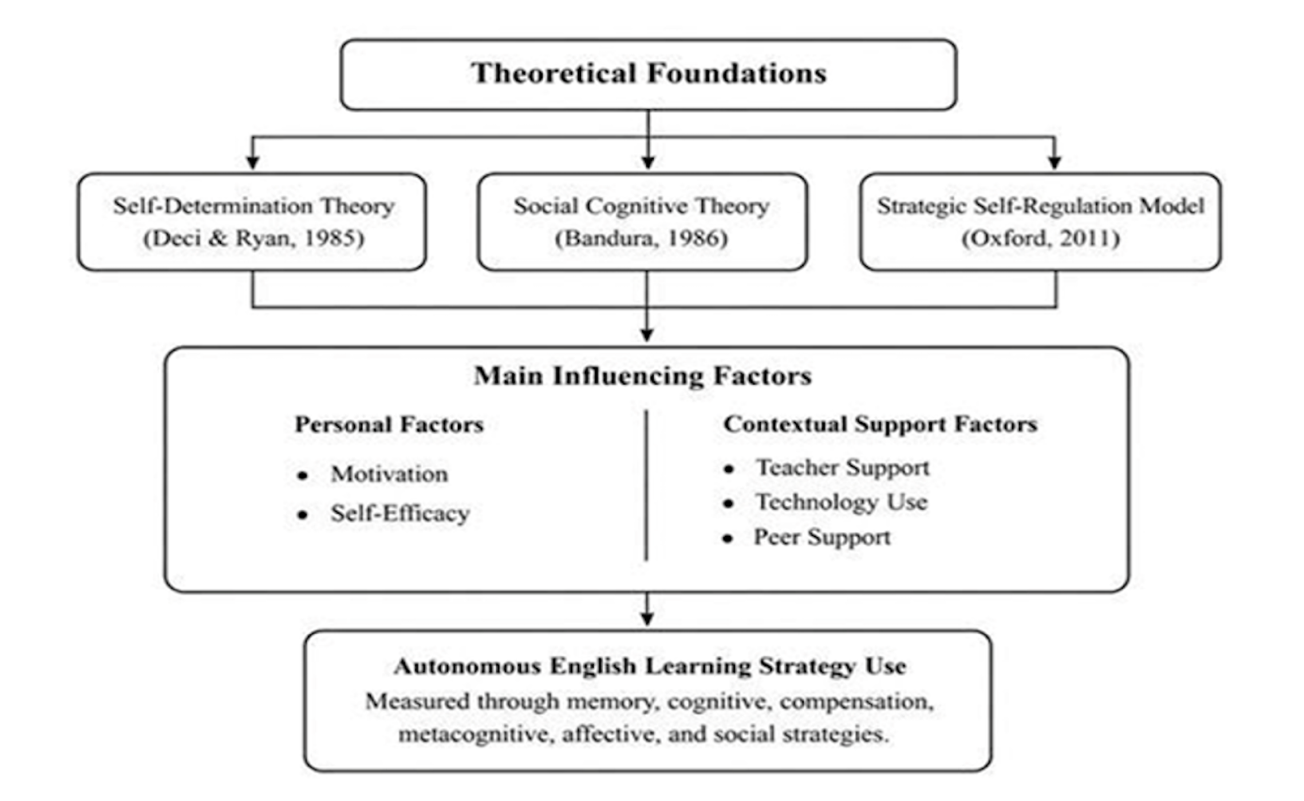
A conceptual framework examined non-English-major students’ autonomous English learning strategy use at Binh Duong Intermediate School of Economics. It draws on Self-Determination Theory (Deci & Ryan, 1985), Social Cognitive Theory (Bandura, 1986), and Oxford’s Strategic Self-Regulation Model (Oxford, 2011). Self-Determination Theory explains motivation, while Social Cognitive Theory explains self-efficacy. Oxford’s model explains purposeful strategy use in six categories, namely memory, cognitive, compensation, metacognitive, affective, and social strategies. The framework also includes teacher support, technology use, and peer support. These factors represent both learner-related and contextual influences that may shape how students manage and regulate English learning activities. Accordingly, five predictors, namely motivation, self-efficacy, teacher support, technology use, and peer support, are examined in relation to overall autonomous English learning strategy use (see Figure 1).
METHODOLOGY
This study employed a mixed-methods research design in which quantitative questionnaire data served as the primary source of evidence, while qualitative interview data provided supplementary explanation and contextual understanding. The methodology included research instruments, participant sampling, data collection and processing, analytical methods, and interview data analysis.
Research Instruments
This study used a survey questionnaire and a semi-structured interview. To collect quantitative data about learning strategies, this study employed a questionnaire on a five-point Likert scale from 1 (Never) to 5 (Always). It contained 55 items in two sections. The first included 30 items measuring autonomous English learning strategies based on Oxford’s (1990) six categories, namely memory, cognitive, compensation, metacognitive, affective, and social strategies. The second section contained 25 items measuring five factors, namely motivation, self-efficacy, teacher support, technology use, and peer support. Each factor included five items rated from 1 (Strongly Disagree) to 5 (Strongly Agree). All questionnaire items were newly developed for this research and structured to align with the framework of the six categories mentioned.
The study also used semi-structured interviews with ten non-English majors. Each participant spent approximately three to five minutes in the interview, and six questions covered two areas. The first addressed students’ autonomous English learning strategies, perceived effectiveness, and difficulties. The second examined motivation, self-efficacy, teacher support, technology use, and peer support, which were the same constructs as those in the questionnaire.
Data Collection and Processing
Sampling method
The study was conducted at BDISE in Binh Duong, Ho Chi Minh City, during the 2025-2026 academic year. The participants were 164 non-English-major students enrolled in compulsory English courses across different vocational programmes, and they answered the survey questionnaire. After data screening, two incomplete responses were removed, leaving 162 valid responses. The study used convenience sampling because the participants were selected based on their accessibility, availability, and willingness to participate. Although this method was suitable for the institutional context, it may limit the extent to which the findings can be generalised beyond the study setting, and it may overrepresent students who were more engaged and accessible, possibly leading to overestimation of the relationship between motivation and autonomous strategy use.
For the qualitative data, ten students from BDISE participated in semi-structured interviews. Before the interviews, the participants were informed about the purpose of the study, the voluntary nature of their participation, the confidentiality of their responses, and the use of the data for academic purposes only. Ten of the 162 participants were invited to take part in interviews to provide further information about their autonomous English learning strategies, learning difficulties, motivation, self-efficacy, teacher support, technology use, and peer support. Identification codes were assigned to protect their identities.
Data collection process
Data were collected in two stages through an online questionnaire and semi-structured interviews. The questionnaire was administered online via a Google Forms link and was completed by students independently in about 5 to 7 minutes. Before participation, students were informed of the study’s purpose, the voluntary nature of their involvement, the confidentiality of their responses, and the use of the data solely for academic purposes. During the first stage, the questionnaire was distributed through Google Forms to non-English-major students at BDISE. After the data collection period, all responses were screened for completeness and validity. Of the 164 responses, 2 were excluded because they were incomplete or invalid, resulting in a final dataset of 162 valid cases for quantitative analysis. The second stage continued with semi-structured interviews with ten students whose confidentiality was protected. Each interview lasted approximately three to five minutes and explored students’ autonomous English learning strategies, difficulties, motivation, teacher support, technology use, and peer support. With participants’ permission, the interviews were recorded during Zalo phone calls, then transcribed, reviewed, summarised, and organised according to the main themes used in the qualitative analysis.
Data processing
The questionnaire data were screened before analysis, and incomplete or invalid responses were removed. The final dataset consisted of 162 complete and valid cases. Because all retained responses were complete and usable, no missing-data imputation was required. Responses were converted into numerical scores according to the two five-point Likert scales used in the questionnaire. For the first section, the 30 autonomous English learning strategy items were used to calculate mean scores for six strategy categories, namely memory, cognitive, compensation, metacognitive, affective, and social strategies. In addition, the 30 strategy items were averaged to create an overall autonomous English learning strategy-use score, which served as the dependent variable. The five items belonging to each predictor scale were averaged separately to create scores for motivation, self-efficacy, teacher support, technology use, and peer support. The same cleaned dataset was used for both conventional statistical and machine learning analyses. SPSS was employed for reliability analysis, descriptive statistics, Pearson correlation, and multiple regression, while Python was used for Random Forest Regression and XGBoost Permutation Importance.
Analytical Methods
Reliability and descriptive statistics
Cronbach’s alpha was used to assess the internal consistency of the questionnaire scales. The analysis was conducted for the autonomous English learning strategy scale and each of the five predictor scales, namely motivation, self-efficacy, teacher support, technology use, and peer support. A coefficient of .86 or higher was considered acceptable for the purposes of this educational study. All six scales showed strong internal consistency, with Cronbach’s alpha ranging from 0.86 to .98, and all values surpassed the threshold.
Table 1. Reliability of the Questionnaire Scales
|
Scale |
Number of Items |
Cronbach’s Alpha |
|---|---|---|
|
Autonomous English Learning Strategies (ALS) |
30 |
.98 |
|
Motivation (MOT) |
5 |
.87 |
|
Self-Efficacy (SE) |
5 |
.86 |
|
Teacher Support (TS) |
5 |
.86 |
|
Technology Use (TU) |
5 |
.89 |
|
Peer Support (PS) |
5 |
.87 |
|
N = 162 |
||
Means and standard deviations were calculated to summarise students’ use of autonomous English learning strategies and the measured levels of the five influencing factors. For Research Question 1, descriptive statistics were used to compare the six strategy categories, namely memory, cognitive, compensation, metacognitive, affective, and social strategies. These comparisons helped identify which strategies were reported more frequently and whether noticeable differences existed among the six categories.
Pearson correlation analysis
Pearson correlation analysis was conducted to examine the strength and direction of the relationship between overall autonomous English learning strategy use and each of the five predictor variables, namely motivation, self-efficacy, teacher support, technology use, and peer support. The correlation coefficients were used to determine the extent to which each predictor was associated with students’ overall strategy use. Statistical significance was also examined to identify whether the observed relationships were significant. Correlation was examined before regression because it could show the strength and direction of the relationship between each predictor and the outcome. Multiple regression then assessed the contribution of each predictor when all five were considered at the same time. This analysis provided an initial comparison of the five predictors before their simultaneous contributions were examined through multiple regression analysis.
Random Forest regression
The study also used Random Forest Regression to assess factor importance and predict individual factor contributions. This machine learning method combines multiple decision trees and estimates the relative contribution of each input variable to the prediction of learning strategy use as the target variable. The mean scores for motivation, self-efficacy, teacher support, technology use, and peer support were used as the input variables, and the target variable was overall autonomous English learning strategy use. The process began by analysing the whole dataset to identify which features were most important for this specific group of students. We were not trying to build a model to predict what a new group of people would do. The resulting importance scores were compared to identify which variables contributed most strongly within the Random Forest model. The reported R² value was treated as an in-sample measure of model fit, and it does not guarantee good predictions for new data because a model might fit training data but still fail with other unseen data.
XGBoost Permutation Importance
XGBoost Permutation Importance was used to provide more evidence about the relative importance of the five predictor variables. Permutation importance measures how much model performance drops when one predictor variable is randomly shuffled. A larger drop means that the predictor variable is more important. The five predictor variables were motivation, self-efficacy, teacher support, technology use, and peer support, compared with the use of autonomous English learning strategy as the target variable. When a factor is removed and model performance decreases substantially, that factor makes a stronger contribution. The complete dataset was analysed, and the reported R² value was therefore interpreted as an in-sample measure of model fit rather than as evidence of predictive accuracy.
Interview data analysis
Using Braun and Clarke’s (2006) principles of thematic analysis, the interview responses from ten students were analysed through a theme-based coding process. The responses were reviewed and organised according to six themes, namely autonomous English learning strategies, learning difficulties, motivation, teacher support, technology use, and peer support. Relevant responses were assigned to the appropriate themes and summarised to identify recurring ideas across participants. Particular attention was given to statements concerning future study, employment opportunities, communication ability, and personal confidence because these responses helped explain the prominent role of motivation. The interview data were used as supplementary evidence rather than as a separate source for statistical generalization. They provided contextual explanations of students’ autonomous English learning experiences and helped clarify and support the main quantitative findings.
Data Analysis
The study used descriptive statistics to examine students’ use of six categories of autonomous English learning strategies, namely memory, cognitive, compensation, metacognitive, affective, and social strategies. In addition, Pearson correlation analysis was used to examine the relationships between overall autonomous English learning strategy use and the five predictor variables. Multiple regression analysis was used to determine each predictor variable’s contribution, and Random Forest Regression and XGBoost Permutation Importance subsequently provided complementary rankings of predictor importance. Pearson correlation, regression, Random Forest Regression, and XGBoost Permutation Importance were compared for consistency in ranking. Because these analytical methods assess predictor influence differently, their numerical values were not treated as directly equivalent. Instead, the comparison focused on relative rankings and the consistency of the leading factor across methods. Finally, the interview findings were reviewed and compared with the quantitative results to provide contextual explanations of students’ autonomous English learning experiences and clarify the prominent role of motivation.
RESULTS
The quantitative and qualitative results showed two key patterns. Students used all six groups of autonomous English learning strategies at relatively balanced levels, with Social strategies used most and Affective strategies used least. In addition, of the five factors examined, motivation was consistently the strongest predictor of strategy use across the analytical methods.
Autonomous English Learning Strategies Used by Non-English Majors
Regarding the autonomous English learning strategies used by non-English majors at BDISE, the study used descriptive statistics to examine the six categories of autonomous English learning strategies. The results in Table 2 show that students reported using all six categories of autonomous English learning strategies. Social strategies obtained the highest mean score (M = 3.47), followed by Memory and Metacognitive strategies, which both recorded a mean of 3.45. Cognitive strategies had a mean of 3.43, while Compensation strategies obtained a mean of 3.42. Affective strategies had the lowest mean score (M = 3.39).
Table 2. Autonomous English Learning Strategy Use by Category
|
Descriptive Statistics |
|||||
|---|---|---|---|---|---|
|
N |
Minimum |
Maximum |
Mean |
Std. Dev. |
|
|
Memory_Mean |
162 |
1.80 |
5.00 |
3.45 |
.78 |
|
Cognitive_Mean |
162 |
1.40 |
5.00 |
3.43 |
.77 |
|
Compensation_Mean |
162 |
1.40 |
5.00 |
3.42 |
.78 |
|
Metacognitive_Mean |
162 |
1.80 |
5.00 |
3.45 |
.77 |
|
Affective_Mean |
162 |
1.40 |
5.00 |
3.39 |
.77 |
|
Social_Mean |
162 |
1.80 |
5.00 |
3.47 |
.78 |
|
Valid (listwise) |
162 |
||||
Although Social strategies ranked first and Affective strategies ranked last, the differences among the six categories were relatively small. Rather than emphasising the ranking, the mean scores, which ranged from 3.39 to 3.47, suggest that students used the six categories of strategies at relatively balanced levels.
Factors Influencing Autonomous English Learning Strategy Use
To answer Research Question 2, Pearson correlation analysis and multiple regression analysis were first conducted to examine the relationships and predictive contributions of the five factors. Random Forest Regression and XGBoost Permutation Importance were subsequently employed to provide complementary evidence concerning predictor importance.
Pearson Correlation analysis
The study used Pearson correlation analysis to examine the relationships between overall autonomous English learning strategy use and the five predictor variables. The results are presented in Table 3 below. Table 3 shows that the overall use of autonomous English learning strategy (ALS) was positively correlated with all five predictor variables, and all correlations were statistically significant at the .01 level. Motivation (MOT) showed the strongest connection with strategy use (r = .65), followed by Technology Use (TU), Peer Support (PS), Teacher Support (TS), and Self-Efficacy (SE), with r = .61, r = .59, r = .58, and r = .56, respectively. The levels of motivation, self-efficacy, teacher support, technology use, and peer support were high, suggesting that the level of autonomous English learning strategy use was high. Of the five factors considered, motivation was the most closely tied to the final result.
Table 3. Pearson Correlations with Autonomous English Learning Strategy Use
|
Correlations |
|||||||
|---|---|---|---|---|---|---|---|
|
ALS_Mean |
MOT_Mean |
SE_Mean |
TS_Mean |
TU_Mean |
PS_Mean |
||
|
ALS_ Mean |
Pearson Correlation |
1 |
.65 |
.56 |
.58 |
.61 |
.59 |
|
p-value |
<.001 |
<.001 |
<.001 |
.001 |
<.001 |
||
|
MOT_ Mean |
Pearson Correlation |
.65 |
1 |
.38 |
.41 |
.38 |
.39 |
|
p-value |
<.001 |
<.001 |
<.001 |
.001 |
<.001 |
||
|
SE_ Mean |
Pearson Correlation |
.56 |
.38 |
1 |
.41** |
.36 |
.46 |
|
p-value |
<.001 |
<.001 |
<.001 |
.001 |
<.001 |
||
|
TS_ Mean |
Pearson Correlation |
.58 |
.41 |
.41 |
1 |
.36 |
.41 |
|
p-value |
<.001 |
.001 |
<.001 |
<.001 |
<.001 |
||
|
TU_ Mean |
Pearson Correlation |
.61 |
.38 |
.36 |
.36 |
1 |
.43 |
|
p-value |
<.001 |
<.001 |
.001 |
<.001 |
<.001 |
||
|
PS_ Mean |
Pearson Correlation |
.59 |
.39 |
.46 |
.41 |
.43 |
1 |
|
p-value |
<.001 |
<.001 |
.001 |
<.001 |
<.001 |
||
Multiple Regression analysis
Pearson correlations and other methods often focus on linear relationships and may overlook non-linear relationships, so the contributions of each factor and the importance of individual variables are often unclear. Therefore, this study used algorithms and other analytical methods.
Table 4. Multiple Regression Results for Autonomous English Learning Strategy Use
|
Predictor |
B |
SE |
β |
t |
p |
Tolerance |
VIF |
|---|---|---|---|---|---|---|---|
|
Constant |
-0.54 |
0.21 |
- |
-2.56 |
0.011 |
- |
- |
|
Motivation |
0.33 |
0.05 |
0.33 |
6.37 |
< 0.001 |
0.72 |
1.37 |
|
Self-Efficacy |
0.18 |
0.05 |
0.18 |
3.40 |
< 0.001 |
0.70 |
1.43 |
|
Teacher Support |
0.21 |
0.05 |
0.21 |
3.97 |
< 0.001 |
0.71 |
1.40 |
|
Technology Use |
0.27 |
0.05 |
0.28 |
5.41 |
< 0.001 |
0.73 |
1.37 |
|
Peer Support |
0.17 |
0.05 |
0.17 |
3.20 |
0.002 |
0.66 |
1.52 |
Multiple regression analysis was conducted to examine the predictive contributions of the five variables to the use of autonomous English learning strategies. The results are presented in Table 4 below. The regression model produced R = .84, R² = .70, and an adjusted R² of .69. Thus, the five predictor variables accounted for 70% of the variance in the use of autonomous English learning strategies, and the overall model was statistically significant. All five variables were significant predictors. Motivation had the strongest effect on learning strategy use among non-English-major students (β = .33, p < .001). The next strongest predictor was Technology Use (β = .28, p < .001), followed by Teacher Support (β = .21, p < .001), Self-Efficacy (β = .18, p < .001), and Peer Support (β = .17, p = .002). The Variance Inflation Factor values ranged from 1.4 (Technology Use) to 1.5 (Peer Support), indicating that multicollinearity was not a concern in determining autonomous learning strategy use.
Random Forest regression
The study also used Random Forest regression to provide more evidence about the relative importance of the five predictor factors, and the results are shown in Figure 2.
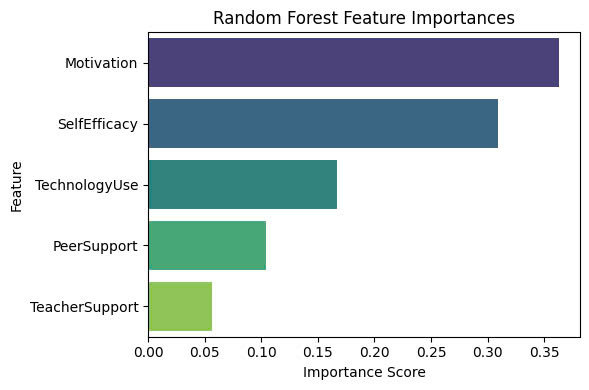
The results showed that Motivation had the highest feature-importance score (.36), followed by Self-Efficacy (.31), while Teacher Support (.06) ranked last. Technology Use scored .17, and Peer Support obtained .10. The model also produced an R² of .96. This high in-sample R² primarily reflects the flexibility of the Random Forest in fitting the training data rather than indicating that the observed data were reliable. We analysed the complete dataset without a separate training and testing split, so this value reflects fit within the available sample, and new samples could be interpreted differently.
XGBoost Permutation Importance
The result from Random Forest regression showed that Motivation scored the highest. This study examined whether the same result could be achieved using a different model, XGBoost Permutation Importance. XGBoost Permutation Importance was used to check feature importance and provide further evidence about the relative importance of the five predictor variables. The results are shown in Figure 3.
The model produced an in-sample R² of .98 or 98%. As with Random Forest, this high in-sample R² reflects model fit to the training data rather than data reliability. Like the Random Forest model, we analysed the complete dataset, but did not use a separate training and testing split, so this value reflects model fit within the available sample. The results also showed that Motivation obtained the highest permutation-importance score (.40), followed by Self-Efficacy (.33), Peer Support (.20), Technology Use (.17), and Teacher Support (.08). Thus, Motivation ranked first, and Teacher Support ranked last.
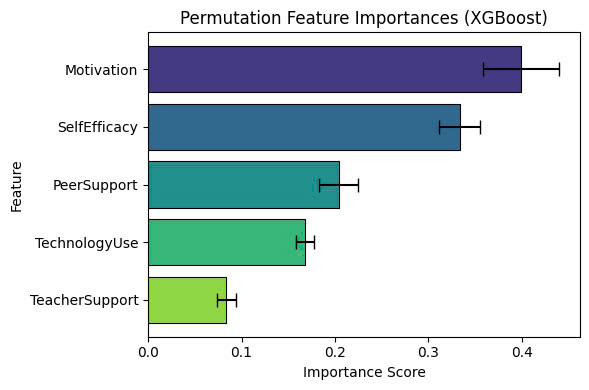
Overall, the XGBoost results were consistent with the Random Forest findings. Both machine learning approaches identified motivation as the most influential predictor and self-efficacy as the second most important factor. However, both models are tree-based, trained, and evaluated on the same sample, and the consistency does not by itself validate the predictor rankings; it may partly reflect shared assumptions between the two algorithms rather than independent confirmation. The results from the Random Forest model, with an R² of .96, and the XGBoost model, with an R² of .98, together suggest that Motivation was the most influential factor affecting the use of autonomous learning strategies among BDISE students when learning English.
Results from the Interview
The data from interviews with ten students provided evidence about students’ autonomous English learning experiences and the factors affecting their use. The responses from the ten participants were in line with the quantitative data. The students said that they used almost all the strategies and that Social strategies were used most often. Interview responses were organised into six themes, with Motivation most frequently referenced by participants, who linked it to future study and employment goals (e.g., NCK01, NTL06). Other factors, such as Teacher support, technology use, peer support, and self-efficacy, were each referenced by a smaller number of participants.
DISCUSSION
The discussion first considers students’ use of the six categories of autonomous English learning strategies and then addresses the relative importance of motivation, self-efficacy, teacher support, technology use, and peer support.
Autonomous English Learning Strategies Used by Non-English Majors
The findings showed that students used all six categories of autonomous English learning strategies. Social strategies obtained the highest mean score, and Affective strategies received the lowest, but differences among the six categories were relatively small. This suggests that students did not rely heavily on one type of strategy but instead used a broad range of strategies in their autonomous English learning. The relatively high use of Social strategies indicates that interaction with classmates or other people may play an important role in students’ English learning. Students may seek help, exchange information, practise English with others, or cooperate with their peers when completing learning activities. This is consistent with Oxford’s (1990) view that Social Strategies support language learning through interaction and cooperation.
However, the slightly lower mean for Affective strategies also suggests that students may make somewhat less frequent use of techniques for managing emotions, anxiety, and confidence during English learning. Because the overall differences among categories were small, the findings show relatively balanced strategy use rather than a single dominant category. The use of various language learning strategies was found in the literature, including Chen and Pan (2015) and Le and Nguyen (2022). In brief, the results show that non-English majors at BDISE employed diverse autonomous English learning strategies, which provided the descriptive foundation for examining the factors that influence their overall strategy use.
Factors Influencing Autonomous English Learning Strategy Use
Motivation
Motivation emerged as the most influential factor across all the analytical methods. It showed the strongest Pearson correlation with autonomous English learning strategy use (r = .65), the largest standardised coefficient in multiple regression (β = .33, p < .001), and the highest importance scores in both Random Forest Regression (.36) and XGBoost Permutation Importance (.40). This finding is consistent with Self-Determination Theory, which emphasises the role of motivation in beginning and sustaining learning behaviour (Deci & Ryan, 1985).
In line with the quantitative data, the students said they used almost all the strategies, Social strategies were used most, and motivation was the factor most frequently highlighted by participants. For example, “motivation helps me continue learning and not give up easily” (NTL06). The students also commonly associated their motivation to learn English independently with future study, employment opportunities, communication ability, and personal confidence. Participants explained that English could help them obtain better jobs, communicate more effectively, and prepare for further education. “My strongest motivation is my future job. I know that English is important for work after graduation” (NCK01). The students’ responses supported the quantitative findings, and motivation was the strongest predictor affecting autonomous English learning strategy use.
Self-efficacy
Across the four analytical methods, Self-Efficacy showed an interesting pattern because its ranking differed across models. It had the lowest Pearson correlation among the five predictors (r = .56) and ranked fourth in multiple regression (β = .18, p < .001), but it increased to second place in Random Forest regression with .31 and XGBoost Permutation Importance with .33. Using several analytical models was intended to check the consistency of Self-Efficacy’s contribution because multiple machine learning models remain underexamined in the literature. In our study, Random Forest Regression and XGBoost Permutation Importance showed that Self-Efficacy was important, which was consistent with Zimmerman’s (2000) view that students who believe in themselves are more likely to take responsibility for their learning. In other words, students who believed in themselves more might be more willing to make plans for learning English and might achieve better results.
Teacher support
The result showed that Teacher Support was associated with autonomous English learning strategy use (r = .58), and Teacher Support ranked third in the multiple regression model (β = .21, p < .001). This suggests that teacher guidance, encouragement, and feedback remain important in supporting students’ learning, consistent with Benson’s (2011) argument that learner autonomy does not exclude the teacher. Teachers may help students develop strategy awareness, confidence, and other forms of support. Therefore, Teacher Support was necessary and important for students.
Technology use
Technology Use showed a strong positive relationship with autonomous English learning strategy use (r = .61) and ranked second in the multiple regression model (β = .28, p < .001). It ranked third in Random Forest Regression (.17) and fourth in XGBoost Permutation Importance (.17). This finding indicates that digital resources can support students’ independent English learning by providing convenient access to learning materials such as online dictionaries, videos, mobile applications, learning websites, and AI-supported tools. The learning resources may provide students with more learning opportunities beyond class and allow students to practise English more regularly. The result is consistent with previous research suggesting that digital learning environments can facilitate learner autonomy by increasing access to learning materials and opportunities for independent practice (Dmitrenko et al., 2021; Tan et al., 2024).
Peer support
The results showed that Peer Support was linked with autonomous English learning strategy use (r = .59) and was a significant predictor in the multiple regression model (β = .17, p = .002). It ranked fourth in Random Forest Regression (.11) and third in XGBoost Permutation Importance (.204). This suggests that classmates and friends could help each other in autonomous English learning and could support cooperation, resource sharing, and discussion of learning difficulties. Although autonomous learning emphasises individual responsibility, learners do not necessarily study alone, and they could work with their friends. This was consistent with Oxford’s (1990) emphasis on social strategies and also aligned with Benson’s (2011) perspective on the development of learner autonomy through talk and interaction. The Peer Support factor was in line with Nguyen and Godwyll (2010), as language learners often used Social strategies, and supportive peers might provide support and encouragement to help students continue learning.
CONCLUSION
This study examined the autonomous English learning strategies used by non-English majors at BDISE and the factors affecting their strategy use. The findings showed that all six groups of strategies were used. Social Strategies were the most common, while Affective strategies were the least common, although the differences were not large. Of the five factors examined in this study, motivation consistently stood out as the most influential driver. Interview data supported the findings when the students said they were motivated to use English for their future, job opportunities, and personal confidence.
These results provide practical recommendations. Because motivation matters most, teachers should help students connect English learning to the goals they most want to achieve and build self-efficacy through achievable tasks and regular feedback. Practical strategies include helping students set realistic goals and gradually shifting responsibility to them so that they gain learning autonomy. Technology, AI tools, learning materials, and peer collaboration through shared resources and joint practice are suggested to help students build learning habits.
However, this study has some limitations. The participants came only from BDISE, so the findings may not generalise to other school settings. The study also relied mainly on students’ self-reported data, which may obscure actual behaviour. The machine learning models were run on the complete dataset, so the results reflect model fit rather than predictive performance on new data. These limitations may have shaped how the findings should be interpreted, especially because the design was based on one school, convenience sampling, and self-report data. The results also could not capture how strategy use or motivation may change over time. Future research could use larger and more varied samples, longitudinal designs, and closer examination of how AI models are shaping autonomous English learning.
References
Abu Shmais, W. A. (2003). Language learning strategy use in Palestine. TESL-EJ, 7(2), 1-17. https://tesl-ej.org/ej26/a3.html
Azza, M., & Rini, S. (2026). Students’ autonomous learning strategies in improving writing skills through global chat rooms in Black Desert Mobile. Proceeding International Conference on Islam, Law, and Society (INCOILS), 5(1), 1-12. https://doi.org/10.70062/incoils.v5i1.378
Bandura, A. (1986). Social foundations of thought and action: A social cognitive theory. Prentice Hall.
Bandura, A. (1997). Self-efficacy: The exercise of control. W. H. Freeman.
Benson, P. (2011). Teaching and researching autonomy (2nd ed.). Pearson Education.
Braun, V., & Clarke, V. (2006). Using thematic analysis in psychology. Qualitative Research in Psychology, 3(2), 77-101. https://doi.org/10.1191/1478088706qp063oa
Chen, H.-I., & Pan, H.-H. (2015). Learner autonomy and the use of language learning strategies in a Taiwanese junior high school. Journal of Studies in Education, 5(1), 52-64. https://doi.org/10.5296/jse.v5i1.6972
Dang, N., Cao, T.-D., Nguyen, T. V. H., Nguyen, T.-L., Nguyen, T.-D., & Nguyen, M.-L. (2025). AI acceptance among Vietnamese university students: Key influencers and perspectives. International Journal of Information and Education Technology, 15(12), 2755-2769. https://doi.org/10.18178/ijiet.2025.15.12.2470
Dang, T. T. (2024). Cultural and situational constraints on undergraduate students’ performance of learner autonomy in EFL learning. Journal of Language Teaching and Research, 15(6), 1791-1799. https://doi.org/10.17507/jltr.1506.04
Dang, T. T. (2025). Developing a model for learner autonomy capacity measurement in EFL learning. rEFLections, 32(2), 1099–1119. https://doi.org/10.61508/refl.v32i2.283186
Deci, E. L., & Ryan, R. M. (1985). Intrinsic motivation and self-determination in human behavior. Plenum. https://doi.org/10.1007/978-1-4899-2271-7
Dmitrenko, N., Petrova, A., Podzygun, O., & Nikolaeva, S. (2021). Strategies in autonomous learning of professionally oriented English communication. Journal of Teaching English for Specific and Academic Purposes, 9(3), 527-540. https://doi.org/10.22190/JTESAP2103527D
Duong, M. T. (2020). First-year English majors’ use of autonomous learning strategies. VNU Journal of Science: Education Research, 36(3), 52-60. https://doi.org/10.25073/2588-1159/vnuer.4439
Gass, S. M., & Selinker, L. (2001). Second language acquisition: An introductory course (2nd ed.). Lawrence Erlbaum Associates. DOI: https://doi.org/10.4324/9781410604651
Green, J. M., & Oxford, R. L. (1995). A closer look at learning strategies, L2 proficiency, and gender. TESOL Quarterly, 29(2), 261-297. https://doi.org/10.2307/3587625
Holec, H. (1981). Autonomy and foreign language learning. Pergamon Press.
Hong-Nam, K., & Leavell, A. G. (2006). Language learning strategy use of ESL students in an intensive English learning context. System, 34(3), 399-415. https://doi.org/10.1016/j.system.2006.02.002
Le, H. T. Q., & Nguyen, T. H. (2022). A study on non-English major students’ learner autonomy: Difficulties and solutions. International Journal of TESOL & Education, 2(3), 197-207. https://doi.org/10.54855/ijte.222313
Little, D. (1991). Learner autonomy: Definitions, issues and problems. Authentik.
Nguyen, H. T. M., & Godwyll, F. (2010). Factors influencing language-learning strategy use of English learners in an ESL context. Mid-Western Educational Researcher, 23(4), 7-13. https://scholarworks.bgsu.edu/mwer/vol23/iss4/3/
Oxford, R. L. (1990). Language learning strategies: What every teacher should know. Heinle & Heinle.
Oxford, R. L. (2011). Teaching and researching language learning strategies. Pearson Education.
Peng, Y. (2019). Strategies for cultivating non-English majors’ autonomous learning ability. English Language Teaching, 12(7), 58-60. https://doi.org/10.5539/elt.v12n7p58
Tan, T. P., Hanh, T. T. N., & Huong, G. N. H. (2024). Learner autonomy through the use of ChatGPT by third-year students of English Faculty at the University of Foreign Language Studies (UFLS). EDUKASIA: Jurnal Pendidikan dan Pembelajaran, 5(2), 139-148. https://doi.org/10.62775/edukasia.v5i2.1159
Tran, L. T. P., Dang, T. T., & Nguyen, T. N. A. (2024). Imagination development as a construct for professional identity of early career English teachers working at public schools: Contributions of interactions with learners. Theory and Practice in Language Studies, 14(2), 329-338. https://doi.org/10.17507/tpls.1402.03
Wang, K. F. (2008). Investigation and analysis of non-English majors’ autonomous English learning in higher vocational colleges [Unpublished master’s thesis]. Zhejiang Normal University.
Xu, J. (2009). A survey study of autonomous learning by Chinese non-English major postgraduates. English Language Teaching, 2(4), 25-32. https://doi.org/10.5539/elt.v2n4p25
Zhao, X., & Chen, W. (2014). Correlation between learning motivation and learner autonomy for non-English majors. World Transactions on Engineering and Technology Education, 12(3), 374-379. https://www.wiete.com.au/journals/WTE&TE/Pages/Vol.12,%20No.3%20(2014)/08-Zhao-X.pdf
Zimmerman, B. J. (2000). Attaining self-regulation: A social cognitive perspective. In M. Boekaerts, P. R. Pintrich, & M. Zeidner (Eds.), Handbook of self-regulation (pp. 13-39). Academic Press. https://doi.org/10.1016/B978-012109890-2/50031-7
Downloads
Published
Data Availability Statement
The data is available for access.
Issue
Section
License
Copyright (c) 2026 Thanh Hoang Ho, Nhon Dang

This work is licensed under a Creative Commons Attribution-NonCommercial-NoDerivatives 4.0 International License.