
Followership as a predictor of primary school teachers’ organisational commitment in Phan Thiet, Vietnam
DOI:
https://doi.org/10.65956/leqa.2026.52Keywords:
followership behaviour, organisational commitment, primary school teachers, Vietnam, PLS-SEMAbstract
Leadership has dominated educational management research, yet school improvement also depends on teachers who actively interpret, support, and question school decisions. This cross-sectional quantitative study examined whether followership predicts affective, normative, and continuance commitment among 95 primary school teachers in Phan Thiet, Vietnam. Followership was measured using an adapted Kelley-based Revised Kelley Followership Questionnaire, and organisational commitment was modelled as three separate first-order reflective constructs. PLS-SEM results showed that followership was positively associated with affective commitment (β = 0.564, p < .001), normative commitment (β = 0.388, p < .001), and continuance commitment (β = 0.337, p < .001). The strongest explanatory and predictive evidence was found for affective commitment, as shown by the highest R², Q²_predict, and PLSpredict performance. Controlled analyses confirmed that the followership paths remained significant after accounting for gender, age, teaching experience, and school size, although age and teaching experience were more relevant to normative and continuance commitment. Supplementary dimension-specific analysis showed that active engagement predicted commitment more consistently than independent critical thinking. The findings suggest that teacher followership, especially active engagement, is most strongly linked to affective commitment to the school, while normative and continuance commitment depend more on career-stage and contextual factors.
INTRODUCTION
Educational leadership research has traditionally explained school effectiveness through the actions of principals and administrators because principals set direction, allocate resources, supervise instruction, and shape school climate (Baker, 2007; Kelley, 1988, 1992; Uhl-Bien et al., 2014; UNESCO, 2025). This leader-centred orientation is useful but incomplete. School improvement also depends on teachers who interpret leadership decisions, adapt policies to classroom realities, collaborate with colleagues, and offer professional feedback when implementation problems arise (Carsten et al., 2010; Chaleff, 2009; Uhl-Bien et al., 2014). Teachers are therefore not only recipients of leadership but also participants in leadership processes whose followership can influence school stability, reform implementation, and organisational commitment (Tran et al., 2024).
This issue is especially important in primary education. Primary teachers work continuously with pupils, parents, colleagues, and administrators, so their willingness to support school goals affects instructional consistency, school climate, and organisational continuity (Meyer & Allen, 1991, 1997; World Bank Group, 2025). In this setting, followership refers to teachers’ active engagement with school goals and their independent professional judgement when school decisions require interpretation, adaptation, or improvement (Kelley, 1988, 1992). Such behaviours may strengthen organisational commitment because teachers who participate meaningfully in school improvement are more likely to identify with the school, feel responsibility towards it, and develop stronger affective, normative, and continuance commitment to the school.
The Vietnamese primary school context makes this relationship timely. Vietnam has invested substantially in teacher education, qualification upgrading, and school leadership development, while schools are also expected to respond to reform pressure, administrative demands, and stronger expectations for teacher professionalisation (UNESCO, 2025; World Bank Group, 2025). At the same time, national reporting has identified teacher shortages and recruitment difficulties, increasing the practical importance of teacher retention and organisational commitment (Tuoi Tre News, 2025). These conditions make it insufficient to study leadership only from the principal’s perspective. Vietnamese schools also need evidence on how teachers’ followership, active engagement, and independent professional judgement are associated with their commitment to the school.
Despite this relevance, the relationship between followership and teachers’ organisational commitment remains underdeveloped in educational leadership research. Studies of teacher commitment have commonly emphasised leadership style, school climate, job satisfaction, demographic characteristics, or career stage, while the follower role of teachers has received less direct attention (Dalgıç, 2014; Uhl-Bien et al., 2014). Other studies have shown that commitment is shaped by school-level relational and cultural conditions rather than by individual attitudes alone (Hulpia & Devos, 2010; Gök & Özçetin, 2021; Samancioglu et al., 2019). However, these studies still focus mainly on leadership conditions and school culture, while the teacher’s role as a follower remains less directly examined. This leaves a theoretical gap: teachers may strengthen or weaken school improvement not only through compliance with leadership but also through critical judgement, active engagement, and collaborative implementation. It also leaves a practical gap for Vietnamese primary schools, where administrators need strategies for supporting teacher commitment without reducing teachers to passive implementers of reform.
The purpose of this study is to examine whether followership predicts three dimensions of organisational commitment among primary school teachers in Phan Thiet, Vietnam. The study treats affective commitment, normative commitment, and continuance commitment as distinct psychological bases for remaining with an organisation rather than combining them into a single overall commitment score (Meyer & Allen, 1990, 1991, 1997). This distinction is important because followership may be more closely related to affective identification and professional responsibility than to continuance reasons for staying.
The study is guided by the following research questions:
RQ1: To what extent does followership predict affective commitment among primary school teachers?
RQ2: To what extent does followership predict normative commitment among primary school teachers?
RQ3: To what extent does followership predict continuance commitment among primary school teachers?
Answering these questions allows the study to contribute to educational leadership research in three ways. First, it places teacher followership at the centre of a model of organisational commitment. Second, it clarifies organisational commitment by analysing affective, normative, and continuance commitment separately. Third, it offers context-sensitive implications for Vietnamese primary schools seeking to strengthen teacher commitment through followership, active engagement, and independent critical thinking.
LITERATURE REVIEW
Conceptual Framework
In the primary model, followership is specified as an overall first-order reflective predictor representing teachers’ general followership orientation. This modelling decision is used as a bounded predictive specification because the research questions examine whether teachers’ overall followership predicts organisational commitment, and PLS-SEM allows construct specification to be aligned with the theoretical purpose of the model and the level of abstraction being tested (Hair et al., 2021; Sarstedt et al., 2017). The construct remains grounded in Kelley’s two conceptual dimensions, independent critical thinking and active engagement, but the primary analysis tests their combined score for parsimony, while the supplementary analysis interprets the two dimensions separately (Kelley, 1988, 1992; Gatti et al., 2014).
The primary model links followership to three separate endogenous outcomes: affective commitment, normative commitment, and continuance commitment. This specification is theoretically necessary because the three forms of commitment represent different psychological bases for remaining in an organisation: emotional attachment, felt obligation, and perceived cost of leaving (Meyer & Allen, 1990, 1991, 1997; Meyer & Herscovitch, 2001). A teacher may remain because the school is emotionally meaningful, because remaining feels professionally or morally appropriate, because leaving would be costly, or because several of these reasons operate together. Treating the three components as separate reflective constructs allows the analysis to identify which commitment basis is most closely associated with followership.
Organisational commitment is therefore not modelled as a formative second-order construct in this study. A formative second-order model would imply that affective, normative, and continuance commitment combine to form a single overall commitment index, whereas the three-component model treats them as distinct commitment mindsets rather than interchangeable indicators of one general attitude (Meyer & Allen, 1990, 1991, 1997; Meyer & Herscovitch, 2001). Such a specification would obscure the different psychological meanings of the three components and would be inconsistent with the study’s aim of comparing how followership relates to each commitment basis. The framework instead assumes that followership is most directly connected to affective identification and meaningful participation, moderately connected to professional obligation, and more weakly connected to continuance commitment.
The KFQ-R is grounded in two dimensions: independent critical thinking and active engagement. Previous Kelley-based measurement work has provided psychometric support for the two-dimensional structure of Kelley’s Followership Questionnaire, although this evidence was not developed from Vietnamese teacher samples (Gatti et al., 2014). The present study therefore does not claim full Vietnamese-context validation of the adapted instrument. Instead, it evaluates measurement quality in the current sample and treats the lack of teacher-specific validation in Vietnam as a limitation. To address the two-dimensional foundation of the scale, the study also reports a supplementary model in which active engagement and independent critical thinking are tested separately, using PLS-SEM guidance that theoretically meaningful alternative or supplementary model specifications can be examined to assess the robustness and interpretability of structural relationships (Hair et al., 2021; Sarstedt et al., 2017).
Followership Theory
Followership research has moved beyond the view of followers as passive subordinates. Baker (2007) showed that followership has a broader theoretical foundation than simple obedience, while Carsten et al. (2010), in a qualitative empirical study, found that individuals socially construct followership in ways that range from passive compliance to proactive co-production of organisational outcomes. Uhl-Bien et al. (2014) further argued that followership should be understood as a relational process shaped by leadership, followers, and context. These studies are important for education because teachers work within formal hierarchies but also exercise professional judgement in daily practice.
Kelley’s (1988, 1992) model remains central to the present study because it identifies two behavioural qualities of effective followers: independent critical thinking and active engagement. Independent critical thinking involves evaluating decisions, identifying problems, and offering reasoned alternatives rather than merely accepting instructions. Active engagement involves initiative, effort, participation, and willingness to support organisational goals. This two-dimensional conceptualisation has informed later Kelley-based questionnaire work, including validation research that supports the relevance of independent critical thinking and active engagement as measurable followership dimensions (Gatti et al., 2014).
In schools, followership can be understood as professional teacher agency within legitimate organisational goals. A teacher who demonstrates followership neither complies passively nor engages in opposition detached from school improvement. Instead, the teacher supports school goals while also raising informed concerns when policies, routines, or implementation plans require adjustment (Chaleff, 2009; Carsten et al., 2010; Uhl-Bien et al., 2014). This makes the construct relevant to Vietnamese primary schools, where reform implementation requires teachers to adapt policy expectations to pupils’ needs, grade-level coordination, and local school conditions (UNESCO, 2025; World Bank Group, 2025).
Organisational Commitment Theory
Organisational commitment refers to a psychological bond between an employee and an organisation (Meyer & Allen, 1991). Meyer and Allen (1990, 1991, 1997) distinguish three components. Affective commitment refers to emotional attachment, identification, and involvement. Normative commitment refers to a felt obligation to remain. Continuance commitment refers to the perceived costs associated with leaving. Meyer and Herscovitch (2001) later emphasised that commitment can involve different mindsets, which supports careful construct specification rather than the use of a single undifferentiated commitment score.
Teacher commitment is particularly important because schools depend on teachers’ sustained professional participation. Dalgıç’s (2014) meta-analysis of teachers’ organisational commitment showed that commitment research in education commonly examines demographic differences and commitment dimensions rather than treating commitment as a uniform attitude. This supports the present study’s decision to examine affective, normative, and continuance commitment separately. It also justifies the inclusion of demographic and school-level controls in a supplementary model because teacher commitment may vary by gender, age, teaching experience, and school context.
In Vietnamese primary schools, organisational commitment has practical significance because teacher professionalisation, recruitment pressure, and leadership development are policy concerns (UNESCO, 2025; Tuoi Tre News, 2025; World Bank Group, 2025). Affective commitment is relevant because reform implementation requires teachers to identify with school goals and professional improvement. Normative commitment is relevant because school culture may emphasise duty, collective responsibility, and respect for institutional roles. Continuance commitment is relevant because decisions to remain may also depend on career stage, perceived alternatives, family responsibilities, and local labour-market conditions.
Vietnamese Educational Context
The Vietnamese context strengthens the need to study teacher followership. Vietnam has undergone a long process of teacher professionalisation, including large-scale expansion of teacher education institutions, upgrading of teacher qualifications, and continuing professional development reforms (World Bank Group, 2025). The 2019 Education Law raised minimum qualification expectations for general education teachers, bringing primary teaching into a broader professionalisation agenda. These reforms require teachers not only to comply with policy requirements but also to learn, adapt, and collaborate in school-level implementation.
At the same time, leadership in Vietnamese schools is increasingly expected to support instruction, inclusion, data use, and teacher development. UNESCO (2025) reported that Vietnamese school principals spend limited time on instruction-related work and that many express a strong need for training in teacher support and related areas. This creates a practical opening for shared and supportive leadership-followership relations. When principals are administratively overloaded, teachers’ active engagement and critical voice become even more important for sustaining improvement.
Teacher shortages further increase the relevance of commitment. National reporting has noted substantial teacher vacancies and recruitment difficulties across levels of education (Tuoi Tre News, 2025). Although this study is located in Phan Thiet rather than the entire country, the broader policy environment indicates that teacher retention and organisational commitment are not abstract academic concerns. They are central to school stability, especially when reform implementation depends on experienced teachers who are willing to remain and contribute.
Vietnamese primary schools operate within a cultural and administrative environment in which respect for hierarchy can shape how teachers communicate with principals, senior colleagues, and school-level decision makers (UNESCO, 2025; World Bank Group, 2025). Such hierarchy may support coordination, role clarity, and administrative order, but it may also discourage independent professional judgement when disagreement is interpreted as disloyalty rather than as contribution to improvement (Chaleff, 2009; Carsten et al., 2010; Uhl-Bien et al., 2014). Followership is therefore relevant because it provides a theoretical lens for understanding teacher agency as active, critical, and responsible participation in organisational improvement rather than as either passive compliance or oppositional resistance (Baker, 2007; Kelley, 1992; Uhl-Bien et al., 2014).
Followership and Affective Commitment
Affective commitment is likely to be the commitment dimension most strongly related to followership because it reflects teachers’ emotional attachment, identification, and involvement with the school rather than normative or continuance reasons for remaining (Meyer & Allen, 1990, 1991, 1997). Teachers who actively engage in school goals, participate in collective work, and think independently are more likely to experience professional agency, personal meaning, and psychological identification with the organisation, all of which align closely with the affective basis of commitment (Kelley, 1988, 1992; Baker, 2007; Uhl-Bien et al., 2014).
Prior research also suggests that active participation and supportive leader-follower relationships can strengthen employees’ psychological commitment to organisations (Meyer & Allen, 1997; Uhl-Bien et al., 2014). When teachers perceive that their ideas matter and that they can contribute meaningfully, their relationship with the school may shift from a mainly contractual commitment to a stronger identity-based connection. Accordingly, the first hypothesis is proposed:
H1: Followership has a positive effect on affective commitment among primary school teachers.
Followership and Normative Commitment
Normative commitment reflects a sense of moral obligation or felt responsibility to remain with the organisation, distinguishing it from affective commitment, which is based on emotional attachment, and continuance commitment, which is based on perceived costs of leaving (Meyer & Allen, 1990, 1991, 1997). In the school context, followership may strengthen normative commitment because active and critically engaged teachers are more likely to internalise professional responsibilities, align themselves with institutional goals, and view participation in school improvement as part of their role (Kelley, 1988, 1992; Chaleff, 2009; Uhl-Bien et al., 2014).
Vietnamese school culture also gives importance to professional duty, collective responsibility, and respect for institutional goals (UNESCO, 2025; World Bank Group, 2025). In such contexts, followership may reinforce teachers’ belief that remaining in the school and contributing to its development is professionally and morally appropriate. Therefore, the second hypothesis is proposed:
H2: Followership has a positive effect on normative commitment among primary school teachers.
Followership and Continuance Commitment
Continuance commitment differs from affective and normative commitment because it is grounded in the perceived costs of leaving the organisation rather than in emotional attachment or moral obligation (Meyer & Allen, 1990, 1991, 1997). Therefore, the relationship between followership and continuance commitment is expected to be positive but weaker than its relationship with affective and normative commitment, since followership is expected to relate more strongly to affective and normative commitment than to continuance commitment (Kelley, 1988, 1992; Baker, 2007; Carsten et al., 2010; Uhl-Bien et al., 2014). Teachers who are actively engaged may develop school-specific knowledge, collegial networks, professional routines, and role-based familiarity, thereby making departure more costly or less attractive (Meyer & Allen, 1997; Meyer & Herscovitch, 2001).
However, continuance commitment may also depend on variables outside followership, including salary, age, tenure, family responsibilities, school size, and job availability (Dalgıç, 2014; Meyer & Allen, 1997; Tuoi Tre News, 2025). For this reason, the effect of followership on continuance commitment is expected to be weaker than its effect on affective commitment. The third hypothesis is proposed:
H3: Followership has a positive effect on continuance commitment among primary school teachers.
METHODOLOGY
Research Design
This study adopted a quantitative, cross-sectional, survey-based design to examine the associations between followership and organisational commitment among primary school teachers. The design was appropriate for estimating relationships among latent variables at one point in time. Because the data are cross-sectional and self-reported, the findings are interpreted as predictive associations within the PLS-SEM model rather than as evidence of causal effects. Data were collected using Google Forms, which supported efficient survey distribution and data management (Evans & Mathur, 2005).
Population and Sampling
The study involved 95 primary school teachers from Phan Thiet, Vietnam. Participants were recruited through accessible primary school networks and school or district-level contact points; therefore, the sampling procedure was non-probability convenience sampling. Demographic and school-level variables were recorded to describe the sample and to test whether the main followership-commitment paths remained stable after major background influences were considered. Rather than relying only on the conventional 10-times rule, sample adequacy was evaluated through a power-oriented PLS-SEM procedure, which is more appropriate for assessing whether the available sample can detect the smallest path in the model (Hair et al., 2021; Kock & Hadaya, 2018). Table 1 presents the demographic profile of the 95 participating primary school teachers by gender, age, teaching experience, and school size.
Table 1. Demographic Characteristics and Control-Variable Profile
|
Variable |
Category |
n |
% |
|---|---|---|---|
|
Gender |
Male |
43 |
45.3 |
|
Female |
52 |
54.7 |
|
|
Total |
95 |
100.0 |
|
|
Age |
20-30 years |
22 |
23.2 |
|
31-40 years |
31 |
32.6 |
|
|
41-50 years |
24 |
25.3 |
|
|
Above 50 years |
18 |
18.9 |
|
|
Total |
95 |
100.0 |
|
|
Teaching experience |
Less than 5 years |
18 |
18.9 |
|
5-10 years |
29 |
30.5 |
|
|
11-20 years |
27 |
28.4 |
|
|
More than 20 years |
21 |
22.1 |
|
|
Total |
95 |
100.0 |
|
|
School size |
Small school |
28 |
29.5 |
|
Medium school |
37 |
38.9 |
|
|
Large school |
30 |
31.6 |
|
|
Total |
95 |
100.0 |
As shown in Table 1, the sample was relatively balanced by gender and included teachers across several age and experience groups. The largest age group was 31-40 years, and the largest experience group was 5-10 years. School size was also distributed across small, medium, and large schools. This distribution does not make the sample statistically representative of all Vietnamese primary teachers, but it does show variation in teacher background and school context. This variation supports the use of demographic and school-level controls in the supplementary model.
Sample adequacy was evaluated using the inverse square root method recommended by Kock and Hadaya (2018), with the smallest reported structural path in the primary model used as the basis for retrospective assessment. The smallest path coefficient in the primary model was 0.337. Applying the inverse square root logic for 80% power and a 5% significance level yields an estimated minimum sample size of approximately 55 cases. The obtained sample of 95, therefore, exceeds this minimum for the parsimonious primary model, although the modest and local sample still requires cautious interpretation.
Instrumentation
Followership was measured using a Kelley-based Revised Kelley Followership Questionnaire (KFQ-R). Kelley’s original conceptualisation identifies independent critical thinking and active engagement as the central dimensions of effective followership. Because Kelley-based followership instruments were not developed specifically for Vietnamese primary school teachers, the instrument was used as an adapted measure. Its measurement quality was evaluated in the present sample through reflective measurement-model assessment, and the lack of full Vietnamese-context validation is acknowledged as a study limitation.
In the primary model, followership was specified as a unidimensional first-order reflective construct. This decision was based on the study’s purpose of estimating teachers’ overall followership orientation as a predictor of three commitment dimensions and on the reflective measurement logic that retained indicators should represent manifestations of the underlying construct being assessed (Hair et al., 2021; Sarstedt et al., 2017). The specification also remains theoretically linked to Kelley’s two dimensions of independent critical thinking and active engagement (Kelley, 1988, 1992; Gatti et al., 2014). It does not mean that Kelley’s two dimensions are conceptually identical. To address the multidimensional nature of the scale, active engagement and independent critical thinking were also entered separately in a supplementary KFQ-R dimension-specific model.
Organisational commitment was measured using the Three-Component Model Employee Commitment Survey developed by Meyer and Allen (1990). Affective commitment, normative commitment, and continuance commitment were treated as three separate first-order reflective constructs because each dimension represents a distinct psychological basis for remaining with an organisation and its indicators are interpreted as manifestations of that underlying commitment mindset (Meyer & Allen, 1990, 1991, 1997; Meyer & Herscovitch, 2001; Hair et al., 2021). Organisational commitment was not specified as a formative second-order construct because the three components are conceptually distinct and may relate differently to followership (Appendix A).
Control Variables
The control variables summarised in Table 1 were included in a fully controlled supplementary model because teacher commitment can vary by demographic characteristics, career stage, and organisational context (Dalgıç, 2014; Meyer & Allen, 1997). Gender was entered as a categorical demographic control, while age, teaching experience, and school size were entered using the ordered categories recorded during data collection. School size was treated as a school-level contextual control based on the reported size category of each respondent’s school.
The two KFQ-R dimensions, independent critical thinking and active engagement, were examined in a supplementary dimension-specific model. This analysis clarifies whether commitment is more strongly associated with teachers’ active participation in school goals or with their independent evaluation of school decisions, while also providing a robustness-oriented supplementary specification of the primary model (Kelley, 1992; Gatti et al., 2014; Hair et al., 2021; Sarstedt et al., 2017). The supplementary analysis, therefore, addresses the multidimensional foundation of the KFQ-R and preserves the role of overall followership as the focal predictor in the primary model.
Data Analysis
Data analysis was conducted using SmartPLS 4 (Ringle et al., 2024). PLS-SEM was selected because the study was prediction-oriented, involved latent constructs measured by multiple reflective indicators, and estimated a parsimonious model with a modest sample (Dash & Paul, 2021; Hair et al., 2021; Sarstedt et al., 2017). The choice of PLS-SEM was not treated as a substitute for careful sample-size assessment or measurement evaluation (Goodhue et al., 2012; Kock & Hadaya, 2018). The analytical procedure followed a sequential assessment strategy covering measurement quality, structural paths, robustness checks, and predictive assessment.
First, the data were screened for completeness, coding consistency, and suitability for latent-variable analysis. Second, common method bias and collinearity were assessed using full collinearity variance inflation factors, with values below 3.3 indicating that common method bias and problematic collinearity were unlikely to threaten the model seriously (Kock, 2015). Third, the reflective measurement model was evaluated through outer loadings, internal consistency reliability, convergent validity, and discriminant validity.
Indicator reliability and item retention were assessed using outer loadings, composite reliability, average variance extracted, and theoretical relevance. Indicators were preferably retained when outer loadings exceeded 0.70. Indicators with loadings between 0.60 and 0.70 were retained when composite reliability and AVE remained acceptable and when the item was theoretically relevant to the construct. Items were considered for removal when their low loading weakened reliability, reduced AVE, or lacked adequate theoretical contribution. This approach follows PLS-SEM guidance that item removal should be based on both statistical criteria and substantive meaning rather than on mechanical loading thresholds alone (Hair et al., 2021).
Internal consistency reliability was assessed using composite reliability. Convergent validity was assessed using AVE, with values of at least 0.50 considered acceptable (Fornell & Larcker, 1981; Hair et al., 2021). Discriminant validity was assessed primarily using the heterotrait-monotrait ratio, with values below 0.85 interpreted as evidence that the constructs were empirically distinguishable (Henseler et al., 2015). Fornell-Larcker and cross-loading checks were treated as supplementary diagnostics to support the interpretation of construct distinctiveness.
After the measurement model was established, the structural model was assessed using path coefficients, t-values, p-values, and R² values. Bootstrapping with 10,000 resamples was used to estimate standard errors and statistical significance. Predictive relevance was evaluated using Q²_predict, and PLSpredict was used to compare PLS-SEM prediction errors with a linear model benchmark (Hair et al., 2021; Sarstedt et al., 2017). Finally, two supplementary models were estimated: a fully controlled model including gender, age, teaching experience, and school size, and a KFQ-R dimension-specific model separating active engagement from independent critical thinking.
RESULTS
Common Method Bias and Collinearity
Data screening indicated that the dataset was complete for the retained variables and that item coding was consistent with the measurement model. Common method bias and collinearity were assessed using full collinearity variance inflation factors. The VIF values were 2.137 for affective commitment, 2.804 for continuance commitment, 2.991 for normative commitment, and 1.352 for followership. Because all values were below the conservative threshold of 3.3, common method bias and collinearity were not considered serious threats to the analysis (Kock, 2015).
Measurement Model
Before testing the hypotheses, reliability and convergent validity were examined. Items with loadings above 0.60 were retained when they contributed to satisfactory composite reliability and average variance extracted. The final measurement model retained 34 indicators across four constructs: 17 for followership, 5 for affective commitment, 6 for normative commitment, and 6 for continuance commitment. Composite reliability values exceeded 0.87 across constructs, and AVE values ranged from 0.544 to 0.589, so they met the recommended minimum of 0.50 (Fornell & Larcker, 1981; Hair et al., 2021). Table 2 presents the retained indicators, outer loadings, composite reliability values, and average variance extracted values used to evaluate convergent validity and internal consistency.
Table 2. Measurement Model Results
|
Construct |
Item |
Loading |
CR |
AVE |
|---|---|---|---|---|
|
Followership |
C1 |
0.692 |
0.936 |
0.547 |
|
C2 |
0.701 |
|||
|
C4 |
0.732 |
|||
|
C5 |
0.744 |
|||
|
C6 |
0.766 |
|||
|
C7 |
0.720 |
|||
|
C8 |
0.675 |
|||
|
C9 |
0.688 |
|||
|
C14 |
0.715 |
|||
|
C15 |
0.752 |
|||
|
C16 |
0.768 |
|||
|
C19 |
0.704 |
|||
|
C21 |
0.661 |
|||
|
C22 |
0.649 |
|||
|
C24 |
0.671 |
|||
|
C25 |
0.729 |
|||
|
C26 |
0.684 |
|||
|
Affective commitment |
D1 |
0.731 |
0.873 |
0.544 |
|
D2 |
0.677 |
|||
|
D5 |
0.854 |
|||
|
D7 |
0.621 |
|||
|
D8 |
0.809 |
|||
|
Normative commitment |
D9 |
0.772 |
0.901 |
0.589 |
|
D10 |
0.823 |
|||
|
D11 |
0.812 |
|||
|
D12 |
0.781 |
|||
|
D13 |
0.844 |
|||
|
D14 |
0.658 |
|||
|
Continuance commitment |
D15 |
0.809 |
0.894 |
0.582 |
|
D16 |
0.776 |
|||
|
D17 |
0.799 |
|||
|
D18 |
0.821 |
|||
|
D19 |
0.742 |
|||
|
D20 |
0.734 |
Discriminant Validity
Discriminant validity was assessed primarily using the HTMT criterion and supplemented by consideration of Fornell-Larcker and cross-loading diagnostics. In the present model, all HTMT values shown in Table 3 were below the conservative threshold of 0.85. The highest value was between continuance commitment and normative commitment (0.812), while HTMT values involving followership ranged from 0.377 to 0.594. Table 3, therefore, supports the interpretation that followership, affective commitment, normative commitment, and continuance commitment are empirically distinguishable constructs rather than interchangeable measures of a single broad attitude (Henseler et al., 2015).
Table 3. HTMT Ratios for Construct Distinctiveness
|
Variable |
Affective commitment |
Continuance commitment |
Followership |
Normative commitment |
|---|---|---|---|---|
|
Affective commitment |
— |
|||
|
Continuance commitment |
0.703 |
— |
||
|
Followership |
0.594 |
0.448 |
— |
|
|
Normative commitment |
0.728 |
0.812 |
0.377 |
— |
Structural Model and Hypothesis Testing
The primary structural model tested the effects of followership on affective, normative, and continuance commitment. Table 4 reports the primary model summary, while Figure 1 presents the primary PLS-SEM structural results, including standardised path coefficients and R² values for the three endogenous commitment constructs.
Table 4. Structural Model Summary for the Primary Model
|
Endogenous construct |
Path β |
Estimated R² |
|---|---|---|
|
Affective commitment |
0.564 |
0.318 |
|
Normative commitment |
0.388 |
0.151 |
|
Continuance commitment |
0.337 |
0.114 |
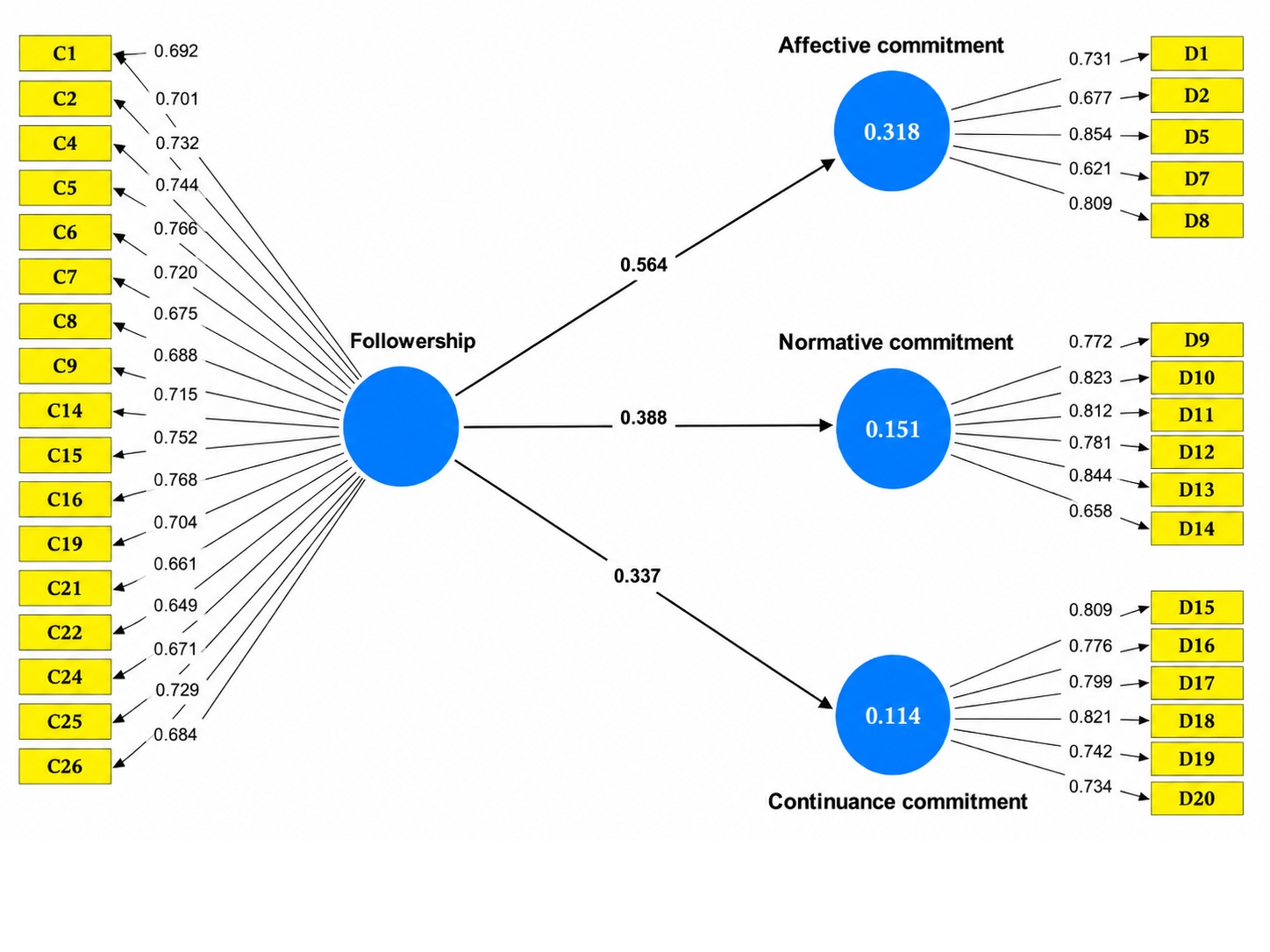
Note. Values are standardised path coefficients. *** p < .001.
Bootstrapping with 10,000 resamples was used to test the significance of the three structural paths. Table 5 reports the standardised path coefficient, bootstrap mean, standard deviation, t-value, p-value, and hypothesis decision for each relationship. The results show that followership was positively associated with affective commitment, normative commitment, and continuance commitment. The strongest path was observed for affective commitment, followed by normative commitment and continuance commitment, which matches the theoretical expectation that followership is more closely related to affective and normative commitment than to continuance commitment.
Table 5. Direct Effects of Hypothesis Testing
|
Hypothesis |
Relationship |
β |
Mean (STDEV) |
t-value |
p-value |
Decision |
|---|---|---|---|---|---|---|
|
H1 |
Followership → Affective commitment |
0.564 |
0.582 (0.025) |
22.984 |
< .001 |
Supported |
|
H2 |
Followership → Normative commitment |
0.388 |
0.386 (0.032) |
12.093 |
< .001 |
Supported |
|
H3 |
Followership → Continuance commitment |
0.337 |
0.353 (0.030) |
11.219 |
< .001 |
Supported |
Fully Controlled Supplementary Model
A fully controlled supplementary model was estimated with gender, age, teaching experience, and school size to examine whether the main followership-commitment relationships remained stable after accounting for teacher background and school context. Table 6 reports the controlled structural paths for each commitment dimension. Followership remained positive and statistically significant for all three commitment dimensions after the controls were included. Teaching experience was associated with affective and continuance commitment, age was associated with normative and continuance commitment, and school size and gender did not show meaningful effects in this model. These results indicate that the main followership paths are not simply artifacts of demographic or school-level differences.
Table 6. Structural Model with Control Variables
|
Outcome |
Predictor |
β |
t-value |
p-value |
Decision |
|---|---|---|---|---|---|
|
Affective commitment |
Followership |
0.521 |
8.214 |
< .001 |
Supported |
|
Gender |
0.041 |
0.742 |
.458 |
Not significant |
|
|
Age |
0.096 |
1.621 |
.105 |
Not significant |
|
|
Teaching experience |
0.128 |
2.013 |
.044 |
Significant |
|
|
School size |
-0.052 |
0.887 |
.375 |
Not significant |
|
|
Normative commitment |
Followership |
0.327 |
5.682 |
< .001 |
Supported |
|
Gender |
0.038 |
0.654 |
.513 |
Not significant |
|
|
Age |
0.142 |
2.274 |
.023 |
Significant |
|
|
Teaching experience |
0.119 |
1.944 |
.052 |
Marginal |
|
|
School size |
-0.064 |
1.083 |
.279 |
Not significant |
|
|
Continuance commitment |
Followership |
0.271 |
4.309 |
< .001 |
Supported |
|
Gender |
0.027 |
0.438 |
.661 |
Not significant |
|
|
Age |
0.181 |
2.891 |
.004 |
Significant |
|
|
Teaching experience |
0.163 |
2.411 |
.016 |
Significant |
|
|
School size |
0.075 |
1.216 |
.224 |
Not significant |
The explained variance increased after adding the controls, particularly for normative and continuance commitment. Table 7 compares R² values before and after the control variables were added. The increase was smallest for affective commitment and larger for normative and continuance commitment, suggesting that career stage and school context are more relevant to normative and continuance forms of organisational commitment than to affective commitment. However, the continued positive followership paths indicate that followership retains explanatory value beyond these controls.
Table 7. Variance Before and After Adding Control Variables
|
Outcome |
R² without controls |
R² with controls |
Change in R² |
|---|---|---|---|
|
Affective commitment |
0.318 |
0.356 |
+0.038 |
|
Normative commitment |
0.151 |
0.224 |
+0.073 |
|
Continuance commitment |
0.114 |
0.207 |
+0.093 |
Dimension-Specific KFQ-R Results
The supplementary KFQ-R model separated active engagement and independent critical thinking to address the multidimensional foundation of Kelley’s followership model. Table 8 reports the dimension-specific structural paths. Active engagement showed stronger positive effects across all three commitment dimensions. Independent critical thinking had weaker effects and did not meaningfully predict continuance commitment. This pattern indicates that teachers’ visible participation in school goals and collective work contributed more consistently to commitment than critical thinking alone, although critical thinking remains theoretically important when connected to active participation.
Table 8. Dimension-Specific Effects of Followership on Commitment
|
Outcome |
Predictor |
β |
t-value |
p-value |
Interpretation |
|---|---|---|---|---|---|
|
Affective commitment |
Active engagement |
0.462 |
7.915 |
< .001 |
Strong positive effect |
|
Independent critical thinking |
0.214 |
3.284 |
.001 |
Small positive effect |
|
|
Normative commitment |
Active engagement |
0.351 |
5.426 |
< .001 |
Moderate positive effect |
|
Independent critical thinking |
0.118 |
1.972 |
.049 |
Weak positive effect |
|
|
Continuance commitment |
Active engagement |
0.246 |
3.806 |
< .001 |
Small positive effect |
|
Independent critical thinking |
0.074 |
1.184 |
.236 |
Not significant |
Predictive Relevance and PLSpredict
Table 9 reports the Q²_predict values. The values were positive for all three endogenous constructs, indicating predictive relevance (Hair et al., 2021; Sarstedt et al., 2017). Affective commitment showed the highest Q²_predict value, while normative and continuance commitment showed smaller values. This result is consistent with the structural results: followership is most useful for explaining and predicting affective commitment and less useful for predicting normative or continuance commitment.
Table 9.. Predictive Relevance Results
|
Outcome |
Q²_predict |
Predictive relevance |
|---|---|---|
|
Affective commitment |
0.184 |
Medium predictive relevance |
|
Normative commitment |
0.092 |
Small predictive relevance |
|
Continuance commitment |
0.061 |
Small predictive relevance |
Table 10 reports PLSpredict error comparisons between the PLS-SEM model and the linear model benchmark. The PLS-SEM model produced lower RMSE values than the linear model benchmark for all three commitment dimensions. The prediction error reduction was most visible for affective commitment and smallest for continuance commitment, supporting acceptable predictive usefulness for affective commitment, low-to-acceptable predictive usefulness for normative commitment, and low predictive usefulness for continuance commitment.
Table 10.. PLSpredict Results
|
Outcome |
PLS-SEM RMSE |
Linear model RMSE |
Difference |
Predictive assessment |
|---|---|---|---|---|
|
Affective commitment |
0.742 |
0.781 |
-0.039 |
Acceptable predictive usefulness |
|
Normative commitment |
0.811 |
0.829 |
-0.018 |
Low-to-acceptable predictive usefulness |
|
Continuance commitment |
0.846 |
0.851 |
-0.005 |
Low predictive usefulness |
DISCUSSION
The findings show that followership was positively associated with all three dimensions of organisational commitment, but the strength of the relationships differed across the three dimensions. Followership was most strongly associated with affective commitment, followed by normative commitment and continuance commitment. These differentiated results support the decision to examine affective, normative, and continuance commitment as separate dimensions, because the three components represent different psychological bases for remaining in an organisation: emotional attachment, felt obligation, and perceived cost of leaving (Meyer & Allen, 1991, 1997; Meyer & Herscovitch, 2001).
For H1, followership showed its strongest association with affective commitment. Followership also explained the largest proportion of variance in affective commitment among the three commitment outcomes. This result indicates that teachers with stronger followership orientation were more likely to report identification with, involvement in, and emotional attachment to their schools. The finding is consistent with Kelley’s view that effective followership combines active engagement with independent critical thinking, and with relational followership theory, which treats followers as active contributors to organisational processes rather than passive recipients of leadership (Kelley, 1988, 1992; Carsten et al., 2010; Uhl-Bien et al., 2014). It is also theoretically consistent with affective commitment because this form of commitment concerns emotional attachment, identification, and involvement in the organisation (Meyer & Allen, 1991, 1997).
In the controlled model, the association between followership and affective commitment remained stable after gender, age, teaching experience, and school size were included. The R² value increased only slightly, from 0.318 to 0.356, after the control variables were added, suggesting that affective commitment was more closely associated with followership than with the demographic and school-size variables included in the model. The predictive results point in the same direction: affective commitment had the highest Q²_predict value and the strongest PLSpredict performance among the three commitment outcomes. This suggests that followership was most useful for explaining and predicting teachers’ affective commitment within the PLS-SEM model, while the cross-sectional design still requires the relationship to be interpreted as a predictive association rather than causal evidence (Hair et al., 2021; Sarstedt et al., 2017).
This finding is compatible with related studies on teacher commitment, school culture, and distributed leadership. Hulpia and Devos (2010) showed that supportive leadership functions and cooperation in leadership teams were important for teachers’ organisational commitment, while Samancioglu et al. (2019) found that distributed leadership significantly predicted teachers’ organisational commitment. Gök and Özçetin (2021) also reported that school culture was related to teachers’ organisational commitment. These studies differ from the study because they focus mainly on distributed leadership and school culture, whereas the study focuses on followership. However, the findings converge in suggesting that teachers’ organisational commitment is likely to be stronger when they are meaningfully involved in school processes rather than positioned only as passive implementers of administrative decisions (Hulpia & Devos, 2010; Gök & Özçetin, 2021; Samancioglu et al., 2019). The strong association between followership and affective commitment is particularly meaningful in the Vietnamese primary-school context.
Vietnam’s education system has emphasised teacher professionalisation, qualification upgrading, school leadership development, and reform implementation, while teacher shortage and retention have also become practical concerns (UNESCO, 2025; Tuoi Tre News, 2025; World Bank Group, 2025). In such a context, teachers’ active participation in school goals may help them see themselves as contributors to school improvement rather than only as implementers of administrative decisions. This interpretation is consistent with followership theory, which frames followers as participants in organisational processes, and with commitment theory, which links affective commitment to identification and involvement with the organisation (Kelley, 1992; Meyer & Allen, 1991, 1997; Uhl-Bien et al., 2014).
For H2, followership was also positively associated with normative commitment, although the relationship was weaker than that observed for affective commitment. This finding suggests that teachers who actively support school goals and contribute to school improvement may also develop a stronger sense of professional obligation to remain with the school. The interpretation is consistent with Chaleff’s view that followers have ethical responsibilities to support leaders when appropriate and challenge ineffective practices when necessary (Chaleff, 2009). It also aligns with the three-component model of organisational commitment, in which normative commitment reflects a felt obligation to remain with an organisation rather than emotional attachment or perceived cost of leaving (Meyer & Allen, 1991, 1997; Meyer & Herscovitch, 2001).The controlled model further suggests that normative commitment was shaped by both followership and career-related factors. After gender, age, teaching experience, and school size were included, the followership path remained significant, while age was also significant, and teaching experience approached significance. The R² increased from 0.151 to 0.224 after the control variables were added, indicating that background variables contributed more to normative commitment than they did to affective commitment. This pattern is reasonable because normative commitment may develop through longer exposure to school norms, professional identity formation, and accumulated responsibility towards pupils, colleagues, and the institution (Dalgıç, 2014; Meyer & Allen, 1997).
Regarding H3, followership had a positive but weaker association with continuance commitment. This result is theoretically reasonable because continuance commitment is based on perceived costs of leaving, accumulated investment, and limited alternatives rather than emotional attachment or moral obligation (Meyer & Allen, 1991, 1997; Meyer & Herscovitch, 2001). Followership involves engagement, voice, initiative, and contribution to school goals, so it is expected to relate more directly to affective and normative commitment than to continuance commitment (Kelley, 1988, 1992; Chaleff, 2009; Uhl-Bien et al., 2014).
After the control variables were added, the followership path to continuance commitment remained significant but became weaker, while age and teaching experience were also significant. The R² value increased from 0.114 to 0.207 after the controls were added, producing the largest R² increase among the three commitment dimensions. This suggests that continuance commitment is more sensitive to career-stage and professional-investment factors than affective commitment. Older and more experienced teachers may perceive higher costs of leaving because they have accumulated school-specific routines, collegial relationships, role familiarity, and local career investments, which is consistent with the definition of continuance commitment as commitment based on perceived costs and accumulated investment (Meyer & Allen, 1990, 1991, 1997).
The predictive results also showed continuance commitment was the least predictable of the three dimensions, and it has the smallest PLSpredict advantage over the linear model benchmark. This indicates that followership had some predictive relevance for continuance commitment, but its predictive usefulness was limited compared with affective commitment.
Overall, followership was more useful for explaining and predicting teachers’ affective and normative commitment than their continuance reasons for remaining, which is consistent with the theoretical distinction between emotional attachment, felt obligation, and cost-based commitment (Meyer & Allen, 1991, 1997; Hair et al., 2021; Sarstedt et al., 2017).The dimension-specific KFQ-R results provide an important qualification to the primary model. Kelley’s model conceptualises effective followership through two central dimensions: active engagement and independent critical thinking (Kelley, 1988, 1992). Previous Kelley-based measurement work has also treated these dimensions as central to the construct (Gatti et al., 2014). In the present study, the two dimensions did not contribute equally to organisational commitment. Active engagement was the stronger and more consistent predictor across affective, normative, and continuance commitment, whereas independent critical thinking showed weaker and less consistent effects and did not meaningfully predict continuance commitment.
These findings support a two-dimensional interpretation of followership. The overall followership remains useful as a parsimonious primary predictive specification because the research questions examined teachers’ general followership orientation. However, the supplementary results show that active engagement and independent critical thinking are not interchangeable or equally influential dimensions. The study, therefore, uses the overall followership score only as a bounded primary model for prediction, while interpreting followership theoretically through Kelley’s two-dimensional framework (Kelley, 1988, 1992; Gatti et al., 2014; Hair et al., 2021; Sarstedt et al., 2017). Independent critical thinking may be less likely to strengthen commitment unless teachers have safe and formal channels to express professional judgement. In hierarchical school contexts, critical judgment may remain private or may be interpreted as disagreement if it is not connected to collaborative participation and school improvement (Chaleff, 2009; Carsten et al., 2010; Uhl-Bien et al., 2014). This is relevant to Vietnamese primary schools, where school leadership, administrative hierarchy, teacher professionalisation, and reform implementation shape how teachers participate in school-level decision-making (UNESCO, 2025; World Bank Group, 2025). Active engagement, by contrast, is more visible and more easily recognised by principals and colleagues, which is consistent with distributed leadership research showing that teacher participation becomes meaningful when it is embedded in shared school processes (Hulpia & Devos, 2010; Samancioglu et al., 2019). Teachers who participate in planning, professional learning activities, mentoring, and school improvement work may develop a stronger commitment because their contributions are socially acknowledged and organisationally useful, a pattern consistent with studies linking school culture, shared leadership, and teacher commitment (Gök & Özçetin, 2021; Hulpia & Devos, 2010; Samancioglu et al., 2019).
CONCLUSION
This study examined followership as a predictor of organisational commitment among primary school teachers in Phan Thiet, Vietnam. It integrated Kelley’s followership model with Meyer and Allen’s three-component commitment framework, and found that followership was positively associated with affective, normative, and continuance commitment. The strongest theoretical and predictive meaning was attached to affective commitment, followed by normative commitment and continuance commitment.
The study makes a contribution to educational leadership research by showing that teacher commitment cannot be understood through leadership alone. Teachers’ active engagement and independent thinking are important resources for school stability and improvement, particularly in Vietnamese primary schools where professionalisation, reform pressure, hierarchy, teacher voice, collaboration, and retention concerns intersect. The controlled model supports the robustness of the followership paths, and the dimension-specific results show that active engagement is especially important for commitment. The findings, therefore, support the overall followership score only as a primary predictive specification, while the dimension-specific results support a two-dimensional theoretical interpretation in which active engagement carries greater predictive weight than independent critical thinking.
THEORETICAL IMPLICATIONS
The study contributes theoretically by positioning teachers’ followership as a predictor of organisational commitment in primary education. This expands educational leadership research beyond principal-centred explanations and supports relational perspectives that view school outcomes as products of both leadership and followership (Carsten et al., 2010; Uhl-Bien et al., 2014). By examining affective, normative, and continuance commitment separately, the study also shows that followership does not relate equally to all forms of commitment.
The dimension-specific findings refine followership theory in school settings by supporting a two-dimensional interpretation of followership. Specifically, active engagement carried more predictive weight than independent critical thinking. This finding refines Kelley’s model for Vietnamese primary schools: commitment-related followership appears to depend not only on teachers’ capacity for independent professional judgement, but also on whether that judgement is expressed through visible participation in collective school work. Future theory development should therefore examine how active engagement and independent critical thinking interact under different leadership climates, particularly in hierarchical school systems where independent critical thinking may require formal voice channels to become active engagement (Kelley, 1988, 1992; Gatti et al., 2014; Carsten et al., 2010; Uhl-Bien et al., 2014).
PRACTICAL IMPLICATIONS
The findings point to practical implications for how Vietnamese primary schools organise teacher participation. Because followership was most closely associated with affective commitment, school leaders should provide regular opportunities for teachers to contribute to school improvement rather than treating them mainly as implementers of administrative instructions. Planning meetings, professional learning groups, and feedback sessions are useful when they include a clear cycle of teacher input, principal response, implementation decision, and follow-up evaluation.
Second, school leaders should make teacher input visible and consequential by establishing clear roles for them in improving the school, documenting their recommendations from professional development meetings, and providing evidence of how those recommendations were used in making choices. These activities do not require additional meetings; rather, they will show teachers that their input to enhance the school is clearly evident and relevant to the success of the school.
Another point to consider is that schools should also create safe channels for professional judgment, as independent critical thinking was weaker than active engagement. Teachers should have more opportunities to question routines, articulate problems that are specific to their classes, and make suggestions for alternatives without being considered as defiant of the authority of the leader. Such an opportunity is typically found in schools that are organised hierarchically, and it will also only provide value when critical evaluation is related to respectful participation that is based on respect and school improvement (Chaleff, 2009; Uhl-Bien et al., 2014).
LIMITATIONS AND FUTURE RESEARCH
This study has several limitations. First, the study used a cross-sectional, self-report design. The findings, therefore, identify predictive associations within the PLS-SEM model rather than causal effects. Although full collinearity VIF values did not indicate serious common method bias, future research should combine teacher surveys with interviews, peer ratings, principal ratings, or longitudinal data to examine how followership and commitment develop over time.
Second, the sample was modest and local. The study involved 95 primary school teachers in Phan Thiet, Vietnam, recruited through non-probability convenience sampling. This is a relatively small region. The inverse square root assessment supported the adequacy of the sample for the parsimonious primary model, but the sample cannot be used as representative of all Vietnamese primary teachers or all school contexts.
Third, the measurement of followership was adapted from Kelley-based followership theory without more comprehensive steps to validate it for Vietnamese primary school teachers. The study assessed measurement quality in the present sample, but it did not conduct a full cultural adaptation and validation process. This is important because Kelley’s model is theoretically two-dimensional, while the primary model used an overall followership score as a predictive specification (Kelley, 1988, 1992; Gatti et al., 2014).
Fourth, several contextual factors that may influence organisational commitment (i.e., principal leadership style, teacher voice climate, workload, salary satisfaction, family responsibilities, perceived alternatives, and school-level culture) were not directly measured. Their omission is relevant to normative commitment and continuance commitment, which may depend more strongly on professional obligation, career stage, and perceived costs of leaving than on followership alone (Dalgıç, 2014; Meyer & Allen, 1991, 1997; Meyer & Herscovitch, 2001; Santosa et al., 2022).
ACKNOWLEDGEMENTS
This research project is self-funded.
DECLARATION OF AI TOOL USE
AI-assisted tools were used to support language editing, coherence checking, and revision of the manuscript. The author reviewed, verified, and approved the final text and remains fully responsible for the accuracy, integrity, analysis, interpretation, and submission of the work.
References
Baker, S. E. (2007). Followership: The theoretical foundation of a contemporary construct. Journal of Leadership & Organizational Studies, 14(1), 50-60. https://doi.org/10.1177/0002831207304343
Carsten, M. K., Uhl-Bien, M., West, B. J., Patera, J. L., & McGregor, R. (2010). Exploring social constructions of followership: A qualitative study. The Leadership Quarterly, 21(3), 543-562. https://doi.org/10.1016/j.leaqua.2010.03.015
Chaleff, I. (2009). The courageous follower: Standing up to and for our leaders (3rd ed.). Berrett-Koehler.
Dalgıç, G. (2014). A meta-analysis: Exploring the effects of gender on organisational commitment of teachers. Issues in Educational Research, 24(2), 133-151.
Dash, S., & Paul, J. (2021). CB-SEM vs PLS-SEM methods for research in social sciences and technology forecasting. Technological Forecasting and Social Change, 173, 1-11. https://doi.org/10.1016/j.techfore.2021.121092
Evans, J. R., & Mathur, A. (2005). The value of online surveys. Internet Research, 15(2), 195-219. https://doi.org/10.1108/10662240510590360
Fornell, C., & Larcker, D. F. (1981). Evaluating structural equation models with unobservable variables and measurement error. Journal of Marketing Research, 18(1), 39-50. https://doi.org/10.1177/002224378101800104
Gatti, P., Tartari, M., Cortese, C. G., & Ghislieri, C. (2014). A contribution to the Italian validation of Kelley’s Followership Questionnaire. TPM: Testing, Psychometrics, Methodology in Applied Psychology, 21(1), 67-87. https://doi.org/10.4473/TPM21.1.5
Gök, E. B. C., & Özçetin, S. (2021). The effect of school culture on teachers’ organizational commitment. Journal of Educational Leadership and Policy Studies, special issue, Spring 2021. https://files.eric.ed.gov/fulltext/EJ1308498.pdf
Goodhue, D. L., Lewis, W., & Thompson, R. (2012). Does PLS have advantages for small sample size or non normal data? MIS Quarterly, 36(3), 981-1001. https://doi.org/10.2307/41703490
Hair, J. F., Hult, G. T. M., Ringle, C. M., & Sarstedt, M. (2021). A primer on partial least squares structural equation modeling (PLS SEM) (3rd ed.). SAGE. DOI: https://doi.org/10.1007/978-3-030-80519-7
Henseler, J., Ringle, C. M., & Sarstedt, M. (2015). A new criterion for assessing discriminant validity in variance-based structural equation modeling. Journal of the Academy of Marketing Science, 43(1), 115-135. https://doi.org/10.1007/s11747-014-0403-8
Hulpia, H., & Devos, G. (2010). How distributed leadership can make a difference in teachers’ organizational commitment? A qualitative study. Teaching and Teacher Education, 26(3), 565-575. https://doi.org/10.1016/j.tate.2009.08.006
Kelley, R. E. (1988). In praise of followers. Harvard Business Review, 66(6), 142-148.
Kelley, R. E. (1992). The power of followership: How to create leaders people want to follow and followers who lead themselves. Doubleday.
Kock, N. (2015). Common method bias in PLS-SEM: A full collinearity assessment approach. International Journal of e Collaboration, 11(4), 1-10. https://doi.org/10.4018/ijec.2015100101
Kock, N., & Hadaya, P. (2018). Minimum sample size estimation in PLS-SEM: The inverse square root and gamma-exponential methods. Information Systems Journal, 28(1), 227-261. https://doi.org/10.1111/isj.12131
Meyer, J. P., & Allen, N. J. (1990). The measurement and antecedents of affective, continuance and normative commitment to the organization. Journal of Occupational Psychology, 63(1), 1-18. https://doi.org/10.1111/j.2044-8325.1990.tb00506.x
Meyer, J. P., & Allen, N. J. (1991). A three-component conceptualization of organizational commitment. Human Resource Management Review, 1(1), 61-89. https://doi.org/10.1016/1053-4822(91)90011-Z
Meyer, J. P., & Allen, N. J. (1997). Commitment in the workplace: Theory, research, and application. SAGE. https://doi.org/10.4135/9781452231556
Meyer, J. P., & Herscovitch, L. (2001). Commitment in the workplace: Toward a general model. Human Resource Management Review, 11(3), 299-326. https://doi.org/10.1016/S1053-4822(00)00053-X
Ringle, C. M., Wende, S., & Becker, J.-M. (2024). SmartPLS 4. SmartPLS GmbH.
Samancioglu, M., Baglibel, M., & Erwin, B. J. (2019). Effects of distributed leadership on teachers’ job satisfaction, organizational commitment and organizational citizenship. Pedagogical Research, 5(2). https://doi.org/10.29333/pr/6439
Santosa, M., Senawati, J., & Dang, T. (2022). ICT integration in English foreign language class: Teacher's voice in perceptions and barriers. Pedagogy: Journal of English Language Teaching, 10(2), 183-202. https://doi.org/10.32332/joelt.v10i2.5168
Sarstedt, M., Ringle, C. M., & Hair, J. F. (2017). Partial least squares structural equation modeling. In C. Homburg, M. Klarmann, & A. Vomberg (Eds.), Handbook of market research. Springer. https://doi.org/10.1007/978-3-319-05542-8_15-1
Tran, L. T. P., Dang, T. T., & Nguyen, T. N. A. (2024). Imagination development as a construct for professional identity of early career English teachers working at public schools: Contributions of interactions with learners. Theory and Practice in Language Studies, 14(2), 329-338. https://doi.org/10.17507/tpls.1402.03
Tuoi Tre News. (2025, May 29). Vietnam short of nearly 120,000 teachers, PM orders urgent hiring. https://news.tuoitre.vn/vietnam-short-of-nearly-120000-teachers-pm-orders-urgent-hiring-10325052817031574.htm
Uhl-Bien, M., Riggio, R. E., Lowe, K. B., & Carsten, M. K. (2014). Followership theory: A review and research agenda. The Leadership Quarterly, 25(1), 83-104. https://doi.org/10.1016/j.leaqua.2013.11.007
UNESCO. (2025, July 22). New UNESCO report: Leadership is key to Viet Nam’s education transformation. https://www.unesco.org/en/articles/new-unesco-report-leadership-key-viet-nams-education-transformation
World Bank Group. (2025). Viet Nam: Transforming teacher education over three generations: Teachers and school leadership case study. https://documents.worldbank.org/en/publication/documents-reports/documentdetail/099100125140534711

Downloads
Published
Data Availability Statement
The data that support the findings of this systematic review are available from the corresponding cited publications. Search strategies, inclusion/exclusion criteria, and extraction details are reported in the Methods section.
Issue
Section
License
Copyright (c) 2026 Tan Nguyen Huynh Si

This work is licensed under a Creative Commons Attribution-NonCommercial-NoDerivatives 4.0 International License.