
[Reprint] E-behaviors and e-community formation: An investigation on Vietnamese EFL students
DOI:
https://doi.org/10.65956/tila.2026.22Keywords:
online communication, e-behavior, Vietnamese EFL, e-communityAbstract
Online communications have been widely researched in different education contexts during the last two decades. Together with the development of emerging technology, educational applications have received a huge change in e-communication modes, from unidirectional to interactive websites, asynchronous to synchronous exchanges, and stand alone to networked real-time simulations. These have constituted a platform for the development of online social life and communities. To take advantage of this environment for educational benefits, this study particularly attempts to investigate the habitual behaviors of undergraduates in Vietnam who study English as a Foreign Language when they interact with a Moodle site during an English course. It specifically focuses on students' expectations and awareness of online communication, their preferences related to instant messenger and blogging, and influential impacts on the formation of the online communities. Qualitative data from individual interviews and document analyses have shown that students prefer to use synchronous communication modes and look for instant responses regardless of how often they go online. In addition, the shaping of the online educational communities needs a lot of support, reinforcement, and nurture from the facilitators and real life connections. Finally, the discussion suggests a possible analytical framework for online learning community investigation.
INTRODUCTION
With the non-stop advancement in Information and Communication Technology (ICT) during the last decades, humans have been provided with numerous educational platforms such as CD/DVD players, projectors, and software applications and different means of e-communication such as email, discussion board, chatting, blogging, messaging, and social networking. A lot of attempts to take advantage of ICT for educational purposes have therefore been documented. However, its applications are still limited in the area of second language (L2) training in developing countries such as Vietnam where technology infrastructure in education has not been well-developed, and L2 students have not properly grasped necessary skills to involve themselves effectively in the technology provided.
Therefore, this exploratory study attempts to document the awareness and behaviors of Vietnamese students in higher education when they participate in a virtual learning environment. It also investigates the formation of this environment and mediated factors. The documentation can then be used to inform pedagogical practices, facilitating students’ engagement and increasing their learning outcomes. Using a sample of L2 students and employing an interpretive paradigm, this paper begins with a brief discussion on the development of ICT infrastructure in Vietnam and the reason for online technology adopted for investigation. It then continues with a critical review of the literature in online communication and computer assisted language learning (CALL) to set out the significance of the current study. After presenting the research design and reporting the results, it highlights several issues in the discussion section and puts forward important considerations for future research in the conclusion.
CONTEXT
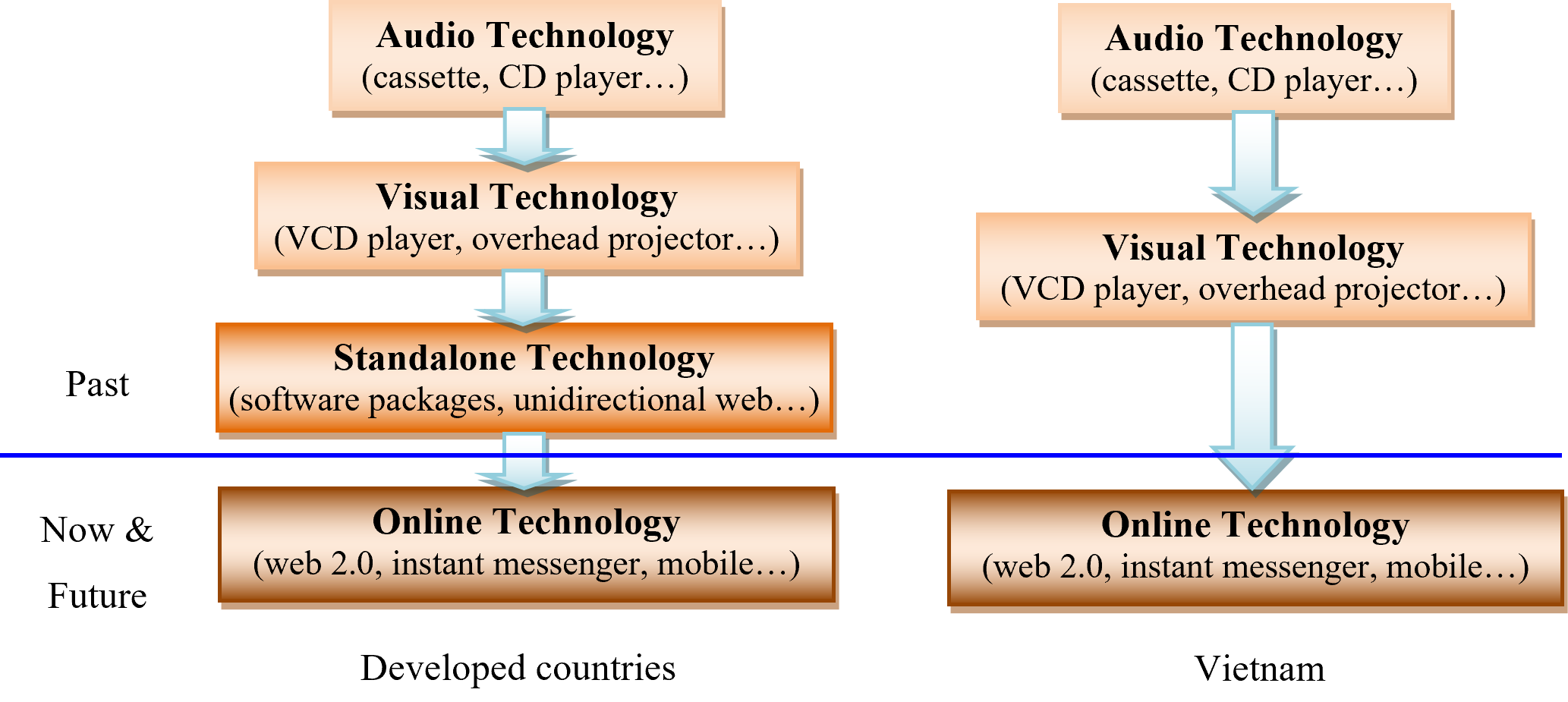
With a centralized mechanism and recent efforts in education investment, Vietnam makes the scene of its technology availability and usage in educational settings generally different from that in other countries. Since the popular arrival of cassette players at schools long time ago, technological equipment such as CD player, video player, and overhead projector has not been found to follow as in many developed countries. Only a few PCs were installed for administrative work. Therefore, the ICT infrastructure in schools even at the higher education level was poorly equipped up to late 2005. In contrast, many families started to afford a personal computer (PC) for their children at home in early 2000, when numerous educational software applications were developed. More recently, the popular presence of the internet in the country and the very affordable broadband offers from local providers have made PCs or even laptops and portable devices become part of children’s life in many families, particularly in big cities. Consequently, there was a big gap between students’ use of computer technology at home and at school except for those majoring in information technology-related areas. A general comparison is presented in Figure 1.
The ICT investment in private and public schools reflected a competitive race between these two school sectors. The private school sector began setting up its own ICT infrastructure in mid 2000s while this investment in the public school sector started in late 2008. As the private sector was self-funded, it was more flexible in using its budget to compete with the public sector. A few years later, acknowledging the advantages of ICT in education, preparing strategic development plans, and being approved by the government, the national education authority commenced setting up the ICT system across school levels with a stronger emphasis on tertiary education. This was marked by the decree No 55/2008/CT- BGDĐT, which provided directives on the establishment and usage of ICT in education. It was expected that most educational institutions would be fully equipped by 2012.
Being lately constructed, the ICT system in education in Vietnam inherited most of the modern technology. It moved from a very poor technology-equipped situation to a modern one with networked computers and fiber optic cable internet connection. Although the software management system has not been properly designed, the hardware infrastructure and internet connection are expected to be exemplary. Therefore, the technology that is and will be adopted by local educators is the online one which features the e-communication modes, web 2.0, social networking, and mobile technology. This is reinforced by students’ current usages of computers at home such as taking part in discussion boards of interests, instant messaging, and blogging. The selection of online technology was also pedagogically based as online technology would facilitate personalized learning (Robertson, Webb, & Fluck, 2007) and provide students a collaborative environment to construct knowledge through self-projection (Garrison & Anderson, 2003), active participation, and negotiation (Oliver, 2001; Vygotsky & Kozulin, 1986). Taking these social and educational factors into consideration, this study focused on the online technology and L2 students’ behaviors in that virtual world.
LITERATURE REVIEW
Networked Communication
Human networked communication, the process of transferring or exchanging ideas via ICT tools, has been widely researched from different disciplines. In L2 education particularly, the integration of local networked communication into school programs has been indicated to give students more opportunities to express ideas (Kern, 1995) with richer linguistic production (Beauvois, 1992), increase their course engagement (Sullivan & Pratt, 1996), and enhance their oral proficiency (Payne & Whitney, 2002). Recently, the employment of different communication channels via internet such as blog, wiki, instant messenger (IM), massively multiplayer online game (MMOG) and social network, has been identified to provide students with vocabulary resources embedded in rich simulated contexts (Purushotma, 2005), increase their confidence, help them recognize language genres (Lam, 2004), and enable them to use L2 more successfully (Hanna & de Nooy, 2003).
Cybercommunity Investigations
As communication is always associated with interlocutors’ context, interpretation and error (Marshall, 2008), a number of recent studies have attempted to inform educators by historically describing the establishment and operation of cybercommunity such as weblog or blog (e. g., Downes, 2004; Mortensen, 2008; Mortensen & Walker, 2002), discussion forum (e. g., Bhappu, Ebner, Kaufman, & Welsh, 2009), social network (e. g., Boyd & Ellison, 2007; Ellison, Steinfield, & Lampe, 2007), IM (e.g., Baron, Squires, Tench & Thompson, 2005; Jacobs, 2008; Lewis & Fabos, 2005), and MMOG (e. g., Ducheneaut, Moore, & Nickell, 2004; Steinkuehler, 2008). Emerging from studies of this new genre of computer mediated communication (CMC) was the inquiry of socio-cultural investigations and related networked-mediated attributes for a better understanding of this non-physically existent community (Bakhtin & Holquist, 1990; Thomas, 2008).
As a result, different theoretical traditions have been drawn on to help researchers elicit insights of the cybercommunity and its communicative transactions. These included broad discussions such as the revisited tension between humanist and behaviorist approach in online situations (Shedletsky & Aiken, 2004), feminist theory (as discussed in Rosser, 2006), Vigotsky-derived theory (Hull & Saxon, 2009), the community of practice (Wenger, 1999) as employed in Thomas (2005), and the flow experience of Csikszentmihalyi (2000) (as discussed in Voiskounsky, 2008). On a more operationalized level was the development of different frameworks such as the three spatial dimensions of online community, namely ontological, social and metaphorical spaces (Gotved, 2002), the integrated cyberconflict framework which was derived from social movement theory, conflict theory and media theory (Karatzogianni, 2006), and the online community framework (Souza & Preece, 2004) developed from semiotic theory (Eco, 1976) to name a few. These indicated that the topic has been examined from various perspectives, ranging from philosophy, media, and critical sociology to ethnography, discursiveness, psychology, socio-cultural perspective, and education (Thomas, 2008).
Cyber Communication in Computer Assisted Language Learning (CALL)
Despite being substantially researched in various disciplines, cyber communication in L2 education has not been empirically investigated. Depicted in contemporary CALL research were several critical issues. Substantial reviews have shown that there was a quite weak judgment on the choice of a technology in relation to the course objectives (Stockwell, 2007). In addition, the selection of variables to be examined was often inappropriately located in the research design; and the results reported were very ambiguous (Felix, 2005). Furthermore, inadequate attention was paid to learners’ level of ICT capability although most of them were novices to CALL (Hubbard, 2005).
Given the immaturity of CMC research in L2 education, the complicated diversity of theory employed in research, and cultural differences, it is necessary to document more research focusing on L2 students’ expectation of and behaviors in cybercommunication. In addition, any possible relationship between students’ online activities with their daily offline practices needs to be taken into account. This means the socio-cultural richness of local contexts can be employed to understand the ICT usage pattern because of its central roles in online communicative exchanges (Bakhtin & Holquist, 1990; Thomas, 2008). It even becomes more important for Asian contexts due to its diversified culture and the increasing number of online users but small number of investigations.
THE PRESENT STUDY
Research Questions
The study aimed to investigate the habitual behaviors of undergraduate students in Vietnam who studied English as a Foreign Language (EFL) when they interacted with a Moodle 1.9 site during an English course. It attempted to address (i) students’ expectations and awareness when communicating online; (ii) their favorite communication modes in online technology; and (iii) possible mediating factors for the formation of their cybercommunities. The research design also allowed other learning variables to be examined, but they are not reported in this paper.
Subjects
The subjects of the study were 247 EFL undergraduate students in a public university in Vietnam. Most of them were from 18 to 19 years old and in the second semester of their candidature. All of them enrolled in the Listening – Speaking course and were divided into five groups which were taught by three lecturers. Their classes met once a week during 16 weeks and each meeting lasted for four hours. They had not worked with any Learning or Course Management System (LMS or CMS) as part of their school activity prior to this study.
Measurements
The study employed a mixed method design, including a short demographic survey, documents derived from the LMS reports and email exchanges during the course, and semi-structured individual interviews by the end of the course. The survey consists of items to describe the sample such as gender, age range, and self-rated level of computer proficiency. The reports generated from LMS include login error details, global forum statistics, and course activities statistics. Relevant communication with the webmaster via email and IM regarding technical supports were documented. The interview comprises three groups of guided questions to elicit students’ expectations when taking part in the virtual space, their preferences on using certain modes of online communication and factors associated with their cybercommunities. The assessment of each variable is indicated in the following sections.
As the study attempted to document local students’ expectation and behaviors as they worked with the LMS, the data process was designed to accommodate different responses from the subjects. Therefore, the semi-structured interview was selected to gain access to the participants’ mind and extract their thoughts and preferences (Tuckman, 1999). The interview questions were piloted with two students from the same cohort before the main interview data was collected for content validation. All of the interviews were conducted by the same researcher. The interviewees were also advised to possibly use any English words or phrases that they thought more convenient to express themselves although the interview language was their mother tongue. In addition, the interviewer paid serious attention to the local socio-cultural characteristics during every interview such as relationship maintenance, cheerful atmosphere, and appropriate motivating stimuli. All of these data were then located in a situation which was profiled by the data from the demographic survey and LMS reports.
Awareness and expectation investigations
Students’ awareness of taking part in the LMS was initially examined by analyzing the login error report and their selection of using a communication mode to achieve a purpose. It was also addressed by students’ interview responses, concerning their decision on posting either a text message or a voice message in a thread. Their expectation in the pre- ,while- and post-phases of the online participation processes was elicited by the first group of interview questions such as “How often do you access the LMS, and what do you often want to see or get from it?” and “What do you hope for after completing a task or posting a message on LMS?”
Communication mode preference investigations
Students’ favorite modes of online communication were described by retrospective descriptions of their online daily habits. They were asked to re-tell a normal process of their going online by responding to the second group of interview questions such as “When you would like to go online, you turn on your computer and what do you often do next? What do you often do after that and what for?” and “If you have something interesting or sad and would like to share with the others, how would you do that?” All modes of online communication identified in each conversation such as IM, email, blog, forum were noted, and the reasons for using each of them in a certain order were explored. The communication modes that students often used to seek technical support were also documented to include in the analysis.
Cybercommunity formation investigations
The formation of online communities was investigated from both the LMS and other anticipated social networks. First, observation was done on the community development within each class and across the classes of the same course. Participation in each community was analyzed in consideration with the roles of lecturers in charge. Second, in the last section of the interview, the interviewees were asked to name some of the online communities that they had ever been involved with as a member, why they joined, and how they built up and maintained their connections with other members. The main questions were “Do you participate in any social network? What do you often do with that and what for?” If they did not have any social network, they were also asked why they did not. The relationship between their real life contacts and online contacts was also addressed in the interview session.
Procedures
The Vietnamese version of the demographic survey which had undergone a back-translation process was distributed to the participants at the beginning of the course. After that, students’ email addresses were collected and students’ LMS accounts were generated from a Moodle site which had been set up and trialed for six months. They were told to expect an email which provided their own account information and general details about how to access, navigate the site and seek support by the end of the first week. A demo tutorial about all the functions of the site was conducted in each class in the second week. A question and answer section was followed and technical support was provided to both students and lecturers during the course to minimize technical barriers.
The LMS site was hosted in the same city where the participants were staying to facilitate loading speed. Players for the Voice of America (VOA) and British Broadcasting Corporation (BBC) radio channels were integrated. A randomly shown clip box from YouTube was also added to the home page of the site. In addition, the default blog module of Moodle was replaced by the OU blog, giving students more flexible options such as allowing comment and setting visibility level for each entry. A function for posting voice messages, using NanoGong technology, was also included in the site. This module allowed students to record their talk in an audio file, replay it and embed it in their posting with a few clicks, instead of typing in the message.
The site was password-protected and structured into three main sections, namely personal section, class section, and public section. The first one allowed each student to update a number of personal details such as nickname, favorites, IM username, blog url. The second section could be accessed by only members of each respective class. It featured a number of activities facilitated by the class lecturers and was the place for students to perform their learning. The public section included a notice board, a technical support forum, a general discussion forum, a chat room, and a global blog. A separate section for lecturers was also created to maintain the discussions among lecturers and the webmaster. In addition, every site member could always track the login records of the others with a simple click.
The activities from LMS started in the third week and prolonged to the end of the course. It weighted 15 percent in the course score for the first four classes and was totally optional for students in the fifth class. By the end of the course, students were invited to take part in an individual interview and several responded, except for the fifth class. The interview conversations were transcribed and translated into English. Reported in this study were the four cases from the first four classes. The selection of these cases was based on the richness of the data produced by the subjects.
RESULTS
There was a total of 247 students enrolled in five classes, but only 147 students (118 females and 29 males) responded to the survey. This balance between males and females corresponded to the normal gender distribution in an EFL major in Vietnam generally. These students rated their level of computer proficiency (general skills such as MS Office, web, chat, email, blog…) as a little above average (M=3.12, given Maverage=3). Most of them thought that their computer skills were average (63.3 percent); others thought that their skills were either good (21.1 percent) or very good (3.4 percent). Only 19 students rated their computer skills as bad and very bad, taking 8.2 percent and 4.1 percent of the total sample respectively.
Although the LMS outline for every class was almost similar, students’ participation in each class was varied. The virtual class outline was structured into six categories, namely course administration, sharing learning experience, improving listening skills, improving speaking skills, group presentations and short tests and quizzes. Each category included subcategories, depending on the lecturers. Students in the first four classes regularly took part in the LMS activities, but only 14 out of 36 students in the fifth group (whose participation was totally nonobligatory) accessed the LMS. Their level of access was also very limited in both public and class sections. Their postings were found in the public section only, not in their own class page.
Awareness and Expectation
Technological awareness
Log file analyses indicated that many students were not aware of their login accounts. There were 221 login attempts using odd username patterns by 80 student turns. These usernames included full email address, part of email address, full name with blanks, and username or nickname from somewhere else. In several cases, up to seven or eight consecutive attempts of an odd username were identified. Some students used their own email accounts, instead of their LMS accounts, to log in the LMS and had to seek technical support after several failures. One student even forwarded her account details to another person and asked him to communicate with the webmaster although she did not have any problem. She was not aware of revealing her personal details and violating the course requirements when doing that.
Examining the communication between the webmaster and students via email and IM also brought the issue of technological awareness into account. Several students insisted that their email addresses did not include .vn at the end although this was clearly indicated in their mailboxes. Many others who failed to seek technical support via IM due to the unavailability of the service at certain times did not use the alternative communication mode. They did not leave any details that enabled the webmaster to track their account details later to provide support either. Therefore, many technical conversations were unintentionally divided into different pieces, carried out time by time. These examples indicated that a group of students encountered even basic technical problems, while the majority of them did not.
Content awareness
The qualitative differences between thread starting postings and thread replying postings were clearly presented across virtual classes. While the thread starting messages were often seen in the form of a paragraph or two and rich in contents, most of the replies were short, normally in the form of a phrase, a sentence or two. Some students also reported that they often came to the site to post their messages, read comments from the others on their previous messages and reply if necessary. They were not quite interested in reading their classmates’ postings. Some others were relatively selective in clicking on a thread to read or joining an activity.
No voice message was posted across the five classes during the course with different reasons, indicating different levels of participation awareness. Some students reported that they did not know about the availability of the voice message facility. Some reported that they knew about the facility but did not have necessary equipment such as microphone and speakers to be able to record their talks. Some others recorded their talks but did not post the files due to insufficient confidence or potential criticism from their peers. Two of the responses to the question “Why didn’t you post any voice message?” are included below.
Student D:
“First, it is fine to type my messages. Second, other people may not understand what I say [if I post my voice message]. Third, I do not like to listen to my voice. Online text messages are just the same for everyone, no personality can be revealed.”
Student Th:
“After recording my talk, I feel that it is very different from my real voice or not as good as my real voice. And the main reason is that I am not confident enough with my pronunciation. […If] I become the first person posting voice messages, others will think that I am too arrogant because my voice is not sweet enough, and my pronunciation is not totally accurate.”
Expectation
Students’ level of expectation about the LMS was very different, resulting from seeing it as a compulsory uninteresting course component to a joyful and useful playground to engage in. Further investigations on this variable showed that the feeling of having to work with the LMS did not always produce the feeling that the site was uninteresting and useless. Similarly, the feeling of enjoying the site did not always come from the eye-catching interface or the interesting contents. Students’ expressions of attitude toward the LMS and their behaviors are presented below to frame their mixed expectations.
Student T indicated that because regular participation in virtual class activities was required, LMS became the first site that he came to every time he went online. However, that did not prevent him from enjoying surfing the LMS, posting messages, sharing video clips, and commenting on his peers’ postings. This experience was similar to that of student H, who often went to the site for the lecturer’s postings and took part in those discussion threads. These reflected a move from an outsider to an insider of the community, gradually establishing relationships and controlling the situation (as presented in Bhappu et al., 2009). On the contrary, student Th said that she did not care much about the LMS and “always came to it at last” every time she went online. She sometimes shut down the computer without logging into the LMS even though it was her plan to check what was going on in her virtual class initially.
Similar to the blogging students of Burgess (2006), the level of LMS access in this study was different from one student to another. Some did not go to the site regularly because they considered it as an out-of-plan or leisure activity (student H and Th respectively). Meanwhile, two other students (student T and D) saved more time for the course than usual. They also prepared something before coming to the site. These differences basically reflected the availability of facilities to students and their level of expectation about the LMS. If they expected to enrich their knowledge from the site, exchange ideas with friends, and contribute to the virtual class resources, they came to the site more regularly and even more frequently in some cases. However, if they did not expect to get much from the site, they did not get there often regardless of how often they went online.
The students’ expectation about the LMS activities while taking part in the online activities was also dissimilar. While student D and T only paid attention to the ideas presented in the postings, students H and Th often attempted to evaluate their friends’ postings and referred to their friends’ performance in face-to-face class. Similarly, student D, T and Th indicated that they would leave comments on the postings that were interesting to them. However, student H seemed to be very resistant to giving comments. She sometimes typed her comments down but did not post them. Students’ reaction to a new and interesting topic was also different. Student H reported that she thought about it and planned to revisit it for further details, meanwhile student T said that he would look for additional details about the topic in other resources.
Students’ expectations after completing an online task were also various. Although most of them agreed that they often looked for comments on their work, their perspectives on getting feedback were very different. Student D thought that the number of comments on her work indicated the degree of its quality, but student Th disagreed with that. Student T would read his postings again if they received any feedback, but student H rarely read her postings again in any situation. Student T expected comments from the lecturer while student D did not. Student D preferred to have a relaxing communicative environment which was not monitored and controlled by strict rules and regulations.
Preference on Communication Mode
All students reported that they were involved in using IM, email and social networking although the facilities for these activities were not available at school, and they were not formally trained to take part in that social domain. Yahoo services were most favored by this group of students, reflecting the convenient and suitable applications that this provider offered to the local market. Their habitual behavior of logging in to Yahoo Messenger (YM) when starting their online activities seemingly indicated the importance of this communication channel to them. It was reported to be used for maintaining connections with friends by three students. However, student H only used it to send very short and reminding messages to some friends although she always had access to YM.
Students’ selection of email and social network channels for communication reflected the type of information and communicative objectives. All students agreed that blogging was used to share emotions, diaries and personal stories. However, student H used it very little in comparison to the others who accessed their blogs on a daily basis. She spent more time on reading and responding to emails. In contrast, student Th rarely used email, and student T only used it to receive notifications from his social networks. It was also noted that students H and T said that they maintained different social networks at the same time because their current network was about to close or they would like to be connected all the time.
Examining over 200 email threads and YM dialogues regarding technical issues during the course indicated that students’ selection of a communication mode also depended on the convenience of the technology and their immediate expectations in a communicative session. Many of them did not want to log in their webmail account and looked for the support email; it was easier and faster to contact the webmaster with a few clicks, using YM which was currently running. This also happened with those who stayed online more frequently and needed instant responses. In contrast, those using email were more careful in addressing the problems that they encountered and included more details to facilitate processing their request. These indicated that if the students put great importance on the requests and sincerely expected a satisfactory answer, they would use email with careful descriptions of the problems. Otherwise, IM was adopted.
Cybercommunity Formation
LMS community
The LMS community development reflected a moving trend toward the bigger group where more active participants with more postings were found. All students and lecturers made a very limited number of postings (10 threads and 23 replies) in the reflective learning section in their five virtual classes. On the contrary, a huge number of postings were found in global forum (21 threads and 12 replies) and global blog (113 threads and 114 replies) where everyone in the cohort could access although postings in this public section did not count for the course score. A student even asked if she could move to another class to take part in the active discussion that she knew of from her friends because her virtual class was very quiet.
The lecturers’ participation played a crucial role in facilitating the development of the LMS community. Most students in the fifth class did not go to their virtual classroom probably because the lecturer went there once or twice at the beginning of the course only. She may not have mentioned the online component during her class meetings either. In addition, the online participation was totally optional for this class, i.e., the virtual class did not have any weighting on the course score. In contrast, the lecturers of other classes frequently came to the site and facilitated several activities. The online component was compulsory for their students, and they even brought some online conversations to the class for further discussions sometimes. Therefore, it could be seen that all of their students had certain levels of participation in the virtual class.
Other online communities
The students’ online communities other than the one from the school LMS were indicated to form from the connections in real life. All of the four interviewee students reported that more than 65 percent of their friendlist contacts were the people that they had seen and talked to in real life. Their behaviors of new contact establishment showed that they had different levels of openness, varying from relatively open to very reserved. Student Th and T had never seen around 30-35% of their contact lists. They got connected with new people from friends’ introductions, special interest forums, and blog entries. They could start adding new contacts if they felt interested and ready to confirm adding requests from the others. This was completely different from student D and H who had not met only 1-5 percent of people in their contact list. These two students were also very selective in accepting friend requests and never actively added new contacts. Pairing these numbers with 9% of strangers in American teenagers’ friendlist (Lenhart & Madden, 2007) would suggest a rather similar pattern across cultures.
DISCUSSION
The number of students’ failed login records and their awareness of their own email address form indicated that several of them were relatively technologically naïve. While a majority of students were aware that different systems were unlikely to use the same login account, many others were not. As they normally used only one favorite system for online communication, they automatically keyed in the same account whenever being asked for one. Similarly, they were not fully aware of their complete email addresses as they often checked their mailbox from the IM program. Meanwhile, their self-rated level of computer proficiency was a little over average. These data seemed to indicate a discrepancy between students’ behaviors of using technology and their self-rated level of technology skills. They tended to think that they knew how to use it because they used it very often. However, they might not understand the concepts behind it. The main reason for this may originate from the local situation where most of students achieved internet skills through informal learning. In other words, the Internet technology was popularly available at home and in internet cafés, but it was not used in their learning activities at school. As a result, it was suggested that basic technical knowledge was not necessarily acquired even when frequent self-access to internet and cyber communication were achieved. It was also suggested that these students may not need a training period to be familiar with the technology adopted as presented in Xei (2002), for example. However, a set of critical sessions on technology use with explicit explanations of the concepts behind would be more useful for them.
In contrast to students’ inappropriate attention to technical issues, they gave careful consideration to the message content that they put online. They fully understood that the personality and capability demonstrated in their postings would probably be evaluated by some audience. Therefore, they tried to minimize their mistakes, demonstrate their skills and maintain a friendly community atmosphere to promote their face. They wanted to be recognized by the community, and that was not different from what Mortensen (2008) acknowledged in her blogging experience. These indicated that the local students considered the online learning space as formal as their traditional offline class. In addition, they used the anonymity feature of the cyberspace to conform themselves to the culture of the online community rather than taking advantage of that for rebellion or destructive purposes. In other words, students tended to construct a positive and unique identity or netizenship (as in Burgess, 2006) that potentially distinguished them from the others without damaging the community.
Relating students’ engagement in the LMS class section and LMS public section with other free social networks suggested a complex pattern of behaviors and communicative purposes. In principle, the virtual class participation was basically to fulfill the course requirements while the LMS public section and other social communities were more about sharing feelings and demonstrating personalities. However, some students became interested in their virtual class during the course and engaged more intensively in that small community. They found it easier and had more confidence to express themselves (c.f., Kern, 1995; Lam, 2004) academically and socially. These participation differences in the virtual environment indicate that larger and informal communities often gained students’ preference, but the level of engagement is also associated with participants’ sense of belonging which can gradually be built up. It is also suggested that the local students were attempting to include informal content in their online learning space, and that increased their online engagement. These results challenge the learning engagement in the traditional offline class where only formal content is allowed.
Connectedness, instance, and convenience were the most prominent attributes for students’ preference of online communication. Although mutual visibility was not gained in the online communication modalities investigated in this study, interlocutors often expected prompt responses once starting an online conversation. If their expectation was not met, the communication process was broken down and an alternative means was unlikely to be sought for compensation. This breakdown in communication transactions should be expected to happen regularly as many people were reported to prefer being connected only. They did not want to respond promptly even when they could (Baron et al., 2005; Jacobs, 2008). Therefore, the students in this study often targeted other interlocutors or references, instead. In addition, technical difficulties may result in hesitating in using certain types of technology even though the demand for being connected was always preferred.
Various levels of virtual community participation, ranging from marginal, partial to complete, reflect the nature of communication regardless of modalities. First, attracting other interlocutors’ attention to a discussion thread or blog entry was not always the expectation of the starter as he/she would like to keep a memory (Mortensen, 2008), exercise his/her online freedom of speech or reduce stress. The latter two reflect a cultural issue of the local situation where the virtual environment was used to compensate for the disadvantages of the offline environment. Second, requesting group changes to be able to participate in a more active community presents an intention of improving personal knowledge, getting to know more about the others, strengthening current connections, and possibly establishing new relationships. Third, lurking, surfing around cyber communities in free time or even ignoring them suggest students’ cautiousness of, resistance to, or avoidance of the virtual world.
Examining the formation of LMS cybercommunities from the beginning and those currently participated in by students in the study demonstrates the diversity of influential factors resulting from the real social situation. At first, imposing an instrument to draw attention of the target audience to a cybercommunity such as compulsory participation could quickly trigger enthusiasm and curiosity. Once expectation was positive toward the community, and technical issue was not a barrier, the facilitating role of lecturers or mentors became necessary. This role might be shifted from a regular and central position to an irregular and peripheral one as connectedness was established. It seems that the LMS community formation required pre-existing offline connections and the “latent ties” (Haythornthwaite, 2005) which were developed through the participants’ navigation in the virtual environment. Meanwhile, participating in a social network, which had been constructed for a long time, tended to be independent from offline ties (Nip, 2004). This suggests further comparative investigations on the formation and development of these two kinds of cybercommunities.
It was the scope of the study that limited its observations on certain aspects of the situation and put forward ideas for further research. First, the almost silence of the fifth virtual class was not thoroughly examined due to ethical issues although it would be a useful example for the failure of a cybercommunity. Second, the individual communicative competence was not investigated to understand if there was any relationship between online and offline communication performance. Although online space was supposed to create a situation of equal opportunity for all, this study noticed that some silent students in offline class became very active in online class (c.f., Burgess, 2006). Third, the power relation among individuals in offline class was not significantly observed although it might have a certain level of influence on their selection of threads to read and activities to engage in, contributing to shape the virtual power. Fourth, the number of interview subjects included in the analysis was limited; therefore, it is necessary to document more empirical evidence to strengthen the results.
PEDAGOGICAL IMPLICATIONS
The data presented in the study suggest several pedagogical implications for the local context. First, the realities of local students’ technology competence showed a mixed result, urging a critical training program and/or sessions on technological concepts for students to effectively benefit from the technology used in a course. Second, employing ICT in education successfully might lead to a different pedagogy which both teachers and students are unfamiliar with. Students are given more power and control in their learning processes, and teachers are expected to be ubiquitous and prompt facilitators. Therefore, students need to be informed in order to expose themselves more confidently into this environment; and teachers need to be prepared to facilitate a friendly space, trigger necessary incentives, and regularly monitor the activities to increase learning engagement.
In addition, students’ e-behaviors illustrated in the study propose different suggestions for academic cybercommunity construction. First, local students had various purposes for online community participation such as demonstrating their abilities, exploiting their freedom, and communicating with others. These purposes shaped their e-behaviors and engagement level. Therefore, the social dimension of the academic cybercommunity needs to be fostered because it is the supporting driver for engagement behind the task interaction process. Second, while some students concurrently maintained more than one social network; some others were not interested in this social dimension very much. This difference was probably due to students’ levels of experience with ICT and learning styles. Thus, using course requirements and offline social ties would give them an opportunity to develop their ICT competence and experience the benefits of that learning space.
CONCLUSION
This exploratory study provides an initial overview of Vietnamese EFL students’ online communication in both academic and social environments. Analytical examination on the four cases in the study generally yielded two major patterns. Those with higher expectations toward the LMS visited the site more frequently, paid more attention to the main ideas of postings, expected more comments on their postings, and used those comments to evaluate the quality of their postings. Meanwhile, those with low expectations toward the LMS came to the site less often, attempted to evaluate their peers’ postings, and did not expect comments on their postings. The amount of time staying online, availability of online facilities, and psychological openness did not contribute to the structure of these two patterns of cybercommunity engagement. It is expected that other patterns of the relationship between expectation and behaviors would probably be recognized if more data were generated to include in the analysis.
The results also suggest that although the construction of cybercommunity was essentially shaped by peer interlocutors (similar to Thomas, 2005), the lecturers and course requirements played an extremely important role. In other words, although negotiations between novice (students) and expert others (lecturers) on a certain type of content (course requirements) were vital for cybercommunity establishment and maintenance, dialogues among novices were significantly richer and should be the central place for learning to happen. Therefore, a combination of Vygotsky’s novice-expert emphasis and Wenger’s apprenticeship among peers would make a complete framework for online learning community analysis.
ACKNOWLEDGEMENTS
This study was funded by La Trobe University Postgraduate Research Scholarship and Endeavour International Postgraduate Research Scholarship.
References
Bakhtin, M. M., & Holquist, M. (1990). The dialogic imagination: four essays. Austin: University of Texas Press.
Baron, N. S., Squires, L., Tench, S., & Thompson, M. (2005). Tethered or mobile? Use of away messages in instant messaging by American college students [Electronic Version]. Retrieved 10 November 2005, from http://www1.american.edu/tesol/Grimstad-Baron.pdf
Beauvois, M. H. (1992). Computer assisted classroom discussion in the classroom: Conversation in slow motion. Foreign Language Annals, 25(5), 525-534.
Bhappu, A. D., Ebner, N., Kaufman, S., & Welsh, N. (2009). Online communication technology and relational development. In C. Honeyman, J. Coben & G. D. Palo (Eds.), Rethinking Negotiation Teaching: Innovations For Context And Culture (pp. 239-249). Saint Paul: DRI Press.
Boyd, D. M., & Ellison, N. B. (2007). Social network sites: Definition, history, and scholarship. Journal of Computer-Mediated Communication, 13(1). Retrieved from http://jcmc.indiana.edu/vol13/issue1/boyd.ellison.html
Burgess, J. (2006). Blogging to learn, Learning to blog. In A. Bruns & J. Jacobs (Eds.), Uses of blogs (pp. 105-114). New York: Peter Lang.
Csikszentmihalyi, M. (2000). Beyond boredom and anxiety (25th anniversary ed.). San Francisco: Jossey-Bass Publishers.
Downes, S. (2004). Educational blogging. EDUCAUSE Review, 39(5), 14-26.
Ducheneaut, N., Moore, R. J., & Nickell, E. (2004). Designing for sociability in massively multipalyer games: An examination of the third places of SWG. In J. H. Smith & M. Sicart (Eds.), Proceedings of the other players. Copenhagen, Denmark: IT University of Copenhagen.
Eco, U. (1976). A theory of semiotics. Bloomington: Indiana University Press.
Ellison, N. B., Steinfield, C., & Lampe, C. (2007). The benefits of Facebook “friends:” Social capital and college students' use of online social network sites. Journal of Computer-Mediated Communication, 12(4).
Felix, U. (2005). Analysing recent CALL effectiveness research - Towards a common agenda. Computer Assisted Language Learning, 18(1), 1 - 32.
Garrison, R., & Anderson, T. (2003). E-learning in the 21st Century: A Framework for Research and Practice. New York: Routledge.
Gotved, S. (2002). Spatial dimensions in online communities. Space and Culture, 5(4), 405-414.
Hanna, B., & de Nooy, J. (2003). A funny thing happened on the way to the forum: Electronic discussion and foreign language learning. Language Learning and Technology, 7(1), 71-85.
Haythornthwaite, C. (2005). Social networks and Internet connectivity effects. Information, Communication, & Society, 8(2), 125-147.
Hubbard, P. (2005). A review of subject characteristics in CALL research. Computer Assisted Language Learning, 18(5), 351 - 368.
Hull, D. M., & Saxon, T. F. (2009). Negotiation of meaning and co-construction of knowledge: An experimental analysis of asynchronous online instruction. Computers & Education, 52(3), 624-639.
Jacobs, G. E. (2008). People, purposes, and practice: Insights from cross-disciplinary research into instant messaging. In J. Coiro, M. Knobel, C. Lankshear & D. J. Leu (Eds.), Handbook of research on new literacies (pp. 467-490). New York: Lawrence Erlbaum Associates/Taylor & Francis Group.
Karatzogianni, A. (2006). The politics of cyberconflicts. London: Routledge.
Kern, R. G. (1995). Restructuring classroom interaction with networked computers: Effects on quantity and characteristics of language production. Modern Language Journal, 79(4), 457-476.
Lam, W. S. E. (2004). Second language socialization in a bilingual chat room. Language Learning and Technology, 8(3), 44-65.
Lenhart, A., & Madden, M. (2007). Teens, privacy, & online social networks. Pew Internet and American Life Project Report. Retrieved from http://www.pewinternet.org/~/media//Files/Reports/2007/PIP_Teens_Privacy_SNS_Report_Final.pdf.pdf
Lewis, C., & Fabos, B. (2005). Instant messaging,, literacies, and social identities. Reading Research Quarterly, 40(4), 470-501.
Marshall, J. P. (2008). Gender in online communication. In J. Coiro, M. Knobel, C. Lankshear & D. J. Leu (Eds.), Handbook of research on new literacies (pp. 491-519). New York: Lawrence Erlbaum Associates/Taylor & Francis Group.
Mortensen, T. E. (2008). Of a divided mind: Weblog literacy. In J. Coiro, M. Knobel, C. Lankshear & D. J. Leu (Eds.), Handbook of research on new literacies (pp. 449-466). New York: Lawrence Erlbaum Associates/Taylor & Francis Group.
Mortensen, T. E., & Walker, J. (2002). Blogging thoughts: Personal publication as an online research tool. In A. Morrison (Ed.), Researching ICTs in context (pp. 249-279). Oslo, Norway: Intermedia Report.
Nip, J. Y. M. (2004). The relationship between online and offline communities: The case of the Queer Sisters. Media Culture Society, 26(3), 409-428.
Oliver, R. (2001). Developing e-learning environments that support knowledge construction in higher education. In S. Stoney & J. Burn (Eds.), Working for excellence in the e-conomy (pp. 407-416). Churchlands: Australia: We-B Centre.
Payne, J. S., & Whitney, P. J. (2002). Developing L2 oral proficiency through synchronous CMC: Output, working memory, and interlanguage development. CALICO Journal, 20(1), 7-32.
Purushotma, R. (2005). Commentary: You're not studying, you're just... Language Learning and Technology, 9(1), 80-96.
Robertson, M., Webb, I., & Fluck, A. (2007). Seven steps to ICT integration. Camberwell, Vic.: ACER Press.
Rosser, S. V. (2006). Using the lenses of feminist theories to focus on women and technology. In M. F. Fox, D. G. Johnson & S. V. Rosser (Eds.), Women, gender, and technology (pp. 13-46). Urbana: University of Illinois Press.
Shedletsky, L. J., & Aiken, J. E. (2004). Human communication on internet. Boston: Pearson Education, Inc.
Souza, C. S. d., & Preece, J. (2004). A framework for analyzing and understanding online communities. Interacting with Computers, 16, 579–610.
Steinkuehler, C. A. (2008). Cognition and literacy in massively multiplayer online games. In J. Coiro, M. Knobel, C. Lankshear & D. J. Leu (Eds.), Handbook of research on new literacies (pp. 611-634). New York: Lawrence Erlbaum Associates/Taylor & Francis Group.
Stockwell, G. (2007). A review of technology choice for teaching language skills and areas in the CALL literature. ReCALL, 19(02), 105-120.
Sullivan, N., & Pratt, E. (1996). A comparative study of two ESL writing environments: A computer-assisted classroom and a traditional oral classroom. System, 29, 491-501.
Thomas, A. (2005). Children online: learning in a virtual community of practice. E–Learning, 2(1), 27-38.
Thomas, A. (2008). Community, culture, and citizenship in cyberspace. In J. Coiro, M. Knobel, C. Lankshear & D. J. Leu (Eds.), Handbook of research on new literacies (pp. 671-697). New York: Lawrence Erlbaum Associates/Taylor & Francis Group.
Tuckman, B. W. (1999). Conducting educational research (5th ed.). Fort Worth, TX: Harcourt Brace College Publishers.
Voiskounsky, A. E. (2008). Flow experience in cyberspace: Current studies and perspectives. In A. Barak (Ed.), Psychological aspects of cyberspace: theory, research, applications (pp. 70-101). New York, NY: Cambridge University Press.
Vygotsky, L. S., & Kozulin, A. (1986). Thought and language (Translation newly rev. and edited / ed.). Cambridge, Mass.,: M.I.T. Press.
Wenger, E. (1999). Communities of practice: learning, meaning, and identity. Cambridge, MA: Cambridge University Press.
Xie, T. (2002). Using Internet Relay Chat in teaching Chinese. CALICO Journal, 19(3), 513-524.

Published
Issue
Section
License
Copyright (c) 2026 Tin T. Dang, Margaret Robertson

This work is licensed under a Creative Commons Attribution-NonCommercial-NoDerivatives 4.0 International License.