Using critical thinking skills in Pathways 3: A case study among EFL second-year students
DOI:
https://doi.org/10.65956/procia.2026.102Keywords:
challenges, critical thinking skills, EFL second-year students, Pathways 3, standardsAbstract
The integration of critical thinking skills into English as a Foreign Language (EFL) plays an important role in English-majored students’ academic and professional development. This study investigates the use of critical thinking skills embedded in the Pathways 3: Reading, Writing and Critical Thinking textbook (Second Edition) written by Blass, Vargo, and Folse (2013) among second-year students majoring in Translation and Interpretation at Faculty of English, University of Foreign Language Studies - The University of Danang. This is a mixed method design using two different data collection instruments including a document analysis of Pathways 3 and a questionnaire at the end of the fourth semester for 120 second-year students. First, grounded in Paul and Elder’s (2006) framework of nine core standards, the descriptive qualitative method is used to identify the common standards including depth, breadth, relevance, clarity, and precision. Besides, the critical thinking skills in Pathways 3 covered all these nine standards. Subsequently, the quantitative method based on Likert scale questionnaire is used to evaluate the difficulties. There were seven groups of challenges where the lecturers’ lack of direction posed the biggest obstacle. Students perceived the textbook activities to be the easiest to complete since they were well-designed in accordance with the Paul and Elder’s (2006) CT framework’s principles, which state that the most challenging CT abilities accounted for the least frequency.
INTRODUCTION
In the global education context in the 21st century, developing critical thinking (CT) is essential for students to equip themselves with problem-solving skills, information-evaluating skills, and decision-making skills. Many educational systems, especially in developed countries have integrated CT skills into their school curricula at all levels as a core competence together with others. In Vietnam, CT skills are mentioned in educational reform policies in such an era of international integration and the requirement to enhance the quality of human resources.
However, the implementation and evaluation of CT skills in the context of university level still face challenges in terms of perception, methodology, and teaching aids. In the aspect of teaching English as a Foreign Language (EFL), CT skills play an important role as a supportive academic skill which help EFL learners comprehend reading passages, express clear arguments, and respond effectively in academic communication.
Although there are many modern materials and commercial textbooks integrating CT skills into developing language skills such as a series of Pathways published by National Geographic Learning, the use of CT skills in language teaching and learning needs researching. Especially, at the Faculty of English (FE), University of Foreign Language Studies - The University of Danang (UFLS-UD), Pathways 3 is the official commercial textbook in teaching four language skills for second-year students majoring in Translation and Interpretation; nevertheless, little research has been done to find out the standards CT skills align with and challenges that second-year students have to cope with when learning CT skills in Pathways 3.
Based on this teaching and learning context, the current research is conducted to answer two research questions:
- Which standards do CT skills in the Pathways 3 curriculum for second-year EFL students align with?
- What challenges do students face when applying these CT skills?
The result of this research is hoped to provide lecturers with practical aspects in order to design appropriate learning activities to help students overcome difficulties in learning CT skills, thereby improving the quality of English teaching and learning at the level of university in Vietnam.
LITERATURE REVIEW
Critical Thinking and Its Core Components
Critical thinking is defined by Paul and Elder (2006) as “the art of analysing and evaluating thinking with a view to improving it” (p.4). Their framework outlines nine essential components of CT: clarity, accuracy, precision, relevance, depth, breadth, logicalness, fairness, and significance. These intellectual standards provide a systematic model for cultivating CT in academic settings, especially in EFL contexts where learners must decode, interpret, and produce complex discourse.
Table 1. Paul and Elder (2006) Framework for Critical Thinking
|
No. |
Components |
Critical thinking skills |
|---|---|---|
|
1 |
Clarity |
Focusing on the ability to express thoughts in a clear and understandable manner. |
|
2 |
Accuracy |
Ensuring that statements and interpretations are true and free from error. |
|
3 |
Precision |
Providing enough detail to support clarity and avoid vagueness. |
|
4 |
Relevance |
Staying focused on the topic and ensuring that contributions are directly related to the issue. |
|
5 |
Depth |
Addressing the complexities of an issue, rather than offering superficial explanations. |
|
6 |
Breadth |
Considering multiple viewpoints and perspectives. |
|
7 |
Logicalness |
Ensuring that reasoning is consistent and conclusions follow from evidences presented. |
|
8 |
Significance |
Focusing on the most important information relevant to the question. |
|
9 |
Fairness |
Ensuring the justifiability in context, consideration of others’ perspectives, and alignments with proper use of concepts. |
Critical Thinking in the EFL Context
In EFL education, CT has been increasingly acknowledged as crucial for learners’ academic success and global competence (Atkinson, 1997; Davidson, 1998; Dewi et al., 2025; Elfatihi, 2017; Ghafar & Raad, 2023; Golden, 2023; Prakong, 2024). However, learners often face challenges due to limited language proficiency, unfamiliarity with academic discourse, and cultural resistance to critical engagement (Akatsuka, 2020; Grosser & Nel, 2013; Harbuza et al., 2025; Ilyas et al.,2025; Jumariati et al., 2024), and the lack of deep understanding of critical thinking (Aliakbari & Sadeghdaghighi, 2013).
These challenges are further exacerbated by traditional instruction that emphasizes memorization over analysis (Alsaleh, 2020; Dang, 2024). Moreover, the integration of CT into EFL classrooms is often inconsistent, leaving students with unequal opportunities to practice higher-order thinking. According to Gaskaree et al. (2010), critical thinking skills can be used as a tool to integrate four language skills which encourage problem-solving skills, evaluating, and decision-making skills. The challenges related to learning CT skills in EFL context include pedagogical approaches, theory and practice, academic and culture, traditional learning styles, and language competence. The relationship between CT and language proficiency is complex and reciprocal. Cummins (2000) argues that cognitive academic language proficiency develops through cognitively demanding tasks, while Vygotsky’s sociocultural theory (1978) supports the role of interaction and scaffolded instruction in facilitating both language and cognitive development. Learners with higher proficiency are more likely to exhibit CT skills, but linguistic limitations can hinder the expression of these abilities (Li & Wegerif, 2014; Shirkhani & Fahim, 2011).
RESEARCH METHODOLOGY
Research Setting and Participants
The study was conducted at the Faculty of English, University of Foreign Language Studies, University of Danang, focusing on second-year English majors. These students had completed foundational courses and were using the Pathways 3: Reading, Writing and Critical Thinking textbook. A total of 120 students participated, representing a diverse range of language proficiency and academic backgrounds suitable for examining the development of CT skills through the curriculum.
Design of the Study
This research employed a mixed-methods approach including the descriptive qualitative analysis and the quantitative component. The qualitative aspect focused on identifying specific standards aligning with CT strategies integrated in the Pathways 3 curriculum, guided by Paul and Elder’s (2006) framework. The quantitative approach addressed students’ perceived challenges of CT skills through Likert-scale questionnaires.
Data Collection and Analysis
Data were collected via structured questionnaires distributed during class sessions, comprising Likert-scale items assessing difficulties the students encountered in research question 2. Quantitative data were analysed using descriptive statistics (means, standard deviations, frequencies), while qualitative data were thematically categorized based on the CT framework in research question 1. Reliability of the instrument was confirmed with a Cronbach’s alpha of 0.923, indicating high internal consistency.
RESULTS AND DISCUSSION
Standards’ Alignment with Critical Thinking Skills in Pathways 3 Textbook for Second-Year EFL Students
Second-year students at FE had to learn CT skills from Unit 6 to Unit 10 in Pathways 3. There were five different CT skills embedded in Pathways 3 including evaluating visual data, inferring attitude, inferring purpose, applying ideas, and interpreting figurative language (Blass et al., 2013). These 5 CT skills corresponded to 9 standards in Paul and Elder (2006) framework of critical thinking as shown in Table 1.
In Unit 6, evaluating visual data corresponded to clarity, accuracy and precision. Clarity means students at FE must clearly interpret infographics, pictures, diagrams, and charts so others could understand. Accuracy requires students to ensure the data interpretation matches the facts presented. The last one is precision which aims to ask students to provide exact details including numbers and labels without vagueness. Inferring attitude in Unit 7 refers to fairness and breadth. The former assumes that students consider multiple viewpoints before concluding the author’s or speaker’s attitude. The latter points out that students explored diverse perspectives to avoid narrow interpretations. Subsequently, depth (students look beyond surface meaning to uncover the true intent), relevance (they connect the inferred purpose to the main topic or task), and significance (they prioritize the purpose’s importance in the overall context) aligned with inferring purpose in Unit 8. In turn, applying ideas in Unit 9 includes logicalness, relevance, and precision. Logicalness means students develop arguments that follow clear reasoning. Being aware of relevance, students need to directly tie the ideas to the topic or question at hand. The last one enables students to provide well-defined, specific evidence to support their ideas. Eventually, in Unit 10, there are three standards namely breadth (students recognize multiple possible meanings of figurative expressions), depth (they explore underlying implications beyond literal meaning), and clarity (they explain figurative language in ways that are easy to understand) aligning with interpreting figurative language.
Table 2. The Alignment of Critical Thinking Skills in Pathways 3 and the Corresponding Standards in Paul and Elder (2006) Framework
|
Units in Pathways 3 |
Critical Thinking Skills |
Corresponding Standards in Paul and Elder (2006) Framework |
|---|---|---|
|
Unit 6 |
Evaluating Visual Data |
Clarity, Accuracy, Precision |
|
Unit 7 |
Inferring Attitude |
Fairness, Breadth |
|
Unit 8 |
Inferring Purpose |
Depth, Relevance, Significance |
|
Unit 9 |
Applying Ideas |
Logicalness, Relevance, Precision |
|
Unit 10 |
Interpreting Figurative Language |
Breadth, Depth, Clarity |
Based on the information in Table 2, the frequency of CT skills in Pathways 3 and the corresponding standards in Paul and Elder (2006) framework is demonstrated in Figure 1. All standards were used in this textbook evenly, showing a well-rounded approach for second-year students at FE to develop CT skills.
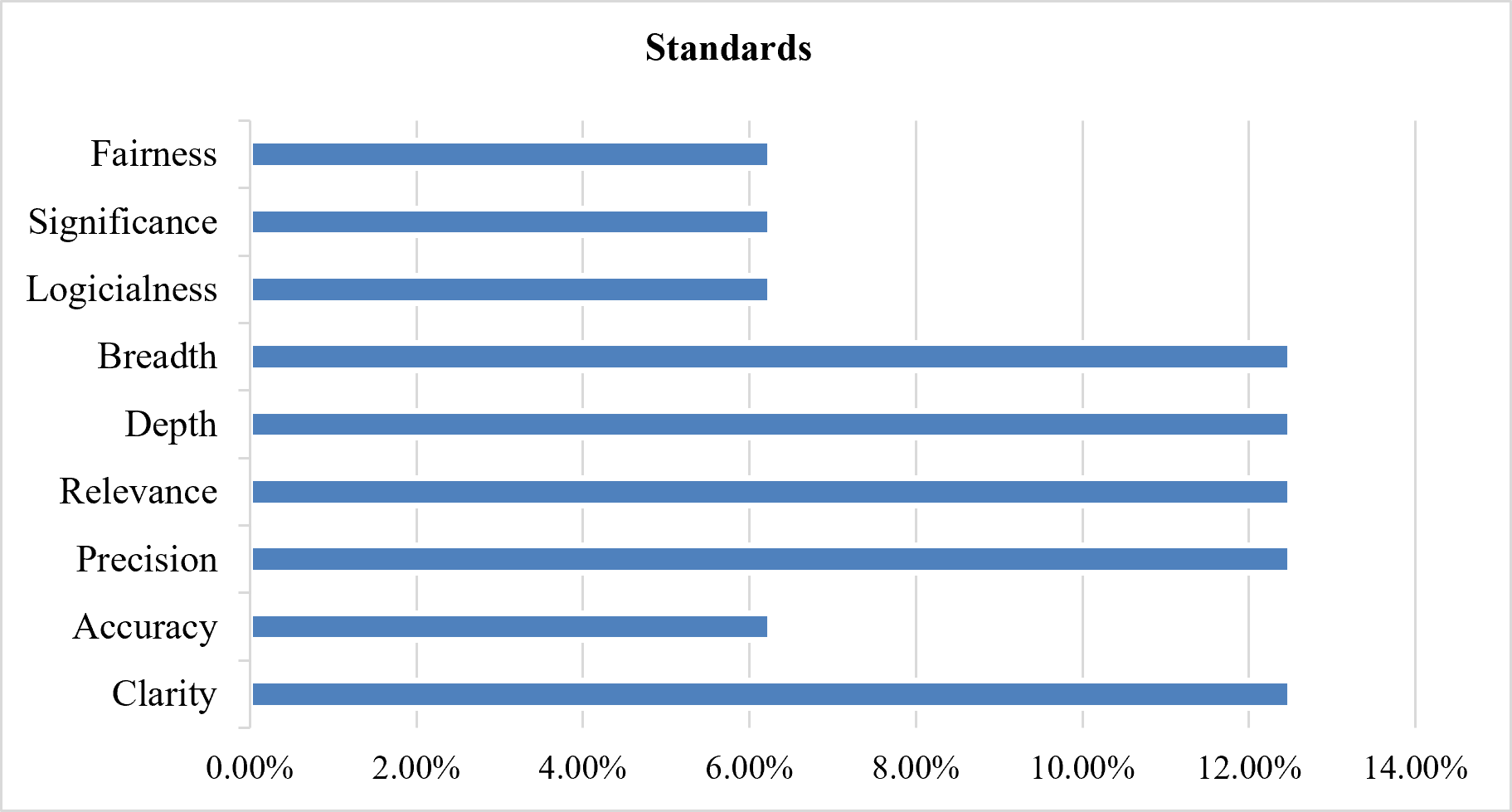
However, the group of standards consisting of clarity, precision, relevance, depth, and breadth with 6.25% each (n=1) was twice higher than the others with 12.5% each (n=2). The outweighed group referred to understanding and explaining the information which was suitable for academic literacy of Pathways 3 designed for second-year students who were supposed to be at intermediate level. The remaining standards helped students to improve evaluating and reflecting skills which are grouped in higher CT according to Krathwohl (2002) when revising the Bloom’s taxonomy.
Challenges Faced by Second-Year EFL Students When Learning Critical Thinking Skills in Pathways 3 Textbook
As can be seen in Table 3, the challenges that second-year students at FE faced when learning CT skills in Pathways 3 comprised of seven different groups of challenges (GC) which were the lack of deep understanding and applying CT (GC1) in questions 1, 2, 3, 4, 5, 6, the time allotted (GC2) in question 7, the lack of confidence when presenting (GC3) in question 8, the degree of lexical resources (GC4) in question 9, the traditional learning style (GC5) in question 10, the CT activities in the textbook (GC6) in question 11, and the lack of specific guidance and support from lecturers (GC7) in question 12.
Overall, the mean values (M) ranged from 3.17 to 3.77, indicating that students perceived critical thinking as an important but challenging skill. The highest mean score was M = 3.77, indicating that students felt that lack of guidance from lecturers (GC7) was the biggest difficulty. This is a key factor affecting the ability to learn and apply critical thinking. Theoretically, Pathways 3 focuses on developing reading, writing, and critical thinking skills. However, in reality, according to the course assessment, only reading and writing skills are assessed for the mid-term and final tests. Therefore, lecturers tended to spend more time helping students develop these two language skills rather than CT skills. Students indicated a strong need for pedagogical intervention, stating, “I feel that I need more support or guidance from lecturers to improve my CT through this textbook” (M=3.77). This emphasizes a gap in ‘pedagogical approaches’ and ‘theory and practice’, suggesting that the current instructional environment may not adequately provide the scaffolded instruction supported by Vygotsky’s sociocultural theory (1978) to facilitate cognitive development.
Table 3. The Challenges That Second-Year Students Face When Learning Critical Thinking Skills in Pathways 3
|
Statements |
1 |
2 |
3 |
4 |
5 |
M |
SD |
|---|---|---|---|---|---|---|---|
|
Challenge Group 1 |
|||||||
|
1. I find it difficult to infer attitude and purpose in complex texts. |
4 (3.3%) |
20 (16.75%) |
38 (31.7%) |
36 (30%) |
22 (18.3%) |
3.42 |
1.07 |
|
2. I struggle to understand CT skills embedded in Pathways 3. |
7 (5.8%) |
15 (12.5%) |
45 (37.5%) |
36 (30%) |
17 (14.2%) |
3.34 |
1.05 |
|
3. I have difficulty synthesizing information from multiple sources. |
4 (3.3%) |
16 (13.3%) |
32 (26.7%) |
42 (35%) |
26 (21.7%) |
3.58 |
1.07 |
|
4. I find it hard to make logical connection between ideas in reading and CT assignments. |
3 (2.5%) |
23 (19.2%) |
40 (33.3%) |
40 (33.3%) |
14 (11.7%) |
3.32 |
0.99 |
|
5. I find it difficult to evaluate different opinions in a reading text. |
1 (0.8%) |
21 (17.5%) |
36 (30%) |
38 (31.7%) |
24 (20%) |
3.52 |
1.02 |
|
6. I find it difficult when discussing or debating topics in Pathways 3. |
4 (3.3%) |
30 (25 %) |
33 (27.5%) |
37 (30.8%) |
16 (13.3%) |
3.25 |
1.08 |
|
Challenge Group 2 |
|||||||
|
7. I find there is not much time left for learning CT skills in Pathways 3. |
0 (0%) |
23 (19.2%) |
42 (35%) |
42 (35%) |
16 (13.3%) |
3.4 |
0.94 |
|
Challenge Group3 |
|||||||
|
8. I am not confident in presenting ideas in English in critical thinking assignments. |
3 (2.5%) |
28 (23.3%) |
34 (28.3%) |
38 (31.7%) |
17 14.2%) |
3.31 |
1.06 |
|
Challenge Group 4 |
|||||||
|
9. I feel overwhelmed by the vocabulary used in CT. |
0 (0%) |
21 (17.5%) |
32 (26.7%) |
45 (37.5%) |
22 (18.3%) |
3.56 |
0.98 |
|
Challenge Group 5 |
|||||||
|
10. I rely too much on memorization instead of analysing or evaluating ideas |
4 (3.3%) |
20 (16.7%) |
36 (30%) |
37 (30.8%) |
23 (19.2%) |
3.45 |
1.08 |
|
Challenge Group 6 |
|||||||
|
11. I feel that the textbook activities are too complicated to practice CT. |
3 (2.5%) |
25 (20.8%) |
54 (45%) |
24 (20%) |
14 (11.7%) |
3.17 |
0.97 |
|
Challenge Group 7 |
|||||||
|
12. I feel that I need more support or guidance from lecturers to improve my CT through this textbook. |
3 (2.5%) |
10 (8.3%) |
29 (24.2%) |
47 (39.2%) |
31 (25.8%) |
3.77 |
1 |
By contrast, the lowest mean score M = 3.17 showed that students had least difficulty in conducting textbook activities (GC6) since they were well-designed based on the standards of CT framework where the most challenging CT skills accounted the least frequency as shown in Figure 1.
On the one hand, students agreed that they had difficulty in the degree of lexical resources (GC4) (M=3.56) and traditional learning style (GC5) (M=3.45). This strong link between language proficiency and CT expression is supported by Grosser and Nel (2013), Harbuza et al. (2025), Li and Wegerif (2014), Shirkhani and Fahim (2011). This issue is also related to the relationship between CT and language proficiency, which Cummins (2000) describes as complex and reciprocal, suggesting that cognitive academic language proficiency develops through cognitively demanding tasks.
The habit of learning vocabulary and ideas by rote learning is not suitable for developing the group of critical thinking skills. The current EFL context faces challenges exacerbated by traditional instruction that emphasizes memorization over analysis. The survey data confirms this pattern, showing that students rely too much on memorization instead of analyzing or evaluating ideas (M=3.45). This difficulty in shifting from rote learning to analytical skills is strongly supported by Alsaleh (2020). This factor falls under the broader category of ‘traditional learning styles’ challenges mentioned in the context of CT integration.
In the lack of deep understanding and applying CT (GC1), students found it difficult to infer attitude and purpose in complex texts (M=3.42), to synthesize information from multiple sources (M=3.58), and to evaluate different opinions in a reading text (M=3.52). This challenge is explicitly supported by the work of Aliakbari and Sadeghdaghighi (2013), and Akatsuka (2020).
Table 3 also reveals specific pedagogical and material-related hurdles faced by students. Students reported struggling to understand CT skills embedded in Pathways 3 (M=3.34). Additionally, a significant number felt that the textbook activities were too complicated to practice CT (M=3.17). Students noted a lack of time, stating, “I find there is not much time left for learning CT skills in Pathways 3” (M=3.4). Students found it difficult when discussing or debating topics in Pathways 3 (M=3.25). These issues highlighted problems specific to the integration and pacing of CT within the curriculum, falling under the general challenge of inconsistent integration of CT.
Students found it hard to synthesizing information from multiple sources (M=3.58). Students found it hard to make logical connection between ideas in reading and CT assignments (M=3.32). These detailed cognitive challenges provide evidence of the specific areas where the core elements CT skills, including problem-solving, evaluating, and decision-making skills, are meant to integrate as suggested by Gaskaree, Mashhady, and Dousti (2010), are weakest.
CONCLUSIONS
Pathways 3 included five distinct CT skills: evaluating visual data, inferring attitude, inferring purpose, applying ideas, and interpreting figurative language. These skills matched nine criteria in Paul and Elder’s (2006) framework, demonstrating a comprehensive method for assessing critical thinking skills. Nonetheless, the set of criteria that included depth, breadth, relevance, clarity, and precision was twice as high as the others. In Pathways 3, which was intended for second-year students who were expected to be at an intermediate level, the outnumbered group referred to comprehending and elucidating the knowledge that was appropriate for academic literacy.
The difficulties second-year students at FE encountered when learning CT skills in Pathways 3 were divided into seven groups of challenges. These included time constraints, a lack of confidence when presenting, the degree of lexical resources, a traditional learning style, the textbook’s CT activities, the lack of specific guidance and support from lecturers, and a lack of deep understanding and application of CT. Critical thinking was seen by students as a crucial but difficult talent. Students expressed a great need for pedagogical assistance and believed that the largest challenge was the professors’ lack of guidance (Dang, 2026). Because the textbook exercises were well-designed according to the CT framework’s principles, where the most difficult CT abilities accounted for the least frequency, students found them to be the least difficult to complete.
References
Akatsuka, Y. (2020). Promoting critical thinking skills in an online EFL environment. Journal of Pan-Pacific Association of Applied Linguistics, 24(2), 95-113.
Aliakbari, M., & Sadeghdaghighi, A. (2013). Teachers’ perception of the barriers to critical thinking. Procedia-Social and Behavioral Sciences, 70, 1-5. https://doi.org/10.1016/j.sbspro.2013.01.031
Alsaleh, N. J. (2020). Teaching critical thinking skills: Literature review. TOJET: The Turkish Online Journal of Educational Technology, 19(1), 21-39.
Atkinson, D. (1997). A critical approach to critical thinking in TESOL. TESOL Quarterly, 31(1), 71-94. https://doi.org/10.2307/3587975
Blass, L., Vargo, M., & Folse, K. (2013). Pathways 3: Reading, writing and critical thinking. National Geographic Learning.
Cáceres, M., Nussbaum, M., & Ortiz, J. (2020). Integrating critical thinking into the classroom: A teacher’s perspective. Thinking Skills and Creativity, 37, 1-18. https://doi.org/10.1016/j.tsc.2020.100674
Cummins, J. (2000). Language, power, and pedagogy: Bilingual children in the crossfire. Multilingual Matters.
Dang, T. T. (2024). Cultural and Situational Constraints on Undergraduate Students' Performance of Learner Autonomy in EFL Learning. Journal of Language Teaching & Research, 15(6). https://doi.org/10.17507/jltr.1506.04
Dang, T. T. (2026). Editorial introduction to the archival reprint issue on learner autonomy, technology, and language development. Journal of Technology Innovation and Learning Advancement, 1(1), 1-9. https://doi.org/10.65956/tila.2026.26
Davidson, B. W. (1998). A case for critical thinking in the English language classroom. TESOL Quarterly, 32(1), 119-123. https://doi.org/10.2307/3587906
Dewi, Y. K., Khalid, A., & Agam, A. A. (2025). The role of critical thinking skills in enhancing problem-solving abilities among high school students. Journal of Education and Social Science, 2(1), 19-24. https://doi.org/10.70716/jess.v2i1.191
Elfatihi, M. (2017). A rationale for the integration of critical thinking skills in EFL/ESL instruction. Higher Education of Social Science, 12(2), 26-31. http://dx.doi.org/10.3968/9702
Fung, D. (2017). The pedagogical impacts on students’ development of critical thinking dispositions: Experience from Hong Kong secondary schools. Thinking Skills and Creativity, 26, 128-139. https://doi.org/10.1016/j.tsc.2017.10.005
Gaskaree, B. L., Mashhady, H., & Dousti, M. (2010). Using critical thinking activities as tools to integrate language skills. Sino-US English Teaching, 7(4), 33-45.
Ghafar, Z., & Raad, B. (2023). The impact of critical thinking on learners to increase their self-regulate in the education process: An overview. International Journal of Arts and Humanities, 1(1), 23-30. https://doi.org/10.61424/ijah.v1i1.13
Golden, B. (2023). Enabling critical thinking development in higher education through the use of a structured planning tool. Irish Educational Studies, 42(4), 949-969. https://doi.org/10.1080/03323315.2023.2258497
Grosser, M. M., & Nel, M. (2013). The relationship between the critical thinking skills and the academic language proficiency of prospective teachers. South African journal of education, 33(2), 1-17.
Harbuza, T., Nypadymka, A., Okhrimenko, O., Mamchenko, S., & Kulazhenko, O. (2025). Developing critical thinking in EFL learners without a linguistic background. Revista on line de Política e Gestão Educacional, 1-24. https://doi.org/10.22633/rpge.v29i00.20233
Heidari, K. (2020). Critical thinking and EFL learners’ performance on textually-explicit, textually-implicit, and script-based reading items. Thinking Skills and Creativity, 37, 1-8. https://doi.org/10.1016/j.tsc.2020.100703
Ilyas, H. P., Solihati, N., & Hikmat, A. (2025). Pedagogies of thought: Unpacking Indonesian EFL teachers’ approaches to critical thinking in language skills instruction. European Journal of English Language Studies, 5(3), 179-190. https://doi.org/10.12973/ejels.5.3.179
Jumariati, J., Nasrullah, N., Sutiono, C., & Khairin Utomo, M. (2024). A study on EFL students’ levels of critical thinking skills. Celtic: A Journal of Culture, English Language Teaching, Literature and Linguistics, 11(2), 215-231. https://doi.org/10.22219/celtic.v11i2.33113
Krathwohl, D. R. (2002). A revision of Bloom’s taxonomy: An overview. Theory into Practice, 41(4), 212-218.
Li, L. (2016). Thinking skills and creativity in second language education: Where are we now?. Thinking Skills and Creativity, 22, 267-272. https://doi.org/10.1016/j.tsc.2016.11.005
Liang, W., & Fung, D. (2021). Fostering critical thinking in English-as-a-second-language classrooms: Challenges and opportunities. Thinking Skills and Creativity, 39, 1-36. https://doi.org/10.1016/j.tsc.2020.100769
Okwara-Kalu, C. E., & Agulanna, G. G. (2020). Enhancing students’ critical thinking skills in the 21st century. Journal of the Nigerian Council of Educational Psychologists, 11(1). 146-157.
Paul, R., & Elder, L. (2006). The miniature guide to critical thinking: Concepts and tools. Foundation for Critical Thinking.
Paul, R., & Elder, L. (2013). Critical thinking: Tools for taking charge of your professional and personal life. Pearson Education.
Prakong, S. (2024). The role of critical thinking in enhancing students’ problem-solving abilities in higher education. Journal of Education, Humanities, and Social Research, 1(1), 10-16. https://doi.org/10.70088/scx8x622
Teo, P. (2024). Being critical and critical being in the language classroom. Thinking Skills and Creativity, 52, 1-12. https://doi.org/10.1016/j.tsc.2024.101493
Vygotsky, L. S. (1978). Mind in society: The development of higher psychological processes. Harvard University Press.
Downloads
Published
Data Availability Statement
N/A
Issue
Section
License
Copyright (c) 2026 Trang Ngo

This work is licensed under a Creative Commons Attribution-NonCommercial-NoDerivatives 4.0 International License.