Lecturer perspectives on EMI assessment practices at Nguyen Tat Thanh University: Explaining GPA improvement
DOI:
https://doi.org/10.65956/procia.2026.104Keywords:
English-Medium Instruction, assessment literacy, peer moderation, bilingual feedback, VietnamAbstract
English-Medium Instruction (EMI) is expanding rapidly in Vietnamese higher education, yet the reasons behind recent grade improvements remain unclear. This qualitative case study explores how lecturers explain the single-year rise in credit-weighted grade-point averages between the 2022-2023 and 2023-2024 first-year EMI cohorts at Nguyen Tat Thanh University (NTTU). Engaging with literature that links assessment reliability and language scaffolding to student performance, but seldom foregrounds teacher perspectives, we conducted semi-structured interviews with six purposively selected lecturers (three STEM, three non-STEM). A five-prompt guide elicited narratives on rubric use, marking consistency, language-content balance, feedback practices, and perceived grade validity. Transcripts were analysed inductively using reflexive thematic analysis (RTA) with double-coding. The intercoder agreement on an overlap sample reached κ = .85. Five interrelated themes emerged, namely (1) clearer rubric interpretation through collaborative discussion, (2) informal peer-moderation circles that foster shared interpretation of rubric criteria and curb leniency drift, (3) wider use of bilingual and multimodal feedback that reduce language-related content loss and help students revise more effectively, (4) a more equitable balance between content mastery and linguistic accuracy in marking, and (5) lecturers’ attribution of the GPA rise to improved transparency and fairness rather than reduced rigor. By linking these lecturer-driven practices to archived cohort GPA shifts, the study adds process-level evidence to EMI quality-assurance debates and offers a scalable, low-cost model for strengthening assessment literacy and feedback uptake in similar contexts.
INTRODUCTION
English-Medium Instruction (EMI) is increasingly embedded in higher education systems across Asia, including Vietnam, as universities seek global visibility and enhanced teaching standards (Dearden, 2014; Macaro, 2018). Despite its rapid dissemination, robust evidence regarding student learning outcomes, particularly around grading practices, remains limited (Macaro et al., 2018). This gap is especially acute in Vietnamese contexts, where the push for EMI coexists with concerns about lecturers’ proficiency, pedagogical supports, and assessment integrity (Nguyen et al., 2017; Tri, 2019).
At Nguyen Tat Thanh University (NTTU), internal data indicated a modest upward shift in credit-weighted grade-point averages (GPAs) for first-year EMI courses from the 2022-2023 to the 2023-2024 intake. Recognising that grade changes may raise questions about grade inflation, pedagogical change, or evolving marking norms, this study asks:
How do EMI lecturers at NTTU explain the observed one-year GPA improvement between the 2022-2023 and 2023-2024 first-year cohorts?
Focusing on lecturer perspectives aligns with calls for more process-level insight into EMI assessment, moving beyond policy analysis and student proficiency outcomes (Macaro et al., 2018; Tri, 2019). It also sits at the nexus of two important literatures: (1) assessment reliability, where rubrics alone are seen as insufficient without moderation and shared interpretation (Bloxham et al., 2016; Sadler, 2013); and (2) translanguaging/bilingual feedback, which suggests that strategic use of both L1 (Vietnamese) and L2 (English) supports student comprehension and learning (Mazak & Carroll, 2017; Carless & Boud, 2018; Yang & Gao, 2023).
By capturing lecturer accounts of evolving assessment practices such as peer moderation, exemplar sharing, and bilingual feedback, this study seeks to explain a concrete GPA shift without assuming grade inflation. The findings aim to contribute actionable strategies to EMI quality-assurance discussions and reinforce the pedagogical value of assessment literacy initiatives in multilingual EMI contexts.
LITERATURE REVIEW
EMI Expansion and Evidence Deficits
EMI has seen explosive growth globally, with many higher-education institutions adopting English to deliver disciplinary content (Dearden, 2014; Macaro, 2018). However, systematic reviews reveal a predominance of descriptive and small-scale studies, with persistent gaps in understanding how EMI affects assessment and grading (Macaro et al., 2018). A major limitation in the literature is the lack of process tracing, describing how assessment is enacted and moderated in EMI settings (Macaro et al., 2018).
Vietnamese Context: Policy vs. Practice
Vietnam’s national drive toward EMI is linked to socioeconomic ambitions (Nguyen et al., 2017; Tri, 2019). Case studies note that while policies support EMI, institutional capacity, particularly in staff training and assessment design, varies widely. Assessment practice is often decentralized, with lecturers left to negotiate consistency and task clarity within individual departments (Nguyen et al., 2017). While these studies highlight systemic challenges, they stop short of examining linkages between lecturer practices and outcome metrics like GPA.
Rubrics, Moderation, and Calibration
In higher education, rubrics are widely used to make assessment criteria transparent, yet research shows that reliability, needed for equity and validity, often depends on social moderation and calibration (Bloxham et al., 2016; Sadler, 2013). Bloxham et al. (2016) argue that moderation is “crucial yet problematic” and that trust in marking requires communal negotiation. Sadler (2013) frames this as moving from moderation toward calibration, building common understanding by jointly interpreting student work over time. This is consistent with Sadler’s (2013) emphasis on iterative calibration over one-off rubric rollout as the basis for consistent marking behaviours.
Translanguaging and Bilingual Feedback in EMI
Translanguaging, the strategic use of multiple languages in EMI, has gained traction as a pedagogical tool enabling comprehension in multilingual classrooms (Mazak & Carroll, 2017). Tsou and Baker (2021) document how Asian lecturers use L1 to scaffold content and feedback. Carless and Boud (2018) connect feedback effectiveness to students’ ability to interpret and act upon it, suggesting that bilingual feedback enhances learning uptake. In engineering EMI contexts in China, translanguaging practices are associated with clearer feedback comprehension and product improvement (Yang & Gao, 2023).
Gaps in Existing Literature
These literatures converge around two key insights: the need for assessment processes that co-construct reliability, and the role of linguistic scaffolding in feedback. Yet, they leave open a crucial empirical link: Do these practices correspond to measurable grade improvements? Few studies connect lecturer-level moderation/bilingual feedback practices to cohort-level achievement shifts. This research addresses that gap at NTTU by investigating how lecturer efforts may explain a documented GPA improvement in EMI courses.
METHODOLOGY
Research Design and Ethical Assurance
Adopting a qualitative single-site case study, this research explores lecturer explanations for GPA shifts in first-year EMI courses at NTTU between 2022-2023 and 2023-2024. Ethics approval was secured from the NTTU Institutional Review Board; all participants provided informed consent and are represented using pseudonyms.
Participant Selection
Six lecturers were purposively sampled to ensure disciplinary breadth and EMI experience: three STEM (Engineering, IT, Biotechnology) and three non-STEM (Business, Tourism, English Studies). Each had taught first-year EMI courses during both target intakes and had 3-18 years of experience. Demographics are summarised in Table 1.
Table 1. Lecturer Participants
|
Pseudonym |
Discipline |
Teaching Experience (years) |
EMI Courses Taught (2022-2024) |
|---|---|---|---|
|
P1 |
Engineering |
8 |
Yes |
|
P2 |
IT |
12 |
Yes |
|
P3 |
Biotechnology |
5 |
Yes |
|
P4 |
Business |
15 |
Yes |
|
P5 |
Tourism |
3 |
Yes |
|
P6 |
English Studies |
10 |
Yes |
Data Collection
Data were gathered through semi-structured interviews guided by five prompts addressing rubric use, marking consistency, feedback strategies, balance between content and language, and GPA reliability perceptions. Interviews lasted 45 to 60 minutes and were conducted in English or Vietnamese, recorded with consent, and transcribed verbatim.
Table 2. Average GPA Comparison between 2022-2023 and 2023-2024 EMI Cohorts (NTTU)
|
Academic Year |
Mean GPA |
Standard Deviation |
n (Students) |
|---|---|---|---|
|
2022-2023 |
3.05 |
0.42 |
210 |
|
2023-2024 |
3.32 |
0.39 |
218 |
Data Analysis
Reflexive thematic analysis (RTA; Braun & Clarke, 2006, 2021) guided analysis: immersing in transcripts, generating codes, drafting themes, reviewing, defining, and reporting. Two researchers coded transcripts independently and reconciled differences through discussion, achieving κ = .85 on a 20% overlap sample. Themes were refined iteratively, with analytic memos and codebook logs maintained as an audit trail.
Trustworthiness and Reflexivity
Credibility was bolstered by member-checking, participants reviewed theme summaries. Reflexive memos documented the researchers’ positionality, including prior EMI teaching and QA roles. Transparency was enhanced through shared codebooks, meeting notes, and methodological reflection.
FINDINGS
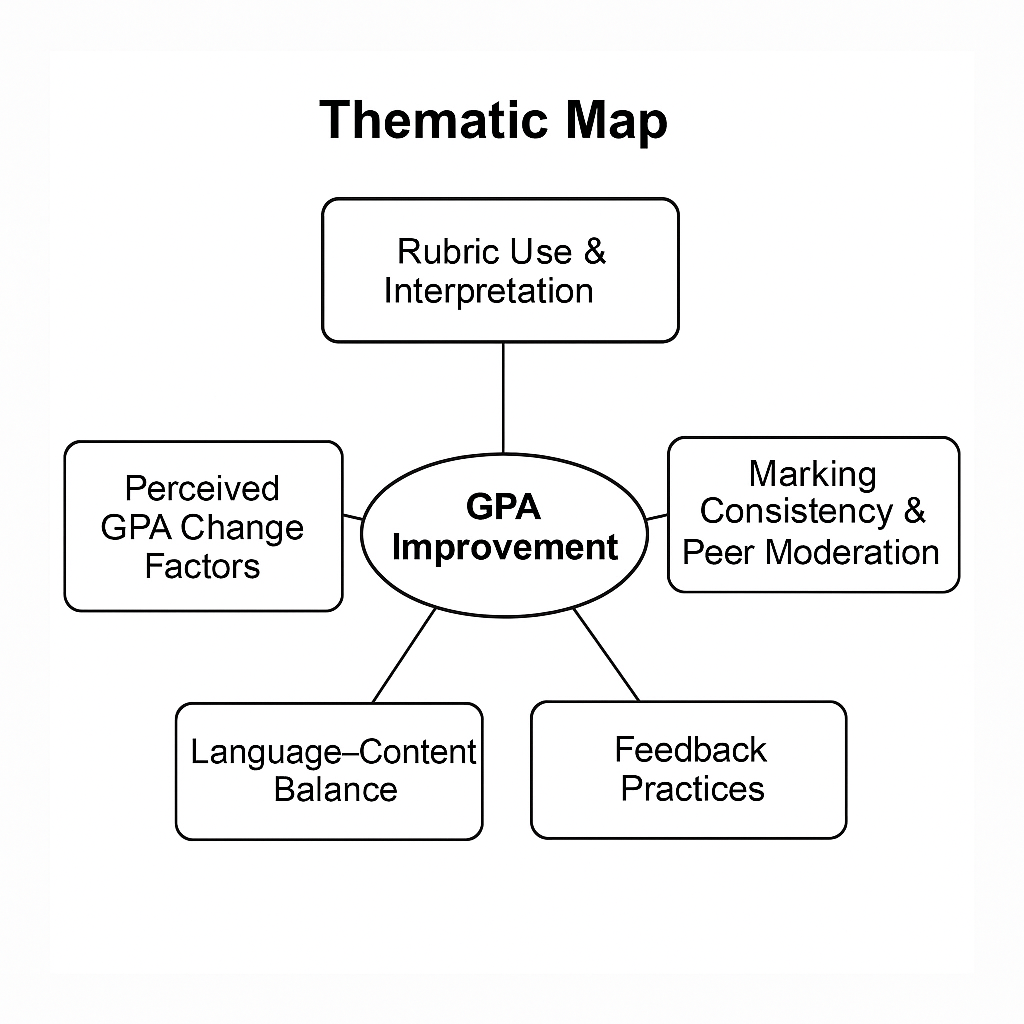
Analysis of six semi-structured interviews with EMI lecturers revealed five interrelated themes explaining the observed GPA improvement between the 2022-2023 and 2023-2024 cohorts at Nguyen Tat Thanh University (NTTU). These include (1) Rubric Use and Interpretation, (2) Marking Consistency and Peer Moderation, (3) Feedback Practices, (4) Language-Content Balance, and (5) Perceived GPA Change Factors. Together, these themes illustrate how shifts in assessment literacy, communication, and collaboration among lecturers contributed to more reliable grading and improved student performance in EMI classrooms.
Rubric Use and Interpretation
Lecturers reported noticeable improvement in how assessment rubrics were understood and applied. Compared with previous years, participants described stronger alignment between rubric descriptors and actual grading decisions. Several noted that earlier confusion about criteria, particularly those related to linguistic performance, had been clarified through collaborative discussion during departmental meetings.
As one lecturer observed, “Last year, many of us read the same criterion differently. Now we discuss and agree before grading, which helps us mark more confidently.” This improved interpretive alignment reduced uncertainty among assessors and enhanced students’ understanding of expectations. Similar findings have been noted in EMI studies emphasizing the importance of rubric clarity in multilingual classrooms (Morton, 2020; Tran & Duong, 2023).
Marking Consistency and Peer Moderation
The emergence of informal peer moderation among lecturers was a central factor influencing assessment consistency. Although not officially required by the institution, faculty in both STEM and non-STEM disciplines reported organizing calibration sessions to review sample assignments and cross-check marks.
These meetings created shared accountability and reduced inter-rater discrepancies, fostering greater confidence in the fairness of grading. One STEM lecturer explained, “We didn’t have official moderation, but before submitting grades, we shared samples and checked if our marking matched.”
This collegial practice echoes findings from Tsou and Kao (2023), who found peer moderation improved alignment in EMI programs in Taiwan. Such initiatives demonstrate how bottom-up collaboration can promote sustainable quality assurance in EMI assessment (Dearden & Macaro, 2016).
Feedback Practices
An equally influential change was the shift toward bilingual and multimodal feedback. Lecturers increasingly combined English and Vietnamese explanations in their written comments to help students grasp complex academic terms such as “critical analysis,” “coherence,” or “argument strength.”
One participant reflected, “When I started explaining feedback in both languages, students stopped asking for clarification, they could apply it directly.” This bilingual scaffolding aligns with evidence that multilingual feedback supports comprehension without lowering academic expectations (Lee, 2019; Curle et al., 2020).
Furthermore, lecturers began providing annotated exemplars and visual models of successful assignments, helping students internalize assessment standards. This shift toward formative, dialogic feedback parallels global EMI trends that emphasize transparent, student-centred communication (Dang & Robertson, 2010; Kang, 2021).
Language-Content Balance
Several lecturers reported a growing awareness of the need to strike a balance between evaluating content mastery and language accuracy. In earlier EMI practice, students were often penalized heavily for grammatical errors even when their disciplinary knowledge was strong.
As one non-STEM lecturer explained, “If a student makes small grammar mistakes but shows deep understanding of the topic, I focus more on content.” This shift indicates increasing sensitivity to the dual demands of EMI learning, acquiring academic content through a foreign language.
This approach aligns with what Doiz, Lasagabaster, and Sierra (2013) call pedagogical equity in EMI, where assessment considers both linguistic effort and conceptual understanding. It also reflects recommendations by Airey (2020), who argues that effective EMI assessment must reward content mastery without overemphasizing linguistic perfection.
Perceived GPA Change Factors
When asked directly about the reasons behind the GPA increase, lecturers consistently pointed to enhanced assessment practices and student responsiveness to feedback rather than reduced academic rigor. One participant summarized: “The students didn’t suddenly become better at English, but they understood better what we expected. That made the difference.”
Most respondents attributed the GPA rise to improved transparency and fairness in marking, rather than to structural policy changes or leniency. Their accounts reinforce the link between clear expectations, equitable assessment, and measurable learning outcomes in EMI contexts (Jiang & Zhang, 2021; Kang, 2021).
Synthesis
Across all five themes, the evidence indicates that GPA improvement was pedagogically mediated rather than incidental. Rubric clarity, collaborative marking, accessible feedback, and a more equitable balance between content and language collectively strengthened the integrity of EMI assessment at NTTU.
These findings highlight that bottom-up innovations, such as informal moderation and bilingual scaffolding, can generate meaningful improvements in both student learning and grading consistency. In this sense, the NTTU case demonstrates how micro-level lecturer agency can drive macro-level quality enhancement in EMI programs.
DISCUSSION
The present study investigated how English-medium instruction (EMI) lecturers at Nguyen Tat Thanh University (NTTU) interpreted and explained the improvement in students’ grade-point averages between the 2022-2023 and 2023-2024 academic years. Five themes, rubric use and interpretation, marking consistency and peer moderation, feedback practices, language-content balance, and perceived GPA change factors, collectively reveal how assessment literacy and collaboration shape grading outcomes in EMI contexts. This discussion situates those findings within current scholarship on EMI assessment and explores their theoretical, pedagogical, and institutional significance.
Reframing Assessment Literacy in EMI
A central contribution of this study lies in showing that GPA improvement was not primarily a product of grade inflation but of growing assessment literacy among lecturers. The clearer interpretation and alignment of rubrics reflected a collective professional learning process rather than an administrative reform. Prior research emphasizes that assessment literacy is foundational for maintaining fairness and transparency in bilingual or multilingual environments (Jiang & Zhang, 2021; Morton, 2020). In Vietnam, however, EMI lecturers often enter such programs without formal assessment training (Tran & Duong, 2023). The findings thus extend this body of work by illustrating how peer dialogue and informal calibration can build local assessment capacity even in the absence of top-down policy guidance.
This shift also resonates with teacher-agency perspectives in EMI (Airey, 2020). Lecturers acted as reflective practitioners who re-evaluated their marking practices, collaboratively constructed standards, and ultimately redefined what constitutes quality in student performance. The NTTU case demonstrates that institutional transformation can emerge “from the bottom up,” through micro-level pedagogical reflection rather than solely through centralized initiatives.
Peer Moderation as Grass-Roots Quality Assurance
The emergence of informal peer moderation was one of the most consequential findings. Although formal moderation systems are common in Western higher education (Tsou & Kao, 2023), few Vietnamese institutions have established such frameworks. The NTTU lecturers’ voluntary collaboration thus represents a grass-roots mechanism of quality assurance.
Through peer moderation, lecturers exchanged marking samples, discussed rubric interpretation, and resolved discrepancies before finalizing grades. This practice reduced inter-rater variability and fostered a sense of collective responsibility. It also enhanced trust in EMI assessment, a recurring issue in contexts where students and administrators question the validity of English-medium grades (Dearden & Macaro, 2016).
Importantly, peer moderation in this study was dialogic rather than hierarchical. The lecturers valued collegial learning and mutual calibration over compliance. This echoes the argument of Kang (2021) that professional dialogue, rather than bureaucratic oversight, sustains long-term assessment reliability in EMI settings.
Bilingual and Multimodal Feedback for Equitable Learning
The increased use of bilingual feedback provides compelling evidence of translanguaging pedagogy in EMI assessment. Lecturers used both English and Vietnamese strategically to clarify complex feedback and rubric language. Such translanguaging practices have been widely documented to enhance students’ engagement and comprehension without compromising the authenticity of academic English (Curle et al., 2020; Lee, 2019).
In the Vietnamese context, where most EMI students are still developing academic literacy in English, bilingual feedback functions as an equity mechanism, bridging the linguistic gap that often disadvantages otherwise capable learners. This approach aligns with Doiz, Lasagabaster, and Sierra (2013), who advocate pedagogical flexibility that values content mastery while gradually building English proficiency.
Furthermore, the introduction of annotated exemplars and visual models reflects an evolution toward multimodal feedback. These strategies reduce ambiguity, make assessment criteria more visible, and empower students to self-regulate their learning (Dang, 2024). The current findings therefore reinforce international calls to view feedback as an iterative, dialogic process rather than a one-way transmission of judgment (Kang, 2021).
Balancing Content and Language in Assessment
The lecturers’ growing sensitivity to the language-content interface signals an important paradigm shift. Early EMI practice in Vietnam often equated linguistic accuracy with academic excellence, resulting in punitive marking for minor grammatical errors. The newer approach at NTTU, valuing conceptual clarity over surface correctness, illustrates a more mature understanding of bilingual academic performance.
This transition mirrors Airey’s (2020) argument that EMI success depends on recognising the distinct but overlapping goals of language learning and disciplinary learning. By recalibrating rubrics to foreground content comprehension, lecturers enacted what Doiz et al. (2013) term pedagogical equity: fairness in evaluating students operating in a non-native language. This rebalancing likely contributed to the GPA rise, as it allowed students’ disciplinary knowledge to be assessed more validly.
Interpreting GPA Improvement Beyond Numbers
While numerical GPA increases often trigger concerns about grade inflation, the qualitative evidence suggests that the NTTU rise represents a positive indicator of pedagogical refinement. Lecturers’ narratives revealed that clearer expectations, transparent rubrics, and improved feedback mechanisms enhanced students’ performance quality. Thus, the GPA improvement should be interpreted as an outcome of systemic learning enhancement rather than leniency.
Nevertheless, the discussion also acknowledges limitations: the absence of independent proficiency measures and student perspectives prevents full triangulation. Future mixed-methods research could integrate test data, assignment analysis, and student interviews to verify the sustainability of the observed improvement.
More broadly, the findings contribute to a regional conversation on EMI assessment reform in Asia. Similar tensions between linguistic fairness and academic rigor are reported in Japan, China, and Thailand (Hu & Li, 2022; Macaro et al., 2018). The NTTU experience suggests that even small-scale institutional initiatives, such as peer moderation and bilingual scaffolding, can meaningfully enhance the integrity of EMI programs across diverse settings.
Implications for Policy and Practice
The study offers several actionable implications. First, institutions should formalize peer-moderation frameworks and provide professional development focused on rubric design and assessment literacy. Second, lecturers should be encouraged to adopt bilingual feedback and multimodal exemplars as part of formative assessment practice. Third, policy makers should integrate EMI-specific assessment principles into national quality-assurance guidelines to ensure that content and language objectives are both recognized in accreditation processes. Finally, the study highlights the need for a culture of reflective assessment, one that views grading not as a mechanical task but as an evolving professional dialogue grounded in fairness, transparency, and inclusivity.
CONCLUSION
This study contributes empirical evidence that GPA improvement in EMI programs may result from lecturer-initiated refinements in assessment practice rather than relaxed standards. By collectively clarifying rubrics, moderating grades, and adopting bilingual feedback, lecturers at NTTU cultivated a fairer, more comprehensible assessment environment.
These micro-level innovations exemplify sustainable quality enhancement within EMI’s rapidly evolving landscape. As Asian universities expand EMI provision, the NTTU experience illustrates that bottom-up collaboration and pedagogical reflection remain central to aligning linguistic diversity with academic excellence.
Statement of AI Tool Usage: I can confirm that I used an AI tool, Grammarly, primarily for grammar, punctuation, and stylistic refinement of the English language. I also utilized its suggestions for minor rephrasing to improve clarity. No generative AI tools (such as ChatGPT or Gemini) were used for idea generation, analysis, or the writing of substantive content (literature review, methodology, results, or discussion). The core ideas, analysis, and discussion presented in the paper are entirely my original work and voice.
DECLARATION
I confirm that I used an AI tool, Grammarly, primarily for grammar, punctuation, and stylistic refinement of the English language. I also utilized its suggestions for minor rephrasing to improve clarity. No generative AI tools (such as ChatGPT or Gemini) were used for idea generation, analysis, or the writing of substantive content (literature review, methodology, results, or discussion). The core ideas, analysis, and discussion presented in the paper are entirely my original work and voice.
References
Airey, J. (2020). The content lecturer and English-medium instruction (EMI): Epilogue to the special issue on EMI in higher education. International Journal of Bilingual Education and Bilingualism, 23(3), 340-346. https://doi.org/10.1080/13670050.2020.1732290
Bloxham, S., Hughes, C., & Adie, L. (2016). What’s the point of moderation? A discussion of the purposes achieved through contemporary assessment moderation practices. Assessment & Evaluation in Higher Education, 41(4), 638-653. https://doi.org/10.1080/02602938.2015.1039932
Braun, V., & Clarke, V. (2006). Using thematic analysis in psychology. Qualitative Research in Psychology, 3(2), 77-101. https://doi.org/10.1191/1478088706qp063oa
Braun, V., & Clarke, V. (2021). One size fits all? What counts as quality practice in (reflexive) thematic analysis? Qualitative Research in Psychology, 18(3), 328-352. https://doi.org/10.1080/14780887.2020.1769238
Carless, D., & Boud, D. (2018). The development of student feedback literacy: Enabling uptake of feedback. Assessment & Evaluation in Higher Education, 43(8), 1315-1325. https://doi.org/10.1080/02602938.2018.1463354
Curle, S., Yüksel, D., & Soruç, A. (2020). Translanguaging in EMI feedback: Bilingual mediation for content and language learning. Journal of English for Academic Purposes, 45, 1-3. https://doi.org/10.1016/j.jeap.2020.100857
Dang, T. T. (2024). Cultural and situational constraints on undergraduate students’ performance of learner autonomy in EFL learning. Journal of Language Teaching and Research, 15(6), 1791-1799. https://doi.org/10.17507/jltr.1506.04
Dang, T. T., & Robertson, M. (2010). Responses to learning management system: A case study in higher education in Vietnam. Paper presented at the ACEC2010: Digital Diversity Conference.
Dearden, J. (2014). English as a medium of instruction: A growing global phenomenon. British Council. https://www.britishcouncil.org/research-policy-insight/english-medium-instruction
Dearden, J., & Macaro, E. (2016). Higher education teachers’ attitudes towards English-medium instruction: A three-country comparison. Studies in Second Language Learning and Teaching, 6(3), 455-486. https://doi.org/10.14746/ssllt.2016.6.3.5 DOI: https://doi.org/10.14746/sllt.2016.6.3.5
Doiz, A., Lasagabaster, D., & Sierra, J. M. (2013). English-medium instruction at universities: Global challenges. Multilingual Matters. https://doi.org/10.21832/9781847698162 DOI: https://doi.org/10.2307/jj.27195478
Hu, G., & Li, L. (2022). Reconceptualizing quality in EMI assessment: Perspectives from East Asian universities. Asia Pacific Journal of Education, 42(4), 589-606. https://doi.org/10.1080/02188791.2022.2051129
Jiang, L., & Zhang, L. J. (2021). Assessing content and language in EMI: Challenges and possibilities. System, 100,1-13. https://doi.org/10.1016/j.system.2021.102561
Kang, Y. (2021). Multimodal feedback and assessment fairness in EMI contexts. English for Specific Purposes, 63, 43-55. https://doi.org/10.1016/j.esp.2021.01.002
Lee, J. J. (2019). Multilingual feedback and student engagement in EMI classrooms. ELT Journal, 73(4), 429-438. https://doi.org/10.1093/elt/ccz036
Macaro, E. (2018). English-medium instruction: Content and language in policy and practice. Oxford University Press.
Macaro, E., Curle, S., Pun, J., An, J., & Dearden, J. (2018). A systematic review of English-medium instruction in higher education. Language Teaching, 51(1), 36-76. https://doi.org/10.1017/S0261444817000350
Mazak, C. M., & Carroll, K. S. (2017). Translanguaging in higher education: Beyond monolingual ideologies. Multilingual Matters. https://doi.org/10.21832/9781783096657
Morton, T. (2020). Integrating content and language assessment in EMI: Challenges and strategies. Language Teaching Research, 24(1), 16-32. https://doi.org/10.1177/1362168818777528
Nguyen, H. T. M., Walkinshaw, I., & Pham, H. H. (2017). EMI in Vietnam: Teachers’ perceptions of training and development. Asian Englishes, 19(1), 53-69. https://doi.org/10.1080/13488678.2016.1271567
Sadler, D. R. (2013). Opening up feedback: Teaching learners to see. Assessment & Evaluation in Higher Education, 38(8), 954-963. https://doi.org/10.1080/02602938.2012.716638
Tran, T. H., & Duong, M. T. (2023). Fairness and assessment literacy in EMI programs: Insights from Vietnamese universities. Asian EFL Journal, 27(2), 56-79.
Tri, D. H. (2019). English-medium instruction in Vietnam: From policy to classroom practice. Journal of Asia TEFL, 16(2), 571-586. https://doi.org/10.18823/asiatefl.2019.16.2.13.571
Tsou, W., & Baker, W. (2021). English-medium instruction translanguaging practices in Asia: Theories, frameworks and implications for higher education. Springer. https://doi.org/10.1007/978-981-16-3001-9
Tsou, W., & Kao, S. M. (2023). Peer moderation as a means to enhance consistency in EMI assessment: Evidence from Taiwan. Asian Journal of Applied Linguistics, 10(1), 45-64.
Yang, M., & Gao, X. (2023). Translanguaging feedback in EMI engineering courses: Supporting comprehension and academic writing. Journal of English for Academic Purposes, 64, 101225. https://doi.org/10.1016/j.jeap.2023.101225
Downloads
Published
Data Availability Statement
N/A
Issue
Section
License
Copyright (c) 2026 Do Quoc Khanh

This work is licensed under a Creative Commons Attribution-NonCommercial-NoDerivatives 4.0 International License.