
Teaching grammar communicatively to EFL students: A mixed-methods study
DOI:
https://doi.org/10.65956/procia.2026.105Keywords:
teaching grammar communicatively, communicative learning, English grammar learningAbstract
This study employed a mixed-methods exploratory design. It aimed to focus on gaining insights and understanding of EFL communicative teaching approach, which employed AI-generated illustrations as an English-medium instruction (EMI) technique to provide rich visual input that supported comprehension of grammar items and communicative tasks in teaching English tenses to EFL learners using pictures at a foreign language centre. Participants were 40 university students (30 female and 10 male) from 19 to 22 years old voluntarily taking part in the study. First, those participants were divided into two groups with 20 students each: The control group (CG) learned English basic tenses through traditional methods, while the experimental group (EG) was taught with AI-prompted images as EMI devices which supported a communicative approach, aiming to enhance understanding and practical use of tenses. Then, EG students were required to respond via post-task Think-Aloud protocol (TAP) after each session. Last, they were interviewed (IDI) to probe deeper insights into their improvement in English grammar, particularly in understanding and applying tenses. The statistical analysis of experimental data was followed by thematic analysis of data sets of post-task TAP responses and the interview. Results and findings revealed the impact of grammar teaching by using images on the research site. The results indicated that when students grasped grammatical items more quickly, they developed a deeper understanding, retained the knowledge longer, and showed greater enthusiasm in using grammar actively and effectively. This increased engagement supported their achievement of EFL classroom learning goals.
INTRODUCTION
Research on teaching grammar has drawn attention to learners in EFL classrooms for decades. According to Ellis (2006), teaching techniques which highlighted grammatical form to support learners in metalinguistic comprehension of the linguistic item and apply it, then produce it in contexts should be deployed. Moreover, Barkley and Major (2018) mentioned ‘Prompts with Pictures’ as one of the in-class activities to build participation in English-medium instruction (EMI) courses. With the assistance of Artificial Intelligence in prompting images for the communicative tasks in communicative grammar teaching, learning outcomes for targeted grammatical items have been improved. This study employed a mix-methods design, including quasi-experimental and post-task Think-Aloud Protocol (TAP) and individual deep interviews (IDI) to find out to what extent and how EFL learners perceived the grammar teaching instructions with the AI-generated images used as instructional technique in class.
STATEMENT OF THE PROBLEM
Based on the EFL classroom observation after dozens of years of teaching, researchers have observed that learners struggle to comprehend English tenses effectively due to the vague and abstract principles, which resulted in poor outcomes in application of the linguistic items. Hence, there was an urge to employ an effective instructional technique for communicative learning in EFL classrooms, which excluded the lack of engagement and real-life context of traditional grammar teaching method whilst compounding advanced effectiveness of visual assistance in teaching grammar communicatively through AI-prompted images, which makes the abstract concepts of the grammatical become more concrete and easier to grasp for learners.
PURPOSE OF THE STUDY
The study aimed to find out to what extent and how teaching grammar communicatively with AI-generated images can enhance EFL learners’ grammar comprehension and encourage active use of tenses in contexts in EFL classrooms.
RESEARCH QUESTIONS
Regarding the purpose of the study, the research questions have been formulated as follows:
1. To what extent does communicative grammar teaching with AI-prompted images affect EFL students’ learning outcomes?
2. How do EFL students perceive communicative grammar teaching with AI-prompted images in enhancing their learning experience?
LITERATURE REVIEW
Communicative Grammar Teaching and AI Integration
The history of English grammar teaching and learning has seen the ongoing development of the grammar pedagogical research and development through decades. However, the communicative features of grammar were prominent in myriads of studies. Grammar as a dynamic process was integrated into communicative use (Larsen-Freeman, 2003) whilst Thornbury (1999) emphasised the inductive, discovery-based grammar learning process. According to Ellis (2006), grammatical items were focused on form-meaning-use connection in communicative contexts. Krashen (1982) also highlighted the comprehensible input as a key notion to grammar acquisition in SLA studies.
Along with the expositional bloom of AI technology which is dominating the trends of pedagogical implications these days, AI-powered applications and AI-prompted instructions were applied more effectively in EFL classrooms. Reinders and Pegrum (2021) explored AI tools (chatbots, visuals) to support autonomous and interactive grammar learning while task-based grammar teaching aligned with real-life communication.
Communicative Methods of Teaching Grammar
According to Brown and Lee (2015), Richards and Rodgers (2014), and Thornbury (1999), communicative methods of teaching grammar can be briefly summarised with some key points following. Communicative grammar was based on the communicative approach of L2 / foreign languages, in which the grammatical items were not taught in isolation but integrated with other language skills.
A communicative grammar lesson might start in very much the same way as a traditional approach with presentation of a grammar item and examples, followed by controlled exercises to practise the grammar items. The highlight of the lesson was that grammar was learned and practiced in context to upgrade students’ linguistic proficiency levels while retrieving their previous experience with the targeted grammar items. The lesson included segments of communicative language teaching tasks, which were implemented in forms of the activities such as role play, information gap, group discussion, which was applied to this study, and interactive games.
The grammar lesson should cover five stages including: Presentation with Recognition, Demonstrating Comprehension, Grammar Explanation, Practice Exercises, and Communicative Expression. Out of four approaches to grammar teaching (traditional approach, structural approach, notional-functional approach, and communicative), the last method was learner-centred, focused on fluency and practical use in authentic contexts, in contrast to the traditional methods which highlighted teacher-centred instruction, focus on accuracy and mastery of language rules.
When designing and preparing for a communicative grammar teaching lesson plan, instructors should incorporate eight principles of communicative grammar consisting of: using tasks, promoting learning by doing, providing rich input, making input meaningful and comprehensible, cooperative learning, focusing on form, giving error feedback, considering affective factors. In other words, key features of communicative methods of teaching grammar emphasize communication capabilities of learners in real-life contexts.
Image Prompt as EMI Technique in Teaching Grammar
Among numerous options for in-class activities for EMI courses, ‘Prompts with Pictures’ is one of the leading techniques for its innovation and effectiveness (Barkley & Major, 2018). In case the targeted grammatical items, the tenses in the study, were considered as the content for an EMI course, ‘Prompts with Pictures’ retrieving AI-generated images was carried out as a practical feasible tool to teach grammar communicatively. This technique was meant to help students become more comfortable applying targeted grammar items and to use visual support to elicit questions from students. The procedure could consist of three steps as follows:
- Show students an image without explanation. Choose an image that is confusing to students. Make sure the image is relevant.
- Ask students to explain the image, or name the processes, and justify their answers as individuals or in groups. Encourage them to use key terms that can also be written on the board.
- Do not give an explanation until students have explored all options. Lead discussions that allow instructors to ensure that students gain the understanding that they need.
Application for The Study
The English basic tenses of simple present, present continuous, simple past, past continuous, past perfect, be going to, will, present perfect, present perfect continuous were the targeted learning linguistic items for the study, in which EFL learners would absorb the communicative grammar teaching and learning with the EMI instructional technique of ‘Prompt with Pictures’ using AI-generated images to assist students to comprehend and cognitively apply the tenses to practical usage and real-life contexts.
METHODOLOGY
Research Site and Participants
The study was conducted in a non-English-major class at a university in Ho Chi Minh City. The participants consisted of second-year students who had successfully completed the A2-level course and passed the final examination, thereby qualifying for progression to the B1-level class. Students who do not meet the A2-level requirements are required to retake the course before enrolling in this class. To ensure comparability across participants, a pre-test was administered prior to the intervention to verify that their English proficiency levels are relatively homogeneous. A total of 40 students took part in the study, divided equally into two groups: Control Group (CG) of 20 students and Experimental Group (TG) of 20 students.
Table 1. Demographic Summary of Participants
|
Group |
No. of Students |
Gender (F/M) |
Birth Year Range |
Mean Age |
|---|---|---|---|---|
|
Control Group |
20 |
17 / 3 |
2003-2004 |
20-21 |
|
Experimental Group |
20 |
18 / 2 |
2004 |
20-21 |
|
Total |
40 |
35 / 5 |
2003-2004 |
20-21 |
Research Design
This research employed a quasi-experimental design to examine the effectiveness of AI-prompted images in enhancing learners’ understanding and use of English grammar tenses. The control group received grammar instruction through the traditional deductive teaching method, while the experimental group was taught using AI-generated visual prompts designed to support conceptual understanding through contextualized imagery. The grammar tenses selected for instruction followed the syllabus of Personal Best B1 (Richmond Publishing), ensuring alignment with the prescribed course materials. All tenses covered in the textbook such as the present simple, present continuous, past simple, past continuous, present perfect, and future forms were included in the intervention. Both groups completed a post-test following the instructional period to evaluate their progress and comprehension of English tenses.
In addition to the pre-test and post-test, qualitative data were collected through a think-aloud (TAP) protocol and semi-structured interviews. The TAP sessions captured students’ cognitive processes and immediate reactions during grammar learning tasks, while the interviews explored their perceptions of learning grammar through AI-generated materials. These qualitative data sets were analysed using thematic analysis, following Braun and Clarke’s (2006) framework, to identify recurring themes and patterns related to students’ engagement, learning strategies, and attitudes toward AI-supported grammar instruction. This mixed-methods approach aims to provide a comprehensive understanding of both the effectiveness and learner experience associated with the use of AI as an instructional aid in grammar teaching.
To be more specific, instruction in both groups was implemented over equivalent time periods. The experimental group lessons followed five structured phases:
- Warm-up and Exposure: Students observe contextual images and discuss what is happening to activate prior knowledge.
- Description Task: Learners write short sentences describing pictures in their own words.
- Peer Review and Scaffolding: Students share and review their sentences with teacher guidance to notice and correct tense forms.
- Rule Discovery: Learners complete guided tasks to identify and formulate grammatical rules inductively.
- Communicative Practice: Students engage in short interactive activities and role-plays applying the target tenses in meaningful contexts.
The control group, in contrast, was taught through rule explanation, examples, and written exercises following the traditional deductive method.
Data Collection
The study employed three data collecting instruments, namely the pre-test and post-test scores to measure the variable of English Grammar learning outcomes depending on the variable of the classroom instructions of teaching grammar communicatively using AI-generated images in the quasi-experimental design, think-aloud (TAP) protocols, and semi-structured interviews. The pre-test and post-test were designed to obtain quantitative data on participants’ progress in learning English grammar tenses before and after the instructional intervention. The TAP protocol was administered after each lesson to elicit students’ reflections, thoughts, and feelings about their learning experiences, particularly their interaction with AI-generated materials. In addition, semi-structured interviews were conducted individually to gain deeper insights into participants’ attitudes, perceptions, and overall experiences of learning grammar through AI-assisted visual prompts.
To ensure participant confidentiality, each student was assigned a unique identification code ranging from E1 to E20 for students in the Experimental/Treatment Group and C1 to C20 for students in the Control Group corresponding to their pre-test and post-test scores. Quantitative data obtained from the tests were analysed using descriptive and inferential statistical methods to evaluate the effectiveness of the instructional approaches. Meanwhile, qualitative data from the TAP, interviews, and AI-generated visual materials were analysed thematically following Braun and Clarke’s (2006) framework. This thematic analysis identified recurring patterns and insights that complemented and enriched the quantitative findings, offering a more comprehensive understanding of learners’ engagement and cognitive processes in AI-supported grammar learning.
RESULTS
To begin with, the quantitative data obtained from the pre-test and post-test were analysed to examine the overall improvement in learners’ grammar performance. As shown in Table 2, both groups showed improvement in their mean scores after the intervention.
Table 2. Descriptive Statistics for Pre-Test and Post-Test Scores in the Control and Treatment Groups
|
Group |
Test |
n |
M |
SD |
|---|---|---|---|---|
|
Control Group |
Pretest |
20 |
24.90 |
6.08 |
|
Control Group |
Posttest |
20 |
34.90 |
5.39 |
|
Treatment Group |
Pretest |
20 |
24.55 |
6.08 |
|
Treatment Group |
Posttest |
20 |
37.55 |
1.39 |
|
Note: M = mean; SD = standard deviation. The control group improved from pretest (M = 24.09, SD = 6.08) to posttest (M = 34.90, SD = 5.39). The treatment group improved from pretest (M = 24.55, SD = 6.08) to posttest (M = 37.55, SD = 1.39). |
||||
The control group improved from a pre-test mean of 24.90 (SD = 6.08) to a post-test mean of 34.90 (SD = 5.39), representing an average gain of +10 points. Meanwhile, the experimental group showed a greater improvement from 24.55 (SD = 6.08) to 37.55 (SD = 1.39), an average gain of +13 points. The smaller standard deviation in the experimental group’s post-test (SD = 1.39) compared to that of the control group (SD = 5.39) indicates more consistent performance among students who received the AI-prompted image instruction. These descriptive results suggest that the intervention had a positive effect on learners’ mastery of grammar tenses. The results of the paired samples t-test confirmed that the mean difference between pre-test and post-test scores was statistically significant (p < .05) for both groups, implying a stronger learning gain attributable to the AI-assisted instructional method. While the test results indicated measurable improvement, further insights into students’ cognitive processes during grammar learning were explored through the think-aloud protocol.
In accordance with Creswell and Creswell (2018) and Creswell and Poth (2024), the qualitative component of this mixed-method study adopted a constructivist perspective, emphasizing students’ reflections, perceptions, and meaning-making processes. Data from the Think-Aloud Protocol (TAP) and semi-structured interviews were analysed using Braun and Clarke’s (2006) thematic analysis framework to identify recurring themes and underlying patterns in learners’ engagement and cognitive strategies. The thematic network derived from the interview and think-aloud data (see Figure 1) illustrates how students perceived the use of AI-generated images in learning grammar tenses. Four major themes emerged: Matters of Meaningful Context, Factors Affecting Learner Engagement, Matters of Input Enhancement, and Challenges in Implementation. Regarding matters of meaningful context, participants consistently emphasized that the AI-generated images made grammar learning more authentic and practical. Students reported that they learned how to observe and infer meanings from visual situations, which helped them apply grammatical structures in real-life communication and spontaneous speaking. This suggests that the use of AI-generated visuals supported contextualized and communicative grammar learning, promoting a deeper understanding of tense usage beyond mechanical drills. In terms of factors affecting learner engagement, most students described the lessons as fun, enjoyable, and impressive, often noting that the images left a strong impression and made grammar learning “helpful and interesting.” This positive affective response indicates that AI-mediated visuals enhanced learner motivation and classroom participation.
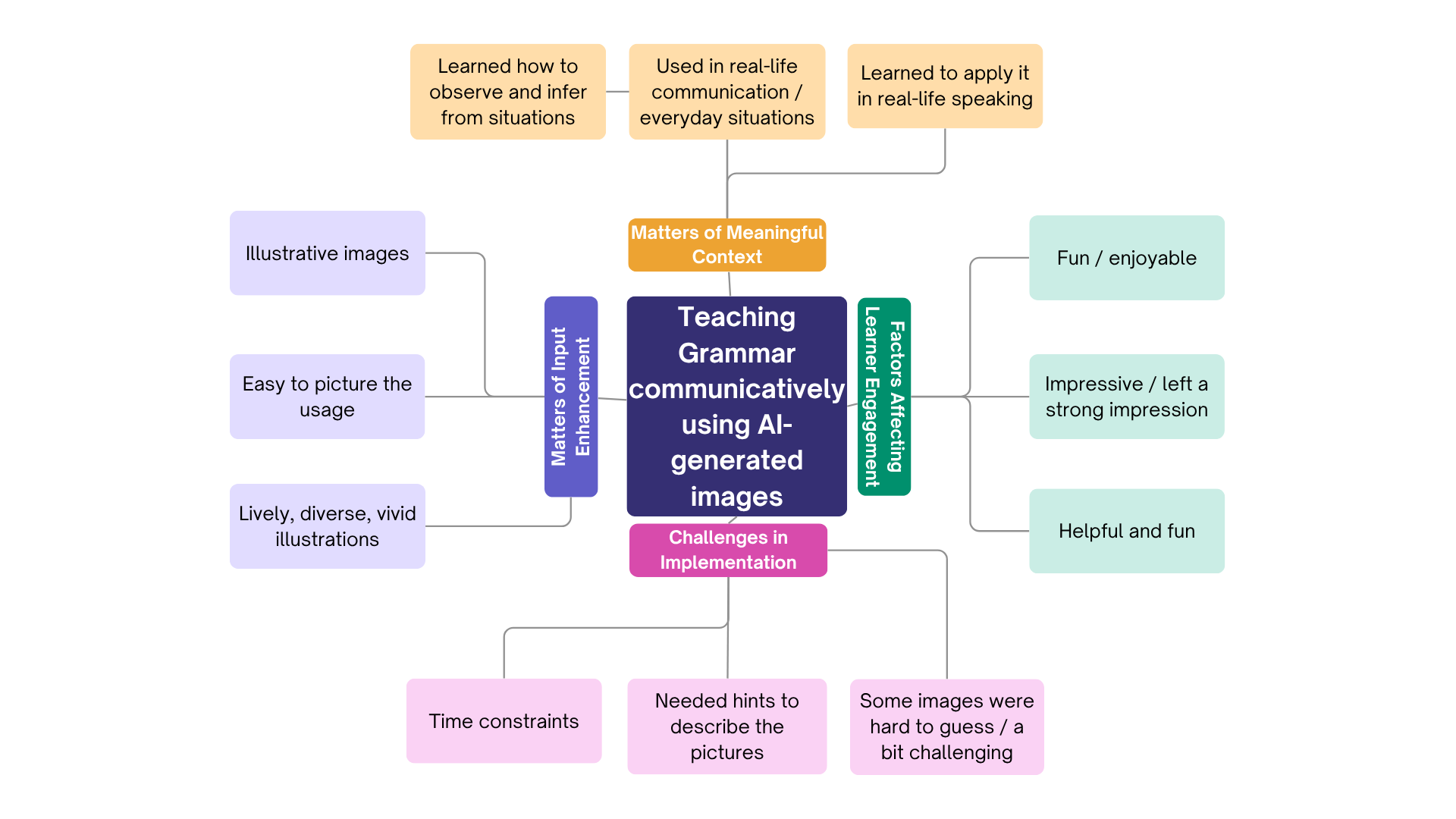
Note: The figure illustrates the main themes and subthemes identified from interview data.
Concerning matters of input enhancement, students highlighted that the AI-generated images were illustrative, vivid, and easy to interpret, which made it easier to visualize grammatical concepts and link them with real-life actions. Learners particularly valued the diversity and liveliness of the visuals, which helped them notice the form-meaning connection of the target grammar tenses more effectively. However, several challenges in implementation were also identified. Some students reported time constraints during lessons, while others found certain images difficult to interpret without hints. A few participants noted that some images were ambiguous or challenging, requiring teacher support to clarify intended meanings. Overall, the qualitative findings indicate that while AI-generated images successfully enhanced contextual understanding and engagement in grammar learning, careful image selection and classroom time management are essential to maximize their pedagogical potential.
To gain a more holistic understanding of students’ experiences, the findings from the think-aloud protocol were complemented by semi-structured interview data. The thematic analysis of the interview data revealed four key themes concerning students’ perceptions of learning grammar communicatively through AI-generated pictures: enhanced understanding, effective learning experience, emotional engagement, and future learning expectations.
Enhanced Understanding
Students reported that AI-generated images made grammar learning clearer and more meaningful. The visual representations helped them connect grammatical structures with real-life situations, facilitating deeper comprehension and long-term retention, as quoted by a participant as follows.
“I feel that learning grammar is much more interesting and easier than the traditional way of learning grammar. The illustration images generated by AI help me easily visualize the specific situation and context of each grammar structure, thereby understanding deeply and memorizing for a long time” (Student 01).
Effective Learning Experience
Participants highlighted that visual prompts supported their cognitive understanding of complex grammar points. In particular, one student recalled the lesson on the past perfect tense:
“I remember the lesson about the past perfect tense, it was very effective for me. The illustration ‘A boy had finished his homework before he went to bed’ helped to visually illustrate the meaning of the action that happened first, making a deep impression on me and making it very easy to understand” (Student 12).
Student 12 kept emphasising that this method:
“Helps me ‘SEE’ the grammar, remember it quickly and for a long time like carving it into my brain. It really reduced a lot of study pressure for me, making the lesson very comfortable and interesting.”
Emotional Engagement
The AI-assisted lessons were described as enjoyable, comfortable, and less stressful than traditional grammar learning. Students appreciated that the images made lessons more interactive and engaging, which in turn improved their motivation to learn.
Future Learning Expectations
All participants expressed enthusiasm about extending the use of AI-generated visuals to other language skills, especially speaking and writing. One learner stated:
“I really want to continue learning this method for other English skills, especially speaking and writing skills. For speaking skills, pictures help me have more ideas to express. When looking at pictures, I can immediately describe situations, emotions, actions, etc. This helps me practice reflexes and enrich my vocabulary naturally. As for writing skills, this method can act as a ‘suggestion’ for me to develop the content of my writing in a more creative manner. I hope that in the future, other skills can also be learned in a lively, effective and engaging way like this” (Student 13).
In summary, the findings suggest that AI-generated visual prompts foster a richer understanding of grammar, promote positive emotional engagement, and enhance students’ readiness to apply similar methods in broader language learning contexts.
DISCUSSIONS
The results provide strong support for both research questions: the effects of teaching grammar communicatively with AI-prompted images in the context of the study were abundantly clear, and the participant shared responsive reception to the instructional technique, including several key insights as the result and findings have evidence of:
(i) Improved grammar retention and use in the experimental group.
(ii) AI-generated images created real-life, engaging contexts.
(iii) Learners used inductive reasoning and peer interaction to discover rules.
The statistical and thematic analytical reports were strongly aligned with the theoretical frameworks discussed earlier. According to Larsen-Freeman (2003) and Thornbury (1999), grammar should be viewed as a dynamic tool for communication, with inductive and discovery-based approaches supporting grammar learning. Similarly, Ellis (2006) and Krashen (1982) emphasized the importance of form-meaning-use connections and comprehensible input in facilitating the acquisition of communicative grammar in classroom settings. In addition, Willis and Willis (2007) highlighted the value of task-based grammar instruction through real-world language use. These theoretical perspectives, combined with the concept that AI fosters autonomous and interactive learning (Dang, 2025; Reinders & Pegrum, 2021), inspired the instructional technique of teaching grammar communicatively through AI-prompted images within the context of this research site. Future researchers may consider expanding the sample size and broadening the scale of the study to enhance the validity and generalisability of the findings.
LIMITATIONS AND PEDAGOGICAL RECOMMENDATIONS
Although the study yielded encouraging results, several limitations should be acknowledged. The small sample size limits the generalisability of the findings, as it may not adequately represent broader learner populations. As Creswell and Creswell (2018) note, sample size directly affects a study’s external validity, making the results more context-dependent. Future research with larger and more diverse samples is therefore recommended to strengthen the robustness of the findings. Second, the absence of teachers as stakeholders in the implementation process may have limited the ecological validity of the findings. Since teachers play a key role in shaping classroom practices and learner engagement, their inclusion could have yielded more contextually grounded insights into the intervention’s pedagogical effectiveness through their differentiation of teaching and learning (Vo et al., 2026). As Thomas and Nair (2022) highlight, teachers’ adaptive decisions and contextual practices critically influence student engagement and learning outcomes.
Third, the study was conducted on a small scale and within one institutional context, which might limit its applicability to other educational settings. Future research should consider expanding the sampling size and including teachers as active collaborators in the process. Moreover, the current study primarily focused on grammar learning and did not extend to other essential English skills such as writing, listening, or pronunciation. Given that communicative competence involves integrated skills, further studies could explore the use of AI-assisted technology to enhance these dimensions.
CONCLUSION
In a nutshell, the study has reached its research aims which were convincing and positive as overall. First, communicative grammar teaching with AI-generated images was effective in improving EFL students’ learning outcomes. Second, EFL students reported that communicative grammar teaching supported by AI-generated images was more effective in learning targeted grammatical items in the context and more natural in cognitive acquisition of the linguistic notions as their language learning experience. Therefore, the instructional technique of teaching grammar communicatively with AI-prompted images was affirmed to be helpful and innovative on the site’s circumstances.
References
Barkley, E. F., & Major, C. H. (2018). Interactive lecturing: A handbook for college faculty. Jossey-Bass.
Braun, V., & Clarke, V. (2006). Using thematic analysis in psychology. Qualitative Research in Psychology, 3(2), 77-101. https://doi.org/10.1191/1478088706qp063oa
Brown, H. D., & Lee, H. (2015). Teaching by principles: An interactive approach to language pedagogy (4th ed.). Pearson Education.
Creswell, J. W. (2009). Research design: Qualitative, quantitative, and mixed methods approaches (3rd ed.). SAGE Publications.
Creswell, J. W., & Creswell, J. D. (2018). Research design: Qualitative, quantitative, and mixed methods approaches (5th ed.). SAGE Publications.
Creswell, J. W., & Poth, C. N. (2024). Qualitative inquiry and research design: Choosing among five approaches (5th ed.). SAGE Publications.
Dang, T. T. (2025). AI tools for language learners: The promotion of learning independence or reliance. In V. P. H. Pham, A. Lian, A. Lian, & J. White (Eds.), Empowering educators: Integrating AI tools for personalized language instruction (pp. 263-280). Springer Nature. https://doi.org/10.1007/978-3-032-01348-4_11
Ellis, R. (2006). Current issues in the teaching of grammar: An SLA perspective. TESOL Quarterly, 40(1), 83-107. https://doi.org/10.2307/40264512
Krashen, S. D. (1982). Principles and practice in second language acquisition. Pergamon. DOI: https://doi.org/10.1111/j.1467-971X.1982.tb00476.x
Larsen-Freeman, D. (2003). Teaching language: From grammar to grammaring. Heinle ELT.
Reinders, H., & Pegrum, M. (2021). Supporting language learning on the move: An evaluative framework for mobile language learning resources. Computer Assisted Language Learning, 34(3), 224-249. https://doi.org/10.1080/09588221.2019.1640255
Richards, J. C., & Rodgers, T. S. (2014). Approaches and methods in language teaching (3rd ed.). Cambridge University Press. https://doi.org/10.1017/9781009024532
Thomas, A., & Nair, P. K. (2022). Investigating teacher influence on student engagement in high schools. The Australian Educational Researcher, 49(3), 633-651. https://doi.org/10.1007/s13384-022-00511-w
Thornbury, S. (1999). How to teach grammar. Longman.
Vo, T. D., Nguyen, L. T., Ho, M. T., & Nguyen, M. V. (2026). Technology-mediated instructional differentiation in CALL. In I. F. A. Badiozaman & A. R. Segar (Eds.), Pedagogical innovation through technology-enhanced learning design: Global case studies and implications for practice (1st ed., pp. 191-212). Routledge. https://doi.org/10.4324/9781003665472-14
Willis, D., & Willis, J. (2007). Doing task-based teaching. Oxford University Press.
Downloads
Published
Data Availability Statement
N/A
Issue
Section
License
Copyright (c) 2026 Nguyen Thi Manh Ha, Thao Vo

This work is licensed under a Creative Commons Attribution-NonCommercial-NoDerivatives 4.0 International License.