
The application of ChatGPT to enhance grammatical accuracy in Part 3 of the IELTS speaking test: A case study of learners at Active English Center, Da Nang
DOI:
https://doi.org/10.65956/procia.2026.119Keywords:
AI tools, ChatGPT, IELTS speaking, grammatical accuracy, grammatical errorsAbstract
In the context of globalization and the increasing demand for international communication, the IELTS certificate plays a pivotal role in providing learners with access to global educational and employment opportunities. However, many students continue to struggle with language skills, particularly speaking, due to the tendency to speak without consciously considering the form of their language. This issue is especially prevalent in Vietnamese contexts where learners often lack sufficient practice environments. This case study was conducted with 12 learners at Active English Center in Da Nang, who practiced with ChatGPT over six weeks to improve grammatical accuracy in IELTS Speaking Part 3. A post-questionnaire was also administered to explore learner perceptions regarding the use of ChatGPT for speaking enhancement. Despite the small sample size, the findings indicate that ChatGPT significantly improves learners’ grammatical accuracy. The study offers practical insights for integrating AI tools into English language instruction and has implications for English as a Medium of Instruction (EMI) contexts where learners face similar challenges in developing spoken accuracy.
INTRODUCTION
Research Background
The International English Language Testing System (IELTS) is among the most widely recognized English proficiency tests. Due to its academic nature, achieving a high band score can be challenging, especially in speaking. Research by Alam and Ashrafuzzaman (2018) highlighted difficulties such as anxiety, lack of focus, and grammatical errors as major barriers to speaking fluently in a second language. Vietnamese learners often rely on word-for-word translation, leading to frequent grammatical errors that affect their IELTS speaking scores. Studies (like Dang, 2025; Rahimi & Fathi, 2022) showed that AI tools can promote learner engagement and improve outcomes. ChatGPT, launched in late 2022, has gained attention for its speed, adaptability, and usefulness in supporting personalized learning (Duong, 2023). However, there is limited research on AI-assisted speaking, especially on grammatical accuracy in structured formats like IELTS Speaking Part 3. Therefore, the study “The application of using ChatGPT to improve Grammatical Accuracy in Part 3 of the IELTS Speaking Test: A Case Study at Active English Center, Da Nang” will explore how ChatGPT helps learners improve their grammatical accuracy in speaking skills, focusing on Part 3 - a test section with great difficulty due to its deep knowledge requirements and abstract questions.
Aims and Objectives
This study aims to investigate the application of Chat GPT to improve the grammatical accuracy of IELTS speaking part 3 of a group of students at Active English Center, Danang City, thereby improving grammatical accuracy in the entire speaking part in IELTS, contributing to the IELTS learning community a highly effective method to practice IELTS speaking in particular and English learners in general.
This research attempts to fulfil three main objectives: first, to investigate common grammatical errors made by IELTS learners at AEC in Speaking Part 3; second, to determine the improvement in grammatical accuracy after using ChatGPT to correct these errors; and finally, to examine the learners’ perceptions after utilizing ChatGPT to improve their grammatical accuracy in this specific section of the test.
Research Questions
The research seeks information for the following questions:
1. What common grammatical errors do IELTS learners at AEC make when practicing IELTS speaking part 3?
2. What are the improvements in grammatical accuracy after using ChatGPT to correct grammatical errors in IELTS Speaking part 3 of IELTS learners at AEC?
3. What are the perceptions of IELTS learners at AEC after using ChatGPT to improve grammatical errors in IELTS Speaking part 3?
Scope of Study
The study focuses on AEC students in Da Nang with IELTS input bands between 5.0 and 6.0. Only AEC students are included to ensure consistent conditions, focusing on grammatical accuracy in IELTS Speaking Part 3, and only ChatGPT is used for grammar support during practice sessions in six weeks.
Key Terms
In this study, several key terms are defined to establish a clear framework. ChatGPT refers to the AI-driven chatbot developed by OpenAI and launched in November 2022, originally built on the GPT-3.5 model, which is capable of generating detailed, human-like responses across a diverse range of topics. This tool is utilized to target grammatical errors, which encompass any flaws or inaccuracies in sentence structure, verb tenses, subject-verb agreement, articles, prepositions, or other core syntactic elements. Specifically, the research evaluates the impact of these corrections on IELTS Speaking Part 3, a crucial component of the high-stakes proficiency test designed to assess a candidate’s ability to express, support, and develop complex opinions using sophisticated linguistic structures.
LITERATURE REVIEW
Literature Review
ChatGPT has shown potential in academic support, offering personalized feedback, translation, and research assistance (Qadir, 2023). Studies have found it enhances self-study, provides quick responses, and facilitates flexible, learner-centred environments (Duong, 2023). In language learning, Rong et al. (2024) found that ChatGPT significantly improved learners’ grammar, structure, and fluency in IELTS speaking practice. Research highlights common grammatical errors among EFL learners, including omissions, additions, misformations, and misorderings (Liu & Wu, 2023; Lestari et al., 2020; Kamlasi, 2019). In IELTS Speaking, grammar is a key scoring criterion. Dashti & Razmjoo (2020) note frequent speaking errors like misuse of articles, prepositions, tense, and subject-verb agreement. Despite AI’s growing role in language education, few studies focus specifically on grammar correction in IELTS Speaking. This study addresses that gap by evaluating ChatGPT’s role in improving grammatical accuracy for Vietnamese learners preparing for IELTS Speaking Part 3.
Theoretical Framework
This study used Error Analysis (EA) developed by Corder (1967), considering language errors as a sign reflecting the process of language acquisition, and Surface Strategy Taxonomy (SST) developed by Dulay et al. (1982). SST classified errors into four main groups: (1) Omission, (2) Addition, (3) Misformation, and (4) Misordering.
To construct the grammatical error classification table for this study, the author referred to three previous studies: Liu & Wu (2023), Lestari et al. (2020), and Damaiyanti (2021), all of which used or adapted the Surface Strategy Taxonomy (SST) model of Dulay et al. (1982). These studies pointed out common errors such as omission, misformation, misordering, addition, and overgeneralization. Based on these results, the author adjusted and built an error table consisting of 4 main groups: (1) Misuse, (2) Omission, (3) Addition, and (4) Misordering - suitable for the context of IELTS Part 3 speaking practice.
In addition, this study used supportive theories: (1) Noticing Hypothesis (Schmidt, 1990) posits that language acquisition requires conscious awareness of errors; (2) Explicit Corrective Feedback (Ellis, 2009) defines explicit CF as direct indications of errors, which help learners recognize and correct mistakes, and (3) Metalinguistic Feedback (Lyster & Ranta, 1997) describe metalinguistic feedback as corrections that explain grammar rules behind errors. In this research, ChatGPT functions as a tool that offers metalinguistic feedback by not only correcting grammatical mistakes in IELTS Speaking Part 3 but also explaining the underlying grammar rules.
Conceptual Framework
The conceptual framework presented in Figure 1 outlines a structured, AI-mediated learning process designed to enhance grammatical precision in academic speaking. The cycle begins when the learner answers a designated IELTS Speaking Part 3 question, generating an initial spoken response that likely contains grammatical errors. Utilizing a pre-determined grammar error table, the learner then inputs their response into ChatGPT, prompting the AI to identify specific linguistic flaws. In turn, ChatGPT analyses the text and delivers targeted intervention by providing both explicit corrective feedback (CF) and detailed metalinguistic explanations regarding the grammatical rules violated. Upon receiving this output, learners actively engage with the Noticing Hypothesis by comparing their original production with the AI’s feedback, thereby developing a conscious awareness of their specific errors and internalizing the correct sentence structures provided. Ultimately, through this systematic practice with corrected responses, the pedagogical intervention aims to achieve optimal learning outcomes, specifically an improvement in the learner’s grammatical accuracy within the context of the IELTS Speaking Part 3 test alongside positive perceptions of the tool’s utility.

METHODOLOGY
Research Design
This study adopts a case study design, aiming to provide an in-depth exploration of how ChatGPT supports grammatical accuracy in IELTS Speaking Part 3 rather than making broad generalizations. The focus on IELTS Speaking Part 3 is pedagogically justified, as this section requires abstract reasoning and extended responses, which tend to expose learners’ grammatical weaknesses more clearly than factual or short-answer tasks. A fixed grammatical error table was employed to support systematic error identification and consistent feedback, aligning with the principles of Explicit Corrective Feedback and the Noticing Hypothesis, which emphasize learners’ conscious awareness of errors and correct forms. The six-week intervention, with three sessions per week, provided sufficient time to observe meaningful changes in grammatical accuracy while remaining feasible within a case study context.
Participants and Sampling
This study involved 12 intermediate-level IELTS students (band 5.0-6.0) from the Active English Center (AEC), selected through convenience sampling based on placement or prior IELTS tests. For confidentiality, they were labeled S1 to S12. The small sample size allows for detailed tracking of individual error patterns, which is suitable for a case study approach.
Data Collection and Instruments
Data were gathered from pre- and post-tests, ChatGPT-based practice sessions, and a post-intervention questionnaire.
To ensure systematic error identification, grammatical errors were coded using a predefined error classification framework based on three prior studies and tailored to IELTS context, consisting of four main categories: Omission (O), Misuse (M), Addition (A), and Misordering (MO). Each category was further divided into specific subtypes (e.g., article misuse, subject-verb agreement, non-finite verbs). The full error classification table is provided in Appendix.
Table 1. Grammatical Error Categories and Coding Scheme
|
Error category |
Code |
Description |
|---|---|---|
|
Omission |
O |
Missing required grammatical element |
|
Misuse |
M |
Incorrect use of grammatical forms |
|
Addition |
A |
Redundant grammatical elements |
|
Misordering |
MO |
Incorrect word order |
The research instruments include a pre-/post-test and a post-questionnaire. Specifically, the pre-test used Speaking Part 3 from Test 3 and the post-test used Test 4 in IELTS Cambridge 18, with Bloom’s taxonomy (1956) applied to ensure the comparability of question complexity between both tests. Additionally, a post-questionnaire featuring Likert-scale and open-ended questions was administered to evaluate user experience, effectiveness, challenges, and suggestions, with the resulting data analysed via descriptive statistics and thematic analysis.
Research Procedures
The research procedure was conducted across three distinct stages. In Stage 1 (Preliminary assessments), 12 IELTS learners with a band score of 5.0-6.0 completed a diagnostic pre-test. During Stage 2 (Intervention with ChatGPT), these learners underwent a 6-week training period to utilize ChatGPT effectively for grammar correction. Finally, in Stage 3 (Post-Assessment), a post-test and an open-ended questionnaire were administered to assess the improvement in their performance and evaluate their perceptions of the intervention.
FINDINGS AND DISCUSSION
The Common Grammatical Errors that IELTS Learners at AEC Make When Practicing the IELTS Speaking Part 3
Rates of error types
The findings showed that Misuse accounting for the highest percentage at 82.2%, followed by Addition errors at 8.9%, reflecting the addition of unnecessary elements to sentences. Omission errors accounted for 7.8%, indicating that students often forgot important elements in sentences. Finally, Misordering errors accounted for only 1.1%, indicating that word order problems were uncommon.
The frequency of major error types
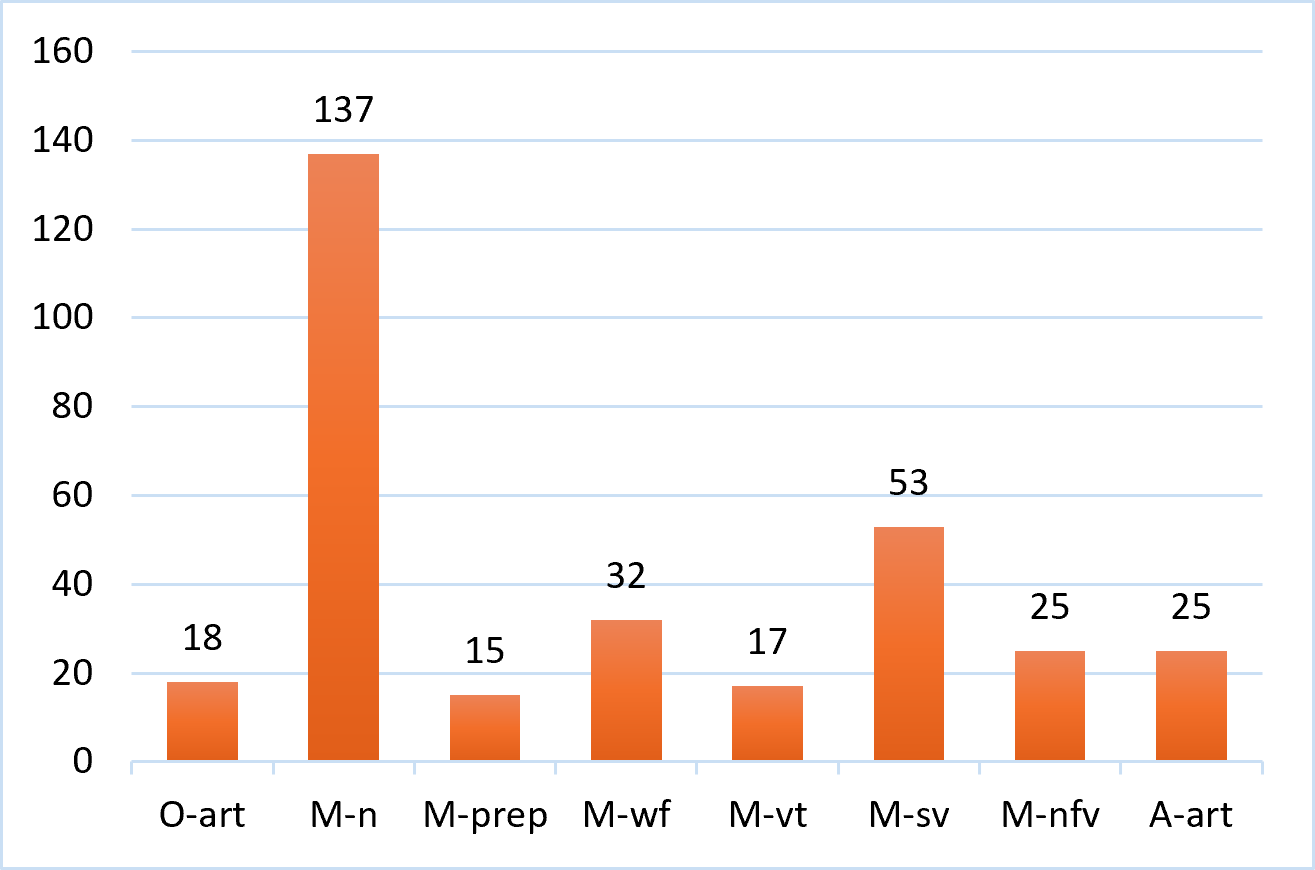
The most common error was incorrect use of singular/plural nouns (137), followed by incorrect subject-verb agreement (53) and incorrect word forms (32). Other errors, such as adding unnecessary articles, incorrect verb forms, and incorrect prepositions, also occurred frequently. The remaining errors occurred very rarely, fewer than 10 occurrences.
The Improvement in Grammatical Accuracy after Using GPT to Correct Grammatical Errors in IELTS Speaking Part 3 of IELTS Learners
Descriptive statistics of grammatical errors in pre-test and post-test
Table 2. Descriptive Statistics of Grammatical Errors in Pre-Test and Post-Test
|
Mean |
N |
Std. Deviation |
Std. Error Mean |
|
|---|---|---|---|---|
|
Pre-test |
29.00 |
12 |
2.796 |
.807 |
|
Post-test |
13.67 |
12 |
3.312 |
.956 |
The mean number of grammatical errors decreased from 29.00 in the pre-test to 13.67 in the post-test, indicating a substantial reduction in errors after the six-week intervention.
Descriptive analysis of error patterns
a. Overall reduction in grammatical errors
All participants demonstrated a reduction in the total number of grammatical errors after the intervention, although the degree of improvement varied across individuals
b. Group-level changes in error types
Table 3. Group-Level Changes in Error Types
|
Error type |
Pre-test (total) |
Post-test (total) |
Trend |
|---|---|---|---|
|
Misuse (M) |
High |
Lower |
Decreased consistently |
|
Omission (O) |
Moderate |
Fluctuated |
Mixed |
|
Addition (A) |
Low |
Slight change |
Slight decrease |
|
Misordering (MO) |
Very low |
Very low |
rare |
The analysis reveals a consistent reduction in Misuse (M) errors across participants, suggesting improved control over grammatical structures. In contrast, Omission (O) errors showed greater fluctuation, with some learners producing more omission errors after the intervention. This pattern may indicate that learners focused primarily on major grammatical issues while paying less attention to minor forms.
Qualitative patterns of grammatical error change
The post-test findings reveal three main patterns of grammatical error change. First, there was a notable reduction in common errors, particularly in the Misuse group involving plural/singular nouns (M-n), subject-verb agreement (M-sv), and word form (M-wf). Clear improvements were also observed in the Addition and Omission of articles, indicating that ChatGPT-supported feedback helped learners identify and correct frequent grammatical problems. Second, new errors emerged, especially in article usage, as some learners shifted their attention to previously problematic structures but had not yet fully mastered article rules. Third, certain errors persisted, including M-n, M-sv, A-art, and O-art, suggesting that these grammatical features remain complex and require sustained practice beyond short-term intervention.
Learners’ Perceptions of Using ChatGPT for IELTS Speaking Practice
Ease of use and learning experience
Most participants reported that ChatGPT was easy to use for IELTS Speaking practice. Learners particularly appreciated the grammar recognition feature, which provided clear corrections and explanations for their grammatical mistakes. Many students indicated that they frequently practiced by repeating ChatGPT’s corrected sentences, which helped reinforce correct grammatical structures in their spoken responses.
Perceived effectiveness in improving grammatical accuracy
Learners perceived ChatGPT as effective in supporting grammatical accuracy, especially in addressing common errors such as subject-verb agreement, singular-plural nouns, and article usage. Several participants also reported improvements in other grammatical aspects, including word forms, non-finite verbs, prepositions, and tense usage. Survey responses revealed that learners often compared their original answers with ChatGPT’s corrected versions and consciously applied the revised structures in subsequent speaking practice.
Satisfaction, limitations, and future use
Learners expressed high levels of satisfaction with using ChatGPT for IELTS Speaking practice and indicated their intention to continue using the tool and recommend it to other learners. Participants highlighted quick feedback, clear explanations, and a comfortable, pressure-free learning environment as major advantages. However, some learners noted occasional inaccuracies in ChatGPT’s error recognition, suggesting that the tool should be used as a supplementary resource alongside other forms of feedback rather than as a sole corrective authority.
DISCUSSION
This study examined the application of ChatGPT in improving grammatical accuracy in IELTS Speaking Part 3 through a case study.
First, the results showed that Misuse errors were the most frequent, followed by Addition and Omission, while Misordering errors were rare. This pattern is consistent with previous studies (Lestari et al., 2020; Pawabutra & Sutakote, 2024), though it differs from Kamlasi (2019), who reported omission as the most common error type. Further analysis indicated that learners mainly struggled with singular/plural nouns, subject-verb agreement, word forms, verb tense, non-finite verbs, and prepositions. These difficulties can be attributed to structural differences between Vietnamese and English, particularly the lack of inflectional morphology and an article system in Vietnamese (Safrida & Kasim, 2016; Damaiyanti, 2021; Simbolon, 2015).
Second, the post-test results demonstrated a clear reduction in grammatical errors following the ChatGPT-assisted intervention. Although some learners showed limited improvement or produced new errors, the overall findings confirm ChatGPT’s effectiveness in supporting error recognition and correction. This aligns with earlier research (Chen et al., 2023; Phieanchang, 2024; Xiao & Zhi, 2023), which highlights the role of AI-generated feedback in promoting noticing and self-correction. These results reinforce the potential of AI-assisted tools in grammar-focused speaking practice.
Third, learners reported positive perceptions of using ChatGPT, particularly valuing its immediate feedback, clear explanations, and flexible practice environment, consistent with Alzahrani (2024). However, similar to Zhang et al. (2024), participants also noted occasional inaccuracies and context-insensitive feedback, suggesting that ChatGPT should function as a supplementary rather than standalone learning tool.
Overall, this study contributes to AI-assisted language learning research by extending ChatGPT’s application to spoken grammatical accuracy in IELTS Speaking Part 3.
CONCLUSION AND IMPLICATIONS
Conclusion
The findings indicate that among the four grammatical error types—Misuse (M), Addition (A), Omission (O), and Misordering (MO)—Misuse errors were the most prevalent, followed by Addition and Omission, while Misordering errors occurred least frequently. Within the Misuse category, the most common errors involved singular/plural nouns, subject-verb agreement, and word form selection, suggesting persistent difficulties in noun and verb usage. Errors related to articles, non-finite verbs, and prepositions were also observed. These results are consistent with previous studies (Lestari et al., 2020; Pawabutra & Sutakote, 2024; Liu & Wu, 2023), though they differ from Kamlasi (2019), who identified omission as the dominant error type.
After six weeks of ChatGPT-assisted practice, most learners showed a significant decrease in grammatical errors in IELTS Speaking Part 3. Nevertheless, some new errors emerged, possibly because learners focused on correcting major error types while overlooking minor ones. This suggests that while ChatGPT effectively supports grammatical awareness and correction, learners still need to develop broader self-monitoring skills. Learners also expressed highly positive attitudes toward using ChatGPT, highlighting its potential as an AI-supported tool for improving grammatical accuracy in speaking.
Implications
The findings suggest that ChatGPT can support effective self-study through instant grammatical feedback and can be integrated into IELTS preparation courses as a supplementary tool. The results also highlight the potential for developing personalized AI-assisted learning tools and provide a basis for future research on other speaking components, such as fluency, pronunciation, and lexical development.
Limitations
This study is limited by its small sample size (N = 12), the absence of a control group, and its short duration. However, as a case study, the focus was on in-depth analysis of learners’ grammatical development rather than broad generalization. In addition, the study examined only grammatical accuracy in IELTS Speaking Part 3, and ChatGPT’s feedback quality depended on learners’ input. Pronunciation-related issues may also have been occasionally misclassified as grammatical errors.
References
Alam, M. A., & Ashrafuzzaman, M. (2018). Challenges of developing speaking skill through classroom interaction of EFL learners. Prime University Journal, 12(1), 67–75.
Alzahrani, R. A. (2024). EFL students’ perception and attitude towards the use of ChatGPT to promote English speaking skills in the Saudi context. Arab World English Journal, 15(1), 318–331. https://doi.org/10.24093/awej/vol15no1.20 DOI: https://doi.org/10.24093/awej/vol15no4.5
Bloom, B. S. (Ed.). (1956). Taxonomy of educational objectives: The classification of educational goals. Handbook I: Cognitive domain. Longmans, Green.
Chen, X., Zou, D., & Xie, H. (2023). An exploratory study of EFL learners’ use of ChatGPT for language learning. Languages, 8(3), 212. https://doi.org/10.3390/languages8030212
Corder, S. P. (1967). The significance of learner’s errors. International Review of Applied Linguistics in Language Teaching, 5(4), 161–170. https://doi.org/10.1515/iral.1967.5.1-4.161
Damaiyanti, S. (2021). Grammatical errors made by students in speaking English. Journal of English Language Teaching and Learning, 2(2), 15–22. https://doi.org/10.18860/jetle.v2i2.11945
Dashti, L., & Razmjoo, S. A. (2020). An examination of IELTS candidates’ performances at different band scores of the speaking test: A quantitative and qualitative analysis. Cogent Education, 7(1), 1770936. https://doi.org/10.1080/2331186X.2020.1770936
Duong, T. L. (2023). Application of ChatGPT in promoting higher education teaching and learning in the era of artificial intelligence. Journal of Science and Technology, Binh Duong University, 6(2), 153–160. https://doi.org/10.56097/binhduonguniversityjournalofscienceandtechnology.v6i2.160
Dulay, H., Burt, M., & Krashen, S. (1982). Language two. Oxford University Press.
Ellis, R. (2009). The study of second language acquisition (2nd ed.). Oxford University Press.
Kamlasi, I. (2019). Describing the students’ grammatical errors on spoken English. ELT-Lectura, 6(1), 83–91. DOI: https://doi.org/10.31849/elt-lectura.v6i1.2289
Lestari, W., Muljanto, S., & Lestari, L. (2020). Grammatical error analysis in EFL speaking performance. English Education and Applied Linguistics Journal, 3(2), 45–53. https://doi.org/10.31980/eealjournal.v3i2.1840
Liu, J., & Wu, C. (2023). An analysis of grammatical errors in Chinese EFL learners’ oral English. Lecture Notes in Education Psychology and Public Media. https://doi.org/10.54254/2753-7048/14/20230983
Lyster, R., & Ranta, L. (1997). Corrective feedback and learner uptake: Negotiation of form in communicative classrooms. Studies in Second Language Acquisition, 19(1), 37–66. DOI: https://doi.org/10.1017/S0272263197001034
Pawabutra, P., & Sutakote, C. (2024). An analysis of grammatical errors in English speaking of Thai EFL learners. Journal of English Language and Linguistics, 5(3), 297–313. https://doi.org/10.62819/jel.2024.625
Phieanchang, T. (2024). Using ChatGPT to improve English grammar skills for EFL learners. Journal of English Studies, 18(2), 1–15. https://so02.tci-thaijo.org/index.php/journaldru/article/view/268054
Qadir, J. (2023). Engineering education in the era of ChatGPT: Promise and pitfalls of generative AI for education. In 2023 IEEE Global Engineering Education Conference (EDUCON) (pp. 1–9). IEEE. https://doi.org/10.1109/EDUCON54358.2023.10123215 DOI: https://doi.org/10.1109/EDUCON54358.2023.10125121
Rahimi, M., & Fathi, J. (2022). Employing e-tandem language learning method to enhance speaking skills and willingness to communicate: The case of EFL learners. Computer Assisted Language Learning, 1–37. https://doi.org/10.1080/09588221.2022.2063121 DOI: https://doi.org/10.1080/09588221.2022.2064512
Rong, Y. D., Xiao, W. Y., Zhang, Y. F., & Xu, X. S. (2024, August). The impact of ChatGPT on Chinese postgraduates’ English learning interest and proficiency: An experience of IELTS speaking project. In Proceedings of the Pacific-Rim Objective Measurement Symposium (PROMS 2023) (Vol. 23, p. 459). Springer Nature. DOI: https://doi.org/10.2991/978-94-6463-494-5_30
Schmidt, R. (1990). The role of consciousness in second language learning. Applied Linguistics, 11(2), 129–158. DOI: https://doi.org/10.1093/applin/11.2.129
Safrida, & Kasim, U. (2016). An analysis of grammatical errors in speaking made by EFL students at the English Department of Syiah Kuala University. Research in English and Education (READ), 1(1), 71–80. https://jim.usk.ac.id/READ/article/view/718
Simbolon, M. (2015). An analysis of grammatical errors on speaking activities. Journal on English as a Foreign Language, 5(2), 71–86. https://doi.org/10.23971/jefl.v5i2.368
Xiao, Y., & Zhi, Y. (2023). An exploratory study of EFL learners’ use of ChatGPT for language learning tasks: Experience and perceptions. Languages, 8(3), 212. https://doi.org/10.3390/languages8030212
Downloads
Published
Data Availability Statement
N/A
Issue
Section
License
Copyright (c) 2026 Anh Nguyen

This work is licensed under a Creative Commons Attribution-NonCommercial-NoDerivatives 4.0 International License.