The role of medical ESP in training a sustainable healthcare workforce
DOI:
https://doi.org/10.65956/procia.2026.120Keywords:
English for specific purposes, medical English, healthcare workforce, sustainable development, intercultural communicationAbstract
In the era of globalisation and transnational healthcare, English for Specific Purposes (ESP) in the medical domain may help strengthen professional language proficiency, intercultural communication, and global awareness among healthcare professionals in the analysed contexts. This scoping review identifies the role of Medical ESP in preparing a healthcare workforce capable of contributing to sustainable development, with a particular focus on Sustainable Development Goals (SDGs) 3 (Good Health and Well-being) and 4 (Quality Education). Guided by the PCC (Population, Concept and Context) framework and a systematic search strategy in the ERIC database, the study synthesised academic literature on the design, implementation, and evaluation of ESP programmes in medical and global contexts. The findings indicate that contemporary Medical ESP curricula increasingly integrate global health, professional ethics, disciplinary communication, and interprofessional education, thereby fostering global competence among medical students and practitioners. At the same time, the role of ESP instructors has evolved from language facilitators to agents of education for sustainable development (ESD). However, notable gaps remain in the explicit incorporation of ESD principles into programme frameworks and in the development of appropriate assessment tools. This review offers preliminary insights that may inform the rethinking and redesign of Medical ESP curricula in line with the demands of a globalised healthcare workforce.
INTRODUCTION
English has become the dominant language of academic exchange and professional collaboration in the globalized era. In this context, English for Medical Purposes (EMP), a branch of ESP, enables medical students and healthcare professionals to access international literature, communicate globally, and engage in multidisciplinary practice (Strevens, 1988). However, many EMP programs fail to meet learners’ academic and professional needs, as students, particularly in Southeast Asia, struggle with reading medical texts, understanding lectures, and producing academic work in English (Hidayati & Meisani, 2023). While EMP can develop intercultural competence, global awareness, and ethical professionalism (Moerland et al., 2023), current programs still focus heavily on terminology and grammar at the expense of critical communication skills and cultural sensitivity (Ngo, 2023). Therefore, this study explores the potential role of EMP in supporting sustainable medical education by addressing curriculum gaps and aligning language training with global health competencies as identified in the selected literature.
METHODOLOGY
Research Design
This study was conducted in the form of a scoping review, aiming to map and analyze academic literature related to the role of English for Specific Purposes (ESP) programs in the medical field in enhancing the training and competency development of healthcare professionals, particularly in the context of implementing the Sustainable Development Goals (SDGs). A scoping review is an appropriate method when it is necessary to provide an overview of an emerging research area that is diverse in content and lacks a clear systematic research framework.
The research process was designed and implemented following the PRISMA-ScR (Preferred Reporting Items for Systematic Reviews and Meta-Analyses extension for Scoping Reviews) guidelines, which are widely recognized international standards for conducting scoping reviews. Additionally, the PCC framework (Population–Concept–Context) proposed by the Joanna Briggs Institute (JBI) was applied to ensure consistency and systematicity in defining inclusion criteria and analyzing content.
PCC Framework Applied in the Study
Population: This includes medical students, nursing students, health sciences learners, and healthcare professionals involved in specialized training contexts that require the use of English for professional purposes.
Concept: The focus is on Medical ESP programs, encompassing aspects such as teaching methods, curriculum structure, learning outcomes, and factors related to developing professional skills in English within the healthcare field.
Context: The programs are implemented in higher education institutions (universities and colleges) or within specialized healthcare training courses. The study context pays particular attention to educational models designed or evaluated under globalization conditions and/or related to sustainable development goals, such as SDG 3 (Good Health and Well-being)
Literature Search Strategy
This study was conducted in accordance with the Preferred Reporting Items for Systematic Reviews and Meta-Analyses Extension for Scoping Reviews (PRISMA-ScR) guidelines and employed the Population–Concept–Context (PCC) framework to guide the identification, selection, and synthesis of relevant literature. The literature search was conducted in June 2025 using the Education Resources Information Center (ERIC) database, which is recognized as one of the most reputable academic databases in the field of educational research.
The search strategy was designed to identify studies related to English for Specific Purposes (ESP) in medical and healthcare contexts while also examining their connections to global competencies and sustainable development goals. To ensure comprehensive data retrieval, the search terms were developed based on the three components of the PCC framework and combined using Boolean operators (AND/OR). The final search string applied in ERIC was as follows: (“English for Specific Purposes” OR “ESP” OR “Medical English” OR “English for healthcare”) AND (“medical education” OR “healthcare professionals” OR “medical students” OR “nursing education” OR “curriculum”) AND (“sustainable development” OR “global health” OR “intercultural communication” OR “global competencies” OR “health equity” OR “professional ethics”).
During the search process, the filters “peer-reviewed only” and “full text available on ERIC” were applied to ensure both academic quality and full accessibility of the selected literature. No publication date restrictions were imposed in order to capture both foundational studies and contemporary research trends related to ESP in medical education and sustainable development.
The initial search identified 17 studies from the ERIC database. As only a single database was utilized, no duplicate records were detected. All 17 studies were screened based on their titles and abstracts. Following this screening process, 12 studies were excluded because they did not sufficiently address ESP within medical or healthcare contexts or failed to discuss sustainability-related dimensions such as global competencies, intercultural communication, professional ethics, or global health. Ultimately, five studies met all inclusion criteria and were selected for in-depth analysis in the present review.
The screening and evaluation processes were conducted manually by two authors through cross-checking procedures to enhance the consistency and reliability of the selection outcomes. The review process consisted of two stages: (1) title and abstract screening and (2) full-text assessment based on predetermined inclusion and exclusion criteria. In addition, no manually selected open-access studies beyond those retrieved from the ERIC database were included in this review.
Inclusion and Exclusion Criteria
The inclusion and exclusion criteria were developed based on the Population–Concept–Context (PCC) framework to ensure the relevance and consistency of the studies included in the analysis. Regarding the inclusion criteria, studies were required to be published in English and available in full-text format to support detailed evaluation. In addition, the selected studies needed to focus on medical students, nursing students, health sciences learners, or healthcare professionals participating in educational programs involving English for Specific Purposes instruction.
In terms of content, the included studies were required to address English for Specific Purposes (ESP), particularly Medical English or English for healthcare, including aspects such as curriculum design, pedagogical approaches, the development of professional communication skills, or occupational competencies within healthcare settings. Furthermore, priority was given to studies examining issues related to sustainable development and global integration in medical education, such as intercultural communication, global competencies, professional ethics, health equity, or the Sustainable Development Goals, particularly SDG 3 (Good Health and Well-being) and SDG 4 (Quality Education).
Studies were excluded if they were not directly related to medical or healthcare contexts, did not address ESP or specialized English instruction, or lacked sufficient data for analysis. In addition, opinion papers, academic commentaries, and studies without accessible full-text versions were excluded from the review. Studies focusing solely on general English language teaching without a specific connection to healthcare or medical professional training were also removed during the screening process.
Screening and Data Analysis Process
The documents retrieved from the search were processed in two stages. First, the titles and abstracts of all records were reviewed to assess their relevance according to the inclusion criteria. Subsequently, the full texts were carefully examined to verify the accuracy of content, context, and other pertinent information. The screening process was conducted manually, with cross-checking among team members to ensure consistency and reliability.
Data were extracted using a standardized coding framework, which included key information such as author(s), year of publication, country, study population, type of document, ESP content focus, sustainable development components integrated, and main findings. The data analysis was performed using thematic analysis to identify major content trends, prominent thematic categories, and research gaps within the existing body of literature.
RESULTS
Characteristics of the Included Studies
Appendix 1 summarizes the characteristics, objectives, designs, and key findings of the reviewed studies, which primarily examine English for Specific Purposes (ESP) in medical and nursing education (Hamilton & Woodward-Kron, 2010; Higgs, 1986; Liao et al., 2019; Tsai, 2025; Wang et al., 2020). Most studies employed case study or theoretical-descriptive designs due to the pedagogical nature of ESP research, while only a few adopted quasi-experimental methods to provide quantitative evidence of instructional effectiveness (Liao et al., 2019).
Participants varied across contexts, including international health science students (Hamilton & Woodward-Kron, 2010), Taiwanese medical students (Liao et al., 2019), EMI nursing students in Asia (Tsai, 2025), and nursing trainees in Oman (Higgs, 1986), reflecting diverse learner needs and implementation practices. Overall, the findings indicate that ESP programs enhance academic and professional language competence as well as intercultural communication and discipline-specific skills. However, limitations such as small sample sizes, narrow research scopes, and short intervention periods reduce the generalizability of the results.
Thematic Analysis
The studies indicate that ESP programs in the medical field do not merely focus on linguistic proficiency, but also deeply integrate soft skills and global competencies essential for healthcare professionals, particularly in the context of globalization and multicultural settings.
Sustainable development and global competence
Several studies emphasize integrating global competence, intercultural communication, and professional ethics into medical ESP to advance SDG 3. Hamilton and Woodward-Kron (2010) promoted intercultural communication through reflective learning (Hamilton & Woodward-Kron, 2010), while Wang et al. (2020) incorporated medical ethics via a Medical Humanities English module (Wang et al., 2020). Tsai (2025) showed that EMI develops both ESP skills and global health perspectives (Tsai, 2025), and Liao et al. (2019) noted that low English proficiency limits access to medical knowledge and professional interaction (Liao et al., 2019). Higgs (1986) demonstrated that ESP aligned with clinical tasks supports sustainable healthcare practice (Higgs, 1986). Overall, ESP should integrate global competence and ethics to prepare healthcare professionals for multicultural settings.
Specialized language needs & professional skills
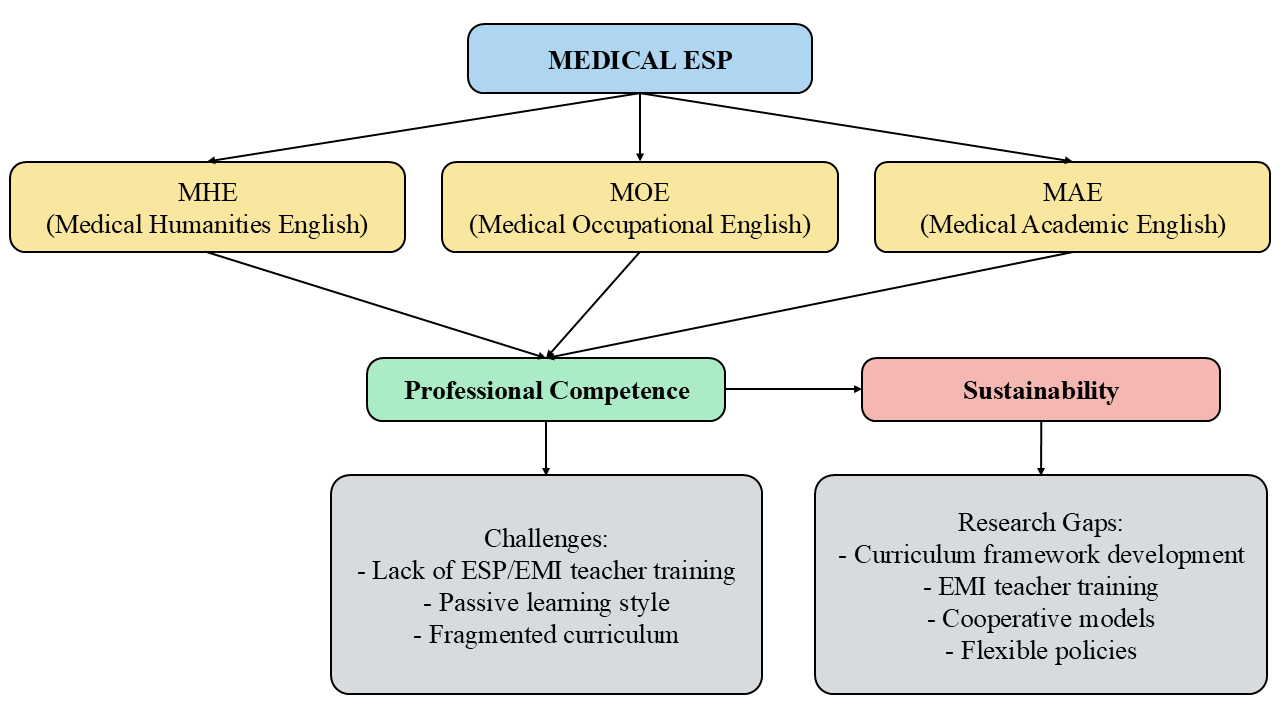
In medical education, English proficiency is viewed as a professional requirement essential to ensuring healthcare quality. Hamilton and Woodward-Kron (2010) emphasized that communication failures in English can negatively affect patient-centered care and treatment outcomes (Hamilton & Woodward-Kron, 2010). Addressing this, Wang et al. (2020) proposed a modular ESP curriculum integrating Medical Humanities English, Medical Occupational English, and Medical Academic English to combine language competence with clinical communication skills (Wang et al., 2020). Similarly, Liao et al. (2019) found that limited English proficiency hinders both access to medical knowledge and professional communication, reinforcing the need for ESP integration in medical training (Liao et al., 2019). Higgs (1986) further demonstrated that ESP should be linked to real clinical tasks, such as drug dosage calculation, to enhance occupational competence (Higgs, 1986). Collectively, these studies highlight that ESP/EOP curricula in medicine must be needs-based and aligned with professional practice to meet international healthcare standards.
Teaching effectiveness and pedagogical approaches
Innovative pedagogical approaches play a key role in improving ESP learning outcomes in medical education. Hamilton and Woodward-Kron (2010) demonstrated that multimedia-assisted instruction using simulated interactions can enhance intercultural communication through reflective learning (Hamilton & Woodward-Kron, 2010). Wang et al. (2020) proposed a modular ESP curriculum integrating humanistic, occupational, and academic components to support comprehensive language and professional development (Wang et al., 2020). Using a quasi-experimental design, Liao et al. (2019) showed that cooperative learning significantly improves students’ English proficiency (Liao et al., 2019). From a qualitative perspective, Tsai (2025) revealed differing perceptions of EMI implementation among students and instructors, reflecting pedagogical and practical challenges (Tsai, 2025). Higgs (1986) illustrated how needs-based course design can align ESP content with real clinical tasks (Higgs, 1986). Collectively, these studies underscore that pedagogical innovation is essential to effective Medical ESP instruction.
Assessment and measurement of effectiveness
Assessment of learning effectiveness is a critical component of ESP research in medical education, providing both quantitative and qualitative evidence of instructional impact. Hamilton and Woodward-Kron (2010) used the Melbourne Medical Students’ Diagnostic Speaking Scale (Grove & Brown, 2001) to monitor international students’ progress in medical communication (Hamilton & Woodward-Kron, 2010). Wang et al. (2020) noted that modular ESP curricula often lack systematic evaluation, calling for stronger empirical validation (Wang et al., 2020). Liao et al. (2019) employed pre- and post-TOEIC testing and reported significant gains—especially in speaking—supporting the effectiveness of cooperative learning (Liao et al., 2019). In contrast, Tsai (2025) proposed an educational approach integrating ethical and cultural dimensions, emphasizing multicultural diversity in relation to EMI requirements, thereby reflecting a shift toward a more comprehensive educational approach compared with earlier perspectives.(Tsai, 2025). Finally, Higgs (1986) emphasized that the assessment of learning outcomes should be closely aligned with specific professional competencies, such as medication dosage measurement, rather than focusing solely on general language proficiency. (Higgs, 1986). The study, however, primarily addressed training outcomes in medical ESP from a healthcare practice perspective, with limited consideration of broader social dimensions and evolving occupational demands in contemporary contexts.
Table 1. Comparative Analysis of Studies on Teaching English for Specific Purposes in Medical Education
|
No. |
Study (Author, Year, Context) |
Theme 1: Sustainable Development and Global Competence |
Theme 2: Specialized Language Needs & Professional Skills |
Theme 3: Teaching Effectiveness and Pedagogical Approaches |
Theme 4: Assessment and Measurement of Effectiveness |
|---|---|---|---|---|---|
|
1 |
Hamilton, J., & Woodward-Kron, R. (2010). Australia. |
Focused on enhancing cultural awareness and intercultural communication competencies among medical students. The study also aimed to strengthen reflective abilities for analyzing the interrelationships among language, communication, and culture. |
Emphasized the cultivation of effective communication competencies and the adoption of patient-centered approaches. Effective communication was considered essential for improving patient treatment adherence. |
Developed a multimedia instructional tool (DVD-ROM) to support the teaching of cultural differences in healthcare communication, integrated with learner-centered pedagogical approaches. |
Applied the Melbourne Medical Students’ Diagnostic Speaking Scale (Grove & Brown, 2001) as an instrument for assessing speaking performance. |
|
2 |
Wang, C., Wang, H., & Luan, X. (2020). China. |
Classified English for Medical Humanities (MHE), Medical Occupational English (MOE) (e.g., doctor–patient communication and clinical examination), and Medical Academic English (MAE). |
Developed a modular instructional framework grounded in ESP theories proposed by Hutchinson & Waters and Jordan. |
The study remained under development, and additional data collection was required to further refine the curriculum framework. |
|
|
3 |
Liao, Li, & Wang (2019). Taiwan. |
English language proficiency was regarded as a prerequisite for acquiring scientific knowledge and developing professional competencies. |
Aimed to improve English language competencies (listening, speaking, reading, and writing) in order to support students’ acquisition of scientific knowledge and professional skill development. |
Employed a quasi-experimental design to evaluate the effectiveness of the optimal cooperative learning grouping technique. The intervention lasted 16 weeks. |
Applied TOEIC scores before and after the intervention for assessment purposes. The findings demonstrated a large effect size (d = 0.87) on listening proficiency and moderate effects on the remaining language skills. |
|
4 |
Tsai (2025). Taiwan |
Nursing students demonstrated positive attitudes toward EMI due to anticipated future professional requirements and global integration. The study also proposed integrating cultural and ethical knowledge into language instruction to support global citizenship competencies. |
Emphasized the development of English language competencies and ESP-related knowledge among nursing students to address future professional demands |
Conducted qualitative research using focus group interviews with nursing students to analyze their attitudes toward EMI. |
Students expressed positive attitudes toward EMI. They considered English language proficiency and cultural understanding essential for EMI participation. |
|
5 |
Higgs (1986). Oman (Case Study). |
The course directly supported the preparation of students for specialized healthcare tasks, thereby contributing to SDG 3 (Good Health and Well-being). |
Designed a specialized course for nursing students focusing on professional competencies such as dosage measurement (e.g., Ampicillin, Digoxin). |
Applied a Task-Based Language Teaching-oriented case study design within project-based learning contexts. |
The course facilitated the development of specialized professional competencies, including dosage calculation and the interpretation of quantitative data. |
Conceptual Synthesis Matrix
In the context of medical workforce education, sustainability is reflected through various dimensions closely associated with professional quality, local capacity, and global integration. First, improving intercultural communication and shifting from a doctor-centered to a patient-centered care model contribute to reducing medical misunderstandings, thereby enhancing healthcare outcomes and fostering a more sustainable health system (Hamilton & Woodward-Kron, 2010).
In addition, international aid projects, including ESP-based training programs, are designed to develop management and professional competencies for local human resources through collaborative education mechanisms, ensuring that educational and healthcare programs can continue to operate effectively even after aid projects end, thereby avoiding resource waste (Higgs, 1986).
More importantly, ESP training in medical education also helps students enhance their global competence, international communication skills, and access to advanced medical knowledge, thereby cultivating a highly skilled, adaptable, and competitive healthcare workforce in the era of globalization (Liao et al., 2019; Tsai, 2025; Wang et al., 2020).
Table 2. The Role of Medical ESP in Developing a Sustainable Healthcare Workforce
|
Main Theme/Topic |
Sustainability/Healthcare Related Factor |
Key Results and Findings |
Current Research Gaps |
(References) |
|---|---|---|---|---|
|
1. Medical ESP Curriculum Construction |
National integration and access to advanced medical technologies: Providing access to accurate English-language resources to support international communication, accelerate medical research processes, and facilitate access to advanced healthcare technologies. |
A modular curriculum framework was proposed, including Medical Humanities English (MHE), Medical Occupational English (MOE), and Medical Academic English (MAE). MOE was identified as the foundation for MAE development. |
Existing research on healthcare English programs remains unsystematic and fragmented. Additional data collection from diverse sources, particularly from non-English-speaking countries, is required to enrich and refine the curriculum framework. |
|
|
2. Intercultural Communication Competence Development (ICC) |
Patient safety and quality of healthcare services: Effective communication in multicultural healthcare environments was considered a fundamental factor contributing to patient outcomes and safety. |
Communication in healthcare settings has shifted toward patient-centered approaches, requiring more complex and nuanced communication competencies. EMI implementation may provide opportunities for students to engage in intercultural education. |
ESP educators face challenges in raising learners’ awareness of multicultural healthcare contexts (e.g., patient culture and accent variation), which influence professional language choices. Intercultural training for healthcare professionals from diverse linguistic backgrounds remains necessary. |
|
|
3. ESP Role in Sustainable Training and Technology Transfer |
ESP supports capacity building and contributes to strengthening local workforce development by reducing dependence on foreign expertise. |
ESP enhances English language proficiency required for technology transfer and specialized knowledge acquisition. |
A managerial gap exists between local staff and foreign experts. EMI instructors frequently lack ESP training. |
|
|
4. Methods and Learning Support |
Limited English language proficiency restricts medical knowledge acquisition and professional communication, thereby requiring effective learning support systems. |
Cooperative learning significantly improves ESP competencies and supports interdisciplinary collaboration. |
Traditional lecture-based approaches limit student interaction; therefore, innovative instructional approaches, such as multimedia-based learning, remain necessary. |
DISCUSSION
The Role of Medical ESP in Sustainable Healthcare Competence
Based on the reviewed studies, Medical ESP, as a branch of ESP is shown to support the linguistic foundation for international communication in healthcare. While global health challenges suggest an increasing need for such skills, further research is required to generalize these findings to a broader post-pandemic landscape (Wang et al., 2020). Beyond accessing medical knowledge, students require English proficiency to develop professional competencies such as clinical communication, presentations, and information processing; otherwise, limited vocabulary and reading skills may hinder their academic and professional progress (Liao et al., 2019). For sustainable medical education, curriculum objectives must prioritize functional language use over isolated linguistic forms (Nguyen et al., 2022), as real healthcare contexts value task performance and practical communication more than grammatical accuracy (Friginal, 2013).
The Importance of Communicative and Intercultural Competence
Evidence from the reviewed studies points toward the benefits of a pedagogical shift toward reflective practice and intercultural competence to support a sustainable healthcare workforce (Hamilton & Woodward-Kron, 2010). As healthcare operates in multilingual and multicultural settings, intercultural awareness enables learners to understand how cultural beliefs shape communication and to engage effectively in global clinical contexts. Clinical communication has also become more complex under the patient-centered care model, demanding nuanced interaction skills (Hamilton & Woodward-Kron, 2010). To support holistic professional development, Wang et al. (2020) advocate integrating Medical Humanities English as a bridge between general and medical English to promote ethical awareness and humanistic values (Wang et al., 2020). For international learners, EMP instruction should also address cultural identity and global responsibility, positioning intercultural communication training as a core educational goal (Tsai, 2025).
Implications for Curriculum Design and Pedagogy
The findings suggest that a sustainable healthcare workforce could benefit from a systematically structured yet flexible Medical ESP curriculum. Wang et al. (2020) proposed a modular framework consisting of three interconnected components: Medical Humanities English (MHE), Medical Occupational English (MOE), and Medical Academic English (MAE). MHE builds ethical and humanistic awareness, MOE develops clinical communication and medical terminology, and MAE enhances academic skills such as scientific writing and presentations (Wang et al., 2020). Curriculum design should also be informed by needs analysis to ensure relevance to real workplace communication demands (Nguyen et al., 2022; Taillefer, 2007). In terms of pedagogy, active learning approaches have proven effective. Cooperative learning enhances all four language skills while promoting interdisciplinary collaboration (Liao et al., 2019), and multimedia tools support reflective practice and intercultural awareness through simulated clinical scenarios (Hamilton & Woodward-Kron, 2010).
Challenges and Limitations
Despite its potential, the implementation of Medical ESP in developing a sustainable healthcare workforce faces several challenges. First, there is often a mismatch between curriculum content and workplace language demands, as many ESP programs still prioritize grammar and terminology over authentic professional communication genres such as clinical reporting or teleconsultation (Friginal, 2013; Nguyen et al., 2022). Second, teacher expertise remains a major concern. Many ESP instructors lack medical background or practical clinical experience, which weakens instructional effectiveness and reduces teacher confidence, while EMI lecturers often report limited training in language pedagogy (Qi et al., 2021; Tsai, 2025). Third, policy and institutional support are needed to ensure program relevance, as highlighted by the call for flexible curriculum policies such as “one policy per university” and “one policy per discipline” in China (Wang et al., 2020). Addressing these issues requires stronger collaboration between medical and educational stakeholders, a function-oriented curriculum model, and targeted professional development for ESP instructors (Nguyen et al., 2022).
References
Friginal, E. (2013). Evaluation of oral performance in outsourced call centres: An exploratory case study. English for Specific Purposes, 32(1), 25-35. https://doi.org/10.1016/J.ESP.2012.06.002
Grove, E., & Brown, A. (2001). Tasks and criteria in a test of oral communication skills for first-year health science students: Where from. Melbourne Papers in Language Testing, 10(1), 37-47.
Hamilton, J., & Woodward-Kron, R. (2010). Developing cultural awareness and intercultural communication through multimedia: A case study from medicine and the health sciences. System, 38(4), 560-568. https://doi.org/10.1016/J.SYSTEM.2010.09.015
Hidayati, L., & Meisani, D. R. (2023). The needs analysis of English for specific purposes: A study in an Indonesian Medical School. Indonesian Journal of English Language Teaching and Applied Linguistics, 7(2), 465-479. https://doi.org/10.21093/IJELTAL.V7I2.1424
Higgs, D. Ed. (1986). Communications skills training in bi-lateral aid projects. Report on the Dunford House Seminar (England, United Kingdom, July 15-25, 1985). English Language Division, The British Council, England, United Kingdom.
Liao, H. C., Li, Y. C., & Wang, Y. H. (2019). Optimal cooperative learning grouping to improve medical university students’ English competencies. SAGE Open, 9(3). https://doi.org/10.1177/2158244019861454
Moerland, I., Vervaet, N., Godderis, L., Versée, M., & Du Bois, M. (2023). Absenteeism at two occupational health services in Belgium from 2014 to 2021. International Journal of Environmental Research and Public Health, 20(4), 1-10. https://doi.org/10.3390/ijerph20043660
Ngo, T. H. L. (2023). Practicing soft skills for medical students in English speaking. International Journal of Multidisciplinary and Current Educational Research, 5(4), 29-35.
Nguyen, T. C. N., Kettle, M., & Doherty, C. (2022). Tertiary education ESP program delivery in Vietnam and language practices in globalised workplaces: Examining the extent of alignment. Language, Culture and Curriculum, 35(4), 440-459. https://doi.org/10.1080/07908318.2022.2076864
Qi, W., Sorokina, N., & Liu, Y. (2021). The construction of teacher identity in education for sustainable development: The case of Chinese ESP teachers. International Journal of Higher Education, 10(2), 284-298. https://doi.org/10.5430/ijhe.v10n2p284
Strevens, P., 1988. ESP after twenty years: A re-appraisal. ESP: State of the Art, 13, 121-146.
Taillefer, G. F. (2007). The professional language needs of Economics graduates: Assessment and perspectives in the French context. English for Specific Purposes, 26(2), 135-155. https://doi.org/10.1016/J.ESP.2006.06.003
Tsai, Y. (2025). The feasibility of implementing the programs of English-medium instruction for internationalization in higher education. Higher Education Studies, 15(3), 312-320. https://doi.org/10.5539/hes.v15n3p312
Wang, C., Wang, H., & Luan, X. (2020). Construction of modular-based curriculum framework for medical English teaching in China. English Language Teaching, 13(12), 37-42. https://doi.org/10.5539/elt.v13n12p37
Downloads
Published
Data Availability Statement
N/A
Issue
Section
License
Copyright (c) 2026 Nguyet Phan, Nhi Pham

This work is licensed under a Creative Commons Attribution-NonCommercial-NoDerivatives 4.0 International License.