Bridging the writing gap: Development and evaluation of the PenTell website for senior high school students
DOI:
https://doi.org/10.65956/procia.2026.123Keywords:
FLEMMS, writing challenges, ADDIE model, constructivist, TPACK theoryAbstract
Writing is one of the significant skills that contributes to every student’s academic and professional success. It supports critical thinking, effective communication, and lifelong learning. However, writing problems remain evident among senior high school students. This study assessed students’ writing performance in vocabulary, grammar, mechanics, and coherence and used the findings to develop the PenTell website as supplementary course material. Anchored in the ADDIE model, constructivist theory, and the TPACK framework, the study employed a descriptive-developmental design. Student essays were evaluated using a validated rubric, and the developed website was assessed by English teachers handling writing subjects. The findings showed that students continued to experience challenges across the four linguistic areas, particularly grammar and mechanics. The teacher evaluation indicated strong agreement with the website’s content quality, instructional design and effectiveness, usability, and accessibility. The study suggests that the PenTell website, together with downloadable modules and assessment activities, can support writing instruction by providing structured, accessible, and technology-enhanced materials for senior high school students.
INTRODUCTION
Writing is a vital skill within the broader competence expected at the senior high school level. Callora and Sunas (2023) emphasise that students’ communicative competence in writing is one of the foundations of 21st-century skills. Therefore, their capacity to use English effectively and appropriately in diverse social and academic contexts must be strengthened. The rise of Industrial Revolution 5.0 shows that strong writing skills are essential for academic success and provide an advantage for learners’ future careers. Writing encourages students to become analytical thinkers and critical problem-solvers, as specified by Maguddayao (2017). Strong writing skills enable them to deliver and communicate information in a clear, rational, and convincing way.
Under Philippine Republic Act No. 10533, or the Philippine Enhanced Basic Education Act of 2013, the senior high school programme was established with the primary goal of preparing students to become ready for future life and employment. To achieve this, students must be provided with the essential knowledge and skills they need to thrive. The Department of Education (DepEd) mandated that effective communication in English should be strengthened, as English serves as a key language for education and commerce (Laguidong & Buda, 2017). When students are proficient in English, more local and international opportunities become available to them, emphasising that writing is significant for career advancement and development (Santos et al., 2022).
Dorje (2023) noted that applicants who demonstrate strong writing abilities and communicate effectively are more likely to benefit from hiring and promotion opportunities, as these processes are highly data-based. Similarly, Smyth (2025) pointed out that, in a 21st-century communication-driven world, poor writing skills can hinder students’ academic and career success. Students with weak writing skills therefore tend to struggle in both academic and professional pursuits.
Filipino students had difficulty understanding and comprehending what they read, as shown by the PISA 2022 results. Filipino learners’ performance remained below the OECD average. Only a small percentage of Filipino students achieved Level 2 or higher in reading, which means that most still experience difficulty identifying main ideas, locating specific information, and conducting deeper text analysis (OECD, 2023). These challenges in reading comprehension are especially concerning because reading directly affects writing. As Magno and Bautista (2021) point out, students who have trouble reading often struggle to write substantial essays and organise their thoughts logically.
One of the studies focusing on the writing challenges of Filipino senior high school students was conducted by Ulit (2018). It revealed that punctuation and sentence structure were the most common errors among public high school students. Another study by Lopez and Dizon (2018) identified limited exposure to reading materials, such as storybooks and academic texts, as one factor contributing to students’ weak vocabulary. In addition, some instructional approaches were identified as ineffective because they failed to address challenges in writing coherence. These included memorisation-based instruction and insufficient feedback during writing sessions. These findings suggest the need for supplementary materials that are integrated into writing practice and provide feedback so that students are informed of what needs to be improved and developed.
Morales (2023) found that although the Grade 7 students at Badas National High School in Mati, Davao Oriental, showed potential in news writing, they still needed guidance in consistency and efficiency, particularly in highlighting coherence in writing. Another challenge was observed among senior high school students at Lorenzo S. Sarmiento Sr. National High School, where many students struggled to express their thoughts clearly in writing and frequently made errors in sentence construction (Barayuga et al., 2024). Betoni and Ulfaika (2020) argued that grammatical competence and successful student writing performance are strongly connected. Hasan and Subekti (2017) also acknowledged that vocabulary mastery has a significant association with individuals’ writing skills. Their studies showed commendable results in essay writing activities when students had sufficient knowledge of English vocabulary and mastery of grammar.
Vocabulary mastery is not only about knowing many words; it is also about using words appropriately and effectively in particular writing conditions and situations (Baskin et al., 2017). Students may have a wide vocabulary, but if they struggle to use the words they know skilfully and appropriately, their texts may lack clarity, accuracy, and a professional tone, as specified by Quines (2023). Such challenges indicate the need for focused instruction that strengthens students’ ability to use words effectively in writing and improve their communicative competence.
Challenges in grammar also significantly obstruct the writing competence of Filipino senior high school students. According to Saavedra and Barredo (2020), commonly observed errors include inconsistent pronoun references, improper use of articles, and incorrect tense usage. Grammatical inaccuracies may lead to vagueness, lack of clarity, and misinterpretation of written texts (Hikamah, 2019). Other factors may influence continuing challenges in grammar in formal writing contexts, including colloquial Filipino and informal language, as stated by Briones et al. (2024). In the study of Quinones (2022), most students found it extremely difficult to recall verb tenses and aspects, varied preposition use, and rules on subject-verb agreement, alongside syntax and prescriptive grammar.
The above-mentioned findings show that English as a Foreign Language (EFL) learners continue to experience writing challenges, specifically in vocabulary, grammar, mechanics, and coherence. These challenges impede learners’ ability to express their thoughts and ideas effectively and clearly in written communication.
LIMITATIONS
The scope of the study was limited to evaluating students’ writing performance and teachers’ evaluation of the developed website. The implementation of the website was not included in measuring its impact on students’ improvement over time. Consequently, the primary focus of the findings was students’ writing performance and the initial evaluation of the website’s potential effectiveness in enhancing writing skills. In light of this, the following questions were answered.
- What is the level of students’ writing performance at Nemesio I. Yabut Senior High School (NIYSHS) and Higher School ng UMak (HSU) in terms of vocabulary, grammar, mechanics, and coherence?
- What supplementary material anchored in the ADDIE model, constructivist theory, and the TPACK framework may be created to help alleviate students’ writing challenges?
- What is the result of the teachers’ evaluation of the created PenTell website?
CONCEPTUAL FRAMEWORK
The figure below shows the conceptual framework of the study, focusing on senior high school students’ writing performance. The study was guided by the ADDIE model, constructivist learning theory, and the TPACK framework. These frameworks served as the basis for understanding the instructional website and identifying how technology and appropriate teaching strategies can support students in improving their writing skills.
The ADDIE instructional model was utilised to organise the structure of the research study and its output. It was designed as a sequential process, yet flexible enough for adjustment and improvement, aligned with the four linguistic areas of vocabulary, grammar, mechanics, and coherence. Since the study aimed to determine students’ writing performance and develop a website to help alleviate their writing challenges, the analysis phase first focused on determining and evaluating their writing performance. The data gathered served as evidence for moving forward to the design phase, in which the learning blueprint was structured. The PenTell website was then developed through Google Sites, with practical features such as downloadable modules and assessments for learners with limited internet access. The contents were supported by constructivist learning theory to strengthen the pedagogical process. By structuring how learning experiences should take place while considering students’ needs, the design and development stages were addressed. However, the implementation phase was not yet conducted because the study focused on evaluating students’ writing performance and creating supplementary learning materials. Future research is therefore recommended to measure the website’s effectiveness during use. The developed website was evaluated by English teachers handling writing subjects and obtained a reasonably positive result.
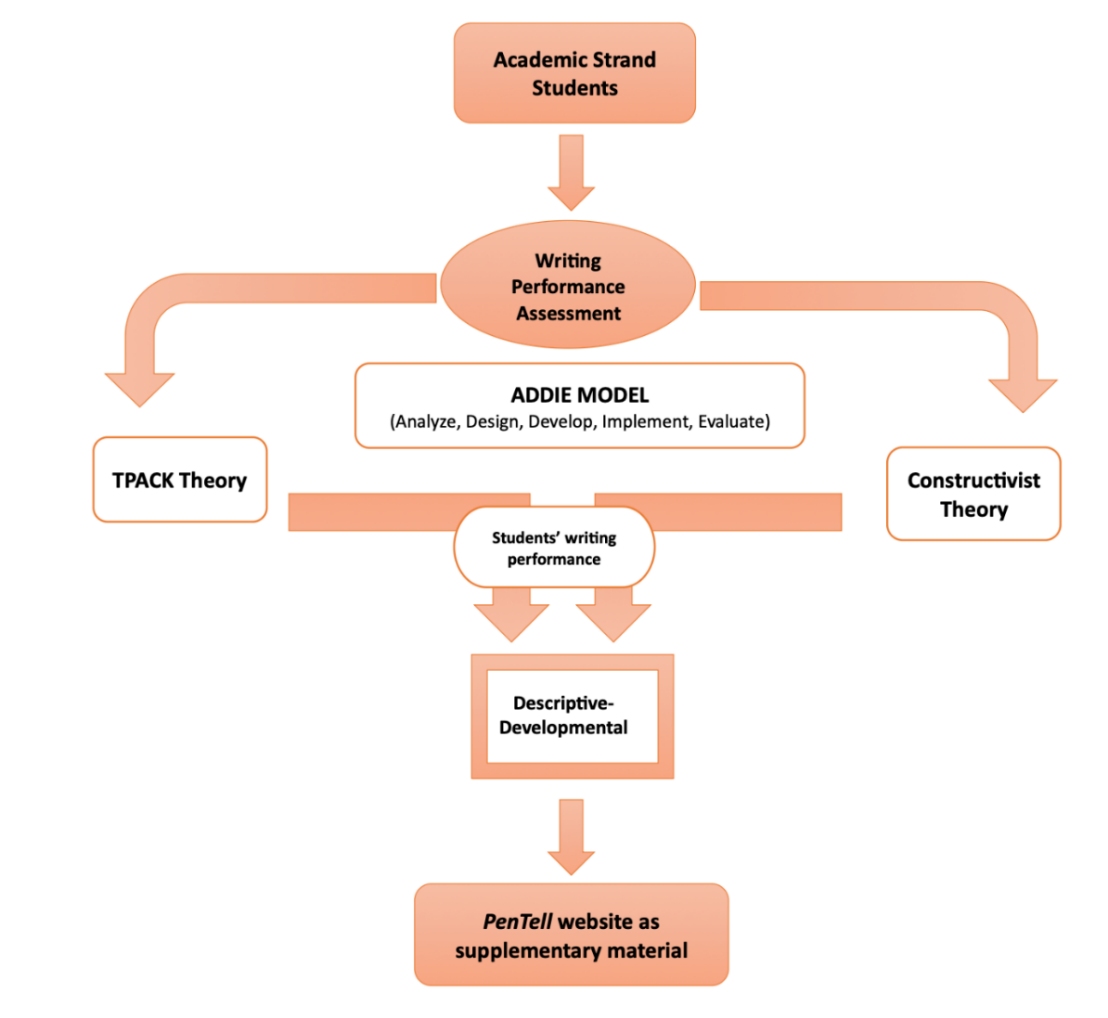
The Technological Pedagogical Content Knowledge (TPACK) framework strengthened the study by addressing writing challenges and creating solutions that combined content, pedagogy, and technology. The framework ensured that integrated materials, such as YouTube videos, websites, modules, and assessments, were relevant and aligned with the objectives and goals of the study.
The combination and interconnectedness of the frameworks make the website suitable for improving learners’ writing skills and strengthening their learning experiences (Dang, 2025). ADDIE shapes the process, constructivism supplies the design, and TPACK ensures that technology integration can hone writing literacy skills through pedagogical and content-based materials (Ammade et al., 2020). Together, these frameworks provided more systematic guidance for the website and offered a strong foundation for its future implementation and evaluation. As indicated by Yildiz Durak (2021), the alignment of the three frameworks supports the PenTell website as adaptable, inclusive, and practical for students’ needs in communicative competence in writing.
METHODOLOGY
To better understand students’ needs in improving their writing performance, a structured approach was utilised. A descriptive-developmental research design was used to assess senior high school students’ writing performance in its natural occurrence, without manipulation or intervention. Descriptive research involves the systematic observation and measurement of variables, providing detailed descriptions without controlling or influencing the phenomena being studied. The developmental approach within the descriptive design examined differences across groups of learners without experimental control (Ibrahim, 2016).
The respondents of the study were Grade 12 students who belonged to the academic track. Voluntary response sampling was utilised, a non-probability sampling procedure in which the researcher did not personally select the participants. Instead, students who met the qualifications and were willing to participate volunteered to respond and take part in the study. Before participating, students received an informed consent form detailing the purpose, procedures, and their rights. Only those who signed the consent form and agreed to write an essay were included in the final sample.
The study utilised multiple research instruments to obtain both quantitative and qualitative data. These included a student writing test with a rubric and an evaluation checklist for the developed PenTell website.
The student essay-writing task with a rubric was designed to assess performance in grammar, vocabulary, mechanics, and coherence. The topics that students could choose from for their writing task were developed based on the objectives of the study and reviewed by experts to ensure that they were clear, appropriate, and suitable for Grade 12 students. The form used in validating the instruments was the tool of P. M. Veroy, RN, MAN. It employed a 5-point rating scale ranging from 5, excellent, to 1, poor. It consisted of seven criteria, namely clarity and directions, presentation and organisation, suitability, adequacy of content, attainment of purpose, objectivity, and appropriateness. The remarks section allowed the validators to provide quality feedback and suggestions. After the suggestions of the expert validators were integrated, the instrument was pilot-tested with students who were not part of the study. The results of the pilot test were then analysed using Cronbach’s alpha, which revealed a coefficient of >.74, indicating the consistency and appropriateness of the instrument for the study.
Furthermore, an evaluation checklist was used to assess the PenTell website. Content quality, instructional design and effectiveness, usability and accessibility, and overall perception were evaluated by the English teachers. Similar to the other instrument, the checklist was reviewed to ensure that each indicator was clear, relevant, and meaningful. Their feedback was used to improve the final version before it was used in the actual evaluation.
Instrument validation and pilot testing are significant steps in research because they ensure that the tools used for data collection are accurate and appropriate. According to Cook and Hatala (2016), validation allows researchers to check the alignment of the instrument with the objective of the study and strengthens the credibility and usefulness of the findings. Without this process, the results may risk not fully reflecting the actual variables being measured. Pilot testing, on the other hand, refines the process and reduces potential errors in data collection, thereby improving the instrument’s validity and reliability (Matimbwa & Ringo, 2025). Taber (2018) emphasised that validation, together with pilot testing, contributes to the development of high-quality research instruments.
The first part of the study involved assessing the writing performance of academic-track students from ABM, HUMSS, and STEM at Higher School ng UMak (HSU) and Nemesio I. Yabut Senior High School (NIYSHS) across four linguistic areas, namely vocabulary, grammar, mechanics, and coherence. Student essays were collected and evaluated using a validated scoring rubric by three inter-raters who were teachers handling writing classes. Each criterion in the rubric used a 4-point scale, with excellent = 5, good = 4, fair = 3, and poor = 2.
The second phase was the development of PenTell as supplementary material. This tailored learning website was created to support students in strengthening their writing skills based on the results from Phase 1. The platform integrated educational videos, systematised modules, comprehensive lessons, and engaging quizzes, all created to address common challenges in vocabulary, grammar, mechanics, and coherence. Through these accessible and engaging course materials, the primary goal of the website is to assist students in developing and improving communicative competence in writing in parallel with classroom instruction. The website also aimed to cater to diverse learners, especially those with limited internet access. The downloadable modules contain the same discussion content and exercises as those on the website and were specifically designed for a hybrid learning setup.
ETHICAL CONSIDERATIONS
Acknowledging the importance of respecting the individual rights and welfare of the participants involved in the study, this section presents the guidelines employed to ensure informed consent, anonymity, confidentiality, and voluntary participation.
Potential student respondents received an individual informed consent form that transparently presented the details of the study, including its purpose, procedures, possible risks and benefits, the right to withdraw at any time, and how their data would be used and kept confidential. The welfare and personal information of both student and teacher respondents were protected at all times from any potential harm that could arise from participating in the research. The data gathered remained confidential throughout the study. The process of analysing the data until the final stage of the study did not cause any harm to the respondents. The study was conducted with honesty and integrity, without fabrication or bias, and the data collected from participants were kept confidential and were not shared with any unauthorised parties.
RESULTS AND DISCUSSION
The table below shows the number of enrolled students in each strand in the two schools. It also provides the frequency and percentage of the actual number of student respondents who participated in the study.
This study relied on voluntary response sampling, meaning that participants chose to take part based on their own interest, availability, and willingness to contribute. There was a total of 302 student participants, with 228 students from Higher School ng UMak (HSU), representing 75.47% of the actual respondents, and 74 from Nemesio I. Yabut Senior High School (NIYSHS), representing 24.52%.
Table 1. Number of Enrolled Students in Each Strand per School and the Frequency and Percentage of HSU and NIYSHS Actual Number of Student Respondents
|
Higher School ng UMak (HSU) |
Nemesio I. Yabut Senior High School (NIYSHS) |
|||||||
|---|---|---|---|---|---|---|---|---|
|
Strand |
No. of enrolled students |
Initial Target participants |
Actual No. of respondents |
Percentage (%) |
No. of enrolled students |
Initial Target participants |
Frequency |
Percentage (%) |
|
ABM |
264 |
84 |
47 |
15.56% |
115 |
64 |
8 |
2.65% |
|
HUMSS |
393 |
125 |
113 |
37.42% |
150 |
83 |
52 |
17.23% |
|
STEM |
205 |
65 |
68 |
22.51% |
58 |
32 |
14 |
4.64% |
|
Total |
862 |
273 |
228 |
75.47% |
323 |
179 |
74 |
24.52% |
Despite this imbalance, the teacher-researcher did not want the efforts of participating students to be wasted and decided to include all essays from students who gave their time and effort. The obvious numerical discrepancy between the two institutions did not diminish the principal objective of this cohort, which was to identify students’ level of writing performance and challenges in vocabulary, grammar, mechanics, and coherence as a basis for creating supplementary course material to help students improve their writing skills in these four components.
Figure 2 presents the methodological framework of the study. It illustrates the relationship among the study variables, students’ writing performance assessment in grammar, vocabulary, mechanics, and coherence, the integration of ADDIE, TPACK, and constructivist theories, and the expected output that aims to address writing challenges, namely the PenTell website.
The figures below present the detailed analysis of students’ writing performance across the four linguistic areas of vocabulary, grammar, mechanics, and coherence. Through these presentations, the differences and similarities in performance among strands and schools can be clearly observed.
Figure 2 shows the respondents’ writing performance in vocabulary. It demonstrates students’ ability to use appropriate terms, expressions, and words in written texts.
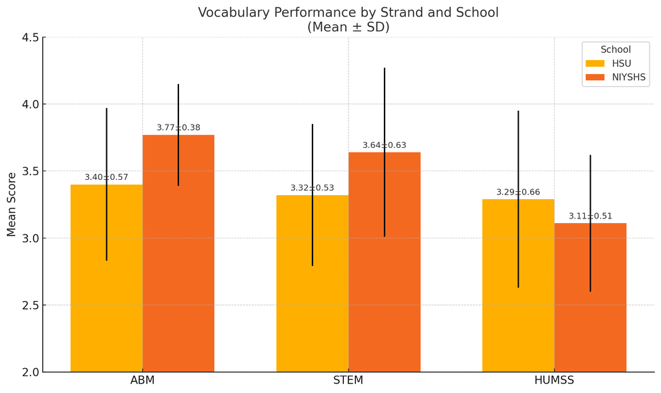
In terms of vocabulary in writing, students from Nemesio I. Yabut Senior High School (NIYSHS) performed better than those from Higher School ng UMak (HSU), which was significantly evident in the ABM and STEM strand results. The NIYSHS ABM students obtained a high mean score of 3.77 (SD = 0.384), in contrast to 3.40 (SD = 0.575) for HSU ABM students. Similarly, NIYSHS STEM students had a mean vocabulary score of 3.64, compared with 3.32 for HSU. The findings suggest that the ABM and STEM strands may have been exposed to systematic instruction in vocabulary and technical aspects of writing.
As asserted by Sukying (2023), a broad vocabulary can be advantageous because it empowers students to communicate with clarity and precision when expressing their ideas and emotions in written form. On the contrary, it is notably unexpected that the HUMSS strands of both schools scored similarly low in vocabulary, with 3.11 for NIYSHS and 3.29 for HSU.
The Philippine senior high school curriculum for the HUMSS strand includes language-intensive subjects aimed at developing reading and writing skills. However, relevant studies have revealed that HUMSS students do not always demonstrate high levels of vocabulary proficiency. An action research study by Cabilona and Milog (2025) reported that Grade 11 HUMSS students lacked sufficient vocabulary skills, leading to the recommendation of supplementary instructional materials to enhance students’ vocabulary development. On the other hand, a correlational study by Anji et al. (2025) showed that students’ lexical ability was poorly demonstrated, signifying that they struggled with word recognition and contextual usage. Another study on literacy among Grade 12 HUMSS students emphasised that limited vocabulary is a contributing factor to reading difficulties (Secondez et al., 2025). The findings reveal that students’ vocabulary development is uneven, despite the strand being language-focused.
Figure 3 presents students’ writing performance in grammar. It illustrates students’ ability to apply grammatical rules properly in writing, including subject-verb agreement, verb usage, and structure.
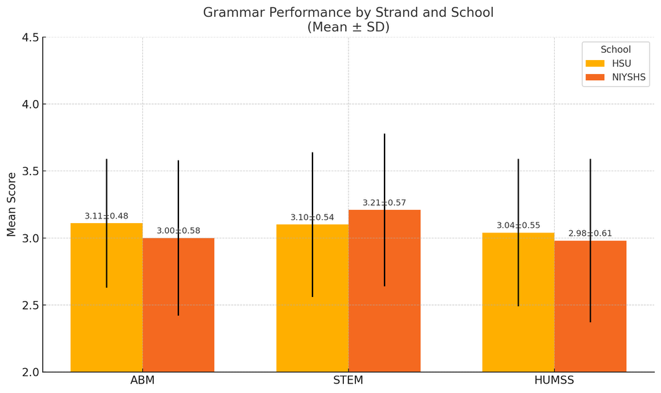
The results show that although there is a slight difference between the two schools in grammar, NIYSHS STEM students performed moderately better than HSU students, with a mean score of 3.21 compared with 3.10. This result may indicate that the writing activities or tasks of STEM students were highly focused on syntactic accuracy, which could be linked to the strong emphasis on technical and academic topics. Seitenova et al. (2023) pointed out that STEM students frequently exhibit sufficient grammatical understanding, although they may struggle to apply more complex grammatical structures effectively in writing. Similar results were found in the ABM strands, where HSU obtained a mean score of 3.11 and NIYSHS had a mean score of 3.00.
In addition, the HUMSS strands of both schools had low grammar ratings, with 2.98 for NIYSHS and 3.04 for HSU. Although there is only a slight difference between the two schools, the results suggest that students were greatly challenged by grammatical structure and subject-verb agreement, including the use of common linking verbs such as “am”, “is”, “are”, “was”, and “were”. These results are supported by Portillo-San Miguel (2021), who found that grammatical correctness is probably less emphasised at the senior high school level, where instruction focuses more on forming and articulating feasible ideas, as generally taught and encouraged in the HUMSS strand.
Appropriate grammar in written work is believed to ensure accuracy and understanding. Subject-verb agreement, sentence structure, and verb consistency are considered among the most challenging aspects of writing. According to Ajaj (2022), English will not be properly and correctly practised without learning grammar. Therefore, grammar instruction should be integrated into the senior high school curriculum.
The figure below shows students’ writing performance in mechanics. It illustrates students’ ability to apply correct punctuation, capitalisation, spelling, and formatting conventions in writing.
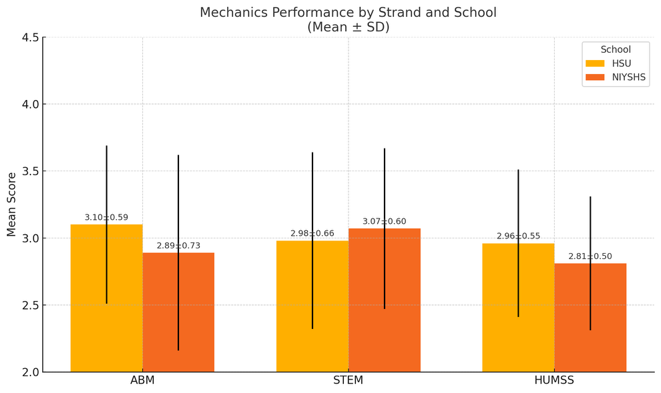
Both schools had low scores in mechanics, which consistently fell around the 3.10 border. Among the academic strands, HUMSS had the weakest performance, with mean ratings of 2.96 for HSU and 2.81 for NIYSHS. The result indicates students’ challenges in capitalisation, punctuation, and spelling. These findings suggest that instruction in both institutions focused more on content than on balanced integration of writing fundamentals. Although HSU may have had higher mean scores than NIYSHS, the results still indicate areas that need to be addressed in students’ writing performance.
A few common error patterns were evident in students’ written texts, making their writing less formal. Many students wrote the pronoun “I” in lower case rather than in the standard uppercase form. They also failed to capitalise personal pronouns and proper nouns, such as names of persons, places, months, and days. Some common observable spelling errors listed by the inter-raters were “trancending”, “catastopy”, “reciev”, “defenitely”, “acomplished”, “percive”, “accomodate”, “liesure”, “infrastractures”, among others. Another observed error was that students often misused punctuation or did not use it at all, as in “lets instead of let’s/let us”, “dont”, “cant”, and “doesnt”. Other issues included not using commas or periods to separate ideas and sentences and missing spaces between sentences.
Mechanics such as capitalisation, punctuation, and spelling are important components of writing. They ensure accuracy, clarity, and correct interpretation of written communication. Kottacheruvu (2023) emphasised that errors in these areas negatively affect the quality, readability, and interpretation of texts. Mechanics in writing are often overlooked because writing instruction usually focuses on content development and idea generation, as shown by Wang and Troia (2023). Studies have also shown that students encounter difficulties with capitalisation and punctuation in academic writing because of overreliance on automated corrections, as noted by Fitria (2022).
The figure below shows students’ writing performance in coherence. It emphasises students’ ability to organise and connect their ideas logically. It also illustrates how students maintain clarity and unity in their writing.
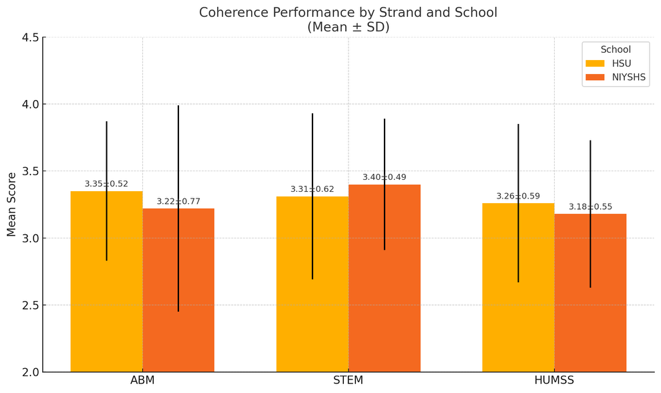
The STEM students from NIYSHS garnered the highest mean score of 3.40, demonstrating better coherence in writing than the other groups. This may indicate that the strand’s focus on logical thinking, systematic procedures, and organised presentation of ideas reflects skills that may appear in students’ writing, as attested by Cuayzon (2024). ABM students from HSU followed with a mean score of 3.35, while ABM students from NIYSHS obtained a mean score of 3.22. The HUMSS strand recorded the lowest mean scores in both schools, with 3.26 for HSU and 3.18 for NIYSHS. Although HUMSS students are commonly expected to excel in writing-related tasks because of the strand’s focus on communication and humanities subjects, the results suggest that coherence in writing is influenced by factors beyond specialisation. Overall, there were only minimal differences in the mean scores, signifying fairly similar levels of coherence in their writing performance.
Urbano et al. (2021) found that Filipino students often produce disorganised written work because they struggle with planning and structuring their ideas. This difficulty is linked to limited instruction on the writing process, particularly in areas such as outlining, drafting, and the effective use of transitions. The study suggests that students’ writing skills can improve remarkably when they are properly guided in organising their thoughts and applying clear techniques in developing their texts.
Based on Crossley et al. (2019), some research findings reveal that readers understand texts better when they are presented in a connected and structured manner because the quality of written form is clear and logical. Although coherence is evidently important in writing, it is still often overlooked. Most students experience challenges in organising and maintaining logical flow between sentences and paragraphs, which is rooted in limited knowledge of the proper use of transition words.
The figure below shows the summary of students’ writing performance across different academic strands in the two schools. The data highlight differences in students’ writing proficiency. Some strands may show consistently higher performance, which could be interpreted as reflecting a stronger emphasis on skills linked to communication and curriculum exposure. Other strands may have lower results, suggesting a need for additional instructional support or writing interventions.
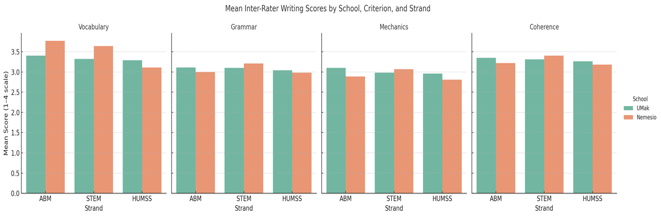
The results from both schools revealed that NIYSHS had higher ratings in vocabulary and coherence, particularly in the ABM and STEM strands. HSU scores were more balanced; however, issues remained in grammar and mechanics, notably in the STEM and HUMSS strands. The repeated low performance of HUMSS students in both institutions, despite HUMSS being the language-centred strand, is concerning. There should be stronger curriculum alignment and greater emphasis on accuracy and structure in writing.
Furthermore, the consistently low scores of both schools in grammar and mechanics stress the need to include all four writing elements in writing subjects and classes. The results also signify that writing classes and activities, aside from being aligned with the course, should review writing fundamentals and refine students’ skills. Comparisons of writing performance across academic strands and schools do not indicate separate systems of final output. Rather, the comparative data are a significant step in framing a consolidated and engaging digital learning platform or website.
As asserted by Combong and Napil (2025), students in different learning cohorts often demonstrate variations in writing performance because of differences in academic needs, learning styles, and instructional exposure. Understanding such differences is important because technology-based learning materials are noticeably effective when designed according to learner variability rather than assuming uniformity (Peungcharoenkun & Waluyo, 2023).
Table 2 shows the evaluation results of the PenTell website as assessed by English teachers handling writing subjects. The evaluation focused on content quality, instructional design and effectiveness, and usability and accessibility.
Table 2. Mean and Standard Deviation of the Teachers’ Evaluation on the Website and Course Materials
|
Category |
Mean |
Standard Deviation |
Verbal Interpretation |
|---|---|---|---|
|
Content Quality |
4.88 |
2.209 |
Strongly Agree |
|
Instructional Design and Effectiveness |
4.78 |
2.186 |
Strongly Agree |
|
Usability and Accessibility |
4.68 |
2.163 |
Strongly Agree |
|
Overall Perception |
4.78 |
2.186 |
Strongly Agree |
|
Final Result |
4.78 |
2.186 |
Strongly Agree |
The study used an evaluation tool made by the teacher-researcher to assess content quality, which had the highest mean score of 4.88; instructional design, with 4.78; effectiveness, accessibility, and functionality, with a mean score of 4.68; overall perception, with 4.78; and the average mean score of 4.78 for the PenTell website. Each domain consisted of five indicators, and each item was rated using a 5-point Likert scale, where 5 meant strongly agree, 4 agree, 3 neutral, 2 disagree, and 1 strongly disagree. The scale allowed the ten language teachers, who were also the validators, to measure the extent to which the website met standard expectations. The teachers explored the website, including its lessons, videos, Google Forms assessments, and downloadable modules, before completing the evaluation tool. The evaluation was conducted under non-experimental conditions, allowing the teacher-evaluators to navigate the website independently and give ratings based on their instructional experience and professional judgement.
English teachers highly approved the PenTell website, highlighting the accuracy, clarity, and relevance of its content, as reflected in the high mean score of 4.88. Learning materials that provide targeted and systematic instruction are highly needed for recurring writing challenges such as sentence construction and idea organisation (Urbano et al., 2021). The effectiveness of genre-based instructional materials helps improve students’ academic performance and written discourse (Reforsado & Raymundo, 2025).
In addition, the teachers described the website and its integrated learning materials as sustainable. Teaching strategies work better alongside learning tools that are practical and usable over the long term. Students subsequently become better and more confident writers when they are provided with systematic and organised writing activities and tasks that challenge them to communicate effectively and efficiently in written form (Omodan, 2021).
CONCLUSION
The present study was designed to assess writing performance and determine the challenges encountered by senior high school students, focusing on four linguistic areas, namely vocabulary, mechanics, grammar, and coherence. By emphasising these linguistic areas as contributory factors that affect communicative competence in writing, this study provides a significant analysis of the writing performance of students in the academic track. Although these students were expected to write well, the findings revealed that a review of writing fundamentals is necessary across all strands.
It is evident that interventions are needed to help students develop basic writing skills. Teachers should set up structured writing programmes and activities that include tasks for improving students’ ability to acquire new words, exercises that help them improve their grammar, and lessons on how to write correctly. Giving students easy access to supplementary materials would help them learn even outside school hours. Despite the existence of artificial intelligence as a helpful writing assistant, it remains necessary to train, develop, and enhance students’ writing skills with the aim of instilling confidence in writing, even in classroom settings where AI is restricted by some educators. This empowers and encourages students to develop independently and rely on their own critical thinking and creativity.
By proposing the PenTell website with downloadable modules and Google Forms quizzes with immediate feedback, the research highlighted tangible support for four key areas, namely vocabulary, grammar, mechanics, and coherence. Considerations for scalability, such as addressing challenges in resource-limited settings or offering flexible implementation models, strengthen its potential for wider adoption across different school contexts.
RECOMMENDATION
English teachers can effectively integrate the PenTell website into classroom learning through several steps. First, they can allocate time for teacher orientation and training. One week may be dedicated to familiarising teachers with the website and integrated materials, such as videos, other verifiable websites, and exercises. This will allow a smooth transition into classroom implementation and help both teachers and students maximise the resources. Second, they can integrate the materials into relevant lesson discussions and writing activities. The modules and website can support classroom activities such as reading comprehension, technical writing, and research skills, ensuring that students engage with systematic content that enhances their communicative competence in writing. Third, teachers can adopt hybrid learning approaches by combining conventional face-to-face teaching with digital activities using the website or modules. This approach provides students with flexible learning opportunities and strengthens writing concepts through interactive tasks both online and offline.
To ensure that the developed modules effectively support writing instruction, curriculum developers can take several steps. First, they can organise the materials so that they align with the standards of the existing curriculum. This requires revisiting the curriculum, reviewing guidelines already established by the Department of Education (DepEd) or the Commission on Higher Education (CHED), and integrating the modules accordingly. This will ensure alignment, connection, and consistency in instructional and learning goals. Second, they can utilise the website and modules as supplementary materials by considering how they may be integrated into senior high school and college-level English programmes and activities to improve students’ communicative competence in writing. The materials can also provide additional opportunities for writing practice, whether online or offline, as the modules can be downloaded and printed. Third, curriculum developers can conduct consistent evaluations and updates. Regular and continuous evaluation of the content is needed to ensure its ongoing relevance and effectiveness, with materials modified and refined based on students’ needs and evolving standards in educational practice.
Information and Communication Technology (ICT) school coordinators play a vital role in ensuring smooth access to, and usability of, the materials. To support the successful integration of the website and digital modules into classroom instruction, several steps can help create a well-prepared learning environment. First, schools should secure the technical infrastructure by ensuring that the school internet connection is stable and that students and teachers have reliable access to computers or mobile devices for digital learning. Potential connectivity issues should be addressed to minimise disruptions when using online platforms. In cases where unavoidable circumstances arise, such as internet connectivity challenges, storage should be allotted so that modules can be saved, kept, and easily retrieved for use. Second, ICT coordinators should provide regular technical support and digital literacy training. They should assist both teachers and students in navigating the digital tools effectively and conduct regular training sessions that focus on maximising the platform’s features while addressing common challenges related to internet connectivity and platform navigation.
References
Ajaj, I. E. (2022). Investigating the difficulties of learning English grammar and suggested methods to overcome them. Journal of Tikrit University for Humanities, 29(6), 45-58. https://doi.org/10.25130/jtuh.29.6.2022.24
Ammade, S., Mahmud, M., Jabu, B., & Tahmir, S. (2020). A TPACK model based instruction in writing: an analysis of TPACK literacy. International Journal of Language Education, 129-140. https://doi.org/10.26858/ijole.v4i2.12441
Anji, A. A., Malik, A. M., Cinco, C. B., Cruz, J. B. D., Madriñan, N. L., Tomanggong, C. S., Andoyo, J. T., & Pondang, K. A. (2025). Lexical ability and reading comprehension among senior high school students. International Journal of Research and Innovation in Social Science, 9(2), 3231-3256. https://doi.org/10.47772/ijriss.2025.9020251
Barayuga, K. A. M., Andrade, J. N., Bagatnan, K. H. P., Cabanting, F. M., Chanco, J. N. R., Catiempo, A. G. T., Intong, C. M., Montera, R. A., Per, J. A. M., Pujol, R. M. M., & Sarmiento, J. P. (2024). Writing skills of senior high school students: A basis for intervention program. International Journal of Research and Innovation in Social Science, 8(4), 2890-2894. https://doi.org/10.47772/IJRISS.2024.804208 DOI: https://doi.org/10.47772/IJRISS.2024.804271
Sukying, A. (2023). The role of vocabulary size and depth in predicting postgraduate students’ second language writing performance. LEARN Journal: Language Education and Acquisition Research Network, 16(1), 575-603.
Baskin, S., Iscan, A., Karagoz, B., & Birol, G. (2017). The use of vocabulary learning strategies in teaching Turkish as a second language. Journal of Education and Practice, 8(9), 126-134. https://eric.ed.gov/?id=EJ1138831
Betoni, T., & Ulfaika, R. (2020). The correlation between students’ grammatical mastery and students’ writing achievement at XI grade students of SMAN 1 Tarakan academic year 2019/2020. Borneo Journal of English Language Education, 2(1). https://doi.org/10.35334/bjele.v2i1.1615
Briones, S. H., Abundo, L. V., Quiñones, P. S., Regilme, K. M. D., Catalan Jr., J. C., Cañeza, D. C. B., & Ocampo, D. M. (2024). Effects of colloquial language on the writing skills of grade 11 students. Journal of English Education Forum (JEEF), 4(2), 70-78. https://doi.org/10.29303/jeef.v4i2.672
Cabilona, J., Milog, D. (2025). Enhancing vocabulary knowledge of grade 11 students through the word web wonders (www) intervention: An action research. EPRA International Journal of Multidisciplinary Research. https://doi.org/10.36713/epra22669
Callora, I. & Suñas, W. (2023). The writing competence of senior high school students in the public schools in Alamada, Cotabato. Psychology and Education: A Multidisciplinary Journal, 7(2), 1-17. https://doi.org/10.5281/zenodo.7646848
Cielo May Urbano, Ma. Angelica Gumangan, Leah Gustilo, Ph.D., & Ma. Pamela A. Capacete (2021). Reading and writing needs of senior high school students: the case of Filipino students in the Philippines. Modern Journal of Studies in English Language Teaching and Literature, 3(1), 140-166. https://doi.org/10.56498/31202154
Combong, J. L. D., & Napil, M. C. (2025). Writing apprehension and learning style as predictors of academic performance in Filipino. American Journal of Education and Technology, 4(2), 1-12. https://doi.org/10.54536/ajet.v4i2.4484
Cook, D. A., & Hatala, R. (2016). Springer Nature Link. https://doi.org/10.1186/s41077-016-0033-y. Advances in Simulation, 1(1). https://doi.org/10.1186/s41077-016-0033-y
Crossley, S. A., Kyle, K., & Dascalu, M. (2019). The Tool for the Automatic Analysis of Cohesion 2.0: Integrating semantic similarity and text overlap. Behavior research methods, 51(1), 14-27. https://doi.org/10.3758/s13428-018-1142-4
Cuayzon, M.L. (2024). Research writing competence of grade 12 students: towards research culture improvement. Journal of Interdisciplinary Perspectives, 2(9), 22-31. https://doi.org/10.69569/jip.2024.0311
Dang, T. T. (2025). AI tools for language learners: The promotion of learning independence or reliance. In Pham, V. P. H., Lian, A., Lian, A., White, J. (Eds.), Empowering educators: Integrating AI tools for personalized language instruction, (pp. 263–280). Springer Nature. https://doi.org/10.1007/978-3-032-01348-4_11
Dorje (2023). The science of promotions: A Tulane researcher gives expert insight. Tulane News, Tulane University. https://news.tulane.edu/news/science-promotions-tulane-researcher-gives-expert-insight
Fitria, T. N. (2022). Identifying grammatical and mechanical errors of students’ writing: using “grammarly” as an online assessment. Lingua Didaktika: Jurnal Bahasa dan Pembelajaran Bahasa, 16(2), 169. https://doi.org/10.24036/ld.v16i2.116824
Hasan, H., & Subekti, N. B. (2017). The correlation between vocabulary mastery and writing skill of secondary school students. JELLT (Journal of English Language and Language Teaching), 1(2), 55-60. https://doi.org/10.36597/JELLT.V1I2.1872
Hikamah, N. (2019). An analysis of grammatical errors in essay writing of EFL senior high school students. English Language Teaching and Learning, 2(1), 45-58.
Ibrahim, A. (2016). Definition, purpose, and procedure of developmental research: An analytical review. Asian Research Journal of Arts & Social Sciences, 1(6), 1-6. https://doi.org/10.9734/arjass/2016/30478
Kottacheruvu (2023). Analysis of spelling errors in English writing: issues and solutions. Journal for Educators, Teachers and Trainers. https://doi.org/10.47750/jett.2023.14.01.057
Laguidong, D. D., & Buda, A.-J. A. K. (2017). Perceptions of parents, students, and teachers of Pikit National High School, Pikit, Cotabato on the implementation of the K to 12 program of the Department of Education. In Proceedings of the 2nd International Conference on Educational Management and Administration (CoEMA 2017) (pp. 249-262). Atlantis Press. https://doi.org/10.2991/coema-17.2017.44
Lopez, A., & Dizon, L. (2018). Reading exposure and vocabulary development. Philippine ESL Journal, 12(1), 20-31.
Magno, C. R., & Bautista, A. G. (2021). Verb usage challenges in the English writing of Filipino senior high school students. Philippine Journal of TESOL, 10(1), 23-38.
Maguddayao, R. (2017). Communicative competence: A factor to effective intercultural communicative competence for EFL learners in the medical pedagogy. International Journal of Advanced Research in Management and Social Sciences, 6(11), 1-25. http://garph.co.uk/IJARMSS/Nov2017/8.pdf
Matimbwa, H. and Ringo, C. (2025). The role of pilot studies on validity and reliability of social science research instruments: A systematic review. East African Journal of Education and Social Sciences, 6(5), 14-27. https://doi.org/10.46606/eajess2025v06i05.0462 DOI: https://doi.org/10.46606/eajess2024v05i03.0382
Morales, P. (2023). Improving grade 7 students’ news writing skills using worksheets assessed through online interviews. Davao Research Journal, 14(1), 6-16. https://doi.org/10.59120/drj.v14i1.9
OECD. (2023). PISA 2022 Results (Volume I and II) - Country Notes: Philippines. OECD Publishing. https://www.oecd.org/en/publications/pisa-2022-results-volume-i-and-ii-country-notes_ed6fbcc5-en/philippines_a0882a2d-en.html
Omodan, B. (2021). Promoting collaborative pedagogy in classrooms: Challenges and solutions. Journal of Education, Teaching and Learning, 6(2), 102-109. https://doi.org/10.26737/jetl.v6i2.2598
Peungcharoenkun, T., & Waluyo, B. (2023). Implementing process-genre approach, feedback, and technology in L2 writing in higher education. Asian-Pacific Journal of Second and Foreign Language Education, 8(1). https://doi.org/10.1186/s40862-023-00211-7
Portillo-San Miguel, E. J. (2021). Writing difficulties encountered by humanities and social sciences students in Philippine politics and governance. International Journal of Language and Literary Studies, 3(3), 156-167. https://doi.org/10.36892/ijlls.v3i3.656 DOI: https://doi.org/10.36892/ijlls.v2i3.656
Quines, Z. M. (2023). Impact of students’ vocabulary level to their reading and writing performance. International Journal of English Language and Linguistics Research, 11(2), 18-32. https://doi.org/10.37745/ijellr.13/vol11n21832
Quiñones, T. F. (2022). A study on the in-depth knowledge of grammar among English major students at the University of Makati: Basis for worktext development. Universitas-The Official Journal of University of Makati, 10 (1).
Reforsado, M., & Raymundo, A. (2025). Written discourse performance of senior high school students: designing genre-based instructional materials. Research in Applied Linguistics, 3(1). https://doi.org/10.31963/rial.v3i1.5070
Saavedra, A. D., & Barredo, C. P. (2020). Factors that contribute to the poor writing skills in Filipino and English of the elementary pupils. International Journal of Innovation, Creativity and Change, 14(5), 1090-1102.
Santos, A., Fernandez, V., & Ilustre, R. (2022). English language proficiency in the Philippines: An overview. International Journal of English Language Studies, 4(3), 46-51. https://doi.org/10.32996/ijels.2022.4.3.7
Secondez, K., Apolonia, J., Damance, M., Medina, B., Macapagal, K., Andulan, J., Agaton, J., Ayles, D., Estilo, R. Espinosa, M,. Cabingan, P., Tabutabu, J., Medalla, C., Cabanlig, M. (2025). Understanding the literacy proficiency in reading among grade 12 humss students. Asia’s Educators and Professionals Awards E-Journal, 2(1). https://www.aepawards.com/e-journal/understanding-the-literacy-proficiency-in-reading-among-grade-12-humss-student
Seitenova, S., Khassanova, I., Khabiyeva, D., Kazetova, A., Madenova, L., & Yerbolat, B. (2023). The effect of STEM practices on teaching speaking skills in language lessons. International Journal of Education in Mathematics, Science and Technology, 11(2), 388-406. https://doi.org/10.46328/ijemst.3060
Smyth. (2025). Sharpening employees’ business writing skills is good for business. SkillPath Blog. https://skillpath.com/blog/sharpening-employees-business-writing-skills-is-good-for-business
Taber, K.S (2018). The use of Cronbach’s alpha when developing and reporting research instruments in science education. Research in Science Education, 48, 1273-1296. https://doi.org/10.1007/s11165-016-9602-2
Ulit, J. (2018). Writing errors of grade 9 students: basis for sentence writing module. Asian Society of Teachers for Research, Inc. http://orcid.org/0000-0002-5860-3010
Wang, H., & Troia, G. A. (2023). How students’ writing motivation, teachers’ personal and professional attributes, and writing instruction impact student writing achievement: a two-level hierarchical linear modeling study. Frontiers in Psychology, 14. https://doi.org/10.3389/fpsyg.2023.1213929
Yildiz Durak, H. (2021). Modeling of relations between K-12 teachers’ TPACK levels and their technology integration self-efficacy, technology literacy levels, attitudes toward technology, and usage objectives of social networks. Interactive Learning Environments, 29(7), 1136-1162. https://doi.org/10.1080/10494820.2019.1619591
Downloads
Published
Data Availability Statement
N/A
Issue
Section
License
Copyright (c) 2026 Dr. Ciney S. Dunque

This work is licensed under a Creative Commons Attribution-NonCommercial-NoDerivatives 4.0 International License.