
Cultural bias in English for tourism: Warmth–competence perceptions and emerging intercultural awareness
DOI:
https://doi.org/10.65956/procia.2026.133Keywords:
cultural bias, stereotype content model, intercultural communicative competence, English for tourismAbstract
The global tourism industry relies heavily on cross-cultural encounters, positioning language proficiency and intercultural competence as essential skills for future professionals. While English for Tourism courses aim to develop communicative competence, little attention has been given to the ways cultural bias shapes how students perceive and respond to cultural others. This qualitative case study explores how six Vietnamese undergraduate tourism students describe tourists and how they recognise and reinterpret their biases in service interactions as part of developing intercultural competence. Drawing on the Stereotype Content Model (SCM) and a targeted Intercultural Communicative Competence (ICC) lens, focusing on attitudes and critical cultural awareness, the study analyses semi-structured interviews conducted in Vietnamese using combined deductive and inductive thematic coding. Results show that students’ early impressions were shaped by both indirect sources (media and family) and direct sources (coursework and workplace contact). Participants routinely described guests using warmth and competence evaluations, reported adjusting service behaviours accordingly (speech rate, formality, and patience), and each recounted at least one incident of reflection and reinterpretation, typically prompted by either direct workplace encounters or classroom feedback. Findings underscore the need for English for Tourism curricula to integrate SCM-informed discussion, explicit stereotype-reflection tasks, and guided reflection on workplace encounters alongside functional language training, so that students can develop both communicative effectiveness and critical intercultural awareness.
INTRODUCTION
The global tourism industry thrives on effective cross-cultural encounters, making language proficiency and intercultural competence indispensable skills for future tourism professionals (Kostić-Bobanović & Gržinić, 2011; Sándorová, 2019). English for tourism courses explicitly aim to prepare students for these service encounters by developing communicative competence through transactional language tasks in service-related contexts (Zahedpisheh et al., 2017). However, they often fail to incorporate structured opportunities for critical reflection on underlying cultural assumptions (Sercu, 2005; Baker, 2015). Deeply ingrained cultural biases often shape how students perceive and respond to cultural “others”, influencing not only communication but also professional conduct in tourism, where misinterpretations can undermine service quality and intercultural trust (Koc, 2020).
Social perceptions about visitors frequently take the form of ambivalent stereotypes, in which a national or cultural group (e.g., tourists from a particular country) is judged on two principal dimensions, namely warmth (friendliness, trustworthiness) and competence (capability, preparedness). The Stereotype Content Model (SCM) identifies these two dimensions and demonstrates how combinations such as “competent but cold” or “warm but incompetent” reliably predict emotional and behavioural responses to out-groups (Fiske et al., 2002; Cuddy et al., 2008). Recent applications of SCM in tourism contexts further illustrate its relevance for understanding destination or visitor image (Rojas-Méndez & Davies, 2024).
Parallel to SCM, Byram’s Intercultural Communicative Competence (ICC) framework emphasises not only knowledge and skills but also attitudes and critical cultural awareness (savoirs-attitudes, knowledge, interpretive/interaction skills, and savoirs’ engager) that enable learners to reflect on and deconstruct stereotypes (Byram, 1997; Byram, 2021). Research suggests that structured reflective practices, such as critical incident analysis and perspective-taking, can support the development of bias awareness and more adaptive intercultural responses (Ladegaard & Jenks, 2018; Devine et al., 2012).
In short, SCM helps identify what content students use to judge tourists, while ICC suggests how education can help students critically evaluate and change those perceptions. Despite this complementary potential, few empirical studies have combined SCM and ICC to examine how tourism students, specifically those enrolled in English for Specific Purposes (ESP) courses such as English for Tourism, perceive cultural others and reflect on their own biases in authentic service settings. Addressing this gap, this qualitative case study investigates how Vietnamese undergraduate tourism students describe visitors in terms of warmth and competence, how these perceptions influenced their service behaviour, and how subsequent experiences led them to re-evaluate earlier assumptions. The study therefore contributes both theoretically (by integrating SCM and a focused ICC lens) and pedagogically (by highlighting reflective practices that may be embedded in ESP curricula).
LITERATURE REVIEW
Cultural Bias in Tourism From Stereotypes to Service Outcomes
Cultural bias, the tendency to interpret others’ behaviour through one’s own cultural lens, remains pervasive in tourism. Industry professionals often rely on national stereotypes to anticipate guest behaviour (Pizam & Sussmann, 1995), leading to “scripted” interactions that overlook individual differences (Ladegaard & Jenks, 2018). Tourism students display similar tendencies, for example assuming high-context cultures communicate indirectly or that individualist cultures are cold or overly straightforward (Jackson, 2008). These generalised impressions are frequently shaped by both indirect exposure, including media, family narratives, and peer discourse, (Setiawan, 2023; Owsianowska, 2020) and direct contact in educational and workplace settings (Baker, 2015). In tourism contexts, such evaluative judgements may influence how service providers anticipate and respond to guests. The consequences of such biases include miscommunication, unequal service delivery, and reputational risks for destinations when certain nationalities are consistently misunderstood and inadequately served (Kim & Perdue, 2013). Understanding these nuanced biases is therefore an important step towards improving intercultural interactions in tourism.
Theoretical Frameworks
The stereotype content model (SCM)
The Stereotype Content Model (SCM) proposes that social groups are commonly evaluated along two universal dimensions, namely warmth, or perceived intentions towards others (e.g., friendliness, trustworthiness), and competence, or perceived ability to enact those intentions (e.g., capability, efficacy, status) (Fiske et al., 2002). These dimensions shape observers’ emotions and behaviours towards the group. As shown in the SCM diagram, different combinations of perceived warmth and competence correspond to four broad stereotype categories.
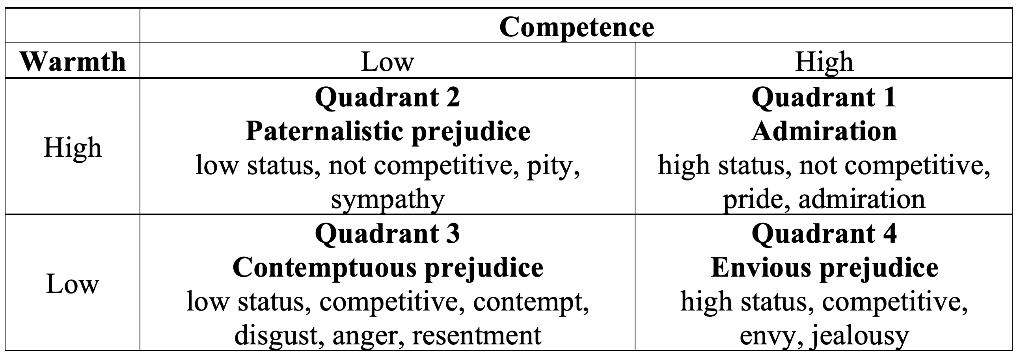
In tourism settings, SCM helps explain how guests are implicitly sorted (e.g., “friendly but naive” tourists could be placed in a high-warmth/low-competence category, whereas “efficient but cold” tourists fall into a low-warmth/high-competence category). This framework reveals the mixed and often ambivalent nature of bias, blending positive and negative judgements (e.g., warm but incompetent, competent but cold), and such mixed perceptions can be particularly persistent (Fiske et al., 2002; Cuddy et al., 2008), thus offering a precise tool for analysing students’ initial expectations of international guests.
Intercultural communicative competence (ICC)
Intercultural Communicative Competence (ICC), as defined by Byram (1997), is a broad skill set that enables effective and appropriate interaction across cultures. It encompasses attitudes (curiosity, openness, respect for otherness), knowledge (of one’s own and others’ social norms and practices), interpretive skills, and critical cultural awareness. ICC emphasises that intercultural competence involves not only factual knowledge and interactional skills but also the capacity to reflect critically on one’s own assumptions and to evaluate cultural practices from multiple perspectives (Byram, 1997; Byram, 2021). In tourism education, this implies the need for an integrated approach that integrates knowledge, skills, and values in preparing students for intercultural encounters (Cardoso et al., 2019). However, ICC is often narrowly addressed in English for tourism as courses tend to prioritise transactional language proficiency over reflective and attitudinal development (Dang, 2025; Sercu, 2005). This creates a risk that students may achieve functional fluency in English yet continue to reproduce stereotypes (Baker, 2015). An effective tourism professional needs not only language skills but also the intercultural mindset to interpret guests’ behaviours without resorting to prejudice. Thus, integrating ICC’s attitudinal and analytical components into English for tourism curricula is essential for moving beyond superficial politeness to genuine understanding.
Integrating SCM and ICC in ESP education
SCM and ICC provide complementary perspectives. SCM identifies the content of stereotypes students apply to tourists and cultural others, while ICC explains how these perceptions can be questioned and reshaped. In ESP education, this learning process can be supported by activities that help students first recognise their initial stereotypes, then interpret cultural behaviours, reflect on mismatches between expectation and reality through role-plays, critical-incident discussions, or guided feedback, and finally reframe their judgements. Few studies, however, have integrated these frameworks in an ESP setting with authentic workplace encounters. Ladegaard and Jenks (2018), for example, examined hospitality students’ critical incidents but did not analyse warmth/competence dimensions. Conversely, Liddicoat and Scarino (2013) stress developing ICC in language education but do not address the specific stereotypes tourism students form about international visitors.
Research Gap
While prior research has examined cultural stereotypes in tourism encounters and separately explored intercultural competence in language education, relatively few studies integrate these perspectives by analysing both the content of students’ perceptions and the processes through which those perceptions are challenged and reinterpreted during ESP training, particularly among learners who gain simultaneous workplace exposure. This gap matters because ESP programmes often emphasise transactional competence while leaving limited space for structured reflection. Traditional teaching techniques like role-plays and scripted dialogues, while useful for practising language functions, can inadvertently reinforce stereotypes if not coupled with reflection (Ladegaard & Jenks, 2018). Research in intercultural training outside the tourism context also shows that explicit bias-reduction strategies, such as perspective-taking exercises and “critical incident” discussions, can effectively reduce prejudiced attitudes (Devine et al., 2012). However, such strategies are rarely incorporated into EFT classrooms, which points to the need to enrich the curriculum with activities that prompt students to examine their own cultural assumptions. This study addresses that gap through a qualitative case analysis of Vietnamese tourism students’ narratives, integrating the SCM and selected ICC dimensions to explore both stereotype content and intercultural development.
RESEARCH OBJECTIVE AND RESEARCH QUESTIONS
This qualitative case study aims to explore how ESP learners majoring in Tourism and Hospitality perceive cultural bias during cross-cultural interactions, based on a thematic analysis of semi-structured interviews. In particular, it examines how students describe people from other cultures in terms of perceived warmth and competence (applying the Stereotype Content Model), and how they recognise, interpret, and adjust their biases in real service contexts as part of developing Intercultural Communicative Competence.
To achieve this aim, the study addresses two research questions.
- How do tourism students describe people from other cultures in terms of warmth and competence?
- How do tourism students recognise and interpret their own cultural biases in cross-cultural interactions, and how does this recognition relate to their development of ICC and to subsequent communicative practice?
METHODOLOGY
Setting and Participants
This research is a qualitative case study taking place at the University of Economics - The University of Danang, Vietnam. A case-study design was chosen because the study seeks to understand how and why these students perceive cultural bias and how recognition of bias relates to intercultural reflection and professional practice in authentic service contexts. The focus is on depth and contextualised understanding rather than on statistical generalisation.
Six undergraduate students (S1-S6) majoring in Tourism or Hospitality participated. All had completed or were enrolled in an English for Tourism course that covers intercultural service encounters in English and held part-time jobs in tourism or hospitality, and therefore had first-hand experience interacting with foreign tourists using English in authentic professional settings. Participants were intentionally sampled to ensure each had both classroom exposure to ESP and practical workplace experience serving international tourists, enabling rich, contextualised narratives. Table 1 summarises participant profiles and relevant contextual details. All students were informed of the study’s purpose and voluntarily consented to participate.
Table 1. Participant Profiles
|
ID |
Year of study |
Age |
Major |
ESP course status |
Job role |
|---|---|---|---|---|---|
|
S1 |
3rd year |
21 |
Tourism and Hospitality |
Enrolled |
Waitress at a seafood beachfront restaurant (Danang) |
|
S2 |
3rd year |
20 |
Tourism and Hospitality |
Enrolled |
Waiter at a café in a tourism hotspot (Danang) |
|
S3 |
4th year |
22 |
Tourism and Hospitality |
Enrolled |
Waitress at Pizza 4P restaurant (Danang) |
|
S4 |
4th year |
22 |
Tourism and Hospitality |
Completed |
Front desk intern at a hotel (Danang) |
|
S5 |
3rd year |
20 |
Tourism and Hospitality |
Enrolled |
Waitress at Hyatt Hotel restaurant (Danang) |
|
S6 |
3rd year |
20 |
Tourism and Hospitality |
Enrolled |
Waitress and receptionist at a restaurant (Danang) |
Data Collection and Analysis
Semi-structured interviews (45-60 minutes each) were conducted individually in Vietnamese (the participants’ native language) to allow them to express their thoughts and anecdotes more freely and precisely. Interviews followed a guide (see Appendix 1) covering five key thematic sections aligned with the study’s focus, including (1) background and cross-cultural exposure (e.g. prior contact with foreigners, work experience with tourists), (2) perceptions of others (SCM lens), (3) self-awareness of bias, (4) influences on perceptions (sources of their images of other cultures), and (5) reflection and intercultural growth (ICC lens). Participants were also asked to recount a critical incident, a memorable cross-cultural encounter in their work or study, and discuss what it taught them or how it affected their perceptions. The interviews were audio-recorded with permission, then transcribed verbatim in Vietnamese and translated into English for analysis and reporting.
Given the study’s exploratory, case-study design and small purposive sample, the analysis focuses primarily on two ICC dimensions most relevant to the study’s aims, namely attitudes and critical cultural awareness, while allowing evidence of interpretive and interactional skills to emerge inductively but does not attempt a full, separate operationalisation of all ICC subcomponents. This targeted approach provides theoretical and analytic depth, allowing us to examine whether recognition of bias (critical cultural awareness) and shifts in attitudes translate into concrete re-interpretations of tourist behaviour and to observable changes in communicative practice, the core concern of this study.
Data were analysed thematically following Braun and Clarke (2006). First, a deductive coding approach was applied using the SCM and ICC frameworks as sensitising concepts. For example, any mention of a group being friendly, warm, cold, or competent/incompetent was noted under “warmth/competence perceptions”, and any instance of a student reflecting on or correcting a stereotype was coded under “bias awareness/ICC development”. Alongside this theory-driven coding, an inductive analysis allowed unexpected themes to emerge from the data (for instance, several students brought up professional identity unprompted, which became a subtheme). Similar codes were grouped into subthemes, and then organised into broader themes that directly address the research questions. The final themes were cross-checked with the interview transcripts to ensure they accurately represented the participants’ accounts. This method highlighted both how students describe people from other cultures (SCM) and how they reflect on their own biases (ICC).
FINDINGS
Thematic analysis of the interviews produced five principal findings that address the research questions, namely (1) sources that initially shaped students’ perceptions of tourists, (2) the attributes students used to describe tourists prior to/at first contact, mapped to warmth and competence, (3) the interactional behaviours students reported enacting in response to those perceptions, (4) concrete workplace or classroom incidents that challenged initial expectations, and (5) participants’ reports of re-evaluation and change over time. Participants are referred to as S1 through S6.
Sources of Perceptions
When asked about where their impressions of other cultures originated, participants consistently pointed to a mix of indirect sources and direct learning experiences.
All six students referred to indirect sources (media and social discourse) as part of their initial image formation. Hollywood movies, Korean dramas, travel vlogs, and even news reports had seeded particular stereotypes (Americans are outspoken, Koreans are trendy but hierarchical, etc.). Some students (4 out of 6 participants) mentioned family jokes, stories, or peer comments as influences on expectations.
“My initial images of other nationalities mostly came from social media, movies, and friends’ stories. For example, I grew up watching a lot of K-dramas and American films, so I already had certain impressions of Koreans and Westerners in my mind.” (S4)
“Mostly from social media and from people around me, especially my family. When I was little, my parents used to joke that since I ate with my hands all the time, I might as well go live in India.” (S2)
Direct sources, including coursework and workplace contact, were also mentioned by all participants. Students noted their university courses (e.g., English for Tourism, Business Communication, Front Office Practice) as sources of knowledge about other cultures, providing general information about communication styles, etiquette, and cultural norms through lectures and role-play activities. Workplace contact, however, was described as providing repeated exposure to tourists from diverse national backgrounds. For example, S1 explained, “Most of our customers are international tourists, so I have many opportunities to interact with people from different cultural backgrounds.” Similarly, S2 stated, “I work at a café in a tourist area in Da Nang, so I have served people from the UK, India, Korea, China, Brazil - really from all over the world.” These accounts indicate that direct, face-to-face interaction in service settings also served as an essential experiential source shaping participants’ perceptions.
Descriptions of Tourists prior to/at First Contact
Students consistently described international tourists in terms of warmth and competence. On initial encounter, students tended to make quick generalisations based on a tourist’s nationality, demeanour, and communication style, which often mapped onto the SCM dimensions.
Western (European, North American, or Australian) tourists were mentioned by five participants and rated highly in both dimensions, usually being depicted as outgoing, approachable, confident, and open-minded (high warmth), and also linguistically capable and self-assured (high competence).
“I find Italians and Americans generally more friendly and approachable.” (S1)
“Western tourists I rate as high in both warmth and competence. They are generally friendly and also well-prepared.” (S6)
Tourists from East Asia elicited more varied perceptions. S1, S2, S3, and S4 described Japanese tourists as polite and organised (competent), but sometimes emotionally reserved.
“I assumed that Japanese people are usually very polite and quiet. So, I prepared myself to act serious, speak softly, and keep a certain distance.” (S4)
“I have always thought that Japanese tourists are rather serious, formal, and polite. I sometimes feel pressured when serving them, because while they appear friendly and easy-going on the surface, they are actually quite demanding on the inside.” (S1)
By contrast, Chinese tourists were often stereotyped by the students (S2, S5, S6) as less easy to communicate with, sometimes described as loud or impatient, leading to a less favourable warmth evaluation.
“The first time I served a group of Chinese tourists, I thought they were a bit impolite because they spoke loudly… I assumed they did not respect others.” (S5)
“I have always assumed that Chinese people have a strong national pride, with low communication ability and openness, because they often don’t want to speak English even if they can.” (S6)
Korean tourists were generally seen more positively in terms of friendliness. Several participants (S5, S6) described Koreans as enthusiastic or kind (high warmth) but noted a language barrier (perceiving relatively low English competence). S6 added, “Koreans are relatively nice and a delight to work with but their competence (in English) is quite low.”
Four participants mentioned Indian tourists, with descriptions ranging from curiosity, frequent questioning, and special requests to initial negative hygiene stereotypes (later re-evaluated).
“Indian customers tend to ask many questions and often make a lot of small requests.” (S3)
“At first, I thought Indian customers were unhygienic and demanding.” (S5)
Service Behaviours and Interactional Adjustments
These warmth/competence judgements clearly influenced how the students approached their service interactions. Participants reported altering their interactional behaviours based on initial impressions, using both language strategies (slower speech, simpler words) and affective strategies (formal distance, extra politeness). Five of six participants (S1, S3, S4, S5, S6) explicitly described such adjustments, while one participant (S2) reported being less influenced by initial impressions.
“From the way someone looks, I can often guess which continent they come from, and then adjust my communication style and behavior accordingly.” (S1)
“With shy Japanese customers, I need to speak more slowly and gently.” (S3)
“With guests I consider less warm, I behave more formally, keep a professional distance, and avoid being too personal.” (S5)
“With straightforward European customers, I communicate more confidently and comfortably.” (S3)
Critical Incidents and Workplace Experiences that Challenged Expectations
When recounting memorable cross-cultural encounters, students often identified specific incidents that served as turning points in their understanding of cultural differences and their own biases. All six participants described at least one specific moment when they realised an assumption they held was inaccurate or unfair, demonstrating the beginning of critical cultural awareness. For instance, S5 candidly shared how her view of Indian tourists changed over time. This student initially harboured a negative stereotype (low warmth towards Indian guests, interpreting certain habits as impolite), but through learning about cultural practices (dietary restrictions or communication styles) she reframed these behaviours as cultural differences rather than personal shortcomings.
“At first, I thought Indian customers were unhygienic and very demanding. But later I learned this comes from their culture and religion, not from rudeness. I felt bad for judging them that way.” (S5)
S4 described a turning point that occurred during a role-play activity in the course. “I caught myself relying on stereotypes during a role-play, like thinking all Americans are loud or all Japanese are reserved. Our lecturer and classmates gave feedback, and I realized I was generalizing too much - treating individuals as if they were just cultural types.” This critical feedback helped her become more mindful that not every customer conforms to a cultural script.
Similarly, S1 revisited her earlier impression of Japanese tourists. What she initially labelled as “coldness” (low warmth) in Japanese customers was reinterpreted as a form of respect and reservation ingrained in Japanese etiquette, which does not necessarily imply lack of friendliness. This does not suggest that her initial interpretation was entirely incorrect, but rather that it was influenced by her own cultural expectations of friendliness. This shift stems from a classroom role-play and the lecturer’s debriefing, where feedback prompted her to see how stereotyping could cause her to miss opportunities to build rapport with guests.
“I thought they were distant and cold…Later I realized this behavior comes from their value of politeness and avoiding confrontation. Once I understood this, my opinion changed.” (S1)
S3 expected European (German and Dutch) tourists to be formal and polite, associating professionalism with composedness. Instead, the group was loud and playful, which she first perceived as rudeness but later reframed as cultural expressiveness and enjoyment. This shifted her stereotype from “cold and formal” to “warm and enthusiastic”, broadening her understanding of what friendliness can look like across cultures.
“I was surprised by how loud they were, but then I saw they were just having fun, not trying to be rude. They actually were very warm to me once I joined in the fun.” (S3)
Intercultural Growth and Professional Identity
All participants reported a significant evolution in their intercultural perceptions over the course of their study and work experience, moving from rigid stereotypes to greater openness and curiosity. Early in their academic programme (or before they had much contact with foreigners), participants admitted their views of other cultures were oversimplified. They tended to classify individuals based on nationalities and often attributed misunderstandings to “how those people are.” However, after further encounters, course feedback, or reflection, the students developed a more sophisticated outlook, characterised by openness to diversity and willingness to decentre one’s perspective.
“When I first started university, I thought some nationalities were always friendly while others were always rude or difficult. Through learning in class and, especially, interacting directly with tourists at work, I realized cultures are much more complex and diverse. Even within one culture, people differ a lot. It opened my mind.” (S4)
“I have become more aware of cultural diversity and differences, and I now have a more open mindset and greater adaptability when working in a multicultural environment.” (S1)
Importantly, the students connected this personal growth to their emerging professional identity in the tourism industry (Tran et al., 2024). They expressed that moving beyond earlier warmth and competence-based assumptions about particular groups and reassessing guests as individuals is part of developing professional competence, not just a personal or ethical issue. In the interviews, students reported a sense of satisfaction when they overcame initial perceptions, for example, by successfully assisting guests they had initially categorised as “difficult.”
“Recognizing my biases helps me treat customers more fairly and appropriately, without putting everyone into the same box. I think this will make me a better staff member in the future, because I can adjust to each guest individually.” (S3)
“… It motivates me to work better, because instead of being overly focused on biases (which would discourage me), I try to provide the best and most fair service.” (S1)
In summary, the findings show that students’ initial impressions were shaped by both indirect sources (media, social discourse, family narratives) and direct sources (coursework and workplace contact). Participants regularly used evaluative language aligned with the SCM dimensions (warmth and competence) when describing tourists, and these initial evaluations influenced their interactional strategies. The data further show that recognition and reinterpretation of prior assumptions most often occurred after direct workplace encounters or prompted reflection (classroom feedback, role-play debriefs), producing what participants described as more open and adaptable professional attitudes.
DISCUSSION
This case study examined how six Vietnamese undergraduate students majoring in Tourism and Hospitality, enrolled in an English for Tourism course, described tourists in terms of warmth and competence, how these perceptions influenced their service behaviour, and how subsequent experiences led them to re-evaluate earlier assumptions. This section discusses the findings through the combined lens of the Stereotype Content Model (SCM) and selected dimensions of Intercultural Communicative Competence (ICC), while acknowledging the limits of the case-study design.
First, participants gave descriptions of tourists that consistently reflected evaluative judgements aligned with warmth (e.g., friendly, reserved, polite, loud) and competence (e.g., able to communicate in English, organised, prepared). Students’ tendency to categorise international guests using broad cultural stereotypes aligns with patterns reported in tourism research. Pizam and Sussmann (1995) noted that even experienced staff rely on mental scripts about guests of different nationalities, while Jackson (2008) observed that learners commonly draw on concepts like high-context vs. low-context communication to generalise about foreigners.
However, the findings do not suggest that participants rigidly placed entire national groups into fixed quadrants. Rather, several attributions were ambivalent, such as describing Japanese tourists as polite yet distant, or Korean tourists as warm yet linguistically limited. These patterns illustrate that students’ perceptions were not always negative but often mixed across evaluative dimensions. In this case study, SCM functioned as a useful analytic framework for categorising the content of students’ perceptions while leaving room for situational complexity and change. Thus, it can be applied as a descriptive lens rather than a predictive model.
The findings also indicate that five of six participants reported adjusting their interactional behaviour based on perceived warmth or competence. These adjustments included modifying tone, degree of formality, patience, and speech rate. For instance, a student might speak slowly and use simpler words with a tourist assumed to have “low competence” in English, or be extra courteous and respectful with a tourist perceived as coming from a “demanding” culture. This suggests that stereotype-based expectations can predispose different service behaviour. The link between stereotypes and behaviour observed in our participants is consistent with prior research that staff expectations can shape customer interactions (Kim & Perdue, 2013). While such adaptations can be positive (e.g., showing sensitivity to a guest’s needs), they also risk reinforcing the students’ initial stereotypes and potentially contributing to discriminatory treatment and service failures if left unexamined.
A further positive finding is the students’ capacity for self-reflection and change, evidence that intercultural competence can be cultivated even in a relatively short span of education and early work experience. A central contribution of this study lies in participants’ accounts of re-evaluating earlier assumptions after direct encounters or guided classroom reflection. All six participants described at least one instance in which a prior generalisation was reconsidered. These moments were typically triggered by four types of experience, including (1) unexpected behaviour contradicting expectations, (2) direct interaction that complicated a prior stereotype, (3) feedback during classroom role-play or discussion, and (4) accumulated workplace experience over time. In each case, the students’ initial warmth and competence judgements were proven incomplete or misleading, and upon reflection or further exposure, they adopted more empathetic and informed interpretations. For example, one student expected Indian tourists to be “very fussy” but found them friendly and appreciative, which prompted her to reconsider her bias and approach future guests more openly. Such incidents clearly demonstrate evidence related to the two aspects of ICC, namely attitudinal shifts (greater openness or caution about generalising) and critical cultural awareness (recognition of one’s own assumptions and willingness to revise them).
Much of this development was experiential. While indirect sources (media, family narratives) contributed to early impressions, direct contact in service settings played a central experiential role in shaping participants’ perceptions. The students identified real interactions and critical incidents as key drivers of change. Each meaningful encounter served as an opportunity for reconsideration. A single interaction or a sequence of similar encounters could prompt a student to reframe a prior generalisation into a more individualised interpretation. However, contact alone did not automatically lead to learning; what appears crucial is not merely exposure, but reflective engagement with that exposure (Dang, 2024). In several cases, such reflection was explicitly supported by classroom activities, such as role-play and instructor feedback, which helped students reinterpret their initial assumptions. This suggests a role for ESP instructors in facilitating the processing of workplace experiences rather than assuming that contact by itself will produce critical awareness. These findings align with Baker’s (2015) observation that language learners do not always reflect on cultural issues unprompted, and they echo critiques that superficial cultural briefings may inadvertently reinforce stereotypes (Sercu, 2005). Put differently, workplace contact appears to create the raw material for learning, while structured reflection helps turn that material into interpretive insight.
Finally, the students’ explicit linkage of bias awareness to professional identity has important implications for tourism education. Through confronting their biases, participants cultivated the skills of empathy, patience, and adaptability, which support excellent customer service and teamwork in tourism. Yet such an attitude does not emerge automatically from language training; it must be nurtured. The fact that the participants, by the end of the study, articulated an understanding of bias management as part of their professional competence suggests that intercultural education adds tangible value to professional preparation, and that students themselves view such learning as relevant and motivating for their future careers.
IMPLICATIONS
The insights from this study point to several practical implications for English for tourism (ESP) instruction within tourism and hospitality programmes.
First, although participants reported that many initial impressions originated in indirect sources (media, family, social discourse), re-interpretation most often followed workplace encounters, and guided reflection helped students articulate and make sense of their experiences, turning them into more explicit interpretive insight. ESP instructors can treat students’ part-time and internship experiences as valuable curricular resources. In practice, this means creating small, structured spaces where students can bring recent workplace encounters into the classroom for guided reflection (for example, a 10-minute debrief after a role-play, a brief reflective paragraph after a shift, or a short peer-sharing slot).
Second, the warmth-competence language that emerged from participants’ own narratives (e.g., “friendly but unprepared,” “polite but reserved”) can be introduced cautiously as a descriptive reflective vocabulary. Presenting SCM as a descriptive analytic lens to help students name their first impressions (rather than as a rigid classification of national character) may make implicit judgements explicit and easier to examine, while class discussions should remain focused on questioning those evaluations rather than reproducing them.
Third, because participants described concrete micro-level service adjustments (speech rate, formality, patience) that were linked to their initial attributions, language training can explicitly connect communicative choices to professional values. Short classroom tasks that ask students to explain why they chose particular language or behaviour in a role-play (e.g., “Which assumption informed your choice of words or tone?”) help make the relationship between perception and practice visible and teachable.
Finally, the link participants made between bias awareness and emerging professional identity suggests that intercultural work in ESP is not only about language forms but also about shaping service mindsets (empathy, fairness, adaptability). This provides a rationale for integrating short, workplace-grounded reflective tasks such as brief post-shift reflection prompts, concise critical-incident narratives, or structured role-play debriefs into ESP syllabi so that language development and professional formation proceed together. Each of the above implications is derived directly from participants’ accounts (sources of perception; workplace-triggered reconsideration; role-play feedback; self-reported behaviour change) and should be piloted and evaluated empirically before wider adoption.
By implementing these approaches, ESP educators can better prepare learners not only as fluent English communicators but also as interculturally competent service providers. This aligns intercultural learning with students’ career motivations, potentially making such training more effective and lasting.
LIMITATIONS AND RECOMMENDATIONS
This study’s findings should be interpreted in light of clear limitations. The research is a small, single-site qualitative case study (n = 6) of ESP learners majoring in Tourism and Hospitality at one Vietnamese university. Therefore, the results are context-bound and are not statistically generalisable. Second, data rely on self-reported interviews, which means that the accounts may foreground reflection and awareness more than observable behaviour in actual service encounters. Future studies could triangulate interviews with classroom observation, workplace observation, or reflective journals to compare reported perceptions with interactional practice. Additionally, the study focused analytically on two ICC dimensions, attitudes and critical cultural awareness, rather than attempting to measure the full ICC construct or observable interactional competence; observational or longitudinal data would be required to confirm whether reported reinterpretations lead to durable behavioural change. Finally, although participants described workplace-triggered reinterpretation, the design cannot establish causal effects of specific pedagogical practices. While the findings suggest that reflective activities may help students articulate and make sense of their experiences, experimental, longitudinal, or mixed-methods research would be needed to test whether the modest instructional steps suggested here reliably produce sustained intercultural development.
CONCLUSION
This study sheds light on how tourism students form, enact, and sometimes revise cultural perceptions in service contexts. Using SCM to characterise the content of initial judgements and a focused ICC lens to track initial stages of reflective growth, the research shows that indirect narratives shape expectation templates while workplace encounters and brief, prompted reflection most reliably facilitate reinterpretation. These results position intercultural awareness as a cumulative, experience-based dimension of professional identity formation for EFL tourism students. Students do not simply acquire language forms, but gradually learn to read behaviour more contextually and to adapt interactional choices accordingly. Practically, modest, low-burden reflective practices that link classroom tasks to students’ workplace experiences appear promising and feasible in ESP settings, though their effectiveness requires empirical testing. Future studies using observational, longitudinal, or experimental designs are needed to establish whether short reflective interventions produce durable changes in interactional competence and service practice. In sum, the study contributes a context-sensitive account of perception and reflection in tourism education and offers actionable, evidence-based starting points for integrating intercultural reflection into English for Tourism curricula.
References
Baker, W. (2015). Research into practice: Cultural and intercultural awareness. Language Teaching, 48(1), 130-141. https://doi.org/10.1017/s0261444814000287
Braun, V., & Clarke, V. (2006). Using thematic analysis in psychology. Qualitative Research in Psychology, 3(2), 77-101. https://doi.org/10.1191/1478088706qp063oa
Byram, M. (1997). Teaching and assessing intercultural communicative competence. Multilingual Matters.
Byram, M. (2021). Teaching and assessing intercultural communicative competence: Revisited (2nd ed.). Multilingual Matters. https://doi.org/10.21832/9781800410251
Cardoso, L. M. C., Rodríguez, M. U., & López, T. G. (2019). La competencia intercultural: Una exigencia actual en la formación del profesional del turismo [Intercultural competence: A current requirement in the training of tourism professionals]. Revista Varela, 19(52), 33-47. https://revistavarela.uclv.edu.cu/index.php/rv/article/view/67
Cuddy, A. J. C., Fiske, S. T., & Glick, P. (2008). Warmth and competence as universal dimensions of social perception: The stereotype content model and the BIAS map. Advances in Experimental Social Psychology, 40, 61-149. https://doi.org/10.1016/S0065-2601(07)00002-0
Dang, T. T. (2024). Cultural and situational constraints on undergraduate students’ performance of learner autonomy in EFL learning. Journal of Language Teaching and Research, 15(6), 1791-1799. https://doi.org/10.17507/jltr.1506.04
Dang, T. T. (2025). Developing a model for learner autonomy capacity measurement in EFL learning. rEFLections, 32(2), 1099–1119. https://doi.org/10.61508/refl.v32i2.283186
Devine, P. G., Forscher, P. S., Austin, A. J., & Cox, W. T. L. (2012). Long-term reduction in implicit race bias: A prejudice habit-breaking intervention. Journal of Experimental Social Psychology, 48(6), 1267-1278. https://doi.org/10.1016/j.jesp.2012.06.003
Fiske, S. T., Cuddy, A. J. C., Glick, P., & Xu, J. (2002). A model of (often mixed) stereotype content: Competence and warmth respectively follow from perceived status and competition. Journal of Personality and Social Psychology, 82(6), 878-902. https://doi.org/10.1037/0022-3514.82.6.878
Jackson, J. (2008). Language, identity and study abroad: Sociocultural perspectives. Equinox Publishing.
Kim, D., & Perdue, R. R. (2013). The effects of cognitive, affective, and sensory attributes on hotel choice. International Journal of Hospitality Management, 35, 246-257. https://doi.org/10.1016/j.ijhm.2013.05.012
Koc, E. (2020). Cross-cultural aspects of tourism and hospitality: A services marketing and management perspective. Routledge. https://doi.org/10.4324/9781003018193
Kostić-Bobanović, M., & Gržinić, J. (2011). The importance of English language skills in the tourism sector: A comparative study of students’ and employees’ perceptions in Croatia. Almatourism: Journal of Tourism, Culture and Territorial Development, 2(4), 10-23. https://doi.org/10.6092/issn.2036-5195/2476
Ladegaard, H. J., & Jenks, C. (Eds.). (2018). Language and intercultural communication in the workplace: Critical approaches to theory and practice. Routledge. DOI: https://doi.org/10.4324/9781315468174
Liddicoat, A. J., & Scarino, A. (2013). Intercultural language teaching and learning. Wiley-Blackwell. https://doi.org/10.1002/9781118482070
Owsianowska, S. (2020). Tourism education from a humanistic perspective: Anthropological inspirations. In M. Della Lucia & E. Giudici (Eds.), Humanistic tourism: Values, norms and dignity (pp. 111-127). Routledge. https://doi.org/10.4324/9781003108993-7
Pizam, A., & Sussmann, S. (1995). Does nationality affect tourist behavior? Annals of Tourism Research, 22(4), 901-917. https://doi.org/10.1016/0160-7383(95)00023-5
Rojas-Méndez, J. I., & Davies, G. (2024). Promoting country image and tourism in new or underdeveloped markets. Journal of Travel Research, 63(3), 755-768. https://doi.org/10.1177/00472875231164967
Sándorová, Z. (2019). The importance of intercultural communicative competences for the tourism labour market: Students’ views and their self-assessment. Journal of Language and Cultural Education, 7(1), 103-117. https://doi.org/10.2478/jolace-2019-0007
Sercu, L. (2005). Foreign language teachers and intercultural competence. Multilingual Matters. https://doi.org/10.21832/9781853598456
Setiawan, A. R. (2023). Tourism and intercultural communication: A theoretical study. Jurnal Komunikasi, 17(2), 186-195. https://doi.org/10.21107/ilkom.v17i2.22733
Tran, L. T. P., Dang, T. T., & Nguyen, T. N. A. (2024). Imagination development as a construct for professional identity of early career English teachers working at public schools: Contributions of interactions with learners. Theory and Practice in Language Studies, 14(2), 329-338. https://doi.org/10.17507/tpls.1402.03
Zahedpisheh, N., Abu Bakar, Z. B., & Saffari, N. (2017). English for tourism and hospitality purposes (ETP). English Language Teaching, 10(9), 86-94. https://doi.org/10.5539/elt.v10n9p86
Downloads
Published
Issue
Section
License
Copyright (c) 2026 Nguyen Khanh Dan Truong

This work is licensed under a Creative Commons Attribution-NonCommercial-NoDerivatives 4.0 International License.