Impact of ChatGPT on metacognition and motivation in EFL academic writing
DOI:
https://doi.org/10.65956/procia.2026.14Keywords:
ChatGPT, EFL writing, metacognition, motivationAbstract
Using a convergent mixed-methodology approach with a within-subject classroom design, the study examines the impact of ChatGPT on EFL learners’ metacognitive strategies and motivation in academic writing. Participants were 120 English junior majors (CEFR level B1/B2) who engaged in the survey, completing the “with vs. without” AI writing tasks. Pre- and post-task surveys and reflections measured changes in self-regulatory behaviours including planning, monitoring, revising, and affective factors such as self-efficacy, task value, and enjoyment. Findings reveal divergent outcomes. Specifically, ChatGPT significantly enhanced planning and revision strategies, especially among B2-level students obtaining large effect sizes (Cohen’s d ≈ 0.85–1.06). Nonetheless, there was a slight decline in monitoring among B1 students due to excessive cognitive reliance on AI. Higher-level students also gained motivational improvements with moderate-to-large effects for self-efficacy (d = 1.19), task value (d = 1.27), and enjoyment (d = 1.23). Plus, gains in self-efficacy were strongly correlated with motivation gains (r = .60–.67, p < .001). Overall, ChatGPT appears to function as a cognitive scaffold and an affective enhancer in EFL academic writing. The study proposes the S.M.A.R.T. AI framework to integrate AI critically and responsibly in writing instruction.
INTRODUCTION
The rapid emergence of artificial intelligence (AI) technologies has begun to reshape academic literacy practices in higher education, including the ways university students approach writing tasks. Among recent developments, ChatGPT has attracted growing interest due to its capacity to generate ideas, suggest language forms, and provide instant feedback on written texts. In English as a Foreign Language (EFL) context, where learners are required to produce increasingly complex academic writing, such tools are becoming part of students’ everyday learning practices rather than occasional technological aids. This shift has prompted renewed discussion about how AI-mediated support influences not only the quality of written products but also the processes through which learners plan, regulate, and evaluate their writing.
In Vietnamese universities, English majors typically develop academic writing competence through skill-based courses such as Essay Writing and IELTS Writing. At Lac Hong University, second-year students enrolled in these courses are required to produce structured academic texts that demonstrate logical argumentation, coherence, and linguistic accuracy. Despite sustained instruction, many students continue to experience difficulties in organizing ideas, revising drafts beyond surface-level corrections, and maintaining confidence when producing extended texts in English. These challenges are often accompanied by hesitation, overreliance on teacher feedback, and limited engagement with reflective writing strategies that support long-term writing development. Within this instructional context, ChatGPT has become an appealing resource for student writers. Many learners report using the tool to generate outlines, refine paragraph structure, correct grammatical errors, or enhance lexical choice. While these practices may lead to noticeable improvements in textual accuracy and fluency, they also raise important pedagogical concerns. Particularly, it remains unclear whether frequent use of AI tools encourages learners to engage more actively with planning and revision, or whether it reduces opportunities for independent monitoring and critical evaluation of their own writing. For educators aiming to foster learner autonomy and self-regulated writing, this tension presents a significant challenge.
Research on ChatGPT use in EFL writing has expanded rapidly in recent years, with much of the existing literature focusing on learners’ perceptions, attitudes, and general satisfaction with the tool Although these studies report increased engagement and perceived usefulness, few of them have examined how the tool affects learners’ planning, monitoring, or revision strategies during writing. Additionally, empirical attention to motivational dimensions such as writing self-efficacy and intrinsic motivation remains limited. Therefore, understanding whether ChatGPT fosters learners’ confidence and engagement or potentially undermines their sense of ownership and effort is critical for informed instructional decision-making. To address these gaps, the present study compared two academic writing tasks: one with ChatGPT and the other without ChatGPT, together with pre-post strategy ratings and post-task reflective responses. Investigating both strategic and affective aspects of writing offers sharper look at how AI-assisted writing is associated with learners’ regulation of the writing process beyond overall attitudes toward the tool.
This mixed-methods study was conducted with 120 second-year English majors enrolled in Essay Writing and IELTS Writing courses at the Faculty of English Language, Lac Hong University. Data were collected through two comparable writing tasks completed under different conditions: with and without ChatGPT, alongside pre-post surveys and post-task reflections to capture both behavioral and affective dimensions of writing.
By examining students’ engagement with planning, monitoring, and revising together with changes in writing self-efficacy and intrinsic motivation, the study aims at providing empirically grounded understandings of how AI-assisted writing is associated with strategic regulation and motivational responses in a Vietnamese EFL context. Since this classroom-based investigation did not involve experimental control or counterbalancing, the focus is not on establishing causal effects but on exploring associations observed in learners’ writing behavior and motivation across writing conditions. Consequently, the study seeks to address the following research questions:
1. In what ways is ChatGPT use related to EFL learners’ metacognitive strategies in academic writing, particularly in planning, monitoring, and revising?
2. How does ChatGPT use correspond with changes in EFL learners’ writing self-efficacy and intrinsic motivation?
LITERATURE REVIEW
Theoretical Framework
Academic writing in a second or foreign language is commonly understood as a complex, recursive activity that requires writers to coordinate cognitive resources, linguistic knowledge, and strategic control. Rather than progressing linearly from idea generation to final draft, writing involves continuous decision-making across multiple stages of composing. Central to this process is learners’ ability to regulate their own thinking and actions while writing. Early work on metacognition by Flavell (1979) conceptualized such regulation in terms of planning, monitoring, and evaluation, emphasizing that effective learning depends not only on cognitive skills but also on awareness and control of those skills. This perspective provides a foundational lens for examining how learners engage with academic writing tasks.
Within EFL writing research, metacognitive strategies are typically described through the interconnected processes of planning, monitoring, and evaluation (Ho & Dang, 2019). Planning refers to writers’ efforts to set goals, generate ideas, and organize content prior to drafting. Monitoring involves ongoing awareness of coherence, clarity, and task requirements as the text develops, while evaluation requires writers to reflect on revisions and assess the extent to which the final text meets communicative goals. Together, these processes describe how writers regulate their composing activity and make strategic decisions at different stages of writing. In the present study, these dimensions serve as key indicators of learners’ metacognitive engagement with academic writing tasks.
Writing development has also been theorized through Bereiter and Scardamalia’s distinction between knowledge telling and knowledge transforming. According to this model, novice writers often rely on knowledge telling, retrieving information and recording it with minimal restructuring or reflection (Bereiter & Scardamalia, 1987). More experienced writers, by contrast, engage in knowledge transforming, actively reshaping ideas in response to rhetorical goals, audience considerations, and emerging problems during composing. This shift reflects increased strategic control and metacognitive regulation, as writers evaluate alternatives and revise meaning rather than focusing solely on surface-level form. The model thus offers a useful framework for examining how external support may interact with learners’ composing processes.
Motivation represents another important dimension shaping writers’ engagement with academic tasks. Bandura’s theory of self-efficacy emphasizes that learners’ beliefs about their capabilities influence the effort they invest, the strategies they adopt, and their persistence when encountering difficulties (Bandura, 1997). In writing contexts, higher self-efficacy is associated with greater willingness to revise, experiment with language, and sustain effort during complex composing tasks. Complementing this view, Dörnyei’s L2 Motivational Self-System conceptualizes motivation as a dynamic construct shaped by learners’ ideal L2 self, perceived task value, and self-regulatory capacity (Dörnyei, 2009). These perspectives highlight the close relationship between motivational beliefs and strategic engagement in writing.
From a sociocultural perspective, writing development is also understood as mediated through interaction and external support. Vygotsky’s concept of the Zone of Proximal Development proposes that learners can perform beyond their current level of independent ability when appropriate scaffolding is available (Vygotsky, 1978). In writing instruction, such scaffolding has traditionally been provided by teachers, peers, or instructional resources. With advances in digital technology, AI-based tools have increasingly been discussed as potential mediational means that may support planning, revision, and reflection. Whether such support facilitates or constrains learners’ development depends on how it is integrated into the writing process and internalized over time.
These theoretical perspectives frame academic writing as a metacognitively regulated and motivationally mediated activity that can be shaped by external support. By integrating insights from metacognition, writing development, motivation, and sociocultural theory, the present study adopts a framework that allows for systematic examination of how ChatGPT use relates to learners’ strategic engagement with writing and their motivational orientations toward academic writing tasks. In this framework, ChatGPT is considered as a mediational tool which may influence learners’ engagement with writing processes in particular ways. Planning, monitoring, and revision represent key dimensions of metacognitive strategy use that are likely to be influenced by how learners interact with AI-generated suggestions during different stages of writing. Additionally, writing self-efficacy and intrinsic motivation are considered relevant affective factors because AI support may change learners’ confidence, task perception, and sense of ownership. These constructs are not examined separately but in relation to learners’ overall experience of writing with and without ChatGPT assistance in an academic setting.
ChatGPT in EFL Writing
The rapid development of generative artificial intelligence has led to growing interest in how tools such as ChatGPT may support EFL writing in higher education. As a large language model capable of generating text, correcting grammar, and suggesting structural revisions, ChatGPT is increasingly used by students during different stages of the writing process, including idea generation, drafting, and revision. In response, recent empirical research has begun to examine learners’ experiences, performance outcomes, and concerns related to AI-assisted writing.
Several studies have explored learners’ and teachers’ readiness for and perceptions of ChatGPT use in academic contexts. In a large-scale survey study conducted in university English for Academic Purposes settings, Kohnke et al. (2023) examined preparedness for generative AI among both students and teachers. Their findings indicate generally positive attitudes toward ChatGPT, particularly in terms of perceived usefulness and confidence support, while also emphasizing uncertainties related to ethical use and assessment practices. The learners’ ethical use of generative AI was further observed as serious learners’ misconduct in the pedagogy of teaching and learning (Tran et al., 2025). These results imply that ChatGPT is widely viewed as a supportive resource, though institutional and pedagogical guidance remains necessary.
Beyond preparedness and perceptions, research has also investigated the effects of ChatGPT on students’ writing performance. Using a mixed-methods intervention design, Mahapatra (2024) examined ESL undergraduates’ academic writing before and after guided ChatGPT use. The study reported significant improvements in overall writing quality, especially in clarity and organization, alongside positive learner perceptions of AI-based feedback. However, the author noted that performance gains did not automatically translate into deeper strategic awareness, underscoring the need to examine how learners engage with the tool rather than focusing solely on outcomes.
Learners’ experiences and perceptions of ChatGPT use in EFL writing have been further explored in regional contexts. Focusing on university students in Thailand and Vietnam, Meniado et al. (2024) employed a mixed-methods approach to examine how learners used ChatGPT for second language writing. Participants reported benefits in idea development, feedback efficiency, and confidence, but also expressed concerns about accuracy, overreliance, and the need to verify AI-generated content (Dang, 2025). These findings confirm the dual role of ChatGPT as both a facilitative and potentially constraining resource in EFL writing.
Issues of authenticity and authorship have also emerged as a central theme in recent studies. Investigating EFL students’ academic writing experiences, Werdiningsih et al. (2024) found that while learners valued ChatGPT for linguistic and organizational support, they also experienced tension regarding originality and ownership of their texts. Students reported adopting various strategies to balance AI assistance with personal contribution, indicating that ChatGPT use involves ongoing negotiation between support and autonomy rather than straightforward acceptance of generated output.
More recently, attention has shifted toward learners’ metacognitive engagement with ChatGPT-based feedback. In a mixed-methods study examining EFL learners’ use of ChatGPT for writing feedback, Teng (2025) found that students with higher metacognitive awareness were more reflective and selective in how they used AI recommendations. These learners were more likely to evaluate, adapt, and question feedback rather than accept it uncritically, and they reported higher engagement and confidence during writing. Conversely, learners with lower metacognitive awareness tended to rely more heavily on ChatGPT output, raising concerns about dependency and reduced self-regulation.
Recent EFL writing research indicates that ChatGPT can enhance learner engagement and confidence while supporting certain aspects of writing quality through timely feedback and linguistic assistance. At the same time, studies reviewed above highlight ongoing concerns related to authenticity, authorship, overreliance, and variation in how learners engage with AI-generated feedback. Although recent studies have reported gains in writing quality and student satisfaction, most of them have focused on short-term outcomes or self-reported experiences. Therefore, less is known about the relationship between ChatGPT use and students’ metacognitive strategy use and motivational control across prolonged, process-oriented writing tasks. Seeking to address this gap, the present study looks into how learners engage with ChatGPT during academic writing tasks, focusing on their use of metacognitive strategies and their motivational responses across writing conditions. Rather than evaluating the tool itself, the study explores how strategic and affective factors are related to learners’ experiences when writing with and without ChatGPT support.
Metacognitive Strategy Use
While the previous section reviewed general uses of ChatGPT in EFL writing, this subsection focuses specifically on how such use relates to learners’ metacognitive strategy engagement. Studies published in recent years claim that ChatGPT use may influence EFL learners’ metacognitive strategy engagement in uneven ways. While AI-generated feedback can support planning and revision by helping learners generate ideas and restructure drafts, it may also discourage active self-monitoring when learners rely on automated generation without sufficient evaluation. Evidence from EFL writing research indicates that learners with higher metacognitive awareness tend to engage more reflectively with ChatGPT feedback, whereas those with lower awareness are more likely to accept AI suggestions with limited strategic regulation (Teng, 2025). From a writing development perspective, this pattern aligns with Bereiter and Scardamalia’s distinction between knowledge-telling and knowledge-transforming processes: strategic engagement with ChatGPT may facilitate knowledge transforming through evaluation and reorganization of ideas, whereas passive use is more likely to result in surface-level improvements. This distinction underscores the importance of examining not merely whether learners use ChatGPT, but how their metacognitive strategies mediate its role in the writing process.
Motivation and Writing Self-Efficacy in EFL Writing
Building on the discussion of strategy use, this subsection turns to affective dimensions, particularly writing self-efficacy and intrinsic motivation in AI-assisted writing contexts. Motivation and writing self-efficacy are key affective factors shaping learners’ engagement in second language writing. From a social cognitive perspective, self-efficacy refers to learners’ beliefs about their ability to perform writing tasks successfully, influencing effort, persistence, and willingness to revise (Bandura, 1997). Complementing this view, Dörnyei’s L2 Motivational Self-System emphasizes the role of learners’ ideal L2 self and perceived task value in sustaining engagement with demanding writing tasks (Dörnyei, 2009). Together, these perspectives underscore that motivation and confidence are closely connected to learners’ strategic involvement in writing.
In AI-mediated writing contexts, motivational processes may shift as external support alters learners’ experience of task difficulty. ChatGPT can reduce linguistic and organizational barriers by providing immediate feedback, which may strengthen learners’ confidence and willingness to continue writing. Empirical evidence clarifies that learners’ motivational responses to ChatGPT are shaped by their metacognitive awareness: learners who engage reflectively with AI feedback tend to report more constructive experiences and stronger confidence, whereas less strategic use may weaken ownership and intrinsic motivation (Teng, 2025).
Guided by these insights, the present study conceptualizes writing self-efficacy and intrinsic motivation as affective dimensions that interact with metacognitive strategy use during AI-assisted academic writing. By examining changes in learners’ confidence and motivation alongside their reported strategy use, the study seeks to clarify how ChatGPT use influences motivational regulation in EFL academic writing.
METHODOLOGY
Participants
The study involved 120 second-year English majors (aged 19 – 21) at Lac Hong University, Vietnam, all of whom were enrolled in Essay Writing and IELTS Writing courses. To assess English writing proficiency at the start of the semester, students completed a placement task modeled on IELTS Writing Task 2. The test followed the IELTS format and was independently scored by two trained instructors who had undergone rubric calibration and reached consensus on rating procedures to ensure inter-rater reliability. Based on the results, students were categorized into CEFR B1 and B2 levels to allow for comparison across proficiency groups. Although the test was developed in-house, the scoring process adhered to standardized descriptors adapted from the official IELTS rubric. All participants had prior experience using ChatGPT for at least three writing-related tasks, but none had received formal instruction in AI-assisted writing. This participant profile reflects a typical EFL university context and supports the study’s aim of exploring the relationship between ChatGPT use, metacognitive strategy engagement, and writing-related motivation.
Research Design
Adopting a convergent mixed-methods framework, this research sought to unpack the relationship between ChatGPT use, EFL learners’ metacognitive writing strategies and writing-related motivation. A single-method lens was deemed insufficient to capture the complexity of the research questions, which spanned both quantifiable affective shifts such as self-efficacy, task value and enjoyment and process-oriented strategic behaviours like planning, monitoring, and revising (Creswell, 2014; Creswell & Plano Clark, 2018). The quantitative data included pre- and post-test rating scales to track changes in metacognitive strategies (planning, monitoring, revising) and pre-post affective measures, which allowed for comparisons across writing conditions (with and without ChatGPT) and across proficiency groups (B1 vs. B2). These data underwent rigorous testing, including Cronbach’s alpha for reliability and inferential t-tests to determine effect sizes. Simultaneously, qualitative insights were harvested from open-ended questionnaires, which were processed through thematic coding with a double-coder review and consensus procedures to contextualize how students engaged with ChatGPT during different stages of the writing stages. Both data types were collected during the same instructional period and analysed separately. Integration occurred during interpretation through meta-inference by comparing statistical patterns with student reflections to identify convergence or divergence. The comparisons are presented in the Findings and Discussion section, specifically where changes in affective factors and strategy use are supported or nuanced by students’ reported experiences with ChatGPT. Given the classroom-based design without experimental control, the study focuses on observed relationships rather than causal effects.
Data Collection Instruments
Three data collection instruments were employed in this study: writing samples, a survey, and a post-writing questionnaire. These instruments were designed to capture learners’ metacognitive strategy use and motivational responses during AI-assisted academic writing.
Writing samples
Two writing samples were collected from each participant. Writing Sample 1 required students to produce an academic essay without access to AI tools under supervised classroom conditions. Writing Sample 2 involved the same writing prompt but allowed full access to ChatGPT, enabling learners to use the tool freely for idea generation, drafting, feedback, or revision. Using an identical prompt across both conditions helped control for topic effects and facilitated comparison of learners’ writing approaches. The two tasks were conducted one week apart to minimize immediate recall although the possibility of practice or memory effects cannot be fully ruled out. The writing-sample results are therefore interpreted as performance-based evidence under classroom conditions rather than as causal effects. The writing samples were evaluated using an analytic rubric designed to infer learners’ metacognitive strategy use through written texts. The rubric included five criteria: structural coherence, planning evidence, in-text monitoring, revision quality, and overall metacognitive awareness. Each was rated on a four-point scale from 1 (Poor) to 4 (Excellent), with score bands indicating high, moderate, emerging, or minimal metacognitive engagement. Observable indicators such as paragraph alignment, content restructuring, and revision depth were used to assess each strategy. In the rubric, planning evidence, in-text monitoring, and revision quality were used as direct indicators of planning, monitoring, and revising, while structural coherence and overall metacognitive awareness served as supporting indicators of strategic control. Two trained instructors independently scored all samples after participating in a calibration session using benchmark essays. Inter-rater agreement, calculated on 20% of the responses, was 87%, indicating consistent scoring across raters. These rubric-based scores complemented the self-reported pre-post strategy ratings reported in the survey.
Survey
A questionnaire was administered before and after the writing tasks to measure learners’ metacognitive strategy use and motivational factors related to academic writing. The instrument consisted of two main sections: metacognitive strategies (planning, monitoring, and revising) and motivational constructs (self-efficacy, task value, and enjoyment).
The metacognitive strategy section included three subscales with five items each, targeting learners’ regulatory behaviours before, during, and after writing. Planning items focused on pre-writing preparation (e.g., “I make an outline before starting to write”; “I clearly identify the main argument before writing”). Monitoring items examined in-process regulation (e.g., “I pause to check whether I am staying on track”; “I adjust my argument if it seems unreasonable during writing”). Revising items captured post-draft refinement (e.g., “I revise sentence structure after completing the draft”; “I improve vocabulary and phrasing during revision”).
Motivational factors were conceptualized as components of intrinsic motivation drawing on Self-Determination Theory (Deci & Ryan, 2000), which views motivation as arising from perceived competence, task value, and enjoyment. Accordingly, three subscales were included: self-efficacy (belief in writing ability), task value (perceived importance and usefulness of writing), and enjoyment (positive emotional engagement with writing). Sample items included “I feel confident when doing academic writing tasks” (self-efficacy), “Writing tasks help me improve my language skills” (task value), and “I enjoy expressing my ideas in writing” (enjoyment). Each subscale consisted of five items measured on a five-point Likert scale (1 = strongly disagree to 5 = strongly agree).
All items were adapted from established writing self-efficacy and motivation instruments (Bruning et al., 2013) and revised to fit the EFL university context and AI-assisted writing tasks. The adapted questionnaire was piloted with a comparable group of students to ensure clarity and contextual appropriateness.
Reliability analysis demonstrated acceptable to high internal consistency across all subscales at both measurement points, with Cronbach’s alpha values ranging from .882 to .925 for metacognitive strategy scales and from .743 to .91 for motivational scales. These results indicate that the instrument provided stable and reliable measures for examining changes in learners’ strategy use and motivational orientations associated with ChatGPT-supported writing.
Post-writing questionnaire
After completing the AI-assisted writing task, participants responded to a post-writing questionnaire consisting of Likert-scale items and open-ended questions designed to capture their experiences of using ChatGPT during the writing process. The questionnaire focused on three main areas: (1) strategy use in planning, monitoring, and revising; (2) affective responses such as confidence, enjoyment, and motivation; and (3) perceived risks related to dependence on AI and loss of authorship. Open-ended questions invited learners to describe how ChatGPT influenced their idea generation, organization of content, revision decisions, and emotional reactions while writing. Students were also encouraged to reflect on whether the tool helped them think more clearly, whether they relied on it mainly for surface-level correction, and whether their final texts still felt like their own work. These prompts generated qualitative data that revealed patterns of strategic use, increased confidence and motivation, as well as concerns about overreliance and reduced sense of ownership.
The post-writing questionnaire served to complement and interpret the quantitative findings from the surveys and writing tasks. While survey data identified changes in planning, monitoring, and motivational scores, the qualitative responses helped explain why these changes occurred, particularly the rise in planning and revision strategies among higher-proficiency learners and the decline in monitoring among some lower-proficiency learners. Together with the writing samples, the questionnaire primarily informed the analysis of metacognitive strategy engagement (Research Question 1), while its affective components supported interpretation of changes in writing self-efficacy and intrinsic motivation (Research Question 2).
Research Procedures
The study was conducted over seven weeks during the second semester following a classroom-based sequence designed to examine how learners used ChatGPT in academic writing and how such use was associated with their writing strategies and motivation. At the beginning of the study, participants were informed about the purpose and procedures of the research, and written consent was obtained with assurances of voluntary participation and confidentiality.
Students first completed a pre-task survey measuring their metacognitive writing strategies and motivational orientations. They then carried out two academic writing tasks based on the same prompt under different conditions. The first task was completed in class without access to ChatGPT or other digital tools, while the second task, administered one week later, allowed unrestricted use of ChatGPT for planning, drafting, and revision. This sequence reflected normal classroom practice and enabled observation of learners’ natural patterns of tool use.
After finishing the AI-assisted task, participants completed a post-task survey parallel to the pre-task instrument and a reflective questionnaire focusing on their planning, monitoring, revision behaviours, and emotional responses to using ChatGPT. Quantitative survey data were prepared for pre-post comparison, and qualitative reflections were systematically coded to identify recurring themes related to metacognitive strategy use and motivational experiences.
Because the study was conducted under regular classroom conditions without counterbalancing or experimental control, the findings are interpreted as associations between ChatGPT use and changes in learners’ writing strategies and motivation rather than as evidence of causal effects.
FINDINGS AND DISCUSSION
Strategic Writing Gains through ChatGPT Support
This section addresses Research Question 1: “In what ways is ChatGPT use related to EFL learners’ metacognitive strategies in academic writing, particularly in planning, monitoring, and revising?”
Reliability of metacognitive strategy measures
Table 1. Reliability Statistics for Metacognitive Strategy Items (Pre-Task and Post-Task)
|
Task Time |
Scale |
Cronbach’s Alpha |
N of items |
|---|---|---|---|
|
Pre-task |
Planning |
0.906 |
5 |
|
Monitoring |
0.886 |
5 |
|
|
Revising |
0.882 |
5 |
|
|
Post-task |
Planning |
0.911 |
5 |
|
Monitoring |
0.905 |
5 |
|
|
Revising |
0.925 |
5 |
Reliability analysis was used to evaluate the internal consistency of the survey scales about learners’ metacognitive strategies in the pre- and post-intervention phases. The results showed that the Cronbach’s Alpha coefficients of all six scales ranged from 0.882 to 0.925; it showed high to very high reliability (α > 0.80). In particular, the planning in the pre scale achieved 0.906 while planning in the post scale achieved 0.911, reflecting the stability of the measurement tool at both time points. Also, the monitoring and revising scales displayed high reliability in the pre- and post-intervention phases with 0.882 and 0.925 respectively. Therefore, the items in each scale consistently measure the same concept, and they can be reliably used in subsequent statistical analyses.
Table 2. Descriptive Statistics by Level
|
Level |
Strategy |
Pre-task |
Post-task |
||||||
|---|---|---|---|---|---|---|---|---|---|
|
Mean |
SD |
Min |
Max |
Mean |
SD |
Min |
Max |
||
|
B1 |
Planning |
2.97 |
0.77 |
1.2 |
4.4 |
3.24 |
0.83 |
1.2 |
5 |
|
Monitoring |
3.09 |
0.81 |
1.2 |
4.8 |
2.89 |
0.79 |
1 |
4.6 |
|
|
Revising |
3.27 |
0.76 |
1.6 |
5 |
3.31 |
0.87 |
1.4 |
5 |
|
|
B2 |
Planning |
2.91 |
0.86 |
1.2 |
5 |
4.06 |
0.65 |
2.6 |
5 |
|
Monitoring |
3.23 |
0.79 |
1.4 |
5 |
3.30 |
0.83 |
1 |
5 |
|
|
Revising |
3.23 |
0.74 |
1.8 |
5 |
4.24 |
0.71 |
1.6 |
5 |
|
Descriptive statistical analysis revealed differences in how learner groups applied the three writing strategies after using ChatGPT. The improvement was more pronounced in the B2 group, especially in planning (with the increase of average score from 2.91 to 4.06) and revising (from 3.23 to 4.24). For example, questions such as “I define the main point before writing”, or “I improve my vocabulary and expression when revising” recorded higher levels of agreement after the intervention.
Conversely, the monitoring strategy dropped in the B1 group (average score decreased from 3.09 to 2.89). The B2 group maintained a more stable level (from 3.23 to 3.30). Items such as “I pause to check if I’m writing in the right way”, or “I adjust my argument when it seems illogical during my writing process” showed lower usage in B1 students. The responses reflect the different impacts of ChatGPT on the learners’ level. Furthermore, the decrease of standard deviation in most strategies indicated that learner behaviour became more consistent in the post AI phase.
Flavell (1979) claimed that metacognitive strategies formed a crucial foundation for effective learning outcome. In the field of this research, ChatGPT acted as a cognitive scaffold to support students’ writing process so that they could achieve better task completion. Complementing this view, empirical work suggests that AI-mediated support can strengthen strategic control when learners engage reflectively rather than passively (Teng, 2025). This interpretation aligns with the current findings, which highlight the constructive role of ChatGPT in supporting the academic writing process.
Group Differences (B1 vs. B2) in Strategy Gains
To corroborate the findings of the first research question and secure more objective data, it is essential to analyse students’ writing scores as a source of quantifiable evidence.
Essay rubric scores (task comparison)
The presented data show that both B1 and B2 groups clearly made progress after interacting with ChatGPT. Nonetheless, the higher-ranked B2 group improved greatly in the two important strategies: planning and revising. In contrast, B1 group even marginally reduced in monitoring. This pattern suggests that ChatGPT may be more beneficial when learners possess stronger strategic foundations and use the tool as support rather than as a substitute for self-monitoring. For weaker learners, AI just delivered its value with specific pedagogical guidance and assistance.
Table 3. Pre-Post Score Comparison by Proficiency Level
|
Proficiency |
Pair |
Variables |
Mean |
Std. Deviation |
Std. Error Mean |
Lower |
Upper |
t |
df |
Sig. (2-tailed) |
|---|---|---|---|---|---|---|---|---|---|---|
|
B1 |
Pair 1 |
Pre-Planning Evidence Post-Planning Evidence |
-.65850 |
.56132 |
.07247 |
-.80350 |
-.51350 |
-9.087 |
59 |
< .001 |
|
Pair 2 |
Pre-Monitoring Post-Monitoring |
-.71467 |
.63282 |
.08170 |
-.87814 |
-.55119 |
-8.748 |
59 |
< .001 |
|
|
Pair 3 |
Pre-Revision_Quality Post-Revision_Quality |
-.95967 |
.66412 |
.08574 |
-1.13123 |
-.78811 |
-11.193 |
59 |
< .001 |
|
|
B2 |
Pair 1 |
Pre-Planning Evidence Post-Planning Evidence |
-.58283 |
.59432 |
.07673 |
-.73636 |
-.42930 |
-7.596 |
59 |
< .001 |
|
Pair 2 |
Pre-Monitoring Post-Monitoring |
-.51283 |
.70478 |
.09099 |
-.69490 |
-.33077 |
-5.636 |
59 |
< .001 |
|
|
Pair 3 |
Pre-Revision-Quality Post-Revision-Quality |
-.80300 |
.66333 |
.08564 |
-.97436 |
-.63164 |
-9.377 |
59 |
< .001 |
Table 4. Effect Sizes for Between-Group Differences in Metacognitive Strategy Scores
|
Standardizerᵃ |
Point Estimate |
95% Confidence Interval Lower |
Upper |
||
|---|---|---|---|---|---|
|
Pre Planning Evidence |
Cohen’s d |
.3663 |
-.933 |
-1.308 |
-.554 |
|
Hedges’ correction |
.3686 |
-.927 |
-1.300 |
-.550 |
|
|
Glass’s delta |
.3489 |
-.979 |
-1.375 |
-.577 |
|
|
Pre Monitoring (In-text Refinement) |
Cohen’s d |
.3894 |
-.342 |
-.702 |
.019 |
|
Hedges’ correction |
.3919 |
-.340 |
-.698 |
.019 |
|
|
Glass’s delta |
.3850 |
-.346 |
-.708 |
.018 |
|
|
Pre Revision Quality |
Cohen’s d |
.3941 |
-.444 |
-.805 |
-.081 |
|
Hedges’ correction |
.3966 |
-.441 |
-.800 |
-.080 |
|
|
Glass’s delta |
.4268 |
-.410 |
-.774 |
-.043 |
|
|
Post Planning Evidence |
Cohen’s d |
.3836 |
-.847 |
-1.219 |
-.472 |
|
Hedges’ correction |
.3860 |
-.842 |
-1.212 |
-.469 |
|
|
Glass’s delta |
.3496 |
-.930 |
-1.321 |
-.531 |
|
|
Post Monitoring (In-text Refinement) |
Cohen’s d |
.4102 |
-1.056 |
-1.437 |
-.672 |
|
Hedges’ correction |
.4129 |
-1.050 |
-1.428 |
-.668 |
|
|
Glass’s delta |
.4160 |
-1.042 |
-1.442 |
-.634 |
|
|
Post Revision Quality |
Cohen’s d |
.4091 |
-.998 |
-1.376 |
-.617 |
|
Hedges’ correction |
.4117 |
-.992 |
-1.367 |
-.613 |
|
|
Glass’s delta |
.4064 |
-1.005 |
-1.402 |
-.600 |
Cohen’s d analysis revealed a significant empirical impact between the two groups in the post phase. The B2 group exhibited a large effect in monitoring (d = -1.056), substantial differences in planning (d = -0.847) and strong gains in revision (d = -0.998). Before intervention, effect values fluctuated at small to moderate and less consistent levels, except for monitoring (d = -0.342). These indicators point to a positive correlation between language proficiency and the ability to leverage AI to enhance cognitive strategy effectiveness in planning, tracking progress, and refining content efficiently.
According to Vygotsky’s (1978) ZPD theory, to obtain benefits from ChatGPT, learners need accumulate sufficient foundational knowledge and metacognitive skills to use it as a cognitive support tool. This interpretation corroborates the present findings in post-test differences, especially in monitoring and revision quality, were most pronounced in higher-order processes. For B1 learners, pedagogical scaffolding is therefore essential to prevent overreliance on AI-generated output and to support their self-regulation development. This view is consistent with the findings of Marzuki et al. (2023), viewing ChatGPT as useful for content and organization. The researchers also cautioned that excessive reliance may undermine critical thinking and self-editing skills.
Pre- and Post- Gains in Motivation and Self-Efficacy
Subsequently, the following data synthesis from SPSS analysis provides answers to research question 2: “How does ChatGPT use correspond with changes in EFL learners’ writing self-efficacy and intrinsic motivation?”
Table 5. Reliability of Motivation and Self-Efficacy Factors
|
Task Time |
Scale |
Cronbach’s Alpha |
N of items |
|---|---|---|---|
|
Pre-task |
Self-efficacy |
0,91 |
5 |
|
Task value |
0,901 |
5 |
|
|
Enjoyment |
0,743 |
5 |
|
|
Post-task |
Self-efficacy |
0,777 |
5 |
|
Task value |
0,834 |
5 |
|
|
Enjoyment |
0,809 |
5 |
Table 6. Group Differences in Affective Factors
|
Levene’s Test for Equality of Variances |
t-test for Equality of Means |
|||||||||
|---|---|---|---|---|---|---|---|---|---|---|
|
Variable |
Assumption |
F |
Sig. |
t |
df |
Sig. (2-tailed) |
Mean Difference |
Std. Error Difference |
Lower |
Upper |
|
PRE–SEL FEFFICACY |
Equal variances assumed |
1.071 |
.303 |
-.468 |
118 |
.641 |
-.0567 |
.1212 |
-.2966 |
.1833 |
|
Equal variances not assumed |
-.468 |
115.921 |
.641 |
-.0567 |
.1212 |
-.2966 |
.1833 |
|||
|
POST–SELF EFFICACY |
Equal variances assumed |
26.472 |
< .001 |
-6.535 |
118 |
< .001 |
-.6567 |
.1005 |
-.8557 |
-.4577 |
|
Equal variances not assumed |
-6.535 |
99.142 |
< .001 |
-.6567 |
.1005 |
-.8560 |
-.4573 |
|||
|
PRE–TASK VALUE |
Equal variances assumed |
2.204 |
.140 |
-.624 |
118 |
.534 |
-.0767 |
.1228 |
-.3198 |
.1665 |
|
Equal variances not assumed |
-.624 |
113.569 |
.534 |
-.0767 |
.1228 |
-.3199 |
.1666 |
|||
|
POST–TASK VALUE |
Equal variances assumed |
30.170 |
< .001 |
-6.985 |
118 |
< .001 |
-.6167 |
.0883 |
-.7915 |
-.4418 |
|
Equal variances not assumed |
-6.985 |
86.996 |
< .001 |
-.6167 |
.0883 |
-.7921 |
-.4412 |
|||
|
PRE–ENJOYMENT |
Equal variances assumed |
.925 |
.338 |
-.922 |
118 |
.358 |
-.0867 |
.0940 |
-.2728 |
.0994 |
|
Equal variances not assumed |
-.922 |
115.439 |
.358 |
-.0867 |
.0940 |
-.2728 |
.0995 |
|||
|
POST–ENJOYMENT |
Equal variances assumed |
36.892 |
< .001 |
-6.714 |
118 |
< .001 |
-.7000 |
.1043 |
-.9065 |
-.4935 |
|
Equal variances not assumed |
-6.714 |
87.496 |
< .001 |
-.7000 |
.1043 |
-.9072 |
-.4928 |
|||
Table 7. Independent Samples Effect Sizes
|
Variable |
Measure |
Standardizerᵃ |
Point Estimate |
95% Confidence Interval Lower |
Upper |
|---|---|---|---|---|---|
|
PRE–SELFEFFICACY |
Cohen’s d |
.6636 |
-.085 |
-.443 |
.273 |
|
Hedges’ correction |
.6679 |
-.085 |
-.440 |
.271 |
|
|
Glass’s delta |
.7067 |
-.080 |
-.438 |
.278 |
|
|
POST–SELFEFFICACY |
Cohen’s d |
.5504 |
-1.193 |
-1.580 |
-.802 |
|
Hedges’ correction |
.5539 |
-1.186 |
-1.570 |
-.797 |
|
|
Glass’s delta |
.6596 |
-.996 |
-1.392 |
-.592 |
|
|
PRE–TASKVALUE |
Cohen’s d |
.6726 |
-.114 |
-.472 |
.244 |
|
Hedges’ correction |
.6769 |
-.113 |
-.469 |
.243 |
|
|
Glass’s delta |
.7360 |
-.104 |
-.462 |
.255 |
|
|
POST–TASKVALUE |
Cohen’s d |
.4835 |
-1.275 |
-1.666 |
-.880 |
|
Hedges’ correction |
.4866 |
-1.267 |
-1.655 |
-.874 |
|
|
Glass’s delta |
.6110 |
-1.009 |
-1.407 |
-.604 |
|
|
PRE–ENJOYMENT |
Cohen’s d |
.5147 |
-.168 |
-.527 |
.190 |
|
Hedges’ correction |
.5180 |
-.167 |
-.523 |
.189 |
|
|
Glass’s delta |
.5517 |
-.157 |
-.515 |
.203 |
|
|
POST–ENJOYMENT |
Cohen’s d |
.5710 |
-1.226 |
-1.614 |
-.833 |
|
Hedges’ correction |
.5747 |
-1.218 |
-1.604 |
-.828 |
|
|
Glass’s delta |
.7202 |
-.972 |
-1.367 |
-.570 |
The B2 group using ChatGPT showed significant improvements in self-efficacy, task value, and enjoyment compared to the other group. Before the intervention, there were no significant differences between the two groups. However, after applying the AI tool, group B2 showed significantly higher levels of confidence, motivation, and writing enthusiasm.
The effect indices (Cohen’s d) showed a moderate to large impact in self-efficacy (d = .55), task value (d = .48), enjoyment (d = .57). This is not just an improvement in skills, but also an enhancement of positive emotions during the writing process. This means ChatGPT supports language and acts as a personal writing companion. In addition, the tool also enhances positive emotions enabling learners to fulfil their tasks.
These findings resonate with Rahimi et al. (2025), who conceptualized ChatGPT as a co-teacher boosting learners’ self-regulation and motivation through personalized interaction. The current study extends this view by showing how ChatGPT significantly boosts EFL learners’ self-efficacy, perceived task value, and enjoyment in writing.
Correlation Between Motivation and Self-Efficacy Gains
In order to reinforce the analysis for the second research question, supplementing quantitative measures of the correlation between motivation and self-efficacy gains strengthens robust evidentiary basis for the study.
Table 8. Correlation Between Self-Efficacy Gain and Motivation Gain
|
Proficiency Level |
Efficacy gain |
Motivation gain |
||
|---|---|---|---|---|
|
B1 |
Efficacy gain |
Pearson Correlation |
1 |
.596** |
|
Sig. (2-tailed) |
< .001 |
|||
|
N |
60 |
60 |
||
|
Motivation gain |
Pearson Correlation |
.596** |
1 |
|
|
Sig. (2-tailed) |
< .001 |
|||
|
N |
60 |
60 |
||
|
B2 |
Efficacy gain |
Pearson Correlation |
1 |
.668** |
|
Sig. (2-tailed) |
< .001 |
|||
|
N |
60 |
60 |
||
|
Motivation gain |
Pearson Correlation |
.668** |
1 |
|
|
Sig. (2-tailed) |
< .001 |
|||
|
N |
60 |
60 |
The relationship between efficacy gain and motivation gain at two proficiency levels was tested by Pearson correlation. At the B1 level, efficacy gain correlated positively with motivation gain, r(58) = 0.60, p < 0.001. At the B2 level, efficacy gain obtained r(58) = 0.67, p < 0.00, which also correlated positively with motivation gain. The results show a statistically significant association between efficacy and motivation gains at both proficiency levels. The association was stronger for B2 learners than for B1 learners.
This result is firmly consistent with Bandura’s (1997) theory about the role of self-efficacy in promoting learning behaviours. Plus, as observed in a recent study by Huang et al. (2022), AI like ChatGPT assisted learners effectively with grammar correction, expanding vocabulary, and refining text structure. Furthermore, AI improved learning motivation and self-esteem as learners became more confident and persistent in their writing. Remarkably, the authors also warned that the use of AI without pedagogical guidance correlated to dependence and a decline in independent thinking. Above all, ChatGPT is a promising tool when used in a reflective manner and with guidance from teachers.
Aligning Student Experiences with Statistical Evidence
Aiming to supplement and compare with the quantitative results, qualitative feedback from students was analysed using thematic analysis. Two trained coders independently reviewed the feedback, then discussed to resolve discrepancies and obtain consensus on key themes. The analysis process involved initial open coding, theme formation, and theme refinement through periodically comparison. To increase trustworthiness, the research team maintained a record of the analytical decision-making process (audit trail) and conducted peer debriefing with a third researcher not involved in the initial coding. Reflexivity was also maintained throughout to minimize bias.
Strategic use in the planning phase
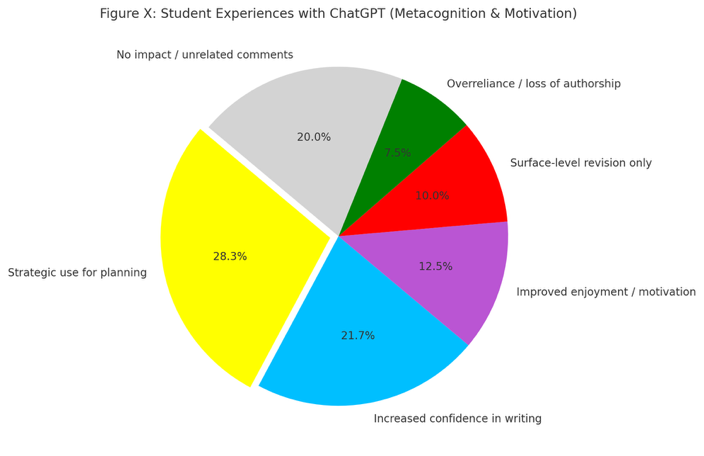
Many respondents shared that ChatGPT enabled them to “clarify and expand their arguments,” “know where to start,” or “outline more clearly.” One student said: “Before, I often didn’t know what to write in the introduction, but with ChatGPT, I knew how to visualize the overall logic of the essay.” These responses accurately reflect increase in the planning score (from 3.48 to 4.05) and align with Flavell’s (1979) metacognitive strategy theory, in which planning is considered the first and most important step in controlling the writing process.
Self-confidence and a sense of ownership
Students reported feeling “improved writing ability” and “less anxious when facing academic writing assignments.” One student wrote: “After using ChatGPT, I feel my English is much less awkward.” This topic aligns with the quantitative result of significantly increased self-efficacy (mean diff = -0.442, p < 0.001) and is explained by Bandura’s (1997) Social Cognitive Theory, which emphasizes the central role of perceived self-efficacy in motivating learning behavior.
Motivation and interest in academic writing
Learners felt the writing process was “less lonely,” and “less boring when accompanied.” One student wrote: “Before, I only wrote to submit assignments. Now I find writing can be fun.” These comments align with the rising scores for task motivation and attitude in the data (mean diff were -0.433 and -0.400, respectively). They also report the positive impact of ChatGPT as a source of inner motivation within the L2 motivational self-system (Dörnyei, 2009). Obviously, not all experiences were positive. Approximately 10% of students reported using ChatGPT only for surface-level error correction or grammar adjustments. Notably, one student frankly stated, “I just pasted the text in to check for spelling errors.” This could indicate that learners haven’t fully utilized monitoring or self-evaluation strategies, as reflected in the data for the B1 level group where the monitoring score decreased slightly at -0.1.
Loss of authorship
Finally, a notable concern arose from the 7.5% of students who felt a loss of authorship and became dependent on ChatGPT. They shared that their AI-edited work “no longer felt like their own.” One student opined: “I find the writing smoother, but it no longer reflects my own voice.” This serves as a reminder of the downsides of technology if not used in a pedagogical way. According to Vygotsky’s Zone of Proximal Development (1978), support tools are only valuable when learners remain actively involved in the process.
In line with the quantitative findings, the learner experience reinforces the quantitative results: ChatGPT acts as an effective scaffolding tool for planning, boosting confidence, and fostering motivation. Nevertheless, to avoid dependence and maintain academic authority, incorporating activities such as reflective journaling, analysis of written work with or without AI, and discussions of academic ethics is essential.
A recent study by Teng and Huang (2025) investigated the impact of ChatGPT on the engagement in academic writing among EFL students. The results showed that the tool benefits learners in motivation improvement, persistence in writing, and especially proactiveness in the planning and editing stages. These findings are consistent with the results of the current study as it exploits the significant improvement in motivation, self-awareness, and purposeful writing strategies. It points out that ChatGPT can serve as a cognitive and emotional support tool in the academic writing process.
IMPLICATIONS
Based on the findings, the study proposes the following pedagogical directions for educational stakeholders to embed AI into teaching writing purposefully and effectively.
For Teachers
Guided by the major trends derived from the research findings, the S.M.A.R.T. AI framework is offered as a pedagogical suggestion to strengthen the implementation of AI tools in the instruction of academic writing in English language classrooms though it is not intended to be considered as a teaching model. The proposed framework is built upon five principles directly associated with the research findings.
- Support metacognitive regulation through encouraging learners to plan, track, and evaluate their writing. This increase was more notable in the B2 group. Planning skills, for instance, improved from 2.91 to 4.06.
- Monitor motivation and avoid dependence on the tool. There were significant improvements in the scores regarding the use of AI support in the higher proficiency levels with different language foundations and strategies.
- Align AI support with proficiency to match learners’ abilities. The qualitative results revealed that most students are aware of how to select and not mechanically copy the content but rather edit and rephrase it in their own words.
- Reinforce authorship and ownership. Qualitative data shows that many students know how to select, not mechanically copy, but edit and rephrase content in their own words.
- Train critical thinking in processing AI content. Most students showed their ability to judge the relevance of grammatical and academic tone offerered by ChatGPT after the intervention.
The framework emphasizes guided instructional practices, such as reflective writing, comparison of AI-assisted and independent drafts, and explicit discussions of academic integrity to balance AI support with learner autonomy and critical engagement. This approach aligns with previous studies of Bandura (1997), Flavell (1979) and Teng (2025) on the need for learners’ metacognitive regulation, self-efficacy, and guidance while using technologies for writing.
For Curriculum Designers
In the context of the inevitable use of AI in learning, curriculum designers should innovate and update curricula and syllabi according to the current trend. Given students’ increasing use of AI tools, academic writing curricula may benefit from explicit AI literacy components, including guidance on verification, authorship, and ethical use. Moreover, designing writing assessments should improve the final product and develop higher-order competencies such as evaluation, critical thinking, and self-regulation. Simultaneously, continuous assessments should be included to track changes in learners’ motivation and perceived competence when embedding AI in teaching writing skills. This will ultimately help ensure that instead of replacing human learners, AI becomes a tool to support their more holistic development in an academic environment.
For Researchers
Future research needs to be closely integrated to further explore the long-term impact of AI on motivation, autonomy, and critical thinking. Beyond that, contextual and cultural factors (institutional expectations, pedagogical norms, and learners’ sociocultural backgrounds) should be considered since students’ use of AI can vary crucially depending on their own level and learning environment. In this respect, Amini et al. (2025) propose an ethical framework for the use of AI; they pay attention to factors such as students’ social backgrounds and institutional guidelines as well. The consideration of social background context contributes by completing and adjusting S.M.A.R.T AI framework to meet the needs of a diverse educational environment.
CONCLUSION
The present study aimed to explore the correlation between the use of ChatGPT and EFL learners’ metacognitive strategy engagement and motivation in academic writing in a Vietnamese university setting. The findings revealed that the use of ChatGPT may facilitate EFL writers in the planning and revising stages of the writing process and improve their self-efficacy and enjoyment in academic writing, but the effectiveness of the application of ChatGPT depends on writing proficiency levels. In the case of lower-level learners, the lack of monitoring and the concern for authorship imply the potential risks involved if the use of AI tools is left without pedagogical intervention. Nonetheless, the internal validity of the study is limited due to the non-counterbalanced order of the writing assignments and the use of the same assignment for both experimental conditions. These design features lead to unintended ordering or training effects. To address these limitations, future studies should conduct a longitudinal and counterbalanced research design under various teaching contexts to elucidate the long-term impact of AI on learners’ improvement in writing skills and motivation.
References
Amini, M., Lee, K. F., Yiqiu, W., & Ravindran, L. (2025). Proposing a framework for ethical use of AI in academic writing based on a conceptual review: Implications for quality education. Interactive Learning Environments, 1-25. https://doi.org/10.1080/10494820.2025.2523382
Bandura, A. (1997). Self-efficacy: The exercise of control. W. H. Freeman.
Bereiter, C., & Scardamalia, M. (Eds.) (1987). The psychology of written composition. Routledge.
Bruning, R., Dempsey, M., Kauffman, D. F., McKim, C., & Zumbrunn, S. (2013). Examining dimensions of self-efficacy for writing. Journal of Educational Psychology, 105(1), 25-38. https://doi.org/10.1037/a0029692
Creswell, J. W. (2014). Research design: Qualitative, quantitative, and mixed methods approaches (4th ed.). SAGE.
Creswell, J. W., & Plano Clark, V. L. (2018). Designing and conducting mixed methods research (3rd ed.). SAGE.
Dang, T. T. (2025). AI tools for language learners: The promotion of learning independence or reliance. In Pham, V. P. H., Lian, A., Lian, A., White, J. (Eds.), Empowering educators: Integrating AI tools for personalized language instruction, (pp. 263-280). Springer Nature. https://doi.org/10.1007/978-3-032-01348-4_11
Deci, E. L., & Ryan, R. M. (2000). The “what” and “why” of goal pursuits: Human needs and the self-determination of behavior. Psychological Inquiry, 11(4), 227-268. https://doi.org/10.1207/S15327965PLI1104_01
Dörnyei, Z. (2009). The L2 motivational self system. In Z. Dörnyei & E. Ushioda (Eds.), Motivation, language identity and the L2 self (pp. 9-42). Multilingual Matters. DOI: https://doi.org/10.2307/jj.30945943.5
Flavell, J. H. (1979). Metacognition and cognitive monitoring: A new area of cognitive-developmental inquiry. American Psychologist, 34(10), 906-911. https://doi.org/10.1037/0003-066X.34.10.906
Ho, N. B. and Dang, T. T. (2019). Impacts of online formative assessment on EFL students’ writing achievement. Journal of Science Ho Chi Minh City Open University, 9(1). 55-69. https://doi.org/10.46223/HCMCOUJS.soci.en.9.1.271.2019
Huang, W., Hew, K. F., & Fryer, L. K. (2022). Chatbots for language learning - Are they really useful? A systematic review of Chatbot‐supported language learning. Journal of Computer Assisted Learning, 38, 237-257. https://doi.org/10.1111/jcal.12610
Kohnke, L., Moorhouse, B. L., & Zou, D. (2023). Exploring generative artificial intelligence preparedness among university language instructors: A case study. Computers and Education: Artificial Intelligence, 5, 1-8. https://doi.org/10.1016/j.caeai.2023.100156
Mahapatra, S. (2024). Impact of ChatGPT on ESL students’ academic writing skills: A mixed methods intervention study. Smart Learning Environments, 11(9), 1-18. https://doi.org/10.1186/s40561-024-00295-9
Marzuki, W., Widiati, U., Rusdin, D., Darwin, & Indrawati, I. (2023). The impact of AI writing tools on the content and organization of students’ writing: EFL teachers’ perspective. Cogent Education, 10(2), 1-17. https://doi.org/10.1080/2331186X.2023.2236469
Meniado, J. C., Huyen, D. T. T., Panyadilokpong, N., & Lertkomolwit, P. (2024). Using ChatGPT for second language writing: Experiences and perceptions of EFL learners in Thailand and Vietnam. Computers and Education: Artificial Intelligence, 7, 1-9. https://doi.org/10.1016/j.caeai.2024.100313
Rahimi, A. R., Sheykhkholeslami, M., & Mahmoudi Pour, A. (2025). Uncovering personalized L2 motivation and self-regulation in ChatGPT-assisted language learning: A hybrid PLS-SEM-ANN approach. Computers in Human Behavior Reports, 17, 1-15. https://doi.org/10.1016/j.chbr.2024.100539
Teng, M. F. (2025). Metacognitive awareness and EFL learners’ perceptions and experiences in utilising ChatGPT for writing feedback. European Journal of Education, 60(1), e12811. https://doi.org/10.1111/ejed.12811
Teng, M. F., & Huang, J. Y. T. (2025). Incorporating ChatGPT for EFL writing and its effects on writing engagement. International Journal of Computer-Assisted Language Learning and Teaching, 15(1), 1-21. https://doi.org/10.4018/IJCALLT.367874
Tran, T. L. N., Le, V. T., & Nguyen, T. L. (2025). Teachers’ perspectives about the benefits, challenges, and strategies for using generative AI in English language teaching. The JALT CALL Journal, 21(3), 1-31. https://doi.org/10.29140/jaltcall.v21n3.102514
Vygotsky, L. S. (1978). Mind in society: The development of higher psychological processes. Harvard University Press.
Werdiningsih, I., Marzuki, & Rusdin, D. (2024). Balancing AI and authenticity: EFL students’ experiences with ChatGPT in academic writing. Cogent Arts & Humanities, 11(1), 1-15. https://doi.org/10.1080/23311983.2024.2392388
Downloads
Published
Issue
Section
License
Copyright (c) 2025 Proceedings of International Academia

This work is licensed under a Creative Commons Attribution-NonCommercial-NoDerivatives 4.0 International License.