
The impact of project-based learning on employability of Danang University of Economics students
DOI:
https://doi.org/10.65956/procia.2026.91Keywords:
project-based learning, employability, career adaptability, perceived labour market conditionsAbstract
In the context of increasing demands for sustainable and globally ready graduates, this study explores how Project-Based Learning (PBL) fosters employability among non-English-major students enrolled in English for Specific Purposes (ESP) courses at a business university in central Vietnam. Anchored in a moderated mediation framework, the research examines the mechanism through which project-based learning enhances students’ employability, with career adaptability serving as a mediator and perceived labor market conditions as a moderator. Data from 339 undergraduates were analyzed using Structural Equation Modeling (SEM). Results reveal that project-based learning not only directly enhances employability but also does so indirectly by cultivating career adaptability - a crucial 21st-century skill for navigating complex and evolving job markets. Additionally, students who perceive the labor market as dynamic and competitive gain stronger employability outcomes through increased adaptability. These findings underscore the transformative potential of project-based learning in English language education as a vehicle for sustainable skills development and career preparedness. The study contributes to the discourse on ELT innovation by advocating for integrative pedagogies that align language instruction with real-world competencies, equipping learners to thrive in a globally interconnected workforce.
INTRODUCTION
Higher-education systems worldwide are under intense pressure to demonstrate that their graduates can thrive in a labour market being reshaped by automation, globalisation and recurrent economic shocks (Jackson & Tomlinson, 2020; Masdonati et al., 2022). In emerging economies such as Viet Nam, the challenge is even sharper: enrolment has expanded rapidly, yet employers continue to report sizeable “skill gaps” in competencies such as communication, critical thinking and self-management that fall outside the traditional lecture-based curriculum (Nghia et al., 2023). Business universities, in particular, face scrutiny because their graduates are expected to translate disciplinary knowledge into immediate workplace value. Despite mounting calls for curricula that embed real-world, transferable skills, empirical evidence on how specific pedagogical approaches boost employability, especially for non-English-major undergraduates, remains limited and fragmented.
Project-Based Learning (PBL) has emerged as a promising response to this employability agenda. Rooted in constructivist and experiential learning theories, PBL positions students as active problem-solvers who design, implement and present solutions to authentic tasks (Zhang & Ma, 2023). However, two key gaps persist. First, most PBL-employability studies treat employability as a broad skill-bundle yet rarely unpack the psychological mechanisms through which PBL influences career outcomes. Second, contextual moderators such as students’ perceptions of the external job market are seldom integrated, even though boundary-condition theories suggest that personal resources pay different dividends in buoyant versus adverse economies (Jackson & Tomlinson, 2020).
To address these gaps, the present study adopts Career construction theory (Savickas & Porfeli, 2012) and the USEM model of employability (Knight & Yorke, 2002) as its guiding lenses to test the effect of PBL on employability of non-English-major undergraduates in Vietnam. This study thus (i) extends PBL research to a non-Western, non-English-major context, (ii) clarifies the career adaptability through which PBL enhances employability, and (iii) demonstrates how perceived labour-market conditions shape that pathway. Findings offer evidence-based guidance for curriculum designers and policy-makers seeking scalable strategies to improve graduates’ career readiness.
LITERATURE REVIEW
Project-Based Learning
Project based learning (PBL) is an inquiry driven teaching method grounded in constructivist and experiential learning theories. In this model, students investigate real problems, often based on real world situations, and produce a final product (Kokotsaki et al., 2016; Guo et al., 2020). Zhang and Ma’s (2023) meta analysis defines PBL as a learning approach where real life problems guide the learning process, break traditional subject boundaries, and develop creative thinking, problem posing, critical thinking, and communication skills. Constructivist theory states that learners build knowledge through social interaction and reflection, while experiential learning focuses on turning real experiences into deeper understanding. PBL applies these ideas by asking students to plan, carry out, and evaluate projects in teams, which helps connect theory with practical experience (Zhang & Ma, 2023).
Quantitative and qualitative evidence from different research shows a relatively consistent positive impact of PBL on both learning outcomes and employability skills. Zhang and Ma (2023) found that PBL leads to moderate to large improvements in academic achievement, motivation, and higher-order thinking skills. These effects are particularly strong in Asian contexts and technical disciplines. However, the authors also observed considerable variation across studies. Some quasi-experiments reported no significant differences in problem-solving ability or attitudes compared with traditional instruction.
A systematic review by Rahman et al. (2023) shows that PBL improves communication, collaboration, critical thinking, knowledge application, self-awareness, and self-confidence. These skills align closely with the 21st-century competencies expected by employers. Othman et al. (2017) provide empirical evidence that PBL improves students’ teamwork, leadership, and exposure to real-world problems. The authors argue that group work allows stronger students to support weaker classmates and that all students benefit in terms of respect and leadership development.
Reviews by Viona and Afrianti (2024) and Rahman et al. (2023) also emphasise that PBL and work-based learning help students develop transferable skills such as communication, teamwork, time management, and problem solving. Kenaphoom and Niyomves (2024) extend this argument by showing that work-integrated learning connects academic theory with practical experience. This approach supports the development of critical thinking, problem solving, communication, and adaptability.
Xie and Lan (2025) demonstrate that task-based language teaching, a student-centred and task-driven method similar to PBL, improves fluency, accuracy, and confidence in language use. Kailas and Bhatt (2024a) report that interdisciplinary task-based projects strengthen analytical ability, problem solving, self-management, and adaptability. Together, these findings suggest that PBL and related approaches support a wide range of soft skills and transferable competencies that are important for employability.
By combining constructivist theory with empirical evidence, PBL can be viewed as a learning mechanism that develops transferable skills through student autonomy, collaboration, and authentic problem solving (Guo et al., 2020; Kokotsaki et al., 2016). These competencies correspond closely to the components of career adaptability discussed in the next section.
Career Adaptability
Career adaptability refers to an individual’s readiness and resources for dealing with current and future career tasks, transitions, and challenges. According to career construction theory, adaptability consists of four psychosocial resources: concern (future orientation and planning), control (taking responsibility and exercising self-discipline), curiosity (exploring possible selves and occupations), and confidence (believing in one’s ability to succeed) (Savickas & Porfeli, 2012). Savickas and Porfeli (2012) explains that these resources help individuals anticipate labour market changes, commit to career decisions, explore options, and act on opportunities.
There are many literatures suggest that PBL can support the development of each adaptability resource. First, concern may develop when projects are based on realistic or industry-related contexts. Such projects encourage students to think about workplace expectations and plan accordingly. Viona and Afrianti (2024) explain that work-based learning exposes students to industry practices and workplace environments, helping them understand employment trends and adapt to changing labour markets. Zhang and Ma (2023) also note that PBL encourages career-oriented thinking. These activities promote a future-oriented mindset because students must align project outcomes with professional expectations.
Secondly, control develops when students take responsibility for planning and completing projects. Othman et al. (2017) found that students who participated in PBL showed higher levels of self-management and leadership compared with those in traditional classes. Similarly, Kenaphoom and Niyomves (2024) report that work-integrated learning students often plan their careers with guidance from mentors, which strengthens self-initiative. These findings suggest that the autonomy built into PBL strengthens the control component of career adaptability.
Third, curiosity can increase when projects involve collaboration or cultural diversity. Kailas and Bhatt (2024b) show that interdisciplinary learning increases analytical skills, problem solving, self-management, and adaptability. When students interact with others from different disciplines or cultural backgrounds, they are more likely to ask questions, search for new knowledge, and explore alternative career paths. Xie and Lan (2025) also report that task-based learning promotes exploratory learning and adaptability across cultures, reinforcing the role of curiosity in language-focused projects.
Lastly, confidence develops when students complete hard projects and present their results to real audiences. Rahman et al. (2023) found that PBL improves students’ confidence in public speaking, report writing, and English communication. Suyitno et al. (2025) demonstrate that self-efficacy mediates the relationship between work-based learning and employability, suggesting that confidence plays an important role in linking learning experiences to career outcomes. Kenaphoom and Niyomves (2024) further note that work-integrated learning helps students develop resilience and adaptability when facing changing industry demands. These findings suggest that resolving project difficulties will increase students’ belief in their ability to manage future career tasks.
Career adaptability is widely viewed as an important indicator to employability because adaptable students can respond to future labour market’s uncertainty, learn new skills, and take advantage of emerging opportunities. Suyitno et al. (2025) provide evidence that psychological resources such as self-efficacy and vocational identity improve employability.
Employability
Employability generally refers to the set of skills, knowledge, experiences, and personal attributes that make an individual more likely to secure and excel in employment (Gilbert et al., 2022). Importantly, employability is not just about finding a first job after graduation; it also encompasses the capacity for career development and adaptability in the long term. Key elements of employability include discipline-specific expertise (technical or academic knowledge), generic transferable skills (communication, teamwork, problem-solving, etc.), self-efficacy and confidence, and the ability to continuously learn and adapt in a professional environment (de Guzman & Choi, 2013; Valero et al., 2020). In recent years, universities and policymakers worldwide have placed increasing emphasis on fostering these competencies in students, viewing employability as a critical outcome of higher education and a marker of career success in the knowledge economy (Nghia et al., 2023). In Vietnam, this agenda now intersects with the national policy shift from an EFL model toward an ESL orientation (2025-2035). In this context, employability is increasingly tied to graduates’ ability to use English beyond the classroom for participation in international trade, higher education, digital innovation, and knowledge production. Accordingly, we conceptualise this dimension as English-mediated employability, which means the perceived readiness to mobilise English as a working language for everyday professional communication and participation in globally networked workplaces.
For non-English major students, employability is built on a combination of their field-specific skills and broader soft skills (Scott et al., 2019). While English majors may focus on linguistic and communication skills as part of their core curriculum, non-English majors (e.g. students in business) must often seek out opportunities to develop communication and interpersonal skills alongside their technical training. Studies indicate that employers recruiting graduates from any discipline prioritize attributes like teamwork, communication, problem-solving, and adaptability, in addition to academic qualifications (Tushar & Sooraksa, 2023). This implies that non-English majors need to cultivate these “extra-curricular” or cross-cutting skills to remain competitive in the job market. However, traditional lecture-based curricula in many fields have been criticized for insufficiently developing such skills, which has led to calls for more authentic, skills-oriented learning experiences in higher education (Frame et al., 2015). Universities have responded by embedding employability into the curriculum through internships, collaborative projects, and active learning pedagogies like PBL (Healy, 2023). PBL, in particular, can be a powerful tool for improving the employability of non-English majors. Because PBL inherently requires students to collaborate, communicate their ideas, and apply knowledge to real-world problems, it helps non-English majors practice the soft skills that might not be explicitly taught in their content courses. For example, a business student engaging in a project must work in a team, document and present findings, and perhaps interact with external stakeholders; all of which simulate professional scenarios and build employability. Empirical evidence supports the effectiveness of such approaches: PBL and other work-integrated learning strategies have been shown to help students meet the challenge of adapting their skills to the needs of the world of work, fostering an ability to continually learn and transfer skills to new contexts (Gilbert et al., 2022; Kolmos et al., 2021; Xu et al., 2022). This adaptability and confidence gained from project experiences can be especially beneficial for non-English majors, who may not have as much formal training in communication or career management as their English-major counterparts. In sum, by providing non-English major students with practical experience and broad skill development, PBL can enhance their overall employability, bridging the gap between technical specialization and the holistic skill set demanded by employers.
Perceived Labor Market Conditions as a Moderator
Although a graduate’s own skills and adaptability are central to employability, the surrounding economic factors also strongly shapes career outcomes. Perceived labour market conditions capture how graduates read the external job landscape: how abundant or scarce positions seem in their discipline, how fierce the competition feels, and whether the broader economy appears to be expanding or contracting (Bhat et al., 2021). These subjective impressions usually track tangible indicators such as unemployment figures or sectoral growth and, in turn, influence graduates’ confidence about landing a job. Recent career-development research underscores that such contextual enablers and constraints can amplify or dampen the effect of personal qualities on career success (Masdonati et al., 2022; Ma & Chen, 2024). In other words, even the most adaptable graduates may struggle when the market is exceptionally tight, whereas a buoyant economy allows those with only moderate adaptability to secure work with relative ease. Emerging empirical findings continue to confirm this moderating power of labour-market conditions.
Recent studies provide evidence for the moderating impact of labour market conditions. Analysing survey data from 433 undergraduates in the UK and Australia, Jackson and Tomlinson (2020) showed that students’ perceptions of the graduate labour market shaped how their personal resources translated into employability outcomes. Specifically, positive labour-market perceptions were associated with higher self-perceived employability and a stronger sense of career control, whereas the link between proactive career behaviours and employability weakened when the market was viewed as buoyant and strengthened when it was seen as uncertain. These findings indicate that the same personal resources (e.g., proactivity, control) pay different dividends under different perceived labour conditions, thereby supporting the moderating logic in our model. From a theoretical standpoint, the Psychology of Working Theory and school-to-work transition models explicitly include economic conditions as a boundary condition, positing that economic constraints can moderate the path from individual resources (like adaptability) to career outcomes (Masdonati et al., 2022). In line with this, adaptability may be more or less consequential depending on the external climate. For example, when labour market conditions are perceived as unfavourable (few jobs, poor economy), one might hypothesize that adaptability becomes even more critical as graduates high in adaptability can better cope, retrain, or find alternative pathways, potentially giving them a relative edge. Conversely, in extremely adverse conditions, even adaptable graduates may face underemployment, tempering the benefits of adaptability. On the other hand, when labour market conditions are perceived as favourable, most graduates have opportunities, and adaptability, while still beneficial, might not be as strong a differentiator in securing a position. In the context of our model, perceived labour market conditions are proposed as a moderator of the relationship between career adaptability and employability. This means the strength of the positive effect of adaptability on a student’s employability may vary depending on how the student perceives the job market. Incorporating this moderator recognizes that employability is not determined by personal attributes alone, but by a combination of one’s capabilities and the external environment. By examining this interaction, we acknowledge a more nuanced, realistic scenario: for non-English major students graduating into different job market realities, the payoff of being adaptable might change. This addition to the model thus improves its robustness and relevance, ensuring that any analysis of PBL’s impact on employability through adaptability also accounts for the economic context in which graduates seek jobs.
Research Gaps
Many studies show that PBL improves learning and soft skills, but three big gaps remain. First, most research treats employability as a broad set of abilities and does not explain how PBL affects career outcomes. Reviews show that PBL builds communication, teamwork, problem-solving, time-management and other transferable skills, and these align with the four parts of career adaptability: concern, control, curiosity and confidence. Yet few studies test whether PBL directly raises career adaptability, especially among students who are not in English majors. Many studies note that PBL encourages career thinking, improves self-management and leadership, increase curiosity and builds confidence, but they do not test if these gains lead to higher adaptability. This link matters because adaptability is a key factor for dealing with volatile job markets.
Secondly, research on how career adaptability relates to employability is scattered. Many scholars see career adaptability as a strong predictor of employability because adaptable students can cope with uncertainty, learn new skills and seize opportunities. Yet most studies look at adaptability on its own or at its causes and do not check whether it mediates the effect of teaching methods on employability. For students who do not major in English, employability depends on both field knowledge and soft skills. Universities offer internships, group projects and active learning to build these skills, but we do not know if PBL improves employability through career adaptability. Discovering this would show if adaptability helps students use English and other skills at work.
Finally, PBL research rarely considers the wider job market. Theories and recent surveys suggest that students’ views of job openings, competition and the economy can make personal resources more or less useful. A cross-national study by Jackson and Tomlinson (2020) found that positive views of the job market were linked to higher self-rated employability and that the benefits of proactive behaviour changed with market conditions. But PBL studies rarely test whether perceptions of the job market alter the link between career adaptability and employability. This context matters because even very adaptable graduates may struggle in a weak economy, while moderate adaptability might be enough in a strong market.
In short, past research shows that PBL builds transferable skills and hints that these gains could raise career adaptability, which in turn leads to employability. But we still need to ask three questions: Does PBL directly improve career adaptability? Does career adaptability explain how PBL leads to employability? And do students’ views of the job market affect how adaptability turns into employability? This study answers these questions by testing a model where PBL develops career adaptability, career adaptability enhances employability and job market perceptions change the strength of this last link.
Research Questions and Hypotheses
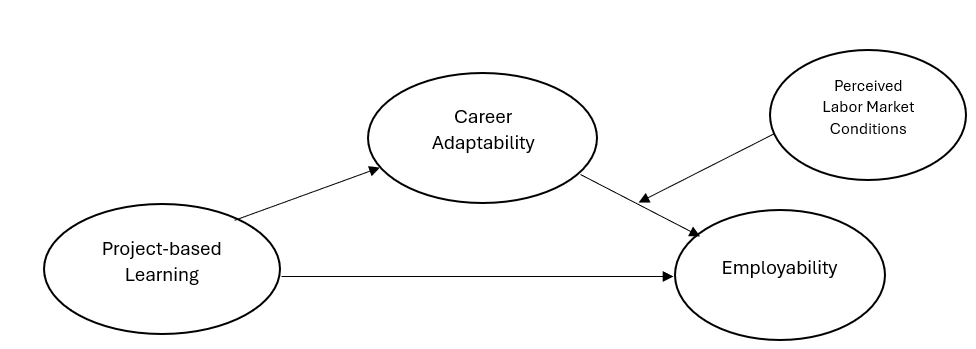
Drawing on the above literature review, we propose a research model in which Project-Based Learning (PBL) enhances students’ employability through the development of career adaptability, and where this mediated effect is contingent on perceived labour market conditions. To empirically investigate this model, we formulate the following research questions (RQs) and hypotheses.
Research questions:
RQ1: To what extent is the perceived quality of Project-Based Learning associated with the employability of non-English-major students?
RQ2: Does career adaptability mediate the relationship between Project-Based Learning and students’ employability?
RQ3: Does perceived labour market conditions moderate the relationship between career adaptability and employability for these students?
Hypotheses:
H1 (Direct Effect): Project-Based Learning has a positive effect on student employability.
Higher levels of perceived PBL quality are positively associated with students’ employability.
H2 (Mediator – Path a): Project-Based Learning is positively associated with career adaptability.
Students engaged in PBL will exhibit higher levels of career adaptability (greater concern, control, curiosity, and confidence regarding their careers) due to the self-directed, problem-solving, and collaborative nature of project work.
H3 (Mediator – Path b): Career adaptability is positively associated with employability.
Students with higher career adaptability will demonstrate higher employability (such as readiness to enter the job market and success in securing employment) compared to less adaptable peers, consistent with adaptability enabling proactive career behaviours.
H4 (Mediation): Career adaptability mediates the relationship between PBL and employability.
In other words, PBL contributes to improved employability in part by developing students’ adaptability. We expect that the positive impact of PBL on employability (H1) will be at least partially explained by increased career adaptability (H2 and H3). Thus, when accounting for adaptability, the direct effect of PBL on employability will attenuate, indicating an indirect effect through the mediator.
H5 (Moderator): Perceived labour market conditions moderate the effect of career adaptability on employability.
The strength of the positive relationship between career adaptability and employability will depend on the student’s perception of the labour market. Specifically, we hypothesize an interaction such that the relationship is stronger when labour market conditions are perceived as challenging (high competition or scarce jobs) and weaker when conditions are perceived as favourable. Under harsh conditions, adaptability may become crucial for securing any available opportunities, whereas in a booming job market even lower adaptability individuals can find jobs (thereby diluting the relative advantage of being highly adaptable). The research model is shown in Figure 1.
THE STUDY
Research Method
The study employs a quantitative research method, utilizing surveys as the primary tool for data collection. This approach allows for the systematic collection of demographic information alongside responses to well-structured questions designed to address the research objectives (Creswell & Creswell, 2022; Fowler, 2014). By using a standardized survey format, the study promotes consistency in data collection, thereby supporting reliable comparisons and subsequent statistical analysis (Dillman et al., 2014; Fowler, 2014). In addition, survey research is particularly useful for efficiently gathering data from a relatively large number of respondents, which can strengthen the rigor of empirical investigation and contribute to a broader understanding of the research topic (Creswell & Creswell, 2022; Dillman et al., 2014).
Sample and Data Collection
A total of 343 responses were collected through an online survey, of which 339 were deemed valid for data analysis. The survey instrument comprised three demographic questions and thirty-seven closed-ended items measured on a five-point Likert scale ranging from "strongly disagree" to "strongly agree." Participants were students from University of Economics, the University of Danang (DUE), representing a variety of academic majors and all enrolled in English for Specific Purposes (ESP) courses, including Business English, Legal English, and English for Economics. These students were uniformly assigned a mid-term project as part of their course assessment, contributing 20% to their final grade. For example, in Business English classes, the assigned project followed the principles of Project-Based Learning (PBL), requiring students to conceptualize and design a product appropriate for an initial market launch. This learning context provided a consistent experiential foundation for the survey investigation. The demographic information of participants is illustrated in Table 1.
Table 1. Demographic Information of the Survey Participants
|
Demographic information |
Frequency (N=339) |
Percentage |
|---|---|---|
|
Gender |
||
|
Female |
280 |
82.6% |
|
Male |
59 |
17.4% |
|
Age |
||
|
18-19 |
21 |
6.2% |
|
20-21 |
299 |
88.2% |
|
22 and above |
19 |
5.6% |
|
Faculty |
||
|
Accounting |
71 |
20.9% |
|
Banking |
4 |
1.2% |
|
Marketing |
26 |
7.7% |
|
Law |
50 |
14.7% |
|
Business Administration |
49 |
14.5% |
|
Economics |
70 |
20.6% |
|
Finance |
17 |
5% |
|
International Business |
18 |
5.3% |
|
Statistics |
6 |
1.8% |
|
E-commerce |
13 |
3.8% |
|
Political Science |
15 |
4.4% |
|
Source: from authors’ calculations |
||
Construct Development
The questionnaire was developed through a multi-step process. First, measurement items for each construct were adapted from previously validated scales in the literature to ensure theoretical and empirical grounding. Second, the wording of the items was adjusted to suit the context of the present study and the characteristics of the target respondents. Third, the draft questionnaire was reviewed by experts/supervisors to assess its content validity, clarity, and relevance. Finally, a pilot test was conducted with a small group of respondents to identify ambiguous or unclear items. Based on the pilot feedback, minor revisions were made to improve wording and readability before administering the final survey. All items were measured using a 5-point Likert-type scale with statements shown in Table 2.
Table 2. Constructs and Items Used in the Research
|
Construct name |
Items coded |
Items |
Previous studies |
|---|---|---|---|
|
Project - based Learning (PBL) |
PBL1 |
In this project, I learned a lot about English language sentence patterns and word usage, and I increased my English vocabulary. |
Shin (2018) |
|
PBL2 |
2. The project makes me happy to participate in English class activities. |
||
|
PBL3 |
3. In the project, I felt it was great to work cooperatively with teammates. |
||
|
PBL4 |
4. After participating in the project, I felt the relationship within my team improved as we worked on the project cooperatively. |
||
|
PBL5 |
5. I felt the contents of the project were relevant. |
||
|
PBL6 |
6. I prefer the authentic materials of the project compared to the materials in a traditional classroom environment. |
||
|
PBL7 |
7. Learning English while doing the project was really beneficial. |
||
|
PBL8 |
8. The project was problematic. |
||
|
PBL9 |
9. After participating in the project, I changed my attitude toward English learning. |
||
|
PBL10 |
10. After participating in the project, I found English learning is not so difficult for me. |
||
|
Career Adaptability |
CA1 |
1. I always try to achieve my goals for my future career. |
Career Adapt-Abilities Scale (CAAS) by Savickas & Porfeli (2012) |
|
CA2 |
2. I realize today’s choices can shape my future career. |
||
|
CA3 |
3. I can confidently make decisions by myself to gain success in my future career. |
||
|
CA4 |
4. I always take responsibility for my actions. |
||
|
CA5 |
5. I always try to spend time exploring my surroundings. |
||
|
CA6 |
6. I always look for opportunities to grow myself. |
||
|
CA7 |
7. I always observe different ways of doing things. |
||
|
CA8 |
8. I ensure that I can perform tasks efficiently. |
||
|
CA9 |
9. I always try my best to overcome obstacles. |
||
|
Employability |
EM1 |
1. I understand the core theories and concepts in my field of study. |
The USEM Model by Knight & Yorke (2002) |
|
EM2 |
2. I can apply what I’ve learned in class to solve real-world problems. |
||
|
EM3 |
3. I have sufficient academic knowledge to perform effectively in my profession. |
||
|
EM4 |
4. I communicate effectively in both written and spoken forms. |
||
|
EM5 |
5. I can work well as part of a team to achieve shared goals. |
||
|
EM6 |
6. I solve problems creatively and efficiently. |
||
|
EM7 |
7. I manage my time and responsibilities well. |
||
|
EM8 |
8. I believe I have what it takes to succeed in my future career. |
||
|
EM9 |
9. I am confident in my ability to adapt to changing job demands. |
||
|
EM10 |
10. I feel ready to enter the workforce after graduation. |
||
|
Perceived Labour Market Conditions (PLMC) |
PLMC1 |
1. I believe that there are plenty of job opportunities in my field of study. |
Rothwell et al. (2008) Bhat et al. (2023) |
|
PLMC2 |
2. I believe I will find a job quickly after graduation. |
||
|
PLMC3 |
3. I feel that the current job market is very competitive. |
||
|
PLMC4 |
4. I think even highly qualified candidates are struggling to find jobs. |
||
|
PLMC5 |
5. I totally believe that the jobs available today are mostly stable and long-term. |
||
|
PLMC6 |
6. I think that it is difficult to find a secure job these days. |
||
|
PLMC7 |
7. I believe the labor market in my country is improving. |
||
|
PLMC8 |
8. I believe overall economic conditions support employment growth. |
Data Analysis
The study employed SPSS and AMOS to perform data analysis. SPSS was used to generate descriptive statistics, providing an overview of the participants’ responses and key variable distributions. Structural Equation Modeling (SEM) was conducted using AMOS to examine the relationships between variables, specifically testing for moderating and mediating effects within the proposed research model.
Reliability statistics
Reliability analysis was conducted using Cronbach’s alpha to assess the internal consistency of the measurement scales (Cronbach, 1951). A Cronbach’s alpha value of 0.70 or higher was considered acceptable, indicating that the items within each construct adequately reflected the same underlying concept (Hair et al., 2018; Nunnally & Bernstein, 1994) as shown in Table 3, Table 4, Table 5 and Table 6.
Table 3. Reliability Statistics of Project-based Learning
|
Item-Total Statistics |
||||
|---|---|---|---|---|
|
Scale Mean if Item Deleted |
Scale Variance if Item Deleted |
Corrected Item-Total Correlation |
Cronbach’s Alpha if Item Deleted |
|
|
PBL1 |
15.42 |
8.120 |
.509 |
.754 |
|
PBL2 |
15.37 |
7.008 |
.646 |
.707 |
|
PBL3 |
15.51 |
7.144 |
.615 |
.718 |
|
PBL4 |
15.57 |
7.393 |
.545 |
.743 |
|
PBL5 |
15.78 |
8.010 |
.463 |
.769 |
|
Source: from authors’ calculations |
||||
Table 4. Reliability Statistics of Career Adaptability
|
Item-Total Statistics |
||||
|---|---|---|---|---|
|
Scale Mean if Item Deleted |
Scale Variance if Item Deleted |
Corrected Item-Total Correlation |
Cronbach’s Alpha if Item Deleted |
|
|
CA1 |
17.85 |
12.736 |
.787 |
.886 |
|
CA2 |
17.79 |
13.101 |
.796 |
.885 |
|
CA3 |
17.78 |
13.021 |
.806 |
.883 |
|
CA4 |
17.81 |
13.104 |
.797 |
.885 |
|
CA5 |
17.93 |
14.116 |
.627 |
.908 |
|
CA6 |
17.96 |
13.620 |
.668 |
.903 |
|
Source: from authors’ calculations |
||||
Table 5. Reliability Statistics of Perceived Labor Market Conditions
|
Item-Total Statistics |
||||
|---|---|---|---|---|
|
Scale Mean if Item Deleted |
Scale Variance if Item Deleted |
Corrected Item-Total Correlation |
Cronbach’s Alpha if Item Deleted |
|
|
PLMC1 |
13.51 |
11.511 |
.784 |
.890 |
|
PLMC2 |
13.45 |
11.822 |
.819 |
.884 |
|
PLMC3 |
13.55 |
11.107 |
.891 |
.868 |
|
PLMC4 |
13.60 |
11.040 |
.889 |
.868 |
|
PLMC5 |
13.96 |
13.013 |
.526 |
.943 |
|
Source: from authors’ calculations |
||||
Table 6. Reliability Statistics of Employability
|
Item-Total Statistics |
||||
|---|---|---|---|---|
|
Scale Mean if Item Deleted |
Scale Variance if Item Deleted |
Corrected Item-Total Correlation |
Cronbach’s Alpha if Item Deleted |
|
|
EM1 |
10.80 |
4.825 |
.477 |
.827 |
|
EM2 |
10.52 |
4.511 |
.675 |
.732 |
|
EM3 |
10.60 |
4.443 |
.721 |
.711 |
|
EM4 |
10.56 |
4.372 |
.633 |
.751 |
|
Source: from authors’ calculations |
||||
Exploratory factor analysis (EFA)
The EFA using Principal Axis Factoring extracted one factor from three items (PBL1–PBL3), with loadings of 0.582, 0.716, and 0.837, respectively as shown in Table 7. All loadings exceed the acceptable threshold, indicating strong associations with a single underlying construct related to project-based learning.
Table 7. Reliability Factor Matrixa
|
Factor |
|
|---|---|
|
1 |
|
|
PBL2 |
.837 |
|
PBL3 |
.716 |
|
PBL1 |
.582 |
|
Source: from authors’ calculations |
|
EFA also extracted one factor from six items (CA1-CA6), with loadings ranging from 0.644 to 0.859. The highest loading was observed for CA3 (0.859), followed closely by CA2 (0.854), CA4 (0.850), and CA1 (0.842), indicating strong associations with the underlying construct. CA6 (0.689) and CA5 (0.644) also showed acceptable loadings, supporting the unidimensionality of the construct as illustrated in Table 8.
Table 8. Factor Matrixa
|
Factor |
|
|---|---|
|
1 |
|
|
CA3 |
.859 |
|
CA2 |
.854 |
|
CA4 |
.850 |
|
CA1 |
.842 |
|
CA6 |
.689 |
|
CA5 |
.644 |
|
Source: from authors’ calculations |
|
One factor was extracted from five items (PLMC1-PLMC5), with loadings ranging from 0.542 to 0.955. PLMC3 (0.955) and PLMC4 (0.948) had the highest loadings, indicating very strong associations with the underlying construct. PLMC2 (0.860) and PLMC1 (0.828) also exhibited strong loadings, while PLMC5 (0.542) was still within the acceptable range, which showed that the scales used in this study were unidimensional, as shown in Table 9.
Table 9. Factor Matrixa
|
Factor |
||
|---|---|---|
|
1 |
||
|
PLMC3 |
.955 |
|
|
PLMC4 |
.948 |
|
|
PLMC2 |
.860 |
|
|
PLMC1 |
.828 |
|
|
PLMC5 |
.542 |
|
|
Source: from authors’ calculations |
||
Similarly, loadings of EM ranged from 0.523 to 0.853. EM3 (0.853) showed the strongest loading, which was followed by EM2 (0.788) and EM4 (0.723), respectively while EM1 (0.523) was also in the acceptable range (>0.5) in Table 10.
Table 10. Factor Matrixa
|
Factor |
|
|---|---|
|
1 |
|
|
EM3 |
.853 |
|
EM2 |
.788 |
|
EM4 |
.723 |
|
EM1 |
.523 |
|
Source: from authors’ calculations |
|
Confirmatory factor analysis (CFA)
Table 11. The Reliability and Validity of the Measurement Model
|
CR |
AVE |
MSV |
MaxR(H) |
CA |
EM |
PBL |
PLMC |
|
|---|---|---|---|---|---|---|---|---|
|
CA |
0.923 |
0.749 |
0.806 |
0.923 |
0.865 |
|||
|
EM |
0.833 |
0.624 |
0.806 |
0.835 |
0.898*** |
0.790 |
||
|
PBL |
0.760 |
0.517 |
0.221 |
0.782 |
0.376*** |
0.470*** |
0.719 |
|
|
PLMC |
0.941 |
0.842 |
0.606 |
0.979 |
0.748*** |
0.778*** |
0.273*** |
0.918 |
|
Source: from authors’ calculations |
||||||||
As can be seen from Table 11, Composite Reliability (CR), Average Variance Extracted (AVE), Maximum Shared Variance (MSV), and MaxR(H) were analysed to confirm the validity and reliability for each construct. With CR all surpassing the 0.7 value, all constructs were showed to be reliable. Regarding convergent validity, AVE figures were in the range from 0.517 (PBL) to 0.842 (PLMC), indicating that the items possessed adequate variance from the latent factor in Table 11.
Nevertheless, mixed results were observed in discriminant validity. While the Fornell-Larcker criterion was satisfied for most constructs, a notable exception was observed between Career Adaptability (CA) and Employability (EM), where the inter-construct correlation (r = 0.898) exceeded the square root of the AVE for both constructs. Additionally, MSV values for CA and EM were higher than their respective AVE values, further indicating a lack of discriminant validity between these two constructs. Despite this limitation, the MaxR(H) values remained close to CR, supporting the overall stability of the constructs.
Table 12. Model Fit Indices
|
Fit Index |
Value |
Interpretation |
|---|---|---|
|
Chi-square |
173.588 |
Significant (p < .001), but expected with large sample sizes |
|
Df |
59 |
Degrees of freedom |
|
Chi-square/df |
2.942 |
Acceptable (< 3) |
|
GFI |
0.928 |
Good (> 0.90) |
|
TLI |
0.957 |
Very good (> 0.95) |
|
CFI |
0.968 |
Excellent (> 0.95) |
|
RMSEA |
0.076 |
Acceptable (≤ 0.08) |
|
PCLOSE |
0.001 |
RMSEA is significantly > 0.05, but still acceptable |
|
Source: from authors’ calculations |
||
Overall, the model demonstrates good fit, with strong support from CFI, TLI, and GFI as calculated in Table 12.
Hypothesis Testing
The structural model results revealed significant relationships among the latent constructs. Project-Based Learning (PBL) had a positive and significant effect on Career Adaptability (CA) (β = 0.612, p < .001), with a critical ratio (C.R.) of 5.482, indicating a moderate-to-strong influence. PBL also showed a significant but weaker direct effect on Employability (EM) (β = 0.216, p < .001; C.R. = 3.407). Moreover, CA was found to be a strong predictor of EM (β = 0.697, p < .001), with a very high critical ratio (C.R. = 15.089), suggesting that career adaptability plays a key mediating role between project-based learning and employability.
The measurement model was also supported, with strong and significant factor loadings for CA indicators. Specifically, CA4 (β = 0.894), CA3 (β = 0.917), and CA2 (β = 0.937) loaded significantly on the CA latent construct, with all p-values below .001 and C.R. values above 20, indicating excellent indicator reliability and construct validity, as shown in Table 13.
Table 13. Mediation Effect
|
Estimate |
S.E. |
C.R. |
P |
Label |
|||
|---|---|---|---|---|---|---|---|
|
CA |
<--- |
PBL |
.612 |
.112 |
5.482 |
*** |
|
|
EM |
<--- |
PBL |
.216 |
.064 |
3.407 |
*** |
|
|
EM |
<--- |
CA |
.697 |
.046 |
15.089 |
*** |
|
|
CA4 |
<--- |
CA |
.894 |
.043 |
20.596 |
*** |
|
|
CA3 |
<--- |
CA |
.917 |
.043 |
21.300 |
*** |
|
|
CA2 |
<--- |
CA |
.937 |
.042 |
22.418 |
*** |
FINDINGS AND DISCUSSION
The results of this study confirmed all proposed hypotheses, providing strong support for the conceptual framework.
PBL and Career Adaptability (H2):
PBL had a significant and positive effect on career adaptability. Students who experienced PBL reported higher levels of concern, control, curiosity, and confidence about their future careers.
PBL and Employability (H1):
PBL showed a direct, yet modest, effect on employability. The results suggest that PBL contributes directly to employability, but stronger effects likely run through other factors.
Career Adaptability and Employability (H3):
Career adaptability had a clear and positive impact on employability. It acts as a main mediator in the link between PBL and employability.
Mediation Effect (H4):
The analysis confirms that career adaptability played a significant mediating role in the relationship between PBL and employability. The results show that PBL improves employability mainly by enhancing students’ adaptability since when the mediating variable is added in the model, the direct impact of PBL on employability decreases while the indirect influence through adaptability stays significant.
Moderation by Perceived Labor Market Conditions (H5):
Students’ perceptions of the labour market significantly moderated the link between adaptability and employability. Specifically, when students see the market as favourable, adaptability has a stronger positive effect on employability.
From these findings, it is clear that PBL positively influences students’ employability. It does so in two ways: directly and indirectly by strengthening career adaptability. This result matches the earlier works by Zhang and Ma (2023), Rahman et al. (2023), and Othman et al. (2017), who all view PBL as an effective pedagogical method to build soft skills and job competencies. Career adaptability made up of initiative, control, curiosity, and confidence (Savickas & Porfeli, 2012) and was identified in the research model as the crucial mediator in the relationship between PBL and employability.
Findings for hypotheses 2 and 3 confirm that students gain stronger adaptability after taking part in PBL, and that this gain helps improve employment opportunities for students. This is consistent with the view of de Guzman and Choi (2013) and Kolmos et al. (2021) who highlights that the ability to learn and adapt helps students’ transition from university to employment.
Hypothesis 4 indicates that adaptability mediates the relationship between PBL and employability. PBL boosts career readiness not just because students finish projects, but because they practice adaptability skills while working in teams, solving problems, and dealing with real-life situations. By doing these activities, they learn how to be responsible for their tasks, set clear goals, think flexibly and change plans when needed. These helps build the confidence they need in the workplace. Therefore, if being applied appropriately, PBL can create an effective environment to help grow students’ inner capacity, thereby improving their employability.
The study also confirms the significant moderating role of perceived labor market conditions. When students perceive the market as optimistic, adaptability has a stronger positive effect on employability. When they expect a tough market, adaptability still helps, but the effect is smaller. This aligns with career-psychology theory described by Masdonati et al. (2022), which states that both personal traits and external environmental factors guide career results.
From an ELT innovation perspective, the findings show that PBL is a sustainable pedagogical approach that transforms English language learning from the development of isolated language skills to the formation of globally prepared competencies. Through practical projects, English acts as an intermediary tool for students to communicate, collaborate, and solve problems in contexts close to the professional environment.
The fact that PBL enhances career adaptability which includes future orientation, self-control, curiosity and confidence demonstrates that ELT can directly contribute to education for sustainable development by fostering lifelong learning and adaptability to change. The moderating role of labor market awareness highlights the importance of integrating socio-economic context understanding into ELT, thereby helping learners translate personal competencies into career readiness in a globalized world.
CONCLUSION
The study investigated the relationship between PBL, career adaptability, labour market perceptions, and employability of non-English major students. The results showed that PBL not only directly affects employability but also indirectly through improving students’ adaptability. At the same time, students’ perceptions of the labour market play a moderating role, influencing the extent to which adaptability is promoted in improving career readiness.
Implications
These findings have some significant implications to improve the effectiveness of PBL in higher education, especially in the context of innovation in ELT towards sustainable development and readiness for global integration. For teachers, the findings emphasize the necessity of the application of PBL in the curriculum for non-English major students, especially within business and professional programs. PBL needs to be designed in a realistic context and have a long enough duration so that students can fully experience the process of teamwork, problem solving and critical thinking. In addition, to ensure the quality of PBL, lecturers should be properly trained on how to design, implement and evaluate PBL activities flexibly and closely to students’ abilities. This is especially important in the context of EME where English is not only a learning goal but also a means of conveying global content and competencies.
Besides, schools need to organize activities to support the development of career adaptability for students, such as career counselling sessions, soft skills training and personal goal orientation. Additionally, the concept of employability should be expanded to include adaptability, resilience, and context-sensitive career planning, rather than solely focusing on employment rates after graduation.
Information on domestic and international labour market also needs to be updated regularly, through the academic advising system or student support centre, to help students have a realistic view of the global career landscape and adjust their career expectations and personal development strategies accordingly
Limitations
Although the study provides some important findings, there are some limitations. First, the survey sample only included non-English major students at a single institutional setting, specifically University of Economics, the University of Danang, so it is difficult to generalize the results to the entire Vietnamese student population. Second, the study analysed 339 valid responses, which, although sufficient for statistical analysis, is still limited compared to the whole school scale or to studies at many different training institutions. This sample size is also not enough to test deeper differences between groups of majors or between different levels of PBL experience.
Additionally, the data were collected at a single point in time, so it does not reflect changes in employability over time or after students have graduated. Besides, most of the data were self-reported by students, so they may be influenced by emotional factors, personal expectations, or the desire to respond positively. Finally, due to the cross-sectional design of the study, it is not possible to confirm the causal relationship between the variables. Although the structural model indicates statistically significant relationships, longitudinal studies are needed to strengthen the causal inferences and enable the observation of the long-term effects of PBL interventions.
Overall, this study reinforces the role of PBL as an effective pedagogical approach in higher education, especially in a context where employers increasingly value soft skills and improvisation. However, for PBL to reach its full potential, investment in project design, teacher training, and student support in both skills and career information is needed. In addition, contextual factors such as the labour market conditions also need to be considered when developing training programs.
The study contributes to providing more evidence for educational administrators and teachers in making appropriate teaching decisions. Besides, it helps clarify the increasingly expanding role of ELT in higher education, not only in developing language proficiency but also in equipping learners with adaptability and readiness to participate in a global learning and working environment. Despite some limitations, the study results lay the foundation for further in-depth studies in the future on how innovative ELT models, especially PBL, can support learners in developing professional competencies in a constantly changing world.
References
Bhat, M. A., Khan, S. T., & Rainayee, R. A. (2023). Assessment of perceived labor market conditions in employees’ turnover intention model–mediation and moderation analyzes. PSU Research Review, 7(1), 1-32. https://doi.org/10.1108/PRR-05-2020-0017.
Creswell, J. W., & Creswell, J. D. (2022). Research design: Qualitative, quantitative, and mixed methods approaches (6th ed.). SAGE.
Cronbach, L. J. (1951). Coefficient alpha and the internal structure of tests. Psychometrika, 16(3), 297–334. https://doi.org/10.1007/BF02310555.
de Guzman, A. B., & Choi, K. O. (2013). The relations of employability skills to career adaptability among technical school students. Journal of Vocational Behavior, 82(3), 199-207. DOI: https://doi.org/10.1016/j.jvb.2013.01.009
Dillman, D. A., Smyth, J. D., & Christian, L. M. (2014). Internet, phone, mail, and mixed-mode surveys: The tailored design method (4th ed.). Wiley. DOI: https://doi.org/10.1002/9781394260645
Fowler, F. J., Jr. (2014). Survey research methods (5th ed.). SAGE.
Frame, T. R., Cailor, S. M., Gryka, R. J., Chen, A. M., Kiersma, M. E., & Sheppard, L. (2015). Student perceptions of team-based learning vs traditional lecture-based learning. American journal of pharmaceutical education, 79(4), 51. https://doi.org/10.5688/ajpe79451.
Gilbert, G., Turner, M., & Haass, O. (2022). Working up to work: Perceived employability of studentscommencing a project management degree. Project Leadership and Society, 3, 100048. https://doi.org/10.1016/j.plas.2022.100048.
Guo, P., Saab, N., Post, L. S., & Admiraal, W. (2020). A review of project-based learning in higher education: Student outcomes and measures. International Journal of Educational Research, 102, 101586. https://doi.org/10.1016/j.ijer.2020.101586.
Hair, J. F., Jr., Black, W. C., Babin, B. J., & Anderson, R. E. (2018). Multivariate data analysis (8th ed.). Cengage.
Healy, M. (2023). Careers and employability learning: pedagogical principles for higher education. Studies in Higher Education, 48(8), 1303-1314. https://doi.org/10.1080/03075079.2023.2196997.
Jackson, D., & Tomlinson, M. (2020). Investigating the relationship between career planning, proactivity and employability perceptions among higher education students in uncertain labour market conditions. Higher education, 80(3), 435-455. https://doi.org/10.1007/s10734-019-00490-5.
Kailas, M., & Bhatt, V. (2024a). The impact of intercultural competence on task-based approach for developing employability skills among technical students. Millenium – Journal of Education, Technologies, and Health, 2(24), 34482. https://doi.org/10.29352/mill0224.34482.
Kailas, M., & Bhatt, V. (2024b). The impact of task-based approach through interdisciplinary learning for fostering employability skills among technical students. International Research Journal of Multidisciplinary Scope, 5(2), 354-361. https://doi.org/10.47857/irjms.2024.v05i02.0488.
Kenaphoom, S., & Niyomves, B. (2024). Enhancing employability through work-integrated learning: An in-depth analysis of strategies, challenges and impacts on graduates’ career readiness. Asian Education and Learning Review, 1(2), 27-47. https://doi.org/10.14456/aelr.2023.8.
Knight, P.T. & Yorke, M. (2002) Employability through the Curriculum. Tertiary Education and Management, 8, 261-276. https://doi.org/10.1080/13583883.2002.9967084.
Kolmos, A., Holgaard, J. E., & Clausen, N. R. (2021). Progression of student self-assessed learning outcomes in systemic PBL. European Journal of Engineering Education, 46(1), 67-89. https://doi.org/10.1080/03043797.2020.1789070.
Kokotsaki, D., Menzies, V., & Wiggins, A. (2016). Project-based learning: A review of the literature. Improving Schools, 19(3), 267–277. https://doi.org/10.1177/1365480216659733.
Ma, Y., & Chen, S. C. (2024). Understanding the determinants and consequences of perceived employability in graduate labor market in China. International Journal for Educational and Vocational Guidance, 24(2), 435-454. https://doi.org/10.1007/s10775-022-09567-7.
Masdonati, J., Massoudi, K., Blustein, D. L., & Duffy, R. D. (2022). Moving toward decent work: Application of the psychology of working theory to the school-to-work transition. Journal of Career Development, 49(1), 41-59. https://doi.org/10.1177/08948453219916. DOI: https://doi.org/10.1177/0894845321991681
Nghia, T. L. H., Ngo, M. T., & Tran, L. T. (2023). Repositioning and modifying the contemporary approach to English language education for Vietnamese graduate employability enhancement. In L. T. Tran, T. L. H. Nghia, & M. T. Ngo (Eds.), English language education for graduate employability in Vietnam (pp. 1–16). Deakin University. https://hdl.handle.net/10779/DRO/DU:24174378.v1. DOI: https://doi.org/10.1007/978-981-99-4338-8_16
Nunnally, J. C., & Bernstein, I. H. (1994). Psychometric theory (3rd ed.). McGraw-Hill.
Othman, H., Mat Daud, K.A., Ewon, U., Mohd Salleh, B., Omar, N.H., Abd Baser, J., Ismail, M.E., & Sulaiman, A. (2017). Engineering students: Enhancing employability skills through PBL. IOP Conference Series: Materials Science and Engineering, 203, 012024. doi:10.1088/1757-899X/203/1/012024.
Rahman, T., Fitria, N., Nurhidayah, E., & Yuliandani, I. (2023). Effects of project-based learning on employability skills: A systematic review. https://doi.org/10.35316/ris.v2i1.473.
Rothwell, A.T., Herbert, I.P., & Rothwell, F.M. (2008). Self perceived employability: construction and initial validation of a scale for university students. Journal of Vocational Behavior, 73, 1-12. doi:10.1016/j.jvb.2007.12.001.
Savickas, M. L., & Porfeli, E. J. (2012). Career Adapt-Abilities Scale: Construction, reliability, and measurement equivalence across 13 countries. Journal of Vocational Behavior, 80(3), 661–673. https://doi.org/10.1016/j.jvb.2012.01.011.
Scott, F. J., Connell, P., Thomson, L. A., & Willison, D. (2019). Empowering students by enhancing their employability skills. Journal of Further and Higher Education, 43(5), 692-707. https://doi.org/10.1080/0309877X.2017.1394989.
Shin, M.-H. (2018). Effects of project-based learning on students’ motivation and self-efficacy. English Teaching, 73(1), 95–114. https://doi.org/10.15858/engtea.73.1.201803.95.
Suyitno, S., Nurtanto, M., Jatmoko, D., Widiyono, Y., Purwoko, R.Y., Abdillah, F., Setuju, & Hermawan, Y. (2025). The effect of work-based learning on employability skills: The role of self-efficacy and vocational identity. European Journal of Educational Research, 14(1), 309-321. https://doi.org/10.12973/eu-jer.14.1.309.
Tushar, H., & Sooraksa, N. (2023). Global employability skills in the 21st century workplace: A semi-systematic literature review. Heliyon, 9(11). https://doi.org/10.1016/j.heliyon.2023.e21023.
Valero, M. D. R., Reid, T., Dell, G., Stacey, D., Hatt, J., Moore, Y., & Clift, S. (2020). Embedding employability and transferable skills in the curriculum: a practical, multidisciplinary approach. Higher Education Pedagogies, 5(1), 247-266. https://doi.org/10.1080/23752696.2020.1816846.
Viona, E., & Afrianti, H. (2024). A systematic literature review on work-based learning: Trends, challenges, and future directions. PPSDP International Journal of Education, 3(2), 771-789. https://doi.org/10.59175/pijed.v3i2.368.
Xie, C., & Lan, G. (2025). The effectiveness of task-based language teaching in improving communicative competence. International Journal of Advanced and Applied Sciences, 12(1), 263-273. https://doi.org/10.21833/ijaas.2025.01.025.
Xu, Y., Liu, D., & Tang, D.-S. (2022). Decent work and innovative work behaviour: Mediating roles of work engagement, intrinsic motivation and job self-efficacy. Creativity and Innovation Management, 31(1), 49-63. https://doi.org/10.1111/caim.12480.
Zhang, L., & Ma, Y. (2023). A study of the impact of project-based learning on student learning effects: a meta-analysis study. Frontiers in Psychology, 14,1202728. https://doi.org/10.3389/fpsyg.2023.1202728.
Downloads
Published
Data Availability Statement
The data that support the findings of this study are available from the corresponding author upon reasonable request.
Issue
Section
License
Copyright (c) 2026 Thi Tuong Vy Le, Anh Tu Pham, Nguyen Dieu Hang Phan, Thi Nhu Quynh Nguyen

This work is licensed under a Creative Commons Attribution-NonCommercial-NoDerivatives 4.0 International License.