
Building speaking confidence in the workplace: The Read-Personalize-Glance method for EOP
DOI:
https://doi.org/10.65956/procia.2026.15Keywords:
English for occupational purposes, role-play, Read-Personalize-Glance, speaking confidenceAbstract
This article introduces the Read-Personalize-Glance (RPG) method, a rehearsal-to-performance routine for building speaking confidence in A1-A2 English for Occupational Purposes (EOP), illustrated through hospitality and tourism classes in Vietnam. In workplace-focused courses like these, learners often hesitate to speak when classroom talk feels evaluative and high-stakes. RPG responds by treating short role-play scripts not as one-off activities but as material learners work through in stages. Classes begin with brief movement-based warm-ups that ease learners into the task, followed by a supported Read phase in which students table read, use gestures to anchor meaning, and shadow models to develop rhythm and intonation. Learners then personalize the script by replacing fixed details with their own information, while the teacher circulates to offer brief, explicit corrections or flags common issues for later discussion. In the Glance phase, attention shifts toward speaking from memory, with learners attempting short stretches “off-book” and quickly checking the script as needed. Students record a short take, use a simple rubric for formative self- and peer feedback, and then record again with one targeted improvement in mind. When technology is used, Artificial Intelligence (AI) supports materials preparation, such as generating or differentiating scripts and vocabulary support, rather than serving as the learning activity itself. Based on classroom observations, this routine reduces initial silence, improves prosody and delivery, and helps learners move from scripted safety toward more confident, workplace-relevant speaking.
INTRODUCTION
In many English for Occupational Purposes (EOP) classrooms in Vietnam, fluency problems are rarely just about pronunciation or vocabulary. More often, they come from how speaking feels in class. For many learners, every time they open their mouth it feels like a public exam. When talk feels evaluative, it is not a surprise that students hesitate. What helps in these situations is not another isolated technique, but a familiar routine that lowers performance pressure, makes support obvious, and gradually moves learners toward speaking more independently at work.
The present article introduces Read-Personalize-Glance (RPG), a simple, repeatable speaking routine that blends rehearsal and communication into one clear cycle. Classes begin with a brief physical and vocal warm-up to get learners out of their heads and into their voices, followed by a short immersion cue. From there, the routine moves through three connected phases. In Read, learners table read a short dialogue, use gestures to lock in meaning, and shadow a model to catch rhythm and intonation. In Personalize, they tweak the dialogue with their own details while the teacher offers quick, in-role corrections or quietly tracks common issues for later feedback. Finally, in Glance, students become less dependent on the written script. Learners attempt short stretches from memory, peek at the text only when needed, and continue (Campbell, 2025).
The goal is straightforward and practical. RPG is designed to feel familiar after just a few uses, so students know what is coming and can focus their energy on speaking rather than learning how to complete the task. It is not meant to replace other approaches or function as a stand-alone solution. Instead, it organizes well-known practices into a predictable sequence that reduces uncertainty and keeps speaking practice moving forward.
The logic behind RPG starts with the body and the voice. Short physical and vocal warm-ups have been shown to improve vocal quality before speaking tasks, which matters when learners are hesitant or tense (Iranpour & Ghelichi, 2023). Allowing brief first-language support during complex setup can also make instructions clearer and faster, as long as English remains the language used for the actual speaking (Cook, 2001). In Vietnam, drama-based approaches have already been shown to support speaking development, offering local evidence that rehearsal-oriented instruction works in this context (Nguyen, 2023). Taken together, these findings point toward preparation that is physical, vocal, and clearly structured rather than purely cognitive.
At the activity level, RPG supports learners in ways that make speaking feel doable rather than risky. Gesture helps learners tie language to meaning in a concrete way, especially when movements clearly match what is being said (Huang et al., 2019; García-Gámez & Macizo, 2023). Working with a partner provides just enough support to keep interaction going when difficulty rises, instead of forcing learners to shut down or fall silent (Vygotsky, 1978; Yawiloeng, 2021). Shadowing gives learners access to natural rhythm and intonation without demanding perfect accuracy at every word (Hamada, 2019). Combined, these supports lower cognitive load while keeping speech active and communicative.
Assessment in RPG follows the same low-pressure logic. Feedback stays short, formative, and closely tied to what learners actually do when speaking. Quick quizzes and simple rubrics emphasize improvement rather than judgment, aligning with well-established formative assessment principles (Black & Wiliam, 1998). The Glance phase extends this approach to memory and retention. Learners try lines from memory, check the text briefly, and repeat the task, often in the next class, one or two days later. The 24-48-hour timing reflects research showing that most forgetting happens within the first one to two days after learning, making spaced recall a practical and efficient addition to speaking routines (Murre & Dros, 2015)
LITERATURE REVIEW
EOP (English for Occupational Purposes)
EOP is a branch of ESP (English for Specific Purposes) that focuses on the English that learners need to perform workplace roles and tasks (e.g., hotel check-in, handling requests, giving directions, managing payment issues). It refers to language for the workplace that is shaped by duties, contexts, and performance demands rather than general conversation topics (Dudley-Evans & St John, 1998).
RPG (Read-Personalize-Glance)
RPG (Read-Personalize-Glance) is a three-phase instructional framework developed by the author that brings together drama-rehearsal strategies, kinesthetic learning, and communicative TESOL (Teaching English to Speakers of Other Languages) practices in a repeatable classroom cycle (Campbell, 2025). Within this framework, Read establishes a supported rehearsal base, Personalize adds self-referenced details to build ownership, and Glance helps learners move toward “off-book” delivery (speaking with little to no reliance on the script) through scaffolded retrieval practice. In this paper, warm-up and immersion cues come first to support readiness and role entry.
L1 (First Language)
L1 (first language) refers to the language a learner uses most automatically for comprehension and interpreting meaning. In multilingual classrooms, this may be the learner’s dominant language rather than the first language learned. In this paper, “L1” serves as shorthand for the language students can use most efficiently for rapid comprehension during task setup; brief, strategic use during complex setup can reduce cognitive load and preserve attention for English-speaking tasks (Cook, 2001).
ZPD (Zone of Proximal Development)
The ZPD describes the gap between what learners can do independently and what they can do with guidance or support from a more capable peer or teacher (Vygotsky, 1978). During the Read phase, pairing and structured peer support help learners sustain the speaking task through light guidance, quick clarification, and modelling rather than disengage from the interaction (Yawiloeng, 2021).
Prosody
Prosody refers to stress, rhythm, and intonation, features of speech that shape meaning and listener perception beyond individual sounds (Arvaniti, 2020). In the RPG cycle, prosody is what learners imitate during shadowing. Learners match stress timing, rhythm, and intonation before they move toward more independent delivery.
Shadowing
Shadowing is a speaking practice technique in which learners repeat a model voice at the same time as the model (or with a slight delay), focusing on prosody and overall delivery rather than word-by-word accuracy alone. Within the RPG cycle, shadowing bridges comprehension with more accurate spoken performance (Hamada, 2019).
Retrieval Practice and Spacing
Retrieval practice involves having learners try to recall or produce language from memory before they check the script, while spacing means revisiting learning after a delay rather than massing practice in a single session. When a second session occurs within one to two days, the delay allows some forgetting, creating a spacing interval that supports stronger retrieval (Murre & Dros, 2015). This design keeps retrieval practice at the centre of learning.
SRL (Self-regulated Learning)
SRL refers to how learners plan, monitor, and adjust their learning through processes such as goal-setting, self-monitoring, and strategic adjustment (Zimmerman, 2000). In this routine, learners enact SRL through a record-reflect-adjust sequence: they record an initial take, use rubric language to identify one improvement target, and then produce a second take with that target in mind.
ACTIVITY PROCEDURES
Setting, Participants, and Implementation
In practice, this procedure is implemented in tertiary EOP classes in hospitality and tourism programs in Vietnam, with mixed A1-A2 cohorts. Teachers usually run the routine as a short cycle across two class meetings, with flexible timing:
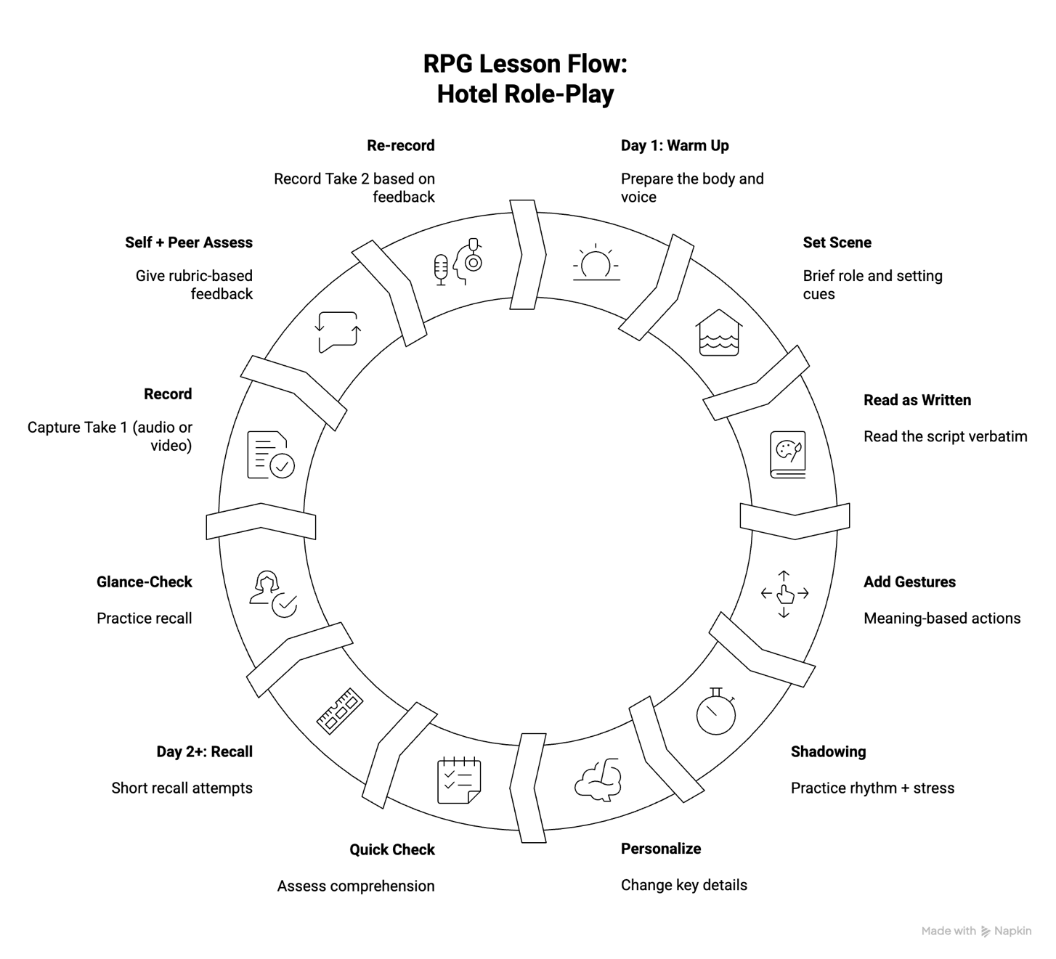
- Day 1: Warm-Up, Immersion, Read, Personalize, Formative Assessment
- Day 2: Glance, Record, Assess, Re-take
Class schedules do not always allow a second meeting within 48 hours. When that happens, teachers can keep a spacing interval by assigning a short homework version of the Glance phase with audio or video recording. In that format, learners still attempt retrieval after a delay; then the class can complete peer assessment and re-take it during the next available lesson. Throughout, teachers use the same core class artifacts (dialogue, rubric, teacher script), which are provided in the appendices and referenced throughout the procedure.
Materials and Preparation
Before class, teachers prepare three core artifacts and a simple modelling plan:
Base dialogue (one page)
Each student receives a paper copy they can hold, annotate, and read independently. In practice, this requires printing enough copies so each learner has their own version rather than sharing per pair. The script includes several stable “slots” that can be modified later (e.g., name, number of nights, room number, WiFi password question, directions). For A1-A2 learners, the dialogue is short enough to support multiple rehearsal cycles within a single lesson.
Rubric (one page)
Each student also receives a paper copy of the rubric, so peer assessment stays concrete and consistent, with space to circle scores and write a brief comment without relying on a screen. Teachers choose the version in advance: the Full Rubric for video or live performance, or the Audio-Only Light Rubric for audio-only recording.
Vocabulary support (optional; flexible format)
When teachers include vocabulary support, it can appear on the same page as the base dialogue, on a separate handout, or briefly on a projected slide. The goal is exposure and re-exposure: learners see key items before they perform and meet them again when they recycle the script. Digital interactive quiz and study platforms (e.g., Wayground [formerly Quizizz], Quizlet, Kahoot) can provide quick study modes, including flashcards. If technology is limited, a short list on the board or projected list works equally well. The routine does not depend on a specific platform.
Modelling plan (brief, selective)
Teachers decide in advance what they will model and what learners will practice independently. At minimum, modelling includes: (a) one table read pass, (b) one gesture sequence (e.g., passport scan, key card handoff, pointing left or straight ahead), and (c) a short shadowing run in which prosody (stress, rhythm, intonation) is named as the imitation target.
Once materials are prepared, technology can serve as a convenience rather than a requirement. When devices or connectivity are limited, pairs can share a phone or perform live while classmates apply the same rubric language. Artificial Intelligence (AI) is used only to prepare materials, not as a learning intervention in this practice-based article.
AI-assisted materials: Two-sentence prompts for creation and differentiation
To support materials preparation, the prompts below are reproduced verbatim for teacher use.
Template prompt (2 sentences):
Create a simple [CEFR level] role-play lesson for my [student group] in a [setting]. Include a short [setting] scene description and an easy [characters] dialogue.
Example: hotel check-in (2 sentences):
Create a simple A1-A2 role-play lesson for my hospitality students in a hotel check-in setting. Include a short lobby scene description and an easy guest-receptionist dialogue.
Differentiation prompt (template - 2 sentences):
Using this script, rewrite it for [CEFR level] students. Include a short [setting] scene description and about 15 key vocabulary items with English → [L1] translations suitable for this level.
Differentiation prompt (example - hotel check-in):
Using this script, rewrite it for A1 ELLs. Include a short hotel lobby scene description and about 15 key vocabulary items with English → Vietnamese translations suitable for this level.
Note on manuscript examples:
This manuscript includes a vocabulary-only example from the A1-A2 model dialogue (Appendix C).
Warm-up (2-3 min)
Start with a brief, embodied warm-up. Students stand, do neck/shoulder rolls (20-30 seconds), take two to three deep vocalized breaths, then say a familiar tongue-twister slowly and slightly faster, with attention to final consonants (e.g., “She sells seashells by the seashore”). The focus is readiness, not perfection.
Pre-read immersion (sensory cues, role cues)
Move straight into a short immersion cue. Provide a 30-45-second English visualization of the hotel front desk (lights, suitcase sounds, soft music, coffee smell; tired but polite). If you have them, optional props (name tag, clipboard) can help students step into role. For lower levels, add a quick L1 translation of the scene-setting paragraph for comprehension, then return to English.
Phase 1 - Read (table read; gestures; shadowing)
With the scene established, move into the Read sequence.
Table read (pairs): Students read in pairs and switch roles. Where possible, pair stronger students with developing learners so peer scaffolding within the ZPD is built into the first pass (Vygotsky, 1978; Yawiloeng, 2021).
Gestures pass: Add gestures linked to hotel actions (passport scan, hand key card, point left for the elevator, point straight ahead). Gestures work best when the movement clearly matches the meaning of the spoken line (Huang et al., 2019; García-Gámez & Macizo, 2023).
Shadowing: Move into shadowing with a fluent model (choral, then pairs), matching rhythm and stress. The teacher treats prosody as the imitation target. In this role, shadowing supports fluency development by keeping attention on stress, rhythm, and intonation (Hamada, 2019).
Phase 2 - Personalize (ownership and formative assessment)
Once learners can produce the model dialogue with support, shift to personalization. Students personalize the script by swapping names, places, and items; lower levels limit changes to nouns, while higher levels add or rewrite a turn (brief humor or a local detail is acceptable). As pairs personalize the dialogue, the teacher moves between pairs and corrects briefly in the moment, keeping interruptions minimal. In larger classes, the teacher can note recurring errors and address them with a quick whole-class correction before the next run. Close the phase with a short recall quiz. A quick check (five to seven questions, delivered through an interactive quiz platform, slides, or paper) keeps attention on key phrases and meaning and provides the teacher with a quick snapshot of what students know (Black & Wiliam, 1998).
Phase 3 - Glance (retrieval and off-book delivery): record; assess; re-take
Shift the focus to speaking from memory. Begin Glance practice in short sections: cover most lines; students deliver two to three lines from memory, glance to check, then continue. Build to longer sections (six lines and then the full dialogue). In this phase, the routine embeds retrieval practice and uses a brief delay to support retention.
Once learners can complete a full run with Glance support, move to recording. Start with a one- to three-minute recording (phone audio/video). Right after the first take, students use the rubric to self-rate and note one strength and one goal. Then a peer rates the same recording with the same rubric, keeping feedback brief and grounded in the rubric criteria. With that feedback in hand, students record a second take while targeting one or two specific features (e.g., clearer final consonants, steadier pace, stronger eye contact). Across the two takes, this record-reflect-adjust sequence aligns with SRL: learners set a goal and adjust on the second take, while drama-based role-play continues to support gains in speaking performance (Nguyen, 2023; Zimmerman, 2000).
Figure 1 provides a visual overview of the RPG sequence described above, moving from Day 1 rehearsal to Day 2 recall and the recording cycle.
DISCUSSION
Practice-Based Observations
In this practice-based article, evidence comes from two sources: classroom patterns that recur during RPG cycles, and anonymous survey responses from Lao Cai College in northern Vietnam (initial needs assessment for first-year English majors; end-of-year surveys for first-year and second-year English majors). To set a baseline, at the start of the year first-year English majors were divided in their comfort speaking English with others (n = 18): 50.0% “very comfortable,” 44.4% “sometimes comfortable,” and 5.6% “not comfortable at all.”
By the end of the year, the pattern had shifted. All respondents in both cohorts reported that they felt more comfortable speaking English in class than at the beginning (first-year: 38.5% “Yes,” 61.5% “A little bit,” 0% “No,” n = 13; second-year: 91.7% “Yes,” 8.3% “A little bit,” 0% “No,” n = 12). Confidence ratings, compared to the beginning of the course, were moderate and similar across cohorts (first-year M = 2.92/5; second-year M = 2.83/5). These self-reports do not measure hesitation or pause length directly. Even so, they reflect the routine’s design goal: make early speaking attempts feel less evaluative, so learners enter talk more readily and stay in the interaction.
The end-of-year data also aligns with what the routine emphasizes in day-to-day teaching: guided speaking practice and rehearsal. In the combined end-of-year sample (n = 25), students most often selected vocabulary practice on Quizizz (80.0%), role-play and conversations (64.0%), and talking to the teacher (60.0%) as activities that helped them learn. Open-ended comments pointed in the same direction, repeatedly asking for more communication and role-play work (e.g., “Speak English more,” “Role play and conversation,” “Create conservation,” and “Learn communication more” [translation of “Học giao tiếp nhiều hơn”]).
At the same time, students continued to report common challenges in speaking. Across cohorts, the most frequently selected challenges were understanding grammar (76.0%), listening to native speakers (68.0%), pronouncing words correctly (60.0%), and speaking without nervousness (48.0%). In class, these challenges tend to appear during early table reads and first takes as hesitation, reduced clarity, and overly general wording. For this reason, the routine keeps feedback brief, explicit, and tied to one or two concrete targets.
Within the cycle, warm-ups followed by low-pressure table reads give reluctant speakers a low-pressure entry point. From there, the Read phase shows where pairs get stuck quickly. The teacher gives a short cue and lets the pair continue; if the same issue repeats, the teacher gives a quick whole-class correction before the next run. Common targets include omitting final consonants, relying too much on rising intonation for statements, and using vague location words (e.g., “there” instead of “left/straight ahead”). Over time, second-take goals tend to cluster around pace and final consonants at A1-A2, then shift toward specificity and repair phrases as learners approach A2-B1.
The rubric supports this shift by keeping peer feedback based on observable criteria rather than personal judgement. Each category uses a one-line guide (e.g., “Smooth pace, few hesitations/fillers,” “Final consonants and stress are clear,” “Uses notes minimally; ‘glance,’ not ‘read’”), which keeps feedback focused on what listeners can hear or what observers can see in the performance. This matches formative assessment principles that emphasize improvement-oriented feedback and learner involvement (Black & Wiliam, 1998). Additionally, evidence presented here is primarily cohort self-report and classroom observation rather than direct timing or speech analysis; claims about reduced hesitation and improved delivery should therefore be read as practice-informed and consistent with the routine’s design rather than as experimentally verified outcomes.
Interpretation of Practice-Based Evidence
The classroom evidence points to three processes that recur across settings. Embodiment (gesture, props, standing delivery) adds physical memory cues to spoken lines and can lower inhibition during performance. Self-reference and motivation make lines more personally meaningful and easier to retain (Rogers et al., 1977). Retrieval and spacing help move newly learned lines into usable speech through repeated recall under light pressure (Karpicke & Roediger, 2008). Vietnamese drama studies provide Vietnam-based evidence for gains in speaking performance and more positive learner attitudes (Nguyen, 2023). Shadowing supports prosody development (Hamada, 2019) while peer scaffolding can help learners stay engaged during practice (Phung & Dang, 2016; Yawiloeng, 2021).
Limitations and Scope
This paper is a practice-based description of the RPG routine as it is implemented in Vietnam-based English for EOP classrooms, illustrated through hospitality and tourism role-plays for A1-A2 learners. The focus is narrow by design: RPG is presented as a repeatable rehearsal-to-performance speaking cycle intended to help learners move toward confident workplace-relevant speaking. Furthermore, the purpose of the article is for instructional clarity and transfer rather than hypothesis testing. The procedures, teacher talk, and sample materials are written to be usable as a classroom routine.
The method descriptor in this paper does not attempt to generalize beyond the Vietnam EOP context, and it does not give evidence that speaking work should be prioritized over other classroom objectives. It also does not cover TEFL contexts outside Vietnam, learner populations beyond A1-A2 (except brief mentions of differentiation), or an extended discussion of AI’s broader educational implications. Finally, the hospitality examples are used as the primary demonstration case; while the routine may transfer to other EOP domains, that transfer is not argued in detail here.
The primary limitation concerns replicability across instructors. RPG can be challenging for teachers who feel underprepared for new routines, who need more coaching to deliver fast, corrective feedback, or who are not confident modelling speaking and prosody in front of a class. In addition, while the paper notes that technology can support materials preparation, it does not provide a full implementation pathway for text-to-speech (TTS) or other modelling tools that could substitute for teacher voice models when instructors prefer that support.
To reduce implementation ambiguity, the appendices provide direct classroom artifacts (sample scripts, rubric language, and teacher-facing examples) that can be used verbatim and adapted. In practice, these artifacts are intended to lower the training burden so that teachers can run the routine with minimal design work and then refine modelling, correction timing, and differentiation over repeated cycles. Given the limitations above, the claims in this article should be read as practice-informed and context-specific. RPG is presented as a plausible, structured routine for A1-A2 EOP speaking in Vietnam, not as a validated intervention with established effect sizes.
Implications for EOP Teaching
In many tertiary EOP classrooms, speaking can get pushed aside because the curriculum is tight, time is limited, and speaking can feel high-stakes for teachers and learners. To that end, role-play can be labelled as impractical, and dialogues may be treated as memorization material that can mainly reward the students who can recite lines quickly. Meanwhile, students who need supported speaking practice may continue to feel pressure, and confidence can remain low. Against this backdrop, RPG can take dialogue work that already exists in many EOP courses and turn it into a predictable routine that can reduce performance pressure. When the speaking process becomes visible and repeatable, more learners may be able to participate, not only the ones who are strong at memorizing scripts.
In practice, the routine can place anxiety reduction and steady speaking practice closer to the center, rather than as a reward for finishing the “real” content. It can also reduce reliance on rote memorization. Scripts still matter, but they may work best when learners rehearse them and personalize them. Workplace vocabulary can fit naturally inside that cycle when it is taught in an immersive and somewhat personalized manner, so learners meet words in use rather than as isolated items to study first and speak later. Task design can change with that framing. Dialogues can stop being one-off examples or “just fun” activities and can become living, reusable texts that learners return to for rehearsal and workplace immersion. Using structured self- and peer assessment can help students monitor their speaking and make targeted adjustments instead of guessing what “good speaking” means.
RPG is multimodal, so it can lend itself to scaffolded interaction across a range of workplace challenges. Gesture, voice, movement, and role can give learners more ways into the task, which can be helpful when customer relations problems appear, misunderstandings, complaints, confusion, or the need to repair communication quickly. The most notable implication is that EOP materials and training programs may name speaking as an outcome, but can offer few realistic, step-by-step modalities for helping anxious learners move from silence to usable workplace talk. RPG can address that gap by offering teachers a clear pathway they can repeat and learners can rely on, even under real classroom constraints.
CONCLUSION
From Rehearsal to Real-World Use
RPG’s main contribution is a repeatable sequence that teachers can use without rebuilding the lesson each time. The routine stays the same, and the script changes. As the cycle repeats, students stop feeling like they are constantly being tested. Instead, they connect directly with what they are learning through personalization and self-reflection. Over time, this process can lead to clearer delivery and greater willingness to practice in front of others. In the end, RPG is a practical rehearsal cycle that makes fluent speaking feel increasingly effortless.
ACKNOWLEDGEMENTS
The author would like to acknowledge the English Language Fellow Program and Lào Cai College for making this classroom-based reflective paper possible.
References
Arvaniti, A. (2020, July 30). The phonetics of prosody. In Oxford Research Encyclopedia of Linguistics. Oxford University Press. https://doi.org/10.1093/acrefore/9780199384655.013.411
Black, P., & Wiliam, D. (1998). Assessment and classroom learning. Assessment in Education: Principles, Policy & Practice, 5(1), 7-74. https://doi.org/10.1080/0969595980050102
Campbell, S. A. (2025). Read-Personalize-Glance: A drama-informed framework for fluency in TESOL. Zenodo. https://doi.org/10.5281/zenodo.16754554
Cook, V. J. (2001). Using the first language in the classroom. Canadian Modern Language Review, 57(3), 402-423. https://doi.org/10.3138/cmlr.57.3.402
Dudley-Evans, T., & St John, M. J. (1998). Developments in English for specific purposes: A multi-disciplinary approach. Cambridge University Press.
García-Gámez, A. B., & Macizo, P. (2023). Gestures as scaffolding to learn vocabulary in a foreign language. Brain Sciences, 13(12), 1712. https://doi.org/10.3390/brainsci13121712
Hamada, Y. (2019). Shadowing: What is it? How to use it. Where will it go? RELC Journal, 50(3), 386-393. https://doi.org/10.1177/0033688218771380
Huang, X., Kim, N., & Christianson, K. (2019). Gesture and vocabulary learning in a second language. Language Learning, 69(1), 177-197. https://doi.org/10.1111/lang.12326
Iranpour, F., & Ghelichi, L. (2023). Effect of vocal warm-up and cool-down exercises on acoustic characteristics in speech-language pathologists: A pilot study. Function and Disability Journal, 6(1), Article 280.1. https://doi.org/10.32598/fdj.6.280.1
Karpicke, J. D., & Roediger, H. L., III. (2008). The critical importance of retrieval for learning. Science, 319(5865), 966-968. https://doi.org/10.1126/science.1152408
Murre, J. M. J., & Dros, J. (2015). Replication and analysis of Ebbinghaus’ forgetting curve. PLOS ONE, 10(7), e0120644. https://doi.org/10.1371/journal.pone.0120644
Nguyen, C. T. (2023). Effects of applying drama-based activities in speaking classes on EFL students’ speaking performance. International Journal of Instruction, 16(3), 991-1012. https://doi.org/10.29333/iji.2023.16353a
Phung, L. T. and Dang, T. T. (2016). The effects of speaking eportfolios on learner autonomy for non-English major students at PetroVietnam University. Hirao School of Management Review, 6. 106-169. https://doi.org/10.14990/00001737
Rogers, T. B., Kuiper, N. A., & Kirker, W. S. (1977). Self-reference and the encoding of personal information. Journal of Personality and Social Psychology, 35(9), 677-688. https://doi.org/10.1037/0022-3514.35.9.677
Vygotsky, L. S. (1978). Mind in society: The development of higher psychological processes (M. Cole, V. John-Steiner, S. Scribner, & E. Souberman, Eds.). Harvard University Press.
Yawiloeng, R. (2021). Peer scaffolding during EFL reading activities: A sociocultural perspective. English Language Teaching, 14(12), 44-54. https://doi.org/10.5539/elt.v14n12p44
Zimmerman, B. J. (2000). Attaining self-regulation: A social cognitive perspective. In M. Boekaerts, P. R. Pintrich, & M. Zeidner (Eds.), Handbook of self-regulation (pp. 13-39). Academic Press. https://doi.org/10.1016/B978-012109890-2/50031-7
Downloads
Published
Data Availability Statement
The classroom materials discussed in this article are included in the appendices. The anonymous student survey results summarized in the Discussion section are not publicly available, as they were collected for classroom reflection and instructional review rather than for public data sharing.
Issue
Section
License
Copyright (c) 2026 Proceedings of International Academia

This work is licensed under a Creative Commons Attribution-NonCommercial-NoDerivatives 4.0 International License.