
L1 interference in collocation use in students’ academic writing
DOI:
https://doi.org/10.65956/procia.2026.185Keywords:
English collocation, academic writing, interference, L1, errorsAbstract
This research investigates the influence of students’ first language (L1) on their use of English collocations in academic writing at a university in Vietnam. Employing a mixed-methods corpus-based approach, the research combines quantitative analysis of error frequency with qualitative examination of error patterns in a collection of students’ written work. Errors are classified according to patterns of L1 transfer, including literal translation, syntactic transfer and inappropriate word choice. The findings reveal that students’ collocational use is greatly affected by L1 interference, particularly in verb-noun and adjective-noun combinations. This may be due to students’ limited exposure to authentic English academic texts and limited emphasis on collocations in academic writing instruction. Accordingly, the study proposes pedagogical measures, including explicit teaching of collocational patterns, increased exposure to academic texts, and the use of learning tools such as ChatGPT and online corpora to mitigate L1 interference and enhance students’ academic writing proficiency.
INTRODUCTION
Research Context
Academic writing has long been a compulsory subject in Vietnamese higher education, particularly for students majoring in English language studies. This skill is not only useful for academic purposes but also provides a foundation for research and international academic engagement. Academic writing requires learners to maintain grammatical accuracy, natural expression, and the proper use of academic vocabulary in context. A number of studies, including those by Nesselhauf (2005), Laufer and Waldman (2011) and Paquot (2017), confirm that the appropriate use of collocations is a key indicator of writing proficiency, contributing to accuracy, coherence and suitable academic style. However, in practice, many students struggle to use collocations effectively, which leads to expressions that sound unnatural or inappropriate for academic discourse.
Research Problem
A growing body of international research on second language acquisition has identified learners’ first language (L1) as a significant influence on target-language use, especially at the lexical level. This phenomenon, known as L1 interference, results in unnatural or inaccurate collocations when learners directly translate expressions from their native language into English. Such interference is particularly noticeable in students’ academic writing in the Vietnamese context, where structural and lexical differences between Vietnamese and English are significant.
Despite the recognised importance of collocations and the persistent influence of L1 interference in second language learning (L2), limited research has focused specifically on its impact on collocation use in academic writing, particularly in the Vietnamese EFL context. Moreover, few studies adopt corpus-based mixed-methods approaches to systematically analyse error patterns and their underlying causes. This gap suggests a timely need for more focused investigation of the role of L1 interference in shaping students’ collocational errors.
Research Objectives
By combining corpus-based analysis with qualitative insights into error patterns, the study aims to explore the impact of L1 interference on Vietnamese students’ use of English collocations in academic writing. By identifying common errors and their sources, the study seeks to provide insights into improving academic writing instruction through targeted pedagogical interventions, including the integration of explicit collocation instruction and the use of technological tools to support language learning.
Research Questions
The study addresses the following research questions:
1. What are the most common collocation errors found in students’ written work?
2. How does L1 interfere with the use of collocations in students’ writing?
3. What are some pedagogical interventions to address L1 interference?
LITERATURE REVIEW
Definition of Collocation
Collocation is defined as the habitual combination of words that co-occur with a frequency that is not entirely random. This concept was first introduced by Firth (1957), who described it as a grouping of words that habitually appear together. According to Firth, the collocation that a word forms determines its meaning. According to Nation’s (1990) analysis of the morphology of the term “collocation,” “col-” means “together,” and “loc-” implies “place or position.” McCarthy and O’Dell (2017) defined collocation as “a set of words that frequently appear together with a high probability” (p. 5), while Halliday and Hasan (1976) described it as a type of lexical cohesion. Similarly, McIntosh et al. (2009) emphasised that collocations are vital for natural speech and writing, allowing learners to express ideas accurately and fluently.
Types of Collocations
Throughout the history of collocation research, scholars have proposed diverse classification systems reflecting different theoretical perspectives. Benson et al. (1986) classified collocations into grammatical and lexical categories. Grammatical collocations combine a primary word class (e.g., noun, verb, adjective) with a grammatical element, while lexical collocations are made up of major word classes. Lewis (2000) identified 20 common collocation types, emphasizing the pedagogical importance of verb-noun and adjective-noun collocations. Hill (2000) categorised collocations into four levels, namely unique, strong, medium and weak collocations. Sinclair (1991) emphasises the tendency of words to co-occur in semi-fixed patterns and regards collocation as part of the idiom principle from a corpus-based perspective. Overall, Benson et al.’s (1986) classification of collocations is considered one of the most practical and systematic frameworks for collocational analysis since it enables researchers to identify, classify and measure collocational trends and errors with a high degree of reliability.
Challenges in Learning Collocations
For language learners, mastering collocations is a significant challenge. According to Hill (2000), many students study words alone rather than as part of collocational structures, leading to unnatural phrasing. Shih (2000) noted that students frequently select synonyms without taking contextual appropriateness into account, making it difficult to choose suitable collocations. According to Siyanova and Schmitt (2008), the vast number of collocations in English can overwhelm learners, making systematic instruction essential. Studies in Vietnam (Nguyen & Hoang, 2023; Nguyen, 2021) also report similar issues.
Errors in Writing
Corder (1967), in The Significance of Learner’s Errors, pointed out that errors are not merely mistakes that need to be fixed but also play an essential part in the process of language learning. In Error Analysis, Corder (1974) categorised errors into two types, namely systematic errors and non-systematic errors. Writing errors are caused by factors such as language transfer, a lack of grammatical and vocabulary knowledge or the effect of the learner’s native language structure. In language teaching, analysing various types of errors allows teachers to determine learners’ limitations and adjust their teaching strategies.
L1 Interference in Collocation Use
L1 interference occurs when learners transfer linguistic structures from their native language into the target language, leading to unnatural or incorrect phrases. Early studies by Bahns and Eldaw (1993) indicate that learners have difficulty understanding collocations due to structural differences between L1 and L2, direct translation and unfamiliarity with idiomatic expressions. Similarly, Laufer and Waldman (2011) found that advanced EFL learners continued to produce numerous collocational errors despite having a relatively large vocabulary, suggesting that lexical knowledge alone is insufficient for accurate collocation use. While both studies acknowledge the influence of L1 transfer, Laufer and Waldman (2011) further emphasise that collocational competence develops independently of general vocabulary proficiency and requires substantial exposure to authentic language input. These findings indicate that although L1 interference is a persistent factor across different proficiency levels and language backgrounds, its effects are intensified by limited exposure to natural collocations and inadequate instructional focus on phraseological competence. As a result, L1 interference significantly affects students’ use of collocations in academic writing, which may result in errors and non-native-like expressions. This influence is observed across different proficiency levels and language backgrounds.
Alsulayyi (2015) compared the collocational performance of advanced Saudi EFL learners studying in the United Kingdom with those studying in Saudi Arabia and found that learners immersed in an English-speaking environment produced significantly fewer grammatical collocation errors. The study attributed this difference to increased exposure to authentic English input and reduced L1 interference. Saudi Arabian students, on the other hand, relied more on avoidance techniques, direct translation, and inadequate collocational knowledge. The most common mistakes were noun-preposition and adjective-preposition collocations, which are consistent with the findings of Bahns and Eldaw (1993) and emphasises the ongoing impact of L1 on grammatical collocations. Alsulayyi (2015) further contended that learners’ limited proficiency led them to steer clear of more complicated structures such as noun + that-clause and adjective + that-clause, implying that collocational errors are not solely caused by L1 interference but rather by the interaction of L1 transfer, language proficiency and learning environment.
Existing research consistently shows that L1 interference can influence learners’ lexical and collocational choices in EFL writing, although its effects seem to differ depending on proficiency, linguistic background and learning setting. A study in Germany by Xia et al. (2023) found that advanced German-speaking learners of English had difficulty with verb-noun collocations and their L1 had a greater impact on output than expected. By analysing essays from various proficiency levels, the study showed that more varied, idiomatic and academically acceptable collocations were employed by upper-intermediate students. Patterns such as adverb-verb and verb-preposition were useful in distinguishing between beginning and upper-intermediate writing. The findings imply that L1 influence persists as proficiency increases, but as learners gain more collocational competence, its expression may become less common or more complex.
This result is mostly in line with the findings of Bennui (2008) and Duangpaserth et al. (2022), who also found that structure transfer and literal translation were the main causes of L1-related errors in EFL writing. Bennui (2008) examined L1 interference in English paragraph writing by 28 third-year English-minor students at Thaksin University, Thailand. Analysing lexical, syntactic, and discourse levels, the study identified issues such as literal translation, structural borrowing, and cultural influence. The study suggests addressing these problems to improve EFL writing quality and reduce L1 interference effectively by combining Thai cultural knowledge, avoiding direct translations of Thai terms into English and absorbing structural elements from the Thai language. Duangpaserth et al. (2022) investigated L1 interference in Lao EFL students’ English writing and translation based on a substantially larger sample of 213 students. Data revealed frequent grammatical and lexical errors at the sentence level, mainly due to word-for-word translation from Lao. The findings highlight interlanguage development and the need to address L1 influence in instruction.
Overall, research from different contexts consistently demonstrates that when learners are unfamiliar with corresponding target-language expressions, they often rely on L1-based linguistic patterns. However, the degree to which the investigations conceptualise and quantify L1 interference varies. While Bennui (2008) and Duangpaserth et al. (2022) investigate L1 interference more extensively across lexical and syntactic aspects, Xia et al. (2023) concentrates on the emergence and distribution of collocations across skill levels. More importantly, while these studies demonstrate that L1 transfer contributes to EFL writing problems, few examine L1 interference specifically in English collocations within academic writing. This gap provides a rationale for the present study, which focuses specifically on L1 interference in Vietnamese EFL students’ collocation use in academic writing.
AI and Technology in Collocation Learning
Recent advances in AI, such as ChatGPT and online corpora, offer innovative solutions for enhancing collocation learning. Research by Warschauer et al. (2023) suggests that AI-assisted tools can provide real-time feedback and assist students in recognising natural word pairings. The use of ChatGPT in a one-week second language (L2) writing practicum is examined in the paper “How ChatGPT’s Automatic Text Generation Impacts Learners in an L2 Writing Practicum: An Exploratory Investigation” by Yan (2023). Employing a qualitative research approach, the study triangulated students’ behaviours and reflections to assess the impact of ChatGPT on L2 writing learners. Findings indicated that ChatGPT improved writing productivity and showed potential for use in L2 writing instruction.
RESEARCH METHODOLOGY
Research Design
This study adopts a mixed-methods research design to comprehensively explore the impact of L1 interference on students’ use of English collocations in academic writing. The study integrates quantitative and qualitative approaches to provide both statistical evidence of collocational errors and in-depth explanations of their linguistic causes. First, a corpus-based analysis is employed to identify and measure the frequency of collocation errors in students’ academic essays. Based on L1 interference patterns, the errors are categorised into different types, such as inappropriate lexical selection, literal translation and syntactic transfer. The most frequent error types, including verb-noun and adjective-noun combinations, are determined using descriptive statistics. Second, to investigate how L1 affects students’ collocational choices, the study qualitatively analyses selected errors in students’ writing samples. The main aim is to identify the patterns of transfer from Vietnamese into English and interpret the linguistic causes behind these errors. The integration of the two methods occurs during the interpretation stage. While the quantitative analysis identifies the most frequent types of collocational errors and their frequency, the qualitative analysis clarifies the causes of these errors by investigating the underlying influence of Vietnamese on English collocation use.
Research Participants
The participants are 30 fourth-year students from the same class, currently practising essay writing in the competency framework course (IELTS) in the Faculty of Foreign Languages at a university in Hanoi. These students, with an average IELTS input band score of 5.5 and an expected output band score of 6.5, have learned how to write different types of IELTS essays and completed basic language practice courses. Students at this level are generally expected to have sufficient English proficiency to express ideas and create basic academic texts, but may still encounter problems with lexical accuracy, especially collocational appropriateness resulting from L1 interference. Additionally, selecting participants from the same class ensures that all essays are taught by the same teacher, with identical writing topics and requirements. Furthermore, participants at this proficiency level were considered appropriate for the study because they had acquired sufficient grammatical knowledge and vocabulary to produce academic essays independently, yet they had not fully developed native-like collocational competence. At this stage, learners are particularly susceptible to relying on their first language when selecting lexical combinations, making L1 interference more evident in their writing. The purpose of the study is to examine students’ understanding, level of collocation use, common errors and the impact of L1 on collocation use in writing, as well as the effectiveness of ChatGPT in assisting with error correction and appropriate collocation use.
Data Collection
The data collection process comprised three main stages to ensure both breadth and depth in assessing students’ collocational competence. First, a survey was administered to assess students’ self-reported understanding and use of English collocations. The questionnaire consisted of eight items designed to evaluate students’ perceptions of their proficiency, difficulties, and strategies in using collocations in academic writing. The survey was distributed via Google Forms, which enabled efficient data collection and automatic compilation of responses. The results were then compiled into visual charts and descriptively analysed by the researcher to identify general trends and patterns in students’ self-assessment.
Second, a collection of 30 student essays was analysed to validate the survey findings and obtain objective evidence of actual language use. Each essay was written on a given topic from the students’ curriculum and was approximately 250 words long. The prompt was “Some believe that people should not continue to work once they reach the age of retirement. Do you agree or disagree? Give reasons for your answer and include relevant examples from your experience.” During the writing process, students were allowed to use their mobile phones to consult online dictionaries and search engines such as Google to simulate authentic writing conditions. However, they were explicitly instructed not to use AI tools such as ChatGPT-4 to ensure that the essays reflected their independent language competence. After submission, the teacher carefully reviewed the essays and identified collocational errors. These errors were subsequently verified and highlighted by the researcher using the Oxford Collocations Dictionary and ChatGPT-4 to ensure accuracy and consistency in error identification.
Finally, a revision stage was implemented to explore how students respond to feedback and use technological support to correct their errors. The marked essays were returned to the students, who were then instructed to use ChatGPT-4 with the prompt “rewrite this phrase correctly” to revise the highlighted collocational errors. The revised versions were collected and compared with the original drafts to analyse the extent to which students were able to recognise and correct their mistakes. This stage provided additional insights into students’ learning processes and the potential role of AI-assisted tools in improving collocational use.
Data Analysis
Quantitative and qualitative methods were both used to analyse the data to achieve a thorough understanding of students’ collocational use and the influence of L1 interference.
First, responses from the survey collected via Google Forms were organised into charts and tables to facilitate interpretation. The eight questionnaire items were grouped into three thematic categories, including self-perceived collocational proficiency, difficulties in collocation use, learning strategies and resources. Then, descriptive statistics, including frequencies and percentages, were calculated for each survey item to summarise participants’ responses. These results were then interpreted to identify general trends, such as students’ level of awareness of collocations and their reliance on translation or external resources. This categorisation enabled the researcher to establish a general profile of students’ collocational competence and provided contextual evidence for interpreting the collocation errors identified in the writing corpus.
Second, 30 collected essays were analysed using a corpus-based method. All collocational errors identified by the teacher and verified by the researcher were coded according to predefined categories of L1 interference. Errors were classified based on collocational categories adapted from the framework proposed by Benson et al. (1986) with seven types (Adjective-noun; Verb-noun; Adverb-adjective; Noun-noun; Adverb-verb; Noun-verb; Verb-preposition) and patterns of L1 interference, including literal translation, syntactic mismatch and inappropriate word choice. Since the main goal of this step was to describe the distribution and relative occurrence of errors within the learner corpus rather than to demonstrate a causal relationship or make statistical generalisations beyond the sample, descriptive statistics were deemed appropriate. The frequency of each error type was calculated to determine the most common patterns, with particular attention given to verb-noun and adjective-noun collocations. Some representative examples were analysed to explain how Vietnamese language structures influenced students’ collocational choices and why these combinations were considered non-native-like in English. Comparisons were also made between the original and revised versions of the essays to evaluate how effectively students corrected their errors using AI assistance. This quantitative analysis helped reveal the extent and distribution of collocational errors across the dataset and provided insights into students’ ability to recognise incorrect collocations and their responsiveness to corrective feedback.
Integrating statistical analysis with in-depth linguistic interpretation ensures both reliability and explanatory depth for the research. This integration enables the researcher not only to identify which errors occur but also to explain why they occur, thereby producing a more comprehensive understanding of the phenomenon (Creswell & Plano Clark, 2018).
RESULTS
Common Collocation Errors and Causes
Table 1. Common Collocation Errors
|
Types of errors |
Frequency |
Example |
Correction by ChatGPT |
|---|---|---|---|
|
Adjective-Noun |
30% |
A limited plus points Enough salary |
A number of strong points/ a few advantages Adequate salary/ sufficient salary/ fair salary/ appropriate salary |
|
Verb-Noun |
25% |
Have pressure Meet health problems |
Experience pressure/ face pressure Encounter health problems/ face health problems/ experience health problems/ struggle with health problems |
|
Compound Noun |
20% |
Work problem Elderly work |
Workplace dilemma/ job challenge Senior employment/ elderly workforce |
|
Verb - preposition |
25% |
Decide retire (Live until they) pass Work past (retirement age) Require all workers having high-tech skills |
Decide to retire/ decide on retirement (Live until they) pass away Work beyond (retirement age) Require all workers to have high-tech skills |
The table reveals that students mainly struggle with four main categories, including adjective-noun combinations, verb-noun combinations, compound nouns and verb-preposition combinations, with adjective-noun errors accounting for the highest proportion (30%). Verb-noun (25%) and verb-preposition (25%) errors also occur frequently, highlighting learners’ difficulty in selecting appropriate verbs and grammatical patterns. The examples reflect L1 interference and limited knowledge of verb complementation patterns. Meanwhile, compound noun errors (20%), though slightly less frequent, still reflect problems in forming conventional multi-word phrases.
Overall, the data indicate that students have difficulty with both lexical and grammatical collocations, particularly with natural word combinations. The corrections provided by ChatGPT show more native-like and contextually appropriate alternatives, highlighting the importance of exposure to authentic language use and corpus-based learning.
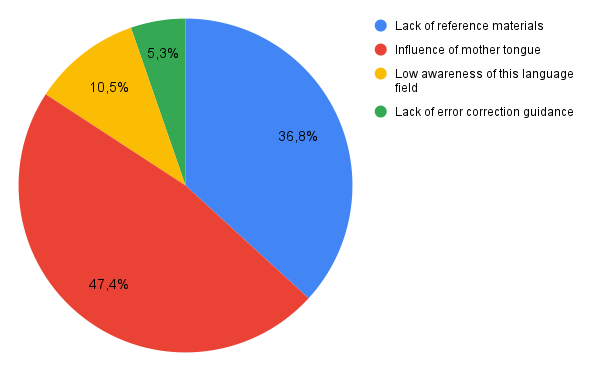
The pie chart reveals that mother tongue interference is the most significant factor (47.4%) contributing to students’ collocational errors. This suggests that learners mainly rely on direct translation from their first language, leading to unnatural or incorrect word combinations in English. The second major factor is the lack of reference materials (36.8%), suggesting that students lack sufficient access to reliable resources such as collocation dictionaries or corpora to support accurate language use. In contrast, limited awareness of collocations (10.5%) plays a smaller but still notable role, indicating that some students are not fully conscious of the importance of collocations in academic writing. Finally, the least influential factor is the lack of error correction guidance (5.3%), suggesting that, although feedback is limited, it is not the primary cause of errors.
Overall, the findings highlight that both L1 interference and insufficient learning resources are key contributors, emphasising the need for increased exposure to authentic input and explicit instruction on collocations.
Addressing L1 Interference
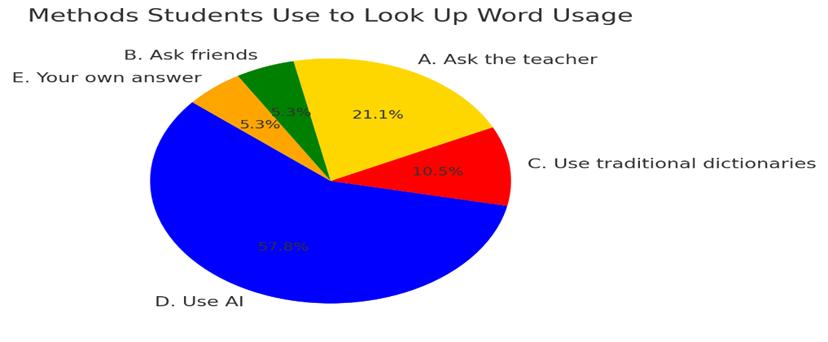
Survey statistics revealed that most students use online tools, previously Google and now ChatGPT, to look up word usage, while about one-fifth seek help from their teachers. This explains why only a limited number of collocation errors were found in their essays. Among students who had not yet used ChatGPT for assistance, some errors listed in section 4.1 remained in their writing. Most errors were successfully revised after AI consultation, although some revisions required further teacher clarification.
DISCUSSION
Causes of Errors
The main reason for adjective-noun errors is the influence of students’ native language, particularly literal translation, whereby Vietnamese students often translate word-for-word from Vietnamese to English. For example, in Vietnamese, people often say “kiếm đủ tiền” or “có mức lương đủ để trang trải cuộc sống.” When translating into English, learners may incorrectly use “enough salary” instead of “enough money” because they perceive salary as synonymous with money. However, the correct English expressions are “have enough money to do something” or, when referring to salary, an appropriate expression is “an adequate/a sufficient salary.” This interference also makes students struggle with verb-noun collocations. For example, when trying to say “gặp các vấn đề về sức khỏe”, students may incorrectly use “meet health problems.” However, collocation dictionaries indicate that the correct verbs for this phrase are “experience,” “encounter,” “struggle with,” or “suffer from.”
Noun-noun collocation errors stem from a lack of awareness of fixed expressions. In Vietnamese, nouns can be combined freely without grammatical changes or additional prepositions, but English academic writing relies heavily on fixed collocations. Moreover, Vietnamese sentences often rely on verbs for meaning, whereas in English, compound nouns or noun phrases can convey ideas more concisely and accurately. For example, in “những người đến tuổi nghỉ hưu,” “nghỉ hưu” functions as a verb, but in English, it is expressed as the noun phrase “people at retirement age.” Since students are unaware of the importance of compound nouns, they might produce phrases that are grammatically correct but sound awkward or non-native.
Similarly, due to differences in Vietnamese patterns of word association, verb-preposition errors are commonly found in students’ writing. In Vietnamese, prepositions are not used as frequently as in English, nor is there a strict requirement for verb-preposition pairing. As a result, when translating ideas into English, students may omit or misuse prepositions. Since they do not recognise the importance of collocations, they make little effort to memorise phrasal verbs, leading to limitations in academic writing, where linguistic precision is crucial. This result is in line with the findings of Bennui (2008) and Duangpaserth et al. (2022), who found that structure transfer and literal translation were the main causes of L1-related errors in EFL writing. The current results, however, emphasise the need for collocational knowledge even more because students may be familiar with the separate meanings of verbs and prepositions but not their common combinations.
Limited exposure to academic English collocations can also account for these errors. Students may have learned general English but not the specific collocations common in academic writing, so instead of producing precise collocations, they might overgeneralise simple collocations to academic contexts. In addition, cultural differences in expression affect students’ use of collocations. Vietnamese academic culture might value different rhetorical styles while English academic style values conciseness, clarity, and certain formulaic expressions, leading to different choices in collocation and phrasing. These findings are largely consistent with previous research on L1 interference in collocation use. The findings are consistent with studies by Bahns and Eldaw (1993), Laufer and Waldman (2011), and Alsulayyi (2015) that direct translation from the native language is the main cause of collocational errors, particularly in verb-noun and adjective-noun combinations. However, while earlier studies primarily emphasised the role of L1 transfer, the current findings further suggest that limited exposure to authentic academic English and insufficient explicit instruction on collocations also contribute substantially to students’ non-native-like collocational choices.
Addressing L1 interference
During writing practice, ChatGPT functions as an intelligent dictionary, helping students select the correct word combinations while traditional methods have their own drawbacks. To be more specific, consulting a paper dictionary is time-consuming and requires students to read entire pages to find the most suitable word. Google and other search engines may return results that are difficult for learners to evaluate for collocational appropriateness. Seeking a teacher’s help in a class of about 30 students can be inconvenient or time-consuming. In contrast, ChatGPT, with its updated and extensive language model, can provide rapid suggestions, allowing students to focus on their writing while also maintaining privacy from their peers.
Based on theories of language transfer and phraseological competence, together with the empirical findings of the present study, the researcher suggests that a combination of technology-assisted feedback, targeted instruction and structured classroom practices may help reduce L1 interference in EFL academic writing. These strategies allow learners to become more aware of their errors, adopt effective writing habits and thus achieve greater proficiency in English. First, classroom practices such as engagement with authentic materials and collaborative writing that explicitly emphasise differences between L1 and L2 collocations may increase syntactic complexity, encouraging more L2 interaction and reducing L1 interference over time without negatively affecting accuracy or fluency. Second, technology-assisted tools such as online collocation aids and corpus consultation can assist learners in identifying and correcting L1-based errors.
To sum up, L1 interference is a key factor in EFL students’ collocation errors in academic writing, affecting both grammatical and lexical combinations. Addressing these challenges requires explicit instruction, awareness of L1-L2 differences and supportive tools to help learners develop more native-like collocational competence.
CONCLUSION
Summary
Collocations play a crucial role in foreign language learning in general and essay writing skills in particular. Mastering collocations is considered a marker of language proficiency, as it allows writers to express ideas in a concise, natural, and fluent manner, similar to native speakers. However, students’ awareness of the importance of collocations and their in-depth understanding of this linguistic aspect remain insufficient. As a result, their essays are often wordy and lack accuracy.
Survey results indicate that students’ collocation errors mainly derive mainly from L1 interference and a lack of reference materials. An analysis of 30 essays also reveals that collocations are used infrequently and students tend to translate directly from Vietnamese to English without considering differences in collocation usage between the two languages, resulting in unnatural or incorrect phrases.
To address this issue, collocations should be integrated into learning materials with specific guidance from teachers. This would enable students to study collocations systematically, understand their importance and develop a habit of using them more frequently. The findings also suggest that AI tools such as ChatGPT may assist students in correcting errors and selecting appropriate word pairs.
Limitations
Despite its contributions, this study has several limitations. First, the sample size was relatively small, consisting of only 30 student essays from a single university, which may limit the generalisability of the findings. Second, the analysis focused primarily on written data and did not examine students’ spoken production or longitudinal development of collocational competence. Third, the study did not experimentally measure the effectiveness of AI-assisted instruction but instead discussed its potential pedagogical implications. The use of AI tools also presents potential limitations, including risks of hallucination, overcorrection, and concerns related to academic integrity, which require careful pedagogical guidance and ethical considerations. As a result, future research should involve larger and more diverse samples, adopt longitudinal or experimental designs, and empirically investigate the impact of AI-integrated instruction on students’ collocation mastery.
Implications
The findings of this study suggest several important pedagogical implications for improving students’ academic writing. First, greater emphasis should be placed on explicit instruction of collocations, particularly common verb-noun and adjective-noun patterns rather than relying solely on incidental vocabulary learning. According to the Lexical Approach (Lewis, 1993), language is acquired more effectively through learning lexical chunks than isolated words, and explicit attention to collocations can improve both lexical accuracy and writing fluency. Second, integrating corpus-based resources and authentic academic texts can enhance students’ exposure to natural language use because these resources enable learners to discover authentic collocational patterns independently, thereby reducing reliance on L1 translation and improving phraseological competence (Sinclair, 1991; Jacob et al., 2025). Finally, the guided use of AI tools can support error correction and raise learners’ awareness of appropriate collocational choices. When designing curricula, it is essential to provide instructional materials and specific guidelines from teachers on how to use AI tools effectively. This would allow ChatGPT to maximise its strengths, serving as a powerful tool to enhance students’ collocation learning while also reducing the workload for teachers in error correction tasks.
Future research can be conducted on a larger scale by involving a larger and more diverse sample across different universities to enhance generalisability. Further studies should also examine how collocational competence develops over time and how L1 interference changes with proficiency. Additionally, future studies may explore the effectiveness of specific instructional interventions, such as corpus-based teaching or AI-assisted learning, in improving students’ collocation use. Finally, investigating other influencing factors, such as learning strategies or proficiency levels, would provide a more comprehensive understanding of collocational development.
In short, this study confirms that L1 interference influences Vietnamese students’ use of collocations in academic writing. Addressing this issue requires targeted teaching strategies, increased exposure to authentic texts and AI-enhanced learning tools. Future research should explore how AI can be integrated into language classrooms to optimise students’ mastery of collocations.
References
Alsulayyi, M. N. (2015). The use of grammatical collocations by advanced Saudi EFL learners in the UK and KSA. International Journal of English Linguistics, 5(1), 32-43. https://doi.org/10.5539/ijel.v5n1p32
Bahns, J., & Eldaw, M. (1993). Should we teach EFL students collocations? System, 21(1), 101-114. https://doi.org/10.1016/0346-251X(93)90010-E
Bennui, P. (2008). A study of L1 interference in the writing of Thai EFL students. Malaysian Journal of ELT Research, 4, 72-102.
Benson, M., Benson, E., & Ilson, R. (1986). The BBI combinatory dictionary of English: A guide to word combinations. John Benjamins.
Corder, S. P. (1967). The significance of learner’s errors. International Review of Applied Linguistics in Language Teaching, 5(1-4), 161-170. https://doi.org/10.1515/iral.1967.5.1-4.161
Corder, S. P. (1974). Error analysis. In J. P. B. Allen, & S. P. Corder (Eds.), The Edinburgh course in applied linguistics: Vol. 3. Techniques in applied linguistics (pp. 122-154). Oxford University Press.
Creswell, J. W., & Plano Clark, V. L. (2018). Designing and conducting mixed methods research (3rd ed.). Sage Publications.
Duangpaserth, K., Meunviseth, Y., & Chanboualapha, S. (2022). An investigation into L1 interference in Lao EFL students’ writing and translation for curriculum and teaching improvement. Journal on English as a Foreign Language, 12(2), 362-382. https://doi.org/10.23971/jefl.v12i2.4105
Firth, J. R. (1957). Papers in linguistics, 1934-1951. Oxford University Press.
Halliday, M. A. K., & Hasan, R. (1976). Cohesion in English. Longman.
Hill, J. (2000). Revising priorities: From grammatical failure to collocational success. In M. Lewis (Ed.), Teaching collocation: Further developments in the lexical approach (pp. 47-69). Language Teaching Publications.
Jacob, S. R., Tate, T., & Warschauer, M. (2025). Emergent AI-assisted discourse: Case study of a second language writer authoring with ChatGPT. Journal of China Computer-Assisted Language Learning, 5(1), 1-22. https://doi.org/10.1515/jccall-2024-0011
Laufer, B., & Waldman, T. (2011). Verb-noun collocations in second language writing: A corpus analysis of learners’ English. Language Learning, 61(2), 647-672. https://doi.org/10.1111/j.1467-9922.2010.00621.x
Lewis, M. (1993). The lexical approach: The state of ELT and a way forward. Language Teaching Publications.
Lewis, M. (Ed.). (2000). Teaching collocation: Further developments in the lexical approach. Language Teaching Publications.
McCarthy, M., & O’Dell, F. (2017). English collocations in use: Advanced (2nd ed.). Cambridge University Press.
McIntosh, C., Francis, B., & Poole, R. (Eds.). (2009). Oxford collocations dictionary for students of English (2nd ed.). Oxford University Press.
Nation, P. (1990). Teaching and learning vocabulary. Heinle&Heinle.
Nesselhauf, N. (2005). Collocations in a learner corpus. John Benjamins. https://doi.org/10.1075/scl.14
Nguyen, X. Q. (2021). Thói quen học và sử dụng kết hợp từ trong bài viết của sinh viên Khoa Tiếng Anh Trường Đại học Ngoại ngữ, Đại học Huế. [English-majored students’ habits of learning and using collocations in writing at the University of Foreign Languages and International Studies, Hue University]. Tạp chí Khoa học Ngôn ngữ và Văn hóa, 5(3), 303-317. https://doi.org/10.63506/jilc.0503.117
Nguyen, T. M. N., & Hoang, T. K. T. (2023). Nghiên cứu về kết hợp từ (collocations) trong bài luận của sinh viên năm 2. [An investigation into the use of collocation in the essays of second-year English-majored students]. Tạp chí Khoa học Ngôn ngữ và Văn hóa, 7(1), 54-64. https://doi.org/10.63506/jilc.0701.74
Paquot, M. (2017). L1 frequency in foreign language acquisition: Recurrent word combinations in French and Spanish EFL learner writing. Second Language Research, 33(1), 13-32. https://doi.org/10.1177/0267658315620265
Shih, R. H.-H. (2000). Collocation deficiency in a learner corpus of English: From an overuse perspective. In A. Ikeya & M. Kawamori (Eds.), Proceedings of the 14th Pacific Asia Conference on Language, Information and Computation (pp. 281-288). PACLIC 14 Organizing Committee. https://aclanthology.org/Y00-1028/
Sinclair, J. (1991). Corpus, concordance, collocation. Oxford University Press.
Siyanova, A., & Schmitt, N. (2008). L2 learner production and processing of collocation: A multi-study perspective. The Canadian Modern Language Review, 64(3), 429-458. https://doi.org/10.3138/cmlr.64.3.429
Warschauer, M., Tseng, W., Yim, S., Webster, T., Jacob, S., Du, Q., & Tate, T. (2023). The affordances and contradictions of AI-generated text for writers of English as a second or foreign language. Journal of Second Language Writing, 62, Article 101071. https://doi.org/10.1016/j.jslw.2023.101071
Xia, D., Chen, Y., & Pae, H. (2023). Lexical and grammatical collocations in beginning and intermediate L2 argumentative essays: A bigram study. International Review of Applied Linguistics in Language Teaching, 61(4), 1421-1453. https://doi.org/10.1515/iral-2021-0188
Yan, D. (2023). Impact of ChatGPT on learners in a L2 writing practicum: An exploratory investigation. Education and Information Technologies, 28(11), 13943-13967. https://doi.org/10.1007/s10639-023-11742-4
Downloads
Published
Issue
Section
License
Copyright (c) 2026 Thi Minh Nguyen

This work is licensed under a Creative Commons Attribution-NonCommercial-NoDerivatives 4.0 International License.