
ISSN: 3083-2330 | Access: Open
Licence: CC BY-NC-ND 4.0
Frequency: Quarterly
Referencing Style
Procia uses APA referencing style (7th edition), with limited modifications to article page ranges and the presentation of tables and figures. Follow APA conventions for in-text citations and reference entries, except for the Procia-specific requirements below. For manuscript layout, use the Procia template and Author Guidelines.
In-text citations
Use the author–date system. Give the surname and publication year: Dang (2026) or (Dang, 2026). For two authors, use “and” in narrative citations and “&” in parentheses: Rybaczewska and Sparks (2022) or (Rybaczewska & Sparks, 2022). For three or more authors, use the first surname followed by “et al.” from the first citation: Dang et al. (2026) or (Dang et al., 2026). Include additional names if needed to distinguish otherwise identical citations.
Separate different works in the same parentheses with semicolons and arrange them alphabetically. Distinguish works by the same author or authors in the same year with letters, such as 2024a and 2024b, consistently in the text and references. Use “n.d.” when no publication date is available; do not guess a date.
For direct quotations, include a page number or another precise locator, such as a paragraph number when pages are unavailable. Enclose quotations of fewer than 40 words in quotation marks. Present quotations of 40 words or more as an indented block without quotation marks. Cite paraphrased ideas as well as quotations.
Author names and citation accuracy
Correctly identifying given name(s) and family name helps ensure that author names appear as intended in citations. When submitting your own work, check these fields in the submission platform and ensure that they agree with the manuscript cover page. Either field may contain several words. Authors are responsible for the accuracy of these entries. If the two versions differ, the platform entries will take precedence. Crossref metadata deposits use the given-name and family-name fields, not the Preferred Public Name field; a preferred display name does not override those details for Crossref indexing. When referencing other publications, follow the reference examples on this page and preserve the spelling and structure of the family names recorded in the source.
Preparing the reference list
Use the heading References. Arrange entries alphabetically by the first author surname or the name of the organisation. Preserve the published author order within each entry. Use surnames followed by initials and a hanging indent of 1.27 cm (0.5 in.). Check that citations and reference entries correspond; personal communications that readers cannot retrieve are cited only in the text.
Use sentence case for article, chapter, book and report titles, retaining capitals for proper nouns and the first word after a colon. Use title case for journal names. Italicise journal names and volume numbers, and the titles of standalone books, reports, theses and webpages. Do not italicise article or chapter titles, journal issue numbers, or edition information.
Include a DOI when one is assigned, using the form https://doi.org/ followed by the identifier. Prefer the DOI to a duplicate URL and do not place a full stop after a DOI or URL. For works without a DOI, include an appropriate public URL where the reference type requires one. Do not include database login links. Check the original source and the destination of each link rather than relying solely on reference-management software.
Journal article
Give the authors, year, article title, journal name, volume, issue, page range and DOI, where available.
Journal-specific modification: page ranges instead of article numbers. Use a page range for every journal article reference, even when the source journal identifies the article by an article number or electronic locator. Replace that article number with the page range of the full-text article. For an article paginated independently from page 1, give the range from the first to the last page, such as 1–18. Retain the original page range when the article uses continuous journal pagination. Verify the range from the full text; do not infer it from the article number or invent pagination. If a paginated version cannot be located, consult the editorial office. Keep the DOI unchanged, including any article number that forms part of the DOI. This requirement differs from standard APA 7 referencing, which uses the article number when the source assigns one instead of a page range.
Single author; article-level page range
Dang, T. T. (2026). The relationship between written corrective feedback preference in EFL writing skills and learner autonomy of Vietnamese students in higher education. Ampersand, 17, 1–12. https://doi.org/10.1016/j.amper.2026.100285
Two authors; page range
Rybaczewska, M., & Sparks, L. (2022). Ageing consumers and e-commerce activities. Ageing and Society, 42(8), 1879–1898. https://doi.org/10.1017/S0144686X20001932
Authored book
Give the authors, year, book title, edition if not the first, publisher and DOI where available. Do not include the city of publication.
Jackson, L. M. (2019). The psychology of prejudice: From attitudes to social action (2nd ed.). American Psychological Association. https://doi.org/10.1037/0000168-000
Edited book
When citing an entire edited collection, put the editors in the author position and add “(Ed.)” or “(Eds.)” before the year. When citing a particular chapter, use the chapter format below.
Torino, G. C., Rivera, D. P., Capodilupo, C. M., Nadal, K. L., & Sue, D. W. (Eds.). (2019). Microaggression theory: Influence and implications. John Wiley & Sons. https://doi.org/10.1002/9781119466642
Chapter in an edited book
Start with the chapter authors and title. Then give the editors, book title, chapter page range, publisher and chapter DOI, where available. In the editor element after “In”, place initials before surnames.
Dang, T. T., Nguyen, T. V. T., & Huynh, L. T. (2026). Contestation of ideologies in English language education in Vietnam: Internationalisation vs. decolonisation. In S. Y. Chew, R. K. Shangeetha, & S. Pillai (Eds.), Language use in Southeast Asia: Present realities and future trends (pp. 184–198). Routledge. https://doi.org/10.4324/9781003656623-14
Report
Use the credited individual or organisation as the author. Include a report number when available. Omit the publisher when it is identical to the author.
National Cancer Institute. (2019). Taking time: Support for people with cancer (NIH Publication No. 18-2059). U.S. Department of Health and Human Services, National Institutes of Health. https://www.cancer.gov/publications/patient-education/takingtime.pdf
Webpage
Give the author, the date associated with the content, the page title, the website name and the URL. Omit the website name if it is identical to the author. A retrieval date is usually unnecessary; include one for unarchived content designed to change over time. Cite an online journal article or report as that type of work, rather than treating every online source as a webpage.
Schaeffer, K. (2021, October 1). What we know about online learning and the homework gap amid the pandemic. Pew Research Center. https://www.pewresearch.org/short-reads/2021/10/01/what-we-know-about-online-learning-and-the-homework-gap-amid-the-pandemic/
Thesis or dissertation
Give the author, year, title, degree type and awarding institution in square brackets, followed by the repository or database and a public URL where available. The example below is a doctoral dissertation available in an institutional repository.
Zambrano-Vazquez, L. (2016). The interaction of state and trait worry on response monitoring in those with worry and obsessive-compulsive symptoms [Doctoral dissertation, University of Arizona]. UA Campus Repository. https://repository.arizona.edu/handle/10150/620615
Published conference paper
Use the format of the published proceedings: a journal article, edited book or chapter in an edited book. The example below is a paper published as a chapter. An unpublished conference presentation requires a different reference format.
Bedenel, A.-L., Jourdan, L., & Biernacki, C. (2019). Probability estimation by an adapted genetic algorithm in web insurance. In R. Battiti, M. Brunato, I. Kotsireas, & P. Pardalos (Eds.), Lecture notes in computer science: Vol. 11353. Learning and intelligent optimization (pp. 225–240). Springer. https://doi.org/10.1007/978-3-030-05348-2_21
Tables and figures
Place the number and title above every table and figure. Write the label, number and one full stop in bold, followed by one space and an italic title on the same line. Align the caption to the left. Use title case for the title and do not add a full stop at its end. This same-line caption is a Procia-specific modification to APA presentation.
Table 1. Number of Accepted Submissions Included in the Corpus
| Submission Type | 2021 | 2022 | 2023 | 2024 | 2025 |
|---|---|---|---|---|---|
| Oral Presentation | 109 | 125 | 114 | 230 | 434 |
| Poster | 8 | 128 | 103 | 136 | 323 |
| Workshop | 19 | 37 | 15 | 45 | 58 |
| Symposium | N/A | N/A | N/A | N/A | 7 |
| Total | 136 | 290 | 232 | 411 | 822 |
Note. Reproduced from Table 1 (p. 4) in “Trends in TESOL/EFL research in Vietnam (2021–2025): A thematic analysis of accepted abstracts from VietTESOL Convention,” by T. T. Dang (2026), Journal of Language Teaching and Learning Today. https://doi.org/10.65956/ltlt.2026.37. Data are unchanged; the table has been typeset for this guide.
Figure 1. Author Keyword Co-Occurrence Network
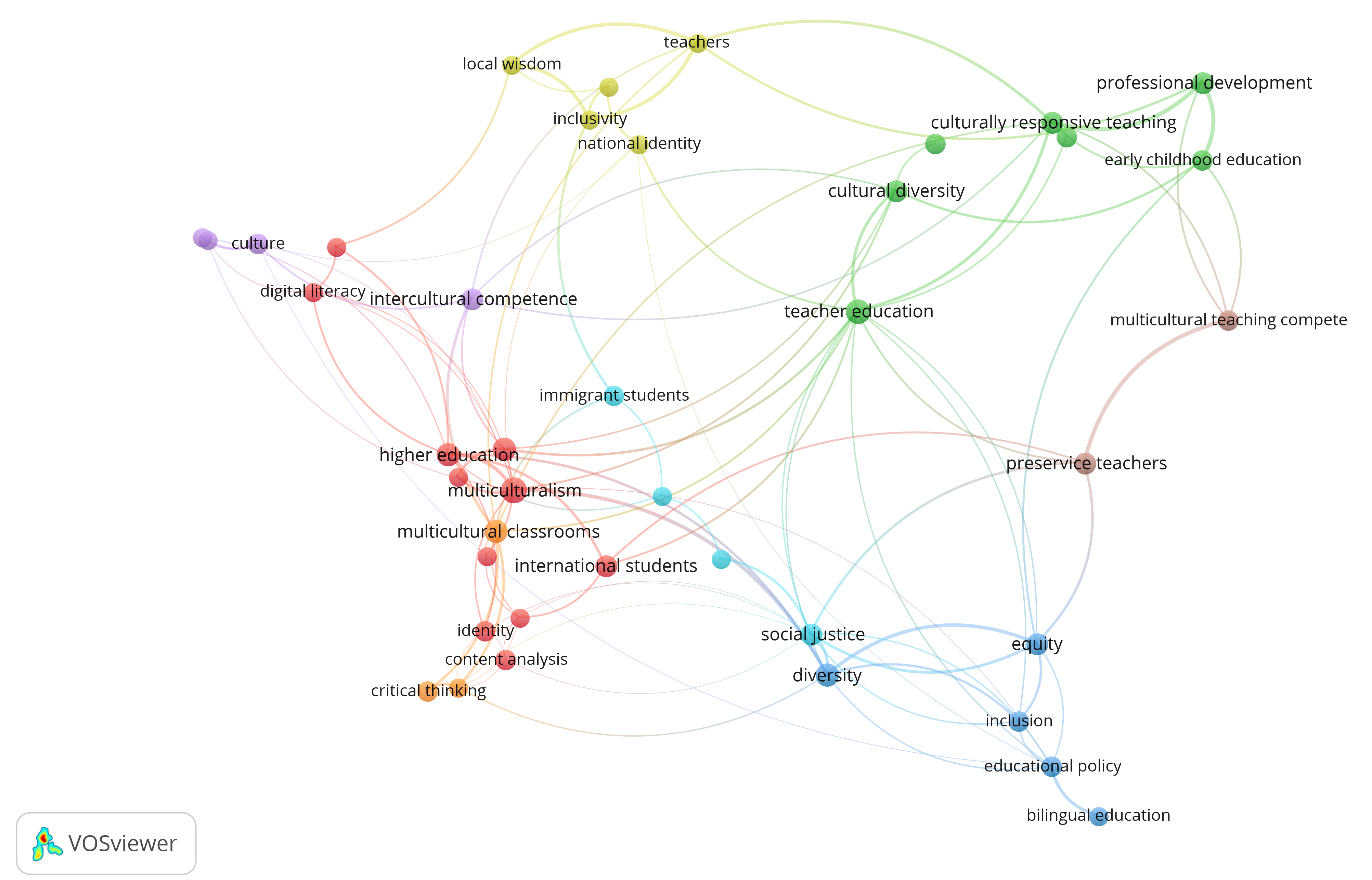
Note. The minimum keyword frequency is three. The focal term is omitted from the visualisation only; the largest component contains 41 terms connected by 107 fractional links. The image is reproduced unchanged from Figure 3 in “From representation to equitable participation: An overview of multicultural education research published in 2025,” by T. T. Dang, S. Elnaili, and T. T. K. Le (2026), Journal of Multicultural Education and Engagement. https://doi.org/10.65956/meen.2026.152. Select the image to view it at full size.
These examples reproduce a table from LTLT and a figure from MEEN. The figure is numbered Figure 1 in this guide and was Figure 3 in the original article. Place the table or figure immediately below its caption. Do not place a figure title below the image.
Number tables and figures separately in the order in which they are first mentioned: Table 1, Table 2; Figure 1, Figure 2. Refer to each by its number in the text. Use editable tables with clear column headings, and ensure that figure labels remain legible at publication size.
Place explanatory notes, abbreviation definitions and source acknowledgements below the table or figure. Begin a general note with italic Note. followed by regular text. Identify reproduced or adapted material and include the source in the reference list. Follow any applicable licence or permission conditions; a citation alone does not replace permission where it is required.
Further guidance
For reference types and citation situations not covered here, consult the official APA Style reference examples. Apply the Procia-specific table and figure format above and use the current journal template for manuscript layout.