Sustainability success in language education: A critical conceptual synthesis
DOI:
https://doi.org/10.65956/procia.2026.205Keywords:
sustainability-oriented language education, educational aims, programme evaluation, epistemic authority, conceptual synthesisAbstract
Sustainability-oriented language education connects language learning with ecological understanding, action, and relationships among languages, knowledges, and communities. These purposes complicate judgments of success because a well-written text, a reported disposition, and a claim of knowledge co-creation may concern different achievements. This critical conceptual synthesis compares Eco-ELT, transformative language teaching for sustainability, language education for sustainable development, and transepistemic education. Drawing on argument-based evaluation, reasoning about educational purpose, and assessment validation, it examines educational aims, evaluation of achievement, and comparison of success claims. The literature supports comparison of aims and practices, but its uneven evidence base does not support an overall effectiveness ranking. Resource appraisal, task performance, self-report, and conceptual argument support different conclusions and require justification suited to each claim. The contribution distinguishes extending evidence-based support for an asserted achievement, adding an explicitly justified educational criterion, and silently substituting another achievement or standard. Further evidence may strengthen a claim, it but cannot by itself justify giving priority to a new purpose. Existing purposes also remain open to criticism. The synthesis explains how comparison can preserve differences in achievement while requiring justification of both the evidence and the authority to determine educational values.
INTRODUCTION
Judgments of success in language education become more demanding when communication is linked to ecological understanding, action, and relationships among languages, knowledges, and communities (Jodoin, 2020; Maijala et al., 2024; Meighan, 2023b; Saiful, 2023). These connections broaden the purposes of language teaching. A communicative product, a reported disposition, and an account of knowledge exchange may all have educational values, depending on what is claimed and how it is supported. Comparison therefore requires attention to both the achievement being judged and the reasons for valuing it.
The Problem of Evaluation Sustainability Success
Judging educational success requires evidence and reasons for valuing an achievement. Language programme evaluation examines interventions, conditions, and consequences, while argument-based evaluation asks how findings support particular interpretations and decisions (Gruba et al., 2016; Norris, 2016). Reasoning about educational purpose asks why an achievement should matter (Biesta, 2009). Sustainability education also provides accounts of competencies, assessment, and impact (O’Flaherty & Liddy, 2018; Redman & Wiek, 2021; Redman et al., 2021; Wiek et al., 2011). The question is how to use these resources when the approaches being compared pursue aims that overlap but differ in meaning.
Language education already distinguishes among kinds of sustainability achievement. Writing and nature empathy have been assessed separately, relational valuation has been followed up after one month, and environmental aspirations have been distinguished from prescribed behaviour (Jodoin, 2022; Saiful & Ver Steeg, 2025; Saiful & Yunianti, 2025). Pedagogical mapping identifies variation in outcomes and limits to direct effectiveness comparisons (Al-Hakimi & Widyaningrum, 2026). Multilingual, transepistemic, and decolonial writing scholarship also addresses community knowledge and evaluative authority (Barrett et al., 2025; Meighan, 2023a; Shah, 2026; Sun & Li, 2026). The contribution sought here is to explain how these judgments relate and what their comparison requires.
Purpose and Research Questions
This critical conceptual synthesis compares ecological English language teaching (Eco-ELT), transformative language teaching for sustainability (TLS), language education for sustainable development (LESD), and transepistemic education (TEE). It examines when comparison calls for further evidence, when it introduces another educational criterion, and when it silently changes the achievement being evaluated. A common criterion may be useful alongside the original purposes of an approach, provided its educational relevance is justified. Both the evidence and the purpose therefore need scrutiny. Making them explicit allows that scrutiny without establishing that either is adequate. The three research questions guide this paper are:
RQ1. What educational aims do the sustainability-oriented language-education approaches pursue?
RQ2. How is the achievement of these aims evaluated?
RQ3. What similarities and differences emerge when success claims are compared across the approaches?
CONCEPTUAL SCOPE AND RATIONALE
The four approaches differ in pedagogical scope and in what they regard as worthwhile achievement. These differences allow an examination of success across language learning and teacher education without treating the approaches as equivalent interventions. The approaches are the subject of comparison. The evaluation and reasoning about the educational purpose guide their interpretation. The contribution lies in the relationships developed through this conceptual comparison, rather than in a new empirical evaluation or a general theory of success (Jaakkola, 2020).
Four Approaches to Sustainability in Language Education
There are four approaches connecting language education with environmental and social concerns at different conceptual levels (Table 1). Eco-ELT is a broad environmental orientation; TLS is a model for didactic integration; LESD is a formulation linking language and sustainability; and TEE is an account of knowledge co-creation. Communication, ethical judgment, and participation recur across them. Yet the name of an approach does not determine the aim of every application. The comparison therefore examines particular commitments and claims, without assigning each approach an exclusive educational function.
Table 1. Four Approaches and their Roles in the Comparison
|
Approach |
Educational orientation |
Comparative significance |
|---|---|---|
|
Eco-ELT |
Ecological understanding, ethical relationships, and environmental research and praxis in English teaching (Saiful, 2020, 2023) |
Variation among language performance, dispositions, resources, and institutional practices |
|
TLS |
Didactic integration informed by holism, pluralism, and action orientation (Maijala et al., 2024) |
Relationships among framework use, communicative work, competence, and transformation |
|
LESD |
Environmental literacy, complex sustainability understanding, and reflective judgment through language education (Jodoin, 2020, 2022) |
Educational purposes distinguished from hoped-for environmental consequences |
|
TEE |
Relationships among languages, knowledges, land, and community through respectful co-creation (Meighan, 2023a, 2023b, 2025) |
Authority to recognise knowledge and judge achievement |
Note. The orientations overlap and do not rank educational value.
Boundaries of the Comparison
The focal sources explicitly develop, apply, or evaluate an identified approach or its components. A shared theme or a citation alone does not establish this connection. Related education for sustainable development (ESD), model-overview, and decolonial scholarship provides context for the analysis (Chaka, 2023; Maijala & Kuusalu, 2025; Manyasi, 2024; Ngo & Le-Khanh, 2025). DEEP, comprising Diversity, Exploration, Expression, and Partnership, also connects world-language education with the United Nations Sustainable Development Goals (SDGs), but is outside the focal analysis (Kong, 2025). This selection supports the conceptual contrasts pursued here without representing the whole field.
The source-level matrix records 36 publications available to this synthesis by October 2026, including 35 originals and one secondary synthesis. These totals count publications, not independent empirical studies. Swedish, Finnish, German, and Spanish settings broaden the comparison beyond English teaching, although findings cannot be assumed to transfer between languages or institutions (Broermann et al., 2025; Maijala, Patzelt, et al., 2025; Orsatti, 2026). The uneven coverage limits generalisation but does not, by itself, determine the conceptual authority of an argument.
ANALYTICAL FRAMEWORK
Comparing success claims requires attention to both support and purpose. One question concerns the grounds for an asserted achievement, and the other concerns why it should count as success. A convincing purpose does not demonstrate its realisation, and a well-supported finding does not establish its educational priority. Argument-based evaluation and reasoning about educational purpose connect these questions while retaining the distinction between evidence-based and normative justification (Biesta, 2009; Gruba et al., 2016; Kane, 2013). The framework guides interpretation rather than prescribes an assessment instrument.
Claims and their Support
An educational aim names an intended achievement. An achievement is a performance, experience, capacity, or change asserted to have occurred. A success claim judges it against a stated or implied standard. Educational worth concerns the reasons for valuing it. Argument-based evaluation examines how evidence, warrants, and assumptions connect a finding with an interpretation or decision, including alternative explanations and wider implications (Gruba et al., 2016). Assessment validation likewise distinguishes support for interpreting a score from support for using it (Kane, 2013). These distinctions help assess whether conclusions about development or a programme are warranted by performance on a task.
Educational Purposes and Evaluative Standards
Qualification concerns capacities and judgment, socialisation concerns participation in existing practices, and subjectification concerns becoming a subject with some independence from those practices (Biesta, 2009). These purposes can overlap or conflict, so effectiveness for one does not establish its priority over another. Agency, educational purpose, and epistemic justice also inform TLS, while sustainability competencies specify capacities such as systems thinking, normative judgment, and implementation (Gericke, 2025; Kuusalu, 2025; Redman & Wiek, 2021; Wiek et al., 2011). These resources clarify what an activity values without placing approaches in exclusive categories or equating measurable outcomes with educational worth.
Three Analytical Dimensions
The three dimensions in Table 2 organise comparison around educational aims, evaluation of achievement, and success claims. Within these dimensions, description identifies what a source proposes or reports, evidence-based appraisal examines its support, and normative criticism considers the reasons and standards for judging success. Questions developed in this synthesis remain distinct from claims made in the sources. Figure 1 shows how these judgments relate. It is an explanatory map, not a validated model.
The questions used to appraise evidence depend on the claim. Judgments of a product require attention to task conditions and criteria. Claims about development need grounds for interpreting change, and causal claims must address alternative explanations. Conceptual arguments depend on defensible premises and connections. Relational judgments require attention to whose experience and authority inform them. Before treating findings as conflicting evidence of effectiveness, it is necessary to check for differences in achievement, context, time, and interpretation. Consistency lies in this reasoning, rather than in identical methods or a numerical quality score.
Table 2. Analytical Dimensions and Research Questions
|
Dimension |
Questions guiding comparison |
Interpretive focus |
|---|---|---|
|
Educational aims (RQ1) |
What achievement is intended, for whom, and in which setting? Why is it worthwhile? |
Purposes, meaning, and context |
|
Evaluation of achievement (RQ2) |
What assessment or justification is proposed or used? What does it support? |
Evidence conditions, warrants, assumptions, and alternatives |
|
Comparison of success claims (RQ3) |
Does comparison extend support for the same claim, add a justified criterion, or silently substitute another judgment? |
Relationships among achievement, purpose, and authority |
Note. The dimensions draw on argument-based evaluation, educational-purpose reasoning, and assessment validation (Biesta, 2009; Gruba et al., 2016; Kane, 2013).
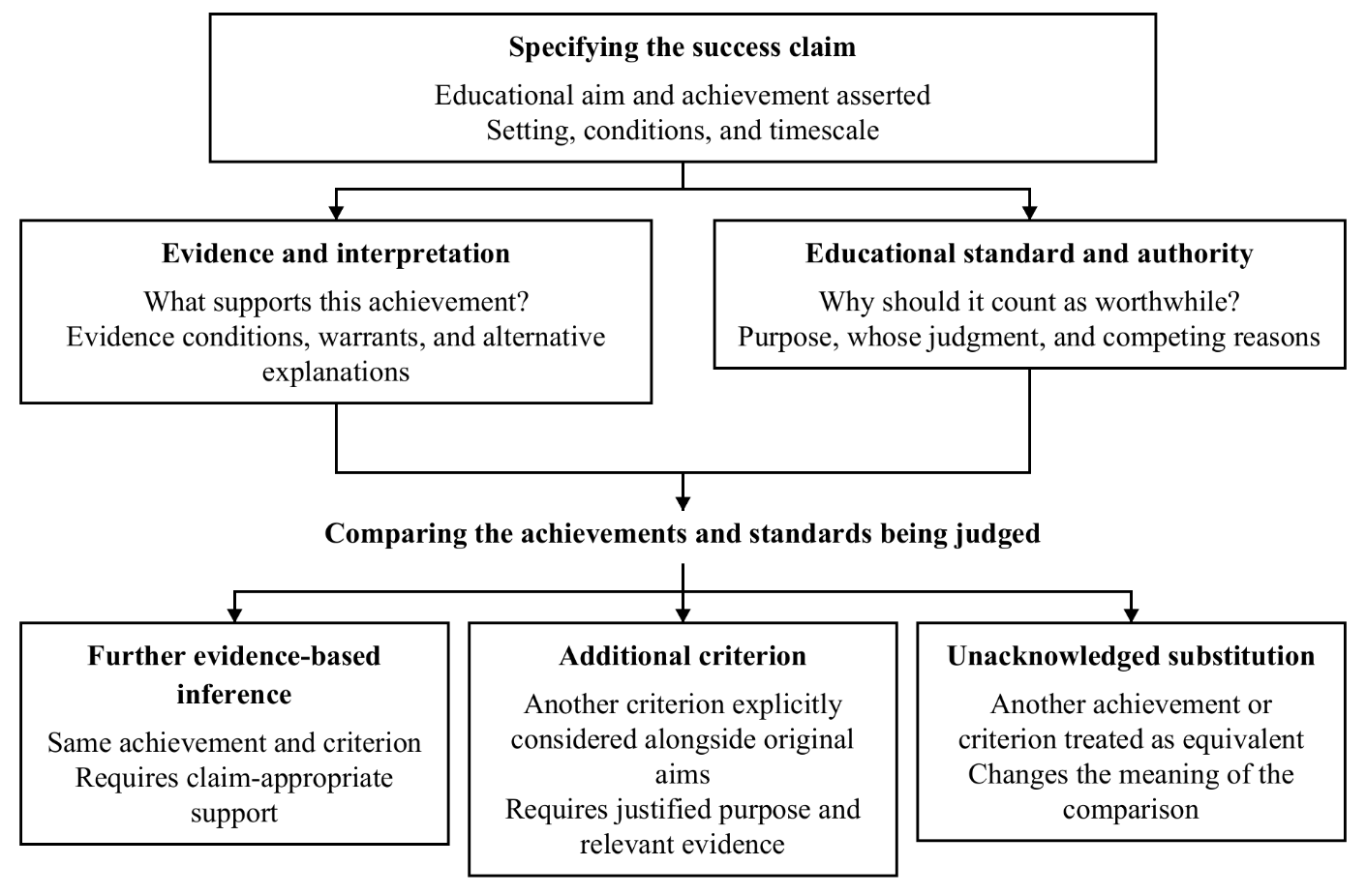
Note. The figure integrates evaluation, purpose, and validation perspectives (Biesta, 2009; Gruba et al., 2016; Kane, 2013). Arrows connect questions rather than causal effects or learning stages.
Interpretive Commitments
This synthesis assumes that claims of achievement should stay within the support available and that educational purposes need to be justified. These commitments make justification open to scrutiny, but the assumptions guiding this synthesis also remain open to criticism. Independent observation is not universally superior to experiential or reflexive accounts. Its relevance depends on the claim. Critiques of privileged knowledge and evaluative conventions also apply to the evaluative standards used in this synthesis (Meighan, 2023a; Shah, 2026). Interpretations by learners and communities, or defensible purposes missing from a focal account, may challenge the assumptions and conclusions of the comparison.
EDUCATIONAL AIMS, PRACTICES, AND ACHIEVEMENT EVIDENCE
The publications examine resources, learner experiences, performances, dispositions, and institutions. Their findings concern both educational provision and achievement. The comparison first examines the purposes pursued and the practices intended or reported to serve them. It then distinguishes proposed assessments and enacted practices from achievements supported by evaluation, including effects where these are claimed. The source-level matrix records the publication-specific evidence. These distinctions allow the analysis to recognise the value of design and practice accounts while examining what they establish about achievement.
Shared Aims and Different Achievements
Communication, ecological understanding, and ethical relationships recur across the approaches. Eco-ELT extends literary and ecocritical work into environmental research and praxis. TLS organises integration through identification, awareness raising, and integration (Maijala et al., 2024; Maijala, Kuusalu, et al., 2025; Saiful, 2020, 2023). LESD connects environmental literacy with complex SDG understanding, values, beliefs, and norms (VBN), reflection, and empowerment (Jodoin, 2020, 2022). TEE connects languages with knowledge co-creation, land, place, and community (Meighan, 2023a, 2023b, 2025). These shared concerns do not make the intended achievements interchangeable.
Even the shared aim of communication covers different capacities. Environmental reading, vocabulary, and writing differ from lexicographic mediation, dialogue, or articulating complex sustainability problems (Broermann et al., 2025; Campoy-Cubillo, 2025; Hämäläinen, 2025; Kalsum et al., 2024; Lestari et al., 2025; Nadiyah et al., 2024; Saiful, 2024b). SDG-related proficiency and participation in self-access activities give the aim another meaning. Spanish tasks connect communication with critical discussion and community initiatives (Griffiths & Jodoin, 2023; Orsatti, 2026). Comparing achievement therefore requires more precision than simply identifying communication as a common aim.
Ethical purposes include connectedness, empathy, and relational valuation, as well as agency and critical sustainability literacy (Gericke, 2025; Kuusalu, 2025; Saiful, 2024a; Saiful & Ver Steeg, 2025; Saiful & Yunianti, 2025). Locally and Islamically grounded environmental learning and students’ experiences give further meaning to the relationship between sustainability and communication (Budiasih et al., 2026; Maijala, Patzelt, et al., 2025; Rosadi et al., 2025). Epistemic reconstruction and reparative curricula raise questions about recognition and institutions (Shah, 2025, 2026). Environmental vocabulary and favourable responses to lessons each address only part of these educational purposes. Table 3 presents a summary of the comparison.
Table 3. Educational Aims across Four Sustainability-Oriented Approaches
|
Educational Aim |
Eco-ELT |
TLS |
LESD |
TEE |
|---|---|---|---|---|
|
Communication |
English language learning through environmental content |
Communication through sustainability inquiry and dialogue |
Language learning through sustainability issues |
Communication across languages and knowledge traditions |
|
Ecological understanding |
Environmental awareness and understanding |
Holistic understanding of complex sustainability issues |
Environmental literacy and complex SDG understanding |
Relationships among language, land, place, and community |
|
Ethical and participatory aims |
Connectedness, empathy, ethical regard for nature, and environmental praxis |
Critical reflection, agency, and action orientation |
Reflection on values, beliefs, and norms, alongside empowerment |
Respectful knowledge co-creation and recognition of community knowledge |
|
Sources |
(Saiful, 2020, 2023; Saiful & Ver Steeg, 2025; Saiful & Yunianti, 2025) |
(Gericke, 2025; Maijala et al., 2024; Maijala, Kuusalu, et al., 2025) |
(Griffiths & Jodoin, 2023; Jodoin, 2020, 2022) |
(Meighan, 2023a, 2023b, 2025; Shah, 2025, 2026) |
Practices as Designs, Enactments, and Interpretations
Material development, inquiry, communicative products, reflection, and projects give practical form to sustainability aims. Eco-ELT resources and TLS materials specify intended integration, while learner accounts describe experiences with documentaries, digital products, and local inquiry across courses (Budiasih et al., 2026; Maijala, Patzelt, et al., 2025; Nadiyah et al., 2024; Putri et al., 2026) (Table 4). These accounts concern design commitments or reported experiences. They do not describe an equivalent treatment across the approaches, even where activities share a name or format.
Table 4. Evaluation of Achievement across the Four Approaches
|
Analytical category |
Eco-ELT |
TLS |
LESD |
TEE |
|---|---|---|---|---|
|
Proposed tools and criteria |
Environmental and language criteria for tasks and materials |
Reflective tasks, communicative products, and competence criteria |
SCOPE principles, feedback, and demonstration of learning |
Journals, video reflection, and self-assessment for knowledge co-creation |
|
Evaluation material |
Material appraisals, writing, disposition surveys, interviews, and institutional observation |
Dictionary products, questionnaires, self-assessments, journals, and project photographs |
Course marks, questionnaires, coded reflections, interviews, attendance, and feedback |
Classroom accounts, reflective tools, scholarly dialogue, and critical autoethnography |
|
Supported judgments |
Material suitability, task performance, reported dispositions, and institutional enactment |
Textual change, reported learning, and documented project activity |
Mixed course and questionnaire findings, participation, and perceived value |
Situated interpretations of knowledge exchange and conceptual reasons for reform |
|
Limits of inference |
No automatic inference from material approval or reported attitudes to learning gains or ecological effects |
No automatic inference from framework use or coded reflection to transformation or causation |
Changed tasks and limited proficiency evidence restrict developmental and causal claims |
Educator interpretations and proposals do not establish shared authority or enacted reform |
|
Sources |
(Bulan et al., 2026; Nadiyah et al., 2024; Saiful, 2024a; Saiful & Ver Steeg, 2025; Saiful & Yunianti, 2025) |
(Broermann et al., 2025; Campoy-Cubillo, 2025; Hämäläinen, 2025; Maijala, Patzelt, et al., 2025; Orsatti, 2026) |
(Griffiths & Jodoin, 2023; Jodoin, 2020, 2022) |
(Meighan, 2023a, 2023b, 2025; Shah, 2025, 2026) |
LESD practices include content and language integrated learning, problem-solving, presentations, and self-access reading and listening with VBN discussion (Griffiths & Jodoin, 2023; Jodoin, 2020). The later SCOPE principles emphasise student-centred learning, critical thinking, feedback, practice and demonstration, and educating others. They cannot be assigned retrospectively to an earlier course (Jodoin, 2022). Transepistemic practices include text analysis, blogs, journals, video reflection, and self-assessment. The institutional proposals concern changes at another scale (Meighan, 2023a, 2023b, 2025; Shah, 2026). What was designed, what took place, and how it was interpreted require separate judgments.
Evidence of Educational Achievement
Resource appraisal asks whether materials are suitable and usable. Expert validation, pupil responses about practicality, and perceptions after use address material quality, engagement, and perceived access to environmental language (Kalsum et al., 2024; Lestari et al., 2025; Nadiyah et al., 2024; Saiful, 2024b). Development stages and pilot enactments also need to be distinguished from experimental comparisons (Budiasih et al., 2026). Not all findings are favourable. Materials from two schools had a sound general pedagogical structure but weak ecological and policy alignment. The study included neither classroom observation nor evidence of learner outcomes (Betonio et al., 2026). Material usability or structure alone cannot establish every intended learning benefit.
Needs, readiness, and institutional inquiries examine the conditions for implementation. These conditions include requirements for local content, teacher and learner preferences, and practical constraints. Favourable teacher beliefs can coexist with uneven reported integration, and neither establishes observed teaching quality or learner change (Bulan et al., 2024, 2025; Ismail et al., 2025; Muthend et al., 2025). Leadership, routines, and organisational vulnerabilities concern how institutions put Eco-ELT into practice, rather than learner transformation (Bulan et al., 2026). Their contribution is to explain conditions and tensions that measures of learner achievement alone would miss.
Performance and disposition findings answer different questions. Appraisal of descriptive writing examines linguistic characteristics and expressed nature empathy, while ecomusicology scales administered before and after teaching concern reported connectedness and interests (Saiful, 2024a; Saiful & Yunianti, 2025). Effect-size statistics cannot be read as percentage growth, so the direction of reported change is retained without repeating that conversion. A separate survey before, after, and one month after teaching traces reported relational valuation over that interval, without independently verifying behaviour, writing improvement, or causal effects (Saiful & Ver Steeg, 2025).
Learner accounts describe perceived meaning and reported action. Six interviews document engagement alongside vocabulary difficulty, anxiety, and support needs, with accounts of habits and campaign involvement that go beyond intentions (Putri et al., 2026). These are participants’ accounts, without independent verification of behaviour or quantified ecological effects. How the accounts were elicited also matters. Some SDG-related comments followed an introduction of the concept during the interview (Putri et al., 2026). This condition qualifies broader interpretations of impact while leaving the experiential value of the accounts intact.
Communicative artifacts allow some achievements to be examined directly. Initial definitions, forum contributions, and final dictionary entries show variable textual and conceptual changes among twenty English Studies students. However, the final task allowed resources unavailable initially, and a modified definition was not necessarily an improvement (Campoy-Cubillo, 2025). Selected Spanish journal excerpts, translated reflections, student materials, and campus-project photographs support expressed understanding, narrated habits, and documented enactment (Orsatti, 2026). Neither account alone establishes transferable proficiency gain or environmental consequences. The Spanish account also leaves cohort size, excerpt selection, and longitudinal outcomes insufficiently documented. Its proposed adaptations need to be distinguished from activities that took place.
Evaluations based on reflection show both what learners report and the conditions affecting those reports. Ninety-four self-assessments from a dialogue course articulate communication, participation, and cultural perspectives. They also justify course completion, so favourable responding, the conditions of public posts, and the teacher-researcher role matter to their interpretation (Hämäläinen, 2025). Fifteen complete responses to a Swedish case-study task indicate greater awareness of complexity alongside limited deeper reflection and little reported change in overall sustainability understanding (Broermann et al., 2025). Another application interprets seventeen post-course accounts through competency categories (Maijala, Patzelt, et al., 2025). Coding an account as competence does not independently demonstrate that capacity.
LESD evaluations combine course performance, questionnaires, and qualitative accounts, with mixed findings. Higher marks in a later cohort coincide with changed assessment formats. Questionnaire comparisons are nonsignificant, while increased VBN-code occurrences and selected interviews inform an interpretation of deeper environmental literacy (Jodoin, 2020). The questionnaire includes self-reported behaviour, but concern, code counts, and verified action remain distinct. In self-access provision, attendance and favourable feedback support participation and perceived value alongside limited repeat attendance and mixed VBN engagement; proficiency was not conclusively measured (Griffiths & Jodoin, 2023). Attendance and proposals for future feedback cannot establish increased learning-centre time or durable language development.
Situated knowledge work and institutional critique call for different judgments. Plant knowledge, place names, and metaphors inform an educator’s interpretation of non-hierarchical co-creation, without participant-level evidence establishing everyone’s experience of authority (Meighan, 2023a,). Scholarly dialogue and critical autoethnography develop conceptual reasons for epistemic reconstruction and reform through professional experience and curriculum examples (Shah, 2025, 2026). Recommendations for institutional change do not establish that change has occurred. Table 5 summarises these differences in support and scope without ranking research genres.
Table 5. Evidence and Limits of Achievement Claims
|
Approach |
Conceptual or design grounds |
Evidence in selected publications |
Supported claims and limits |
|---|---|---|---|
|
Eco-ELT |
Environmental rationales and criteria for materials and tasks |
Accounts of needs and readiness, appraisals, writing, disposition surveys, interviews, and institutional observation |
Resource adequacy, performances, reported dispositions, and institutional enactment require different judgments |
|
TLS |
Didactic reasoning, task design, competency categories, and reflection |
Lexical products, questionnaires, journals, project photographs, and prospective or retrospective framework use |
Textual work, reported learning, and enactment differ from transfer, durable change, ecological effects, and attribution |
|
LESD |
Environmental literacy, SCOPE, and activity design |
Marks, surveys, coded reflections, interviews, attendance, and feedback |
Mixed findings and perceived value do not establish every language or sustainability aim |
|
TEE |
Co-creation, reflexivity, and institutional critique |
Classroom descriptions, reflective tools, dialogue, and autoethnography |
Situated interpretation and reasons for reform differ from established redistribution of authority or enacted reform |
Note. Adequacy depends on the claim. An unestablished effect is not evidence that it did not occur.
COMPARING SUCCESS CLAIMS
When success claims are compared, the achievement being evaluated can change. Reflection may serve different purposes, and different forms of evidence may address related questions. A shared method or approach label therefore gives insufficient grounds for assuming equivalence. Comparison needs to examine how achievement, support, and evaluative standard relate. The following five contrasts examine language products, framework use, participation, behavioural criteria, and epistemic authority to show where further evidence is needed and where the comparison introduces another educational judgment.
Areas of Defensible Comparison
Educational aims can be compared by examining their emphases and overlaps. Practices can be compared through how they are intended or reported to serve those aims (Table 6). The evidence allows judgments about what particular findings support, but it provides no basis for a common effectiveness ranking. Conceptual arguments, accounts of practice, and demonstrated effects each contribute something different. The current study therefore also concerns similarities and differences in these judgments and the justification needed to interpret them further, rather than a score for each approach (Biesta, 2009; Gruba et al., 2016).
Table 6. Qualitative Areas of Comparison
|
Area |
Defensible comparison |
Required justification |
|---|---|---|
|
Educational aims |
Emphases, overlaps, and differences in communication, understanding, judgment, action, and recognition |
Meaning and educational importance of the achievement |
|
Educational practices |
Relationships between proposed or enacted practices and educational aims |
Setting, task conditions, and framework timing |
|
Achievement evidence |
Support provided by findings or arguments, including effects where claimed |
Evidence conditions, inference, scope, and authority |
Note. These areas organise qualitative reasoning rather than numerical ratings.
Language Products and Development
The same artifact can be assessed against different criteria. In descriptive writing, expressed perspective-taking and grammatical accuracy are assessed separately, with nine of eighteen texts meeting the reported accuracy criterion (Saiful & Yunianti, 2025). The task explicitly prompts the perspective of a suffering or abandoned being. Expressing that perspective is an achievement under those task conditions. It does not independently establish an unprompted, durable disposition. Similarly, the quality of a completed task does not show improvement from an earlier state (Kane, 2013). These limits concern what can be inferred from the evidence, rather than the educational value of the task.
Comparison of writing and dictionary work clarifies the different demands of developmental claims. Initial and final dictionary products make change visible, although unequal access to resources limits interpretation as unaided, transferable gain (Campoy-Cubillo, 2025). The writing appraisal lacks a baseline, whereas the dictionary comparison changes task resources. Each therefore needs different grounds for a claim of improvement. The persistence of reported relational valuation over one month concerns continuity in a specified disposition, rather than writing improvement or ecological action (Saiful & Ver Steeg, 2025). Comparison can connect these accounts while preserving their different achievements and time frames.
Framework Use and Attribution
Using a framework to design practice differs from using it later to interpret practice. Explicit TLS-informed task and material design can be compared with a later analysis of an earlier dialogue course, but neither use alone shows that the framework caused the achievement (Campoy-Cubillo, 2025; Hämäläinen, 2025; Maijala, Patzelt, et al., 2025). Later TLS framing of a 2022 Spanish course leaves its original design lineage unresolved. The Swedish application names TLS practice without operationalising every model component (Broermann et al., 2025; Orsatti, 2026). These are substantive uses of the framework, yet they remain different intervention designs.
Knowing when a framework was used does not settle what its evaluation supports. Perceived communication, accounts coded as competence, and limited deeper reflection allow particular judgments, without independently demonstrating capacity or transformation (Broermann et al., 2025; Hämäläinen, 2025; Maijala, Patzelt, et al., 2025). The comparison must separate the role of the framework in practice, the achievement supported by the evidence, and attribution of that achievement. Developmental and causal claims require a further argument that a theoretical label or coding category cannot supply (Gruba et al., 2016; Kane, 2013).
Participation and Action
Attendance, narrated habits, and photographed projects document different forms of participation. Related research on English as a foreign language (EFL) distinguishes frequent presence in a learning space from reported control over learning there (Dang & Le, 2022). Comparison can recognise what was provided, how participants understood their involvement, and what took place, while keeping these achievements distinct (Griffiths & Jodoin, 2023; Orsatti, 2026; Putri et al., 2026). Photographs may establish placement or occurrence, while participant accounts explain experienced meaning. Neither is universally stronger. Increased participation, proficiency, sustained action, and ecological consequences each need support suited to the claim.
Reflection also supports different educational purposes. VBN-related environmental literacy, course self-assessment, and knowledge co-creation associate reflective practice with different achievements (Hämäläinen, 2025; Jodoin, 2020; Meighan, 2023a, 2023b, 2025). The conditions under which a reflection is produced, including its role in assessment, affect what can be inferred from it. Reflective accounts can therefore be discussed together without being treated as a uniform measure. A defensible comparison preserves the judgment supported by each account and identifies the point at which a further inference would be needed.
Justifying a Common Criterion
Aspiring towards environmental action and prescribing it pose different educational questions (Jodoin, 2022). Following up behaviour may clarify consequences, but it cannot by itself justify making conformity the defining achievement. Action competence, subjectification, and critical sustainability literacy give reasons to value independent judgment alongside action (Gericke, 2025; Jensen & Schnack, 1997; Kuusalu, 2025; Mogensen & Schnack, 2010). Action remains relevant, and existing purposes remain open to criticism. The standard used in comparison needs an educational defence, rather than selection simply because it can be measured.
A common criterion may still be justified. For example, courses with different primary aims might also be compared for their contribution to environmental action. This supplementary question can sit alongside their original achievements if its decision context, educational relevance, and evidence are explicit. Equating action with reflective judgment, or treating the absence of action as negating every other achievement, changes the meaning of the comparison. The relevance and authority of an additional purpose therefore need to be justified. Difference from the stated course aims is not, by itself, a reason to accept or reject it (Biesta, 2009; House & Howe, 2000).
Recognition and Institutional Change
Judgments of knowledge co-creation and institutional reform depend in part on whose experience counts. An enacted mini-unit and an educator’s interpretation of knowledge exchange differ from a situated account of professional formation and reasons for reparative change (Meighan, 2023a; Shah, 2026). Allowing diverse expression, influencing what receives recognition, and implementing remedies are separate achievements. Critiques of privileged knowledge and technology already address evaluative authority in the focal scholarship. This synthesis examines the evidence supporting particular judgments and the scope of those judgments, rather than introduces that concern (Meighan, 2023a; Shah, 2026).
A task may prompt questions about its own standard. Questioning positive terminology allows one participant to challenge a dictionary task, without establishing a community-wide judgment (Campoy-Cubillo, 2025). Access, recognition, epistemic authority, and social learning provide further ways to interpret such questions (Barrett et al., 2025; Kerfoot & Bello-Nonjengele, 2023). A review of multicultural-education framings also distinguishes representation from influence over knowledge and decisions. It treats equitable participation as a normative principle, not a demonstrated outcome (Dang, Elnaili, et al., 2026). These resources do not establish reciprocal recognition in the focal practices, and the evaluative criteria used in this synthesis remain open to challenge. Reflexive inquiry or community deliberation may appropriately support relational claims. Adequacy should not depend on resemblance to a proficiency test or a universal positivist standard (Shah, 2026).
The Conceptual Contribution
Three distinctions clarify what a comparative judgment needs to defend. Evidence-based extension retains the achievement and evaluative standard while examining further support for the claim. An additional criterion asks another educational question alongside the original aims and requires relevant reasons and evidence. Unacknowledged substitution treats a different achievement or standard as equivalent, thereby changing what success means. Table 7 relates these distinctions to the worked comparisons. Making evidence and purposes explicit allows both to be criticised; it does not establish that either is adequate.
Table 7. Worked Comparisons and Their Conceptual Results
|
Comparison |
Supported finding or conceptual argument |
Further justification |
|---|---|---|
|
Eco-ELT writing and TLS dictionary work |
Product appraisals under specified conditions |
Improvement, transfer, or durable disposition beyond the task |
|
Framework use within TLS |
Prospective design or later interpretation |
Design lineage, achievement, and attribution treated separately |
|
Participation and action across approaches |
Attendance, narrated involvement, and documented enactment |
Increased participation, learning, sustained action, or ecological consequences |
|
A common behavioural criterion |
Connections among understanding, judgment, and action |
Relevance of an additional criterion without silently replacing original aims |
|
Transepistemic classroom and institutional accounts |
Situated knowledge work and reasons for reform |
Authority, participant influence, and implemented change |
Note. The further judgments are analytical questions, not claims attributed to every source or a hierarchy of methods.
The contribution explains how comparison can proceed when educational judgments differ. Existing mappings document variation in pedagogy and outcomes, while adjacent decolonial, multicultural, and textbook scholarship already examines educational legitimacy, participation, and reparative purposes (Al-Hakimi & Widyaningrum, 2026; Dang, Elnaili, et al., 2026; Shah et al., 2025; Sun & Li, 2026). The comparisons developed here show why seeking further evidence and introducing another purpose require different arguments. Respecting the purposes of an approach leaves them open to external criticism, but a defensible alternative must keep the original achievement visible. This allows evaluation without either erasing differences through uniform indicators or treating differences as a reason to abandon comparison.
IMPLICATIONS AND LIMITATIONS
The distinction between evidence-based and educational justification has implications for research reporting, teaching, and programme decisions. It asks which judgment an assessment supports and why that judgment matters for a particular decision. The proposals below follow from the conceptual argument; their effects on outcomes have not been demonstrated. Their usefulness depends on the setting and available resources, as well as the possibility that participants will disagree about what has been achieved or why it should count as success.
Implications for Evaluation
Evaluation reports can state what is claimed to have been achieved, what supports the claim, and why the achievement is worthwhile. They can also distinguish the use of a framework for design from its use for interpretation (Gruba et al., 2016; Hämäläinen, 2025). Assessments based on self-perception, observation, and tests answer different questions. Combining them is useful when their contributions and disagreements can be explained (O’Flaherty & Liddy, 2018; Redman et al., 2021). Programme comparisons should justify any additional criterion and consider how learners or communities can challenge it. Democratic evaluation and critiques of dominant conventions support such deliberation without prescribing a single instrument (House & Howe, 2000; Meighan, 2023a; Shah, 2026).
Implications for Teaching and Programme Decisions
An achievement can be worthwhile even when its reach is limited. A debate may develop judgment without requiring agreement, and communicative practice can merit use without demonstrating durable transformation. Choosing indicators is itself educational, since indicators can shape the priorities they describe (Dahler-Larsen, 2014; Norris, 2016). Further inquiry should be proportionate to the claim and the capacity available to investigate it (Gruba et al., 2016). Competing global benchmarks and local epistemic priorities are also evident in a conceptual analysis of internationalisation and decolonisation in Vietnamese English education (Dang, Nguyen, et al., 2026). Values-led and curriculum-led orientations in five teachers’ narrative interviews explain approaches to sustainability integration, without establishing classroom effectiveness or learner achievement (Özcan & Gürsoy, 2026).
Limitations
Coverage, publication genres, and settings are uneven, which limits generalisation and makes it difficult to attribute every contrast to approach identity. Named practice without complete operationalisation of a model, unresolved framework chronology, and conceptual dialogue play different roles in the analysis. They are not equivalent intervention evidence (Broermann et al., 2025; Orsatti, 2026; Shah, 2025). Overlapping classroom illustrations and unresolved independence between the Aceh reports also limit claims of replication (Ismail et al., 2025; Meighan, 2023a, 2023b; Muthend et al., 2025). Reporting problems involving questionnaire units, denominators, and effect-size interpretation qualify particular inferences. Missing data have not been reconstructed.
The classifications used in secondary sources are not treated as common measures of achievement. The underlying Eco-ELT review corpus was not individually re-screened here, and another review includes theoretical studies and reviews despite describing screening for empirical data (Al-Hakimi & Widyaningrum, 2026; C. T. & N., 2025). These limitations restrict how findings can be reused and generalised. They do not invalidate conceptual scholarship or show that unmeasured achievements did not occur. The source-level matrix records the detailed qualifications. Alternative theoretical perspectives and participant interpretations may also challenge the evaluative commitments and comparative distinctions used in this synthesis.
Further Inquiry
Future research could trace how design commitments are put into practice and relate to later achievement, noting when a framework enters the process and whether achievements persist. Comparing evaluations that retain an original criterion with those that introduce another could show how stakeholders contest relevance and authority. This would help distinguish insufficient evidence for a shared achievement from disagreement about its educational worth. The practical effects and explanatory limits of the distinctions proposed here remain untested and need further conceptual and empirical examination.
CONCLUSION
The selected approaches pursue overlapping but distinct purposes in communication, understanding, judgment, action, and recognition, and use different forms of evaluation to judge their achievement. Comparing their success claims requires attention to the relationship among achievement, support, and educational standard. The contribution distinguishes extending evidence-based support, adding a justified criterion, and silently substituting another judgment. Further evidence alone cannot justify a new purpose, just as respect for an existing purpose cannot shield it from criticism. Defensible comparison therefore requires both evidence-based and educational justification, with room to challenge the standards adopted.
DECLARATION
Ethics Approval and Informed Consent
Ethics approval and informed consent were not applicable because this article is a conceptual study and involved no human participants or identifiable personal data.
AI Tool Use
No AI or AI-assisted tools were used in the preparation of this manuscript.
Funding
This research received no external funding.
Conflicts of Interest
The author declares no conflicts of interest.
Data Availability
The data supporting the findings of this study are available from the corresponding author upon reasonable request.
Author Contributions
The sole author was responsible for the conceptualization, research design, analysis, interpretation, and preparation of the manuscript and accepts full responsibility for the work.
References
Al-Hakimi, A. N. Z., & Widyaningrum, L. (2026). Pedagogical pathways to sustainability in ELT: A systematic literature review and bibliometric mapping of Eco-ELT research (2015-2025). Journal on English as a Foreign Language, 16(2), 498-527. https://doi.org/10.23971/jefl.v16i2.11328
Barrett, A. M., Milligan, L. O., Sane, E., & Bowden, R. (2025). Multilingual education for sustainable development in sub-Saharan Africa: Towards epistemic inclusion. Prospects. Advance online publication. https://doi.org/10.1007/s11125-025-09731-1
Betonio, S. T., Cortez, E. J. A. T., Mohadali, K. N. B., Sayas, J. R., & Untalan, R. D. (2026). Integration of environmental education into English language teaching: Development, dissemination, and assessment of Eco-ELT materials. International Journal of Research and Innovation in Social Science, 10(10), 2504-2513. https://doi.org/10.47772/IJRISS.2026.101000190
Biesta, G. (2009). Good education in an age of measurement: On the need to reconnect with the question of purpose in education. Educational Assessment, Evaluation and Accountability, 21(1), 33-46. https://doi.org/10.1007/s11092-008-9064-9
Broermann, M., Kuusalu, S.-R., & Maijala, M. (2025). Transformative language teaching practices for sustainability among adult L2 learners of Swedish in a German university: The case study as a teaching method. In M. Maijala, S.-R. Kuusalu, & R. Ullakonoja (Eds.), Transformative language teaching for sustainability: From theory to practice (pp. 165-192). Palgrave Macmillan. https://doi.org/10.1007/978-3-031-85493-4_7
Budiasih, Dewi, F. A. I., Fathan, & Eftanastarini, I. (2026). Development and preliminary validation of an Eco-English language teaching model for critical thinking in Islamic higher education. Journal of Language and Literature Studies, 6(3), 1005-1021. https://doi.org/10.36312/jolls.v6i3.5536
Bulan, A., Pujiarti, T., Purwati, D., Rusdin, Wahyuni, N., Baharudin, Karisma, Y., & dos Reis, A. J. (2026). Institutionalizing Eco-ELT in an Indonesian boarding school: A qualitative case study. Journal of Languages and Language Teaching, 14(4), 1468-1478. https://doi.org/10.33394/jollt.v14i4.18927
Bulan, A., Ramadhan, R. A., & Wahyuni, N. (2024). Need analysis for developing English teaching materials using the Eco-ELT approach to enhance environmental literacy among high school students in Dompu Regency. Jurnal Pendidikan dan Pembelajaran Indonesia (JPPI), 4(1), 72-80. https://doi.org/10.53299/jppi.v4i1.417
Bulan, A., Ramadhan, R. A., Wahyuni, N., & Taufik, T. (2025). Exploring teachers’ and students’ readiness for the implementation of Eco-ELT in rural Indonesian EFL contexts. Forum for Linguistic Studies, 7(11), 1211-1224. https://doi.org/10.30564/fls.v7i11.11677
Campoy-Cubillo, M. C. (2025). Learning outcomes of project-based learning activities on access to functional diversity terms. Frontiers in Education, 9, 1-20. https://doi.org/10.3389/feduc.2024.1450096
Chaka, C. (2023). The geopolitics of knowledge production in applied English language studies: Transknowledging and a two-eyed critical Southern decoloniality. Journal of Contemporary Issues in Education, 18(1), 3-20. https://doi.org/10.20355/jcie29507
C. T., D., & N., S. (2025). A systematic review on integrating environmental sustainability in English language teaching: Strategies for Sustainable Development Goals. Frontiers in Education, 10, 1-12. https://doi.org/10.3389/feduc.2025.1636623
Dahler-Larsen, P. (2014). Constitutive effects of performance indicators: Getting beyond unintended consequences. Public Management Review, 16(7), 969-986. https://doi.org/10.1080/14719037.2013.770058
Dang, T. T., Elnaili, S., & Le, T. T. K. (2026). From representation to equitable participation in multicultural education research published in 2025. Journal of Multicultural Education and Engagement, 1(1), 1-21. https://doi.org/10.65956/meen.2026.152
Dang, T. T., & Le, Q. H. T. (2022). Learning place control: Vietnamese EFL students’ appreciation and trust. International Journal of Language Education and Applied Linguistics, 11(2), 56-63. https://doi.org/10.15282/ijleal.v11i2.6597
Dang, T. T., Nguyen, T. T. V., & Huynh, L. T. (2026). Contestation of ideologies in English language education in Vietnam: Internationalisation vs. decolonisation. In S. Y. Chew, R. K. Shangeetha, & S. Pillai (Eds.), Language use in Southeast Asia: Present realities and future trends (pp. 184-198). Routledge. https://doi.org/10.4324/9781003656623-14
Gericke, N. (2025). Education for sustainable development in subject-specific education and the contribution of language teaching. In M. Maijala, S.-R. Kuusalu, & R. Ullakonoja (Eds.), Transformative language teaching for sustainability: From theory to practice (pp. 27-51). Palgrave Macmillan. https://doi.org/10.1007/978-3-031-85493-4_2
Griffiths, M., & Jodoin, J. J. (2023). Sustainable Development Goals (SDGs) projects in Japanese higher education: Creating meaningful SDGs materials for self-access learning centers. JASAL Journal, 4(1), 110-125. https://jasalorg.com/wp-content/uploads/2023/06/5_griffiths-jodoin-1.pdf
Gruba, P., Cárdenas-Claros, M. S., Suvorov, R., & Rick, K. (2016). Blended language program evaluation. Palgrave Macmillan. https://doi.org/10.1057/9781137514370
Hämäläinen, M. S. (2025). Analyzing the effectiveness of dialogue practice in English as a lingua franca using the model of Transformative Language Teaching for Sustainability. European Journal of Applied Linguistics, 13(2), 422-448. https://doi.org/10.1515/eujal-2024-0034
House, E. R., & Howe, K. R. (2000). Deliberative democratic evaluation. New Directions for Evaluation, 2000(85), 3-12. https://doi.org/10.1002/ev.1157
Ismail, N. M., Muthend, T. Z., & Akmal, N. (2025). Green minds, local hearts: Weaving Eco-ELT with community wisdom. Proceeding of the International Conference on Business, Innovation, Technology, and Science (ICoBITS), 1, 976-985. https://doi.org/10.32664/icobits.v1.104
Jaakkola, E. (2020). Designing conceptual articles: Four approaches. AMS Review, 10(1-2), 18-26. https://doi.org/10.1007/s13162-020-00161-0
Jensen, B. B., & Schnack, K. (1997). The action competence approach in environmental education. Environmental Education Research, 3(2), 163-178. https://doi.org/10.1080/1350462970030205
Jodoin, J. J. (2020). Promoting language education for sustainable development: A program effects case study in Japanese higher education. International Journal of Sustainability in Higher Education, 21(4), 779-798. https://doi.org/10.1108/IJSHE-09-2019-0258
Jodoin, J. J. (2022). Re-envisioning English language teaching in a post-COVID world: Using language education for sustainable development. In R. Khan, A. Bashir, B. L. Basu, & M. E. Uddin (Eds.), Local research and glocal perspectives in English language teaching: Teaching in changing times (pp. 251-265). Springer. https://doi.org/10.1007/978-981-19-6458-9_16
Kalsum, Humaeroah, & Agussalim. (2024). Eco-ELT: Transforming English language teaching through sustainable and innovative materials. IDEAS: Journal on English Language Teaching and Learning, Linguistics and Literature, 12(2), 2350-2360. https://doi.org/10.24256/ideas.v12i2.5640
Kane, M. T. (2013). Validating the interpretations and uses of test scores. Journal of Educational Measurement, 50(1), 1-73. https://doi.org/10.1111/jedm.12000
Kerfoot, C., & Bello-Nonjengele, B. O. (2023). Towards epistemic justice: Constructing knowers in multilingual classrooms. Applied Linguistics, 44(3), 462-484. https://doi.org/10.1093/applin/amac049
Kong, K. (2025). DEEP framework: Transforming language learning with UN SDGs. Foreign Language Annals, 58(4), 941-965. https://doi.org/10.1111/flan.70019
Kuusalu, S.-R. (2025). Linking education for sustainable development globally with language learning. In M. Maijala, S.-R. Kuusalu, & R. Ullakonoja (Eds.), Transformative language teaching for sustainability: From theory to practice (pp. 53-71). Palgrave Macmillan. https://doi.org/10.1007/978-3-031-85493-4_3
Lestari, I. W., Zumrudiana, A., Habibullah, M. R., Fatoni, M., & Nadiyah, F. (2025). EFL learners’ perception on integrating e-reading module with eco-ELT themes. English Review: Journal of English Education, 13(1), 235-246. https://doi.org/10.25134/erjee.v13i1.10461
Maijala, M., Gericke, N., Kuusalu, S.-R., Heikkola, L. M., Mutta, M., Mäntylä, K., & Rose, J. (2024). Conceptualising transformative language teaching for sustainability and why it is needed. Environmental Education Research, 30(3), 377-396. https://doi.org/10.1080/13504622.2023.2167941
Maijala, M., & Kuusalu, S.-R. (2025). Promoting sustainability in European language teaching. European Journal of Applied Linguistics, 13(2), 291-309. https://doi.org/10.1515/eujal-2024-0036
Maijala, M., Kuusalu, S.-R., & Ullakonoja, R. (2025). Introduction—Towards transformative language teaching for sustainability. In M. Maijala, S.-R. Kuusalu, & R. Ullakonoja (Eds.), Transformative language teaching for sustainability: From theory to practice (pp. 1-24). Palgrave Macmillan. https://doi.org/10.1007/978-3-031-85493-4_1
Maijala, M., Patzelt, M., Laine, P., & Merijärvi, S. (2025). Materials for transformative language teaching for sustainability model—Students’ perspectives. In M. Maijala, S.-R. Kuusalu, & R. Ullakonoja (Eds.), Transformative language teaching for sustainability: From theory to practice (pp. 193-221). Palgrave Macmillan. https://doi.org/10.1007/978-3-031-85493-4_8
Manyasi, B. N. (2024). Language education for sustainable development; Application of literature-based models. European Journal of Applied Linguistics Studies, 7(1), 61-79. https://doi.org/10.46827/ejals.v7i1.511
Meighan, P. J. (2023a). Online Worldreviewer Language Spaces (OWLS): Integrating decolonizing technology and heritage language pedagogy in TESOL. In K. Raza, D. Reynolds, & C. Coombe (Eds.), Handbook of multilingual TESOL in practice (pp. 251-266). Springer. https://doi.org/10.1007/978-981-19-9350-3_17
Meighan, P. J. (2023b). Transepistemic English language teaching for sustainable futures. ELT Journal, 77(3), 294-304. https://doi.org/10.1093/elt/ccad004
Meighan, P. J. (2025). Transepistemic language teacher education: A framework for plurilingualism, translanguaging, and challenging colonialingualism. The Modern Language Journal, 109(3), 651-670. https://doi.org/10.1111/modl.13020
Mogensen, F., & Schnack, K. (2010). The action competence approach and the ‘new’ discourses of education for sustainable development, competence and quality criteria. Environmental Education Research, 16(1), 59-74. https://doi.org/10.1080/13504620903504032
Muthend, T. Z., Ismail, N. M., & Akmal, N. (2025). Roots and routes: Local wisdom as the pathway to Eco-ELT. Proceeding of the International Conference on Business, Innovation, Technology, and Science (ICoBITS), 1, 959-967. https://doi.org/10.32664/icobits.v1.103
Nadiyah, F., Lestari, I. W., Putri, N. V. W., & Tauchid, A. (2024). Encouraging students’ environmental awareness through Eco-ELT-based textbooks. Exposure: Jurnal Pendidikan Bahasa Inggris, 13(2), 532-544. https://doi.org/10.26618/exposure.v13i2.15601
Ngo, D., & Le-Khanh, H. (2025). Language education for sustainable development: The role of ESD in English language education and textbooks. International Journal of Research Studies in Education, 14(2), 157-166. https://doi.org/10.5861/ijrse.2025.25816
Norris, J. M. (2016). Language program evaluation. The Modern Language Journal, 100(S1), 169-189. https://doi.org/10.1111/modl.12307
O’Flaherty, J., & Liddy, M. (2018). The impact of development education and education for sustainable development interventions: A synthesis of the research. Environmental Education Research, 24(7), 1031-1049. https://doi.org/10.1080/13504622.2017.1392484
Orsatti, S. M. (2026). Using technology tools to create communicative tasks about sustainable development. In K. Kagan & G. Schiappacasse Tapia (Eds.), Adaptation and challenges of remote teaching and digital tools (pp. 411-466). IGI Global Scientific Publishing. https://doi.org/10.4018/979-8-3373-3902-3.ch014
Özcan, E. N., & Gürsoy, E. (2026). Integrating sustainability into language teaching: Identity-mediated agency among English as a foreign language teachers. Environmental Education Research. Advance online publication. https://doi.org/10.1080/13504622.2026.2708247
Putri, R. C. E., Kholid, M. R., & Hidayat, A. (2026). Challenges and opportunities of Eco-ELT in language learning: A qualitative study. Journal of Linguistics and Social Sciences, 4(2), 23-36. https://doi.org/10.24042/6c0m2b42
Redman, A., & Wiek, A. (2021). Competencies for advancing transformations towards sustainability. Frontiers in Education, 6, 1-11. https://doi.org/10.3389/feduc.2021.785163
Redman, A., Wiek, A., & Barth, M. (2021). Current practice of assessing students’ sustainability competencies: A review of tools. Sustainability Science, 16(1), 117-135. https://doi.org/10.1007/s11625-020-00855-1
Rosadi, A., Kasman, Adhar, Y. I., & Irham. (2025). Eksplorasi kebutuhan ECO-ELT: Berbasis kearifan lokal dan komunikasi global: Perspektif pengajar di pesantren [Exploring Eco-ELT needs based on local wisdom and global communication: Teachers’ perspectives in Islamic boarding schools]. Jurnal Komunikasi dan Kebudayaan, 12(2), 1-17. https://doi.org/10.59050/jkk.v12i2.400
Saiful, J. A. (2020). New innovation in English language teaching: Revealing concepts and applications of ECO-ELT. Tell: Teaching of English Language and Literature Journal, 8(1), 62-72. https://doi.org/10.30651/tell.v8i1.4604
Saiful, J. A. (2023). Eco-ELT for environmental research and praxis in ELT. Journal on English as a Foreign Language, 13(2), 373-398. https://doi.org/10.23971/jefl.v13i2.6335
Saiful, J. A. (2024a). Chirping symphony of nature in the digital art world: How ecomusicology cultivates EFL students’ nature connectedness and interests. Tell: Teaching of English Language and Literature Journal, 12(1), 1-17. https://doi.org/10.30651/tell.v12i1.21678
Saiful, J. A. (2024b). “I can know more vocabularies and their meanings”: EFL students’ perceptions on the impact of English translation of Islamic verses on incidental vocabulary acquisition in English lessons about nature. Journal of English Teaching and Learning Issues, 7(1), 31-40. https://doi.org/10.21043/jetli.v7i1.22770
Saiful, J. A., & Ver Steeg, J. (2025). Eco-ELT for environmental sustainability: Ecocritical academic writing for cultivating ethical relational value to nature. Cambridge Educational Research e-Journal, 12, 126-138. https://doi.org/10.17863/CAM.123112
Saiful, J. A., & Yunianti, S. (2025). Eco-ELT for writing descriptive texts about animals and plants: Fostering writing skill and nature empathy. TESOL Journal, 16(1), 1-8. https://doi.org/10.1002/tesj.909
Shah, W. A. (2025). Thinking through “in-betweenness”: A conversation with Suresh Canagarajah on decolonizing language education and research in South Asia. Applied Linguistics Review, 16(5), 2059-2082. https://doi.org/10.1515/applirev-2024-0195
Shah, W. A. (2026). Toward a transepistemic academe: A critical autoethnography of lived coloniality in Pakistani ELT and academic specialization in (applied) linguistics. In P. Meighan & L. Veliz (Eds.), Countering colonialingualism in language education: Research practices and pedagogies from the Global South (pp. 47-61). Routledge. https://doi.org/10.4324/9781003653653-5
Shah, W. A., Jatoi, Q.-u.-n., & Shah, U. R. (2025). De-centering the anthropocentric worldview in language textbooks: A posthumanist call for discursive reparations for sustainable ELT. Linguistics and Education, 86, 1-14. https://doi.org/10.1016/j.linged.2025.101397
Sun, Y., & Li, W. (2026). A decolonial approach to EAL academic writing education in the GenAI era. Journal of English for Academic Purposes, 84, 1-16. https://doi.org/10.1016/j.jeap.2026.101789
Wiek, A., Withycombe, L., & Redman, C. L. (2011). Key competencies in sustainability: A reference framework for academic program development. Sustainability Science, 6(2), 203-218. https://doi.org/10.1007/s11625-011-0132-6
Downloads
Published
Data Availability Statement
The data supporting the findings of this study are available from the corresponding author upon reasonable request.
Issue
Section
License
Copyright (c) 2026 Tin T. Dang

This work is licensed under a Creative Commons Attribution-NonCommercial-NoDerivatives 4.0 International License.